Measurement of hadronic cross-sections with the BaBar detector
Pith reviewed 2026-05-25 18:25 UTC · model grok-4.3
The pith
BaBar measures exclusive hadronic cross sections in e+e- collisions up to 4 GeV and reports twelve J/ψ and ψ(2S) branching fractions.
A machine-rendered reading of the paper's core claim, the machinery that carries it, and where it could break.
Core claim
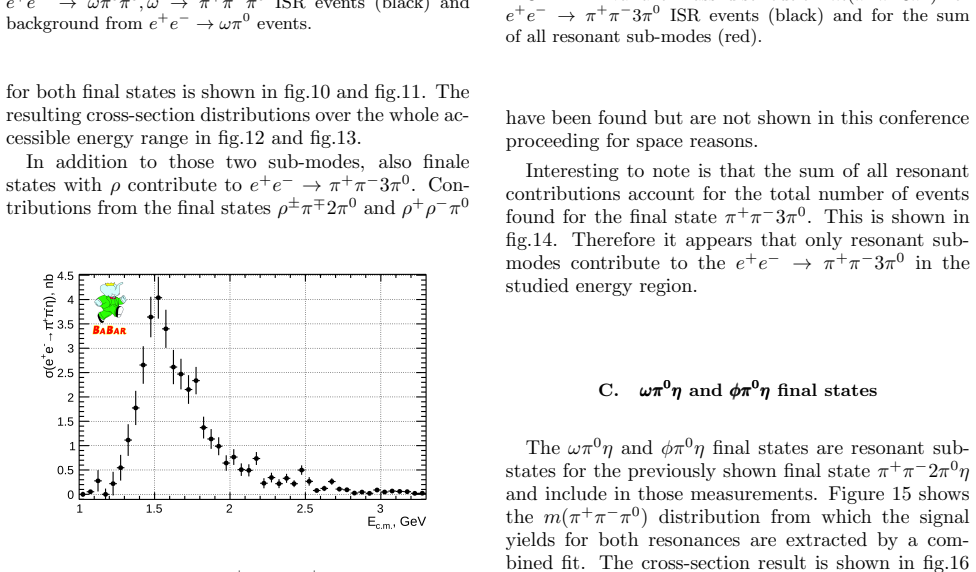
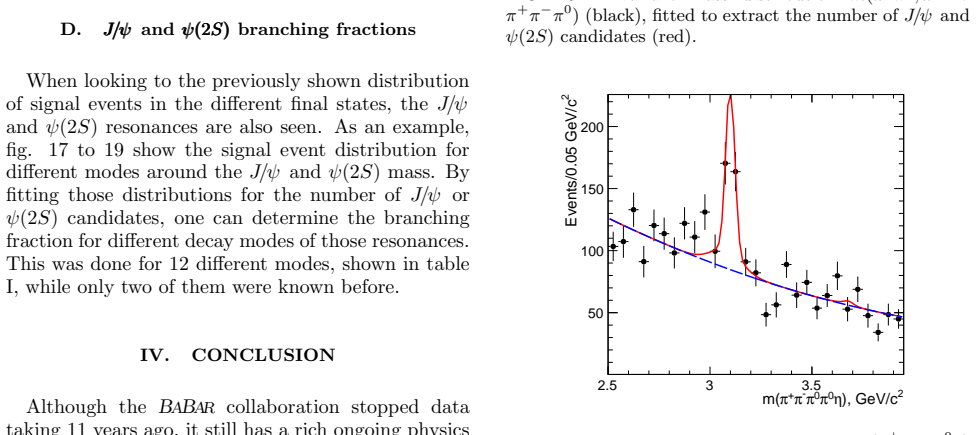
Using the full 514 fb^{-1} dataset collected at a center-of-mass energy of 10.6 GeV, the BaBar experiment measures the cross sections for e+e− → π+π−3π0 and e+e− → π+π−2π0η, including their resonant sub-states, over the mass range from threshold to about 4 GeV/c² and extracts twelve J/ψ and ψ(2S) branching fractions with ten measured for the first time.
What carries the argument
Initial-state radiation technique applied to the full BaBar dataset to reconstruct the hadronic invariant-mass spectrum and convert it into energy-dependent cross sections for the listed final states.
If this is right
- The new cross-section data can be inserted directly into the dispersion integral that computes the hadronic contribution to muon g-2.
- The ten new branching fractions tighten constraints on the decay widths of J/ψ and ψ(2S) into the measured hadronic modes.
- The resonant sub-state analysis maps additional light vector-meson states that contribute to the cross sections.
- The measurements provide a reference dataset for testing models of multi-pion and eta production in the 1-4 GeV region.
Where Pith is reading between the lines
- Combining these results with Belle II data at higher luminosity could further shrink the hadronic uncertainty in muon g-2.
- The same ISR method can be applied to additional final states not yet measured with the full dataset to close remaining gaps.
- If the cross sections deviate from theoretical models in specific mass regions, that points to missing resonances or interference effects that warrant dedicated study.
Load-bearing premise
The reported cross sections and branching fractions assume that detector efficiencies, background subtractions, and luminosity determinations for the full 514 fb-1 dataset at PEP-II are accurate enough to extract unbiased results across the full mass range from threshold to 4 GeV/c2.
What would settle it
An independent measurement of either cross section at another experiment that lies outside the quoted BaBar uncertainty band over a significant fraction of the mass range would falsify the result.
Figures





read the original abstract
A program of measuring the light hadrons production in exclusive $e^+e^-$ to hadrons processes is in place at BaBar with the aim to improve the calculation of the hadronic contribution to the muon $g-2$. We present the most recent results obtained by using the full data set of about $514 \mathrm{fb}^{-1}$ collected by the BaBar experiment at the PEP-II $e^+e^-$ collider at a center-of-mass energy of about $10.6$ GeV. In particular, we report the results on the channels $e^+e^-\rightarrow \pi^+ \pi^- 3\pi^0$, $e^+e^-\rightarrow \pi^+\pi^- 2\pi^0\eta$, and its resonant sub-states. These final states are studied in a wide mass range,from threshold production up to about $4 GeV/c^2$. In addition to the cross-sections, twelve $J/\psi$ and $\psi(2S)$ branching fractions were measured with ten of them be a first-time measurement.
Editorial analysis
A structured set of objections, weighed in public.
Referee Report
Summary. The manuscript reports measurements of exclusive hadronic cross sections in e+e- annihilation using the full BaBar dataset of approximately 514 fb^{-1} collected at PEP-II at √s ≈ 10.6 GeV. It focuses on the channels e+e- → π+π-3π0 and e+e- → π+π-2π0η (including resonant sub-states) over the mass range from threshold to ~4 GeV/c², with the aim of improving the hadronic contribution to the muon g-2. In addition, twelve J/ψ and ψ(2S) branching fractions are presented, ten of which are claimed to be first-time measurements.
Significance. If the results hold, the cross-section data would supply valuable input for the hadronic vacuum polarization term in a_μ calculations, addressing a key uncertainty in the muon g-2 discrepancy. The new branching-fraction results would also expand the experimental database on charmonium decays.
major comments (1)
- No sections, equations, tables, or figures are available in the provided manuscript text. The central claims (cross sections and branching fractions extracted from the 514 fb^{-1} dataset) rest on unstated assumptions about detector efficiencies, background modeling, luminosity determination, and systematic uncertainties across the full mass range; without these details it is impossible to verify whether the data support the reported values.
minor comments (1)
- Abstract, final sentence: grammatical error ('with ten of them be a first-time measurement' should read 'with ten of them being first-time measurements').
Simulated Author's Rebuttal
We thank the referee for reviewing our manuscript and for the positive assessment of its potential impact on hadronic vacuum polarization and charmonium branching fractions. We address the single major comment below.
read point-by-point responses
-
Referee: No sections, equations, tables, or figures are available in the provided manuscript text. The central claims (cross sections and branching fractions extracted from the 514 fb^{-1} dataset) rest on unstated assumptions about detector efficiencies, background modeling, luminosity determination, and systematic uncertainties across the full mass range; without these details it is impossible to verify whether the data support the reported values.
Authors: The complete manuscript (arXiv:1906.09386) contains dedicated sections on the analysis method, event selection, efficiency determination via Monte Carlo, background modeling and subtraction, luminosity determination, and a full breakdown of statistical and systematic uncertainties for each final state and mass bin up to 4 GeV/c^{2}. All equations, tables, and figures supporting the cross-section and branching-fraction results are present. It appears that only the abstract was included in the materials forwarded for review; the full text with these details is available on arXiv and was submitted to the journal. No revision is needed. revision: no
Circularity Check
No significant circularity; experimental measurement report
full rationale
This is a direct experimental measurement paper reporting cross sections and branching fractions extracted from the 514 fb^{-1} BaBar dataset. No derivation chain, fitted parameters renamed as predictions, self-citations as load-bearing premises, or ansatzes are present. Results are stated as outputs of data analysis with standard detector corrections; the central claims do not reduce to their own inputs by construction.
Axiom & Free-Parameter Ledger
Reference graph
discussion (0)
Sign in with ORCID, Apple, or X to comment. Anyone can read and Pith papers without signing in.