Improved Reconstruction for high-resolution Multi-shot Diffusion Weighted Imaging
Pith reviewed 2026-05-25 16:31 UTC · model grok-4.3
The pith
An iterative reweighted least squares formulation speeds multi-shot diffusion MRI reconstruction by a factor of six while supporting conjugate symmetry priors that reduce blurring.
A machine-rendered reading of the paper's core claim, the machinery that carries it, and where it could break.
Core claim
The IRLS formulation of the MUSSELS parallel imaging reconstruction recovers artifact-free diffusion weighted images from multi-shot EPI data without phase compensation, runs approximately six times faster than prior implementations for typical high-resolution matrix sizes, and accommodates conjugate symmetry priors that reduce blurring while preserving detail in partial Fourier data.
What carries the argument
The iterative reweighted least squares (IRLS) solver applied to the MUSSELS parallel imaging objective, extended to enforce conjugate symmetry on the k-space data.
If this is right
- Reconstruction time drops by a factor of about six for 192x192 and 256x256 matrices compared with earlier MUSSELS code.
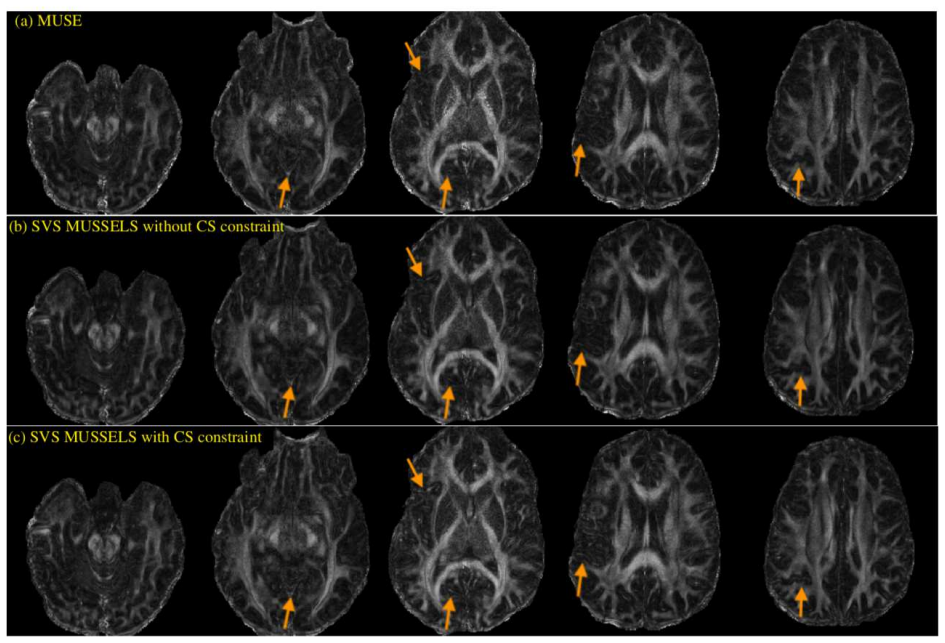
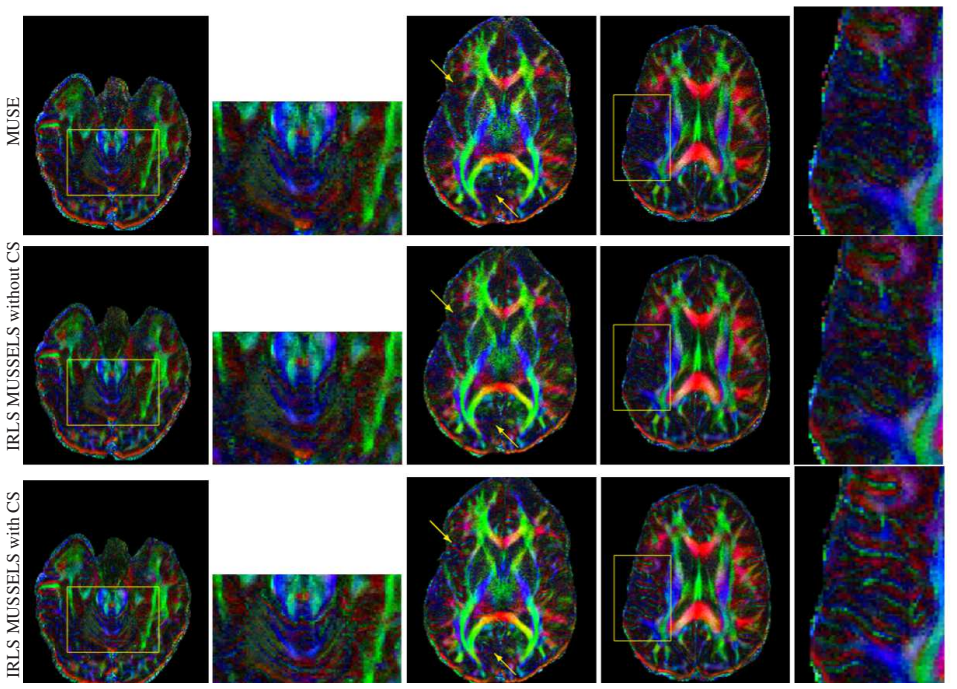
- Conjugate symmetry enforcement reduces blurring and maintains high-resolution features from partial Fourier sampling.
- Overall computational cost becomes comparable to conventional multi-shot DWI pipelines.
- Routine whole-brain high-resolution diffusion studies become feasible with minimal added burden.
Where Pith is reading between the lines
- The same IRLS structure could be reused for other parallel imaging problems that currently scale poorly with matrix size.
- Further priors beyond conjugate symmetry might be added without changing the core solver loop.
- Clinical workflows could shift to higher-resolution protocols without extending scan duration or requiring dedicated reconstruction servers.
Load-bearing premise
Adding the conjugate symmetry prior does not create new artifacts or degrade the inter-shot motion correction that MUSSELS was built to perform.
What would settle it
A side-by-side test on motion-corrupted multi-shot datasets showing that reconstructions using the conjugate symmetry prior contain more residual artifacts or greater signal loss than the original MUSSELS method.
Figures





read the original abstract
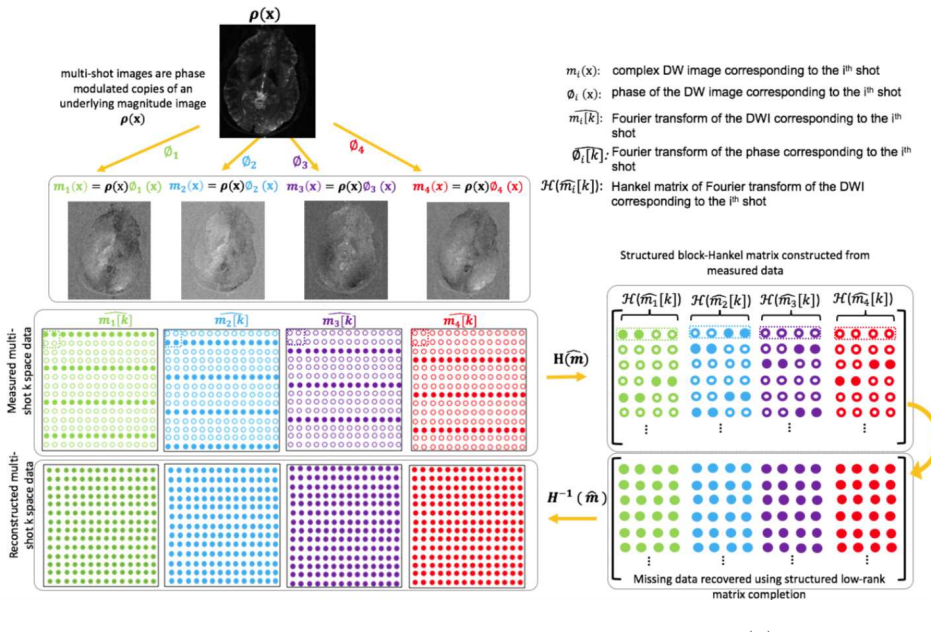
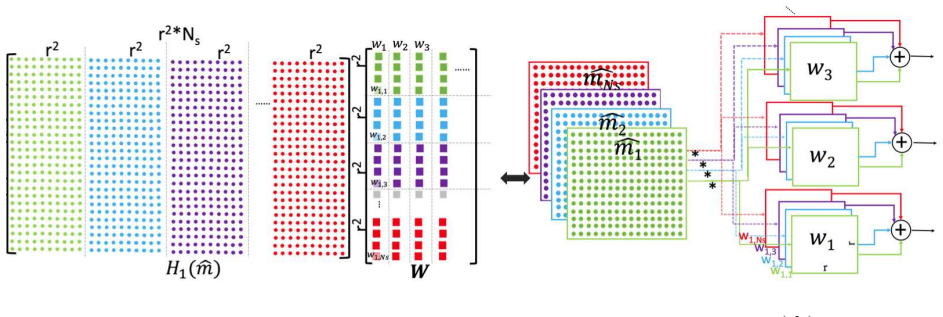
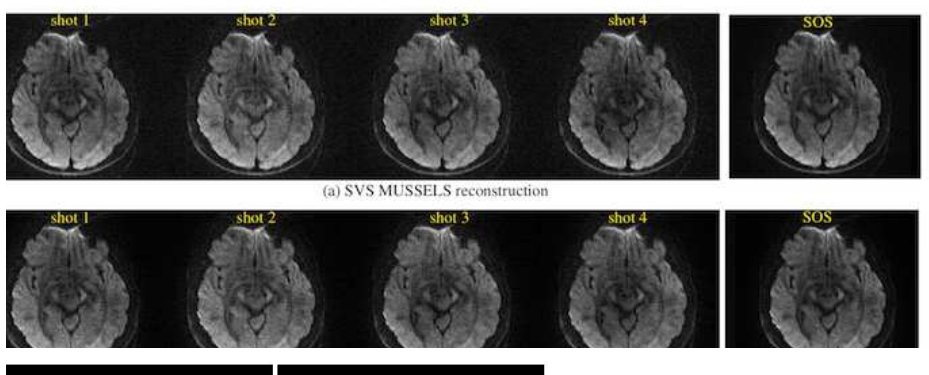
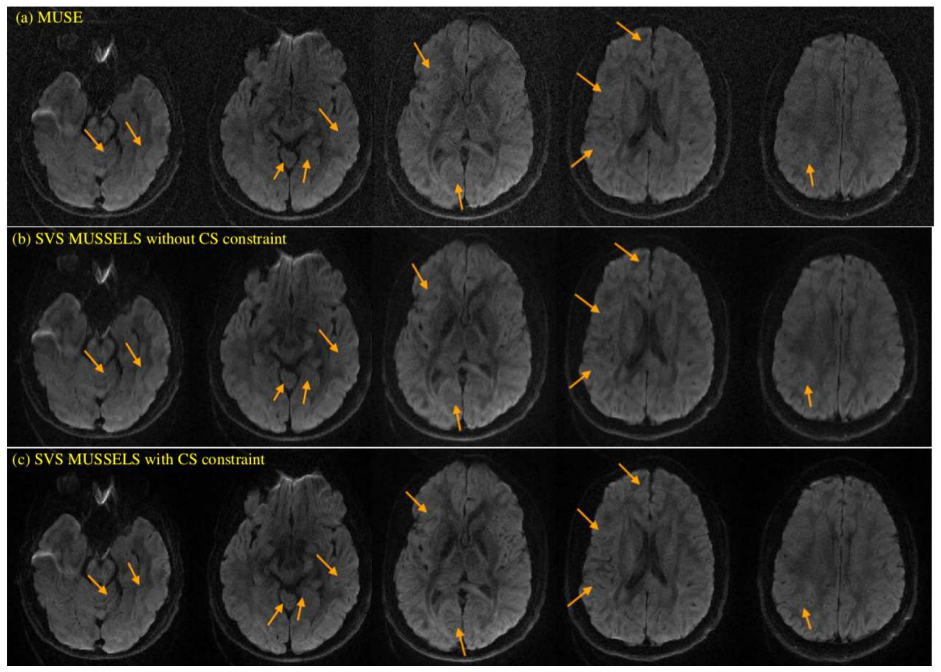
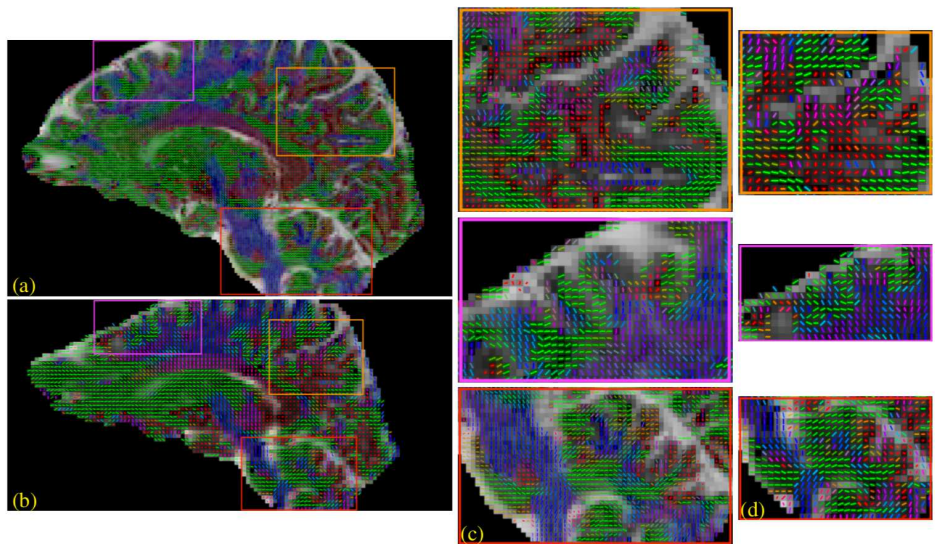
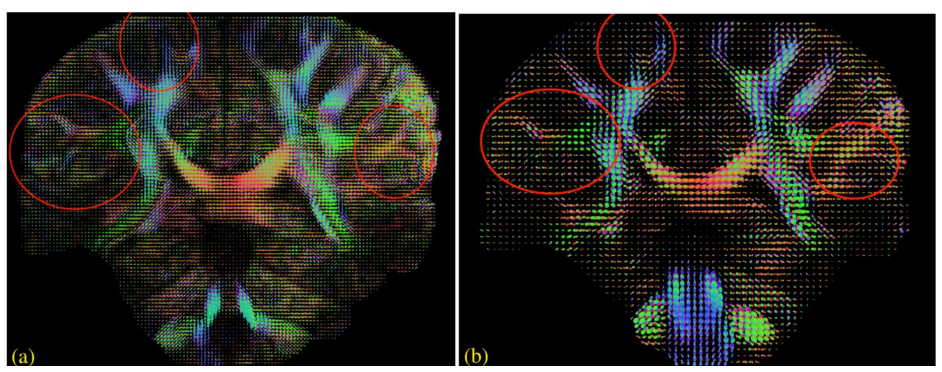
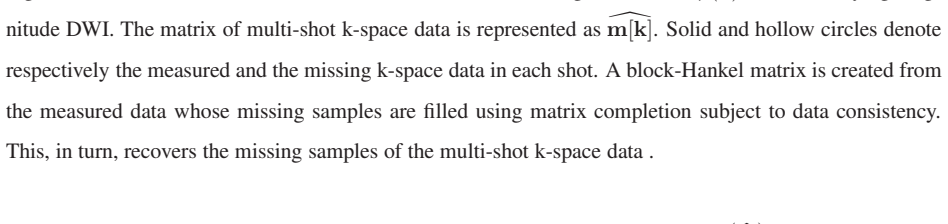
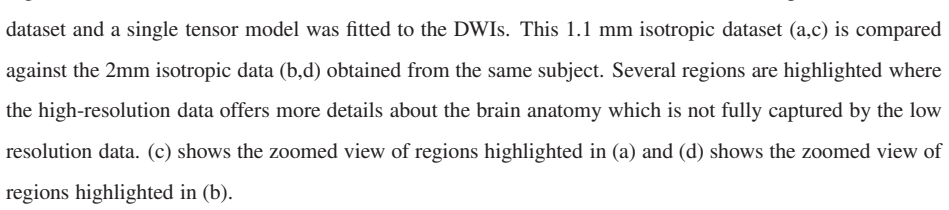
Purpose: To introduce a fast and improved direct reconstruction method for multi-shot diffusion weighted (msDW) scans for high-resolution studies. Methods:Multi-shot EPI methods can enable higher spatial resolution for diffusion MRI studies. Traditionally, such acquisitions required specialized reconstructions involving phase compensation to correct for inter-shot motion artifacts. The recently proposed MUSSELS reconstruction belongs to a new class of parallel imaging-based methods that recover artifact-free DWIs from msDW data without needing phase compensation. However, computational demands of the MUSSELS reconstruction scales as the matrix size and the number of shots increases, which hinders its practical utility for high-resolution applications. In this work, we propose a computationally efficient formulation using iterative reweighted least squares (IRLS) method. The new formulation is not only fast but it enables to accommodate additional priors such as conjugate symmetry property of the k-space data to improve the reconstruction. Using whole-brain in-vivo data, we show the utility of the new formulation for routine high-resolution studies with minimal computational burden. Results: The IRLS formulation provides about six times faster reconstruction for matrix sizes 192x192 and 256x256, compared to the original implementations. The reconstruction quality is improved by the addition of conjugate symmetry priors that reduce blurring and preserves the high-resolution details from partial Fourier acquisitions. Conclusion: The proposed method is shown to be computationally efficient to enable routine high-resolution studies. The computational complexity matches the traditional msDWI reconstruction methods and provides improved reconstruction results.
Editorial analysis
A structured set of objections, weighed in public.
Referee Report
Summary. The manuscript proposes an iterative reweighted least squares (IRLS) reformulation of the MUSSELS reconstruction for multi-shot diffusion-weighted EPI. It claims this yields an approximately six-fold reduction in reconstruction time for 192×192 and 256×256 matrices relative to prior MUSSELS implementations, while the addition of a conjugate-symmetry (Hermitian) prior on k-space data reduces blurring and better preserves high-resolution detail from partial-Fourier acquisitions, all without explicit inter-shot phase compensation.
Significance. If the speed-up and quality claims are substantiated with quantitative metrics and motion-robustness validation, the work would make routine high-resolution msDWI clinically feasible by bringing reconstruction cost in line with conventional parallel-imaging methods while exploiting partial-Fourier data. The absence of error metrics, statistical tests, or explicit checks on the interaction between the new prior and MUSSELS motion handling currently prevents a firm assessment of practical impact.
major comments (3)
- [Abstract] Abstract (Results paragraph): The statement that the IRLS formulation “provides about six times faster reconstruction” for the cited matrix sizes supplies no timing tables, hardware specifications, shot counts, or direct comparison against the original MUSSELS solver; without these data the quantitative speed-up claim cannot be evaluated.
- [Abstract] Abstract (Results paragraph): The claim that conjugate-symmetry priors “reduce blurring and preserve the high-resolution details” and are “accommodated” without degrading inter-shot motion correction is unsupported by any residual-phase maps, motion-parameter error statistics, or image-quality metrics on data containing known inter-shot phase errors. This interaction is load-bearing for the central claim that the method retains MUSSELS motion robustness.
- [Abstract] Abstract (Methods/Results): No description is given of how the IRLS solution was validated against the original MUSSELS implementation (e.g., normalized root-mean-square error, structural similarity, or difference images), leaving the assertion of “improved reconstruction results” without visible quantitative grounding.
minor comments (1)
- [Abstract] The abstract repeatedly uses “accommodated” and “preserves” without defining the precise mathematical incorporation of the Hermitian prior into the IRLS objective; a short methods paragraph clarifying the augmented cost function would improve clarity.
Simulated Author's Rebuttal
We thank the referee for their constructive comments. We address each major comment point by point below, indicating where revisions will be made to the manuscript.
read point-by-point responses
-
Referee: [Abstract] Abstract (Results paragraph): The statement that the IRLS formulation “provides about six times faster reconstruction” for the cited matrix sizes supplies no timing tables, hardware specifications, shot counts, or direct comparison against the original MUSSELS solver; without these data the quantitative speed-up claim cannot be evaluated.
Authors: We agree that the abstract would benefit from additional specifics. The full manuscript reports timing comparisons for the cited matrix sizes in the Results section. We will revise the abstract to reference the hardware platform, shot counts, and direct comparison details, and will ensure a timing table is clearly presented in the main text. revision: yes
-
Referee: [Abstract] Abstract (Results paragraph): The claim that conjugate-symmetry priors “reduce blurring and preserve the high-resolution details” and are “accommodated” without degrading inter-shot motion correction is unsupported by any residual-phase maps, motion-parameter error statistics, or image-quality metrics on data containing known inter-shot phase errors. This interaction is load-bearing for the central claim that the method retains MUSSELS motion robustness.
Authors: The in-vivo whole-brain experiments demonstrate reduced blurring from the conjugate-symmetry prior on partial-Fourier data while retaining the motion-robust property of MUSSELS. To strengthen the claim, we will add explicit supporting material such as residual phase maps or image-quality metrics comparing reconstructions with and without the prior on data with inter-shot phase errors. revision: yes
-
Referee: [Abstract] Abstract (Methods/Results): No description is given of how the IRLS solution was validated against the original MUSSELS implementation (e.g., normalized root-mean-square error, structural similarity, or difference images), leaving the assertion of “improved reconstruction results” without visible quantitative grounding.
Authors: We will revise the manuscript to include a description of the validation procedure, incorporating quantitative metrics such as normalized root-mean-square error and difference images between the IRLS and original MUSSELS reconstructions on the in-vivo datasets. revision: yes
Circularity Check
No significant circularity; reformulation and prior are independent of fitted outputs
full rationale
The paper introduces an IRLS reformulation of the existing MUSSELS method and adds the standard conjugate-symmetry k-space prior; neither step is defined in terms of its own outputs, fitted parameters, or a self-citation chain. All reported speed-ups and quality gains are measured on external in-vivo acquisitions rather than recovered by construction from the same data used to tune the algorithm. No load-bearing uniqueness theorem or ansatz is smuggled in via prior self-work, and the derivation remains self-contained against external benchmarks.
Axiom & Free-Parameter Ledger
axioms (1)
- domain assumption Conjugate symmetry property of k-space data holds for the partial Fourier acquisitions
Reference graph
Works this paper leans on
-
[1]
Image formation in diffusion MRI: A review of recent technical developments
Wu W and Miller KL. Image formation in diffusion MRI: A review of recent technical developments . Journal of Magnetic Resonance Imaging , 46 0 (3): 0 646--662, 2017
work page 2017
-
[2]
Quantifying brain microstructure with diffusion MRI: Theory and parameter estimation
Novikov DS, Fieremans E, Jespersen SN, and Kiselev VG. Quantifying brain microstructure with diffusion MRI: Theory and parameter estimation . NMR in Biomedicine , page 3998, 2018
work page 2018
-
[3]
Jones D, Alexander D, Bowtell R, Cercignani M, Dell'Acqua F, McHugh D, Miller K, Palombo M, Parker G, Rudrapatna U, and Tax C. Microstructural imaging of the human brain with a ‘super-scanner': 10 key advantages of ultra-strong gradients for diffusion MRI . NeuroImage , 182: 0 8--38, 2018
work page 2018
-
[4]
Analysis and correction of motion artifacts in diffusion weighted imaging
Anderson AW and Gore JC. Analysis and correction of motion artifacts in diffusion weighted imaging. Magnetic Resonance in Medicine , 32 0 (3): 0 379--87, 1994
work page 1994
-
[5]
Real diffusion-weighted MRI enabling true signal averaging and increased diffusion contrast
Eichner C, Cauley SF, Cohen-Adad J, M \" o ller HE, Turner R, Setsompop K, and Wald LL. Real diffusion-weighted MRI enabling true signal averaging and increased diffusion contrast . NeuroImage , 122: 0 373--384, 2015
work page 2015
-
[6]
Diffusion-weighted interleaved echo-planar imaging with a pair of orthogonal navigator echoes
Butts K, de Crespigny A, Pauly JM, and Moseley M. Diffusion-weighted interleaved echo-planar imaging with a pair of orthogonal navigator echoes. Magnetic Resonance in Medicine , 35 0 (5): 0 763--70, 1996
work page 1996
-
[7]
Chen NK, Guidon A, Chang HC, and Song AW. A robust multi-shot scan strategy for high-resolution diffusion weighted MRI enabled by multiplexed sensitivity-encoding (MUSE) . NeuroImage , 2013
work page 2013
-
[8]
Mani M, Jacob M, Kelley D, and Magnotta V. Multi-shot sensitivity-encoded diffusion data recovery using structured low-rank matrix completion (MUSSELS) . Magnetic Resonance in Medicine , 78 0 (2): 0 494--507, 2017
work page 2017
-
[9]
Comprehensive reconstruction of multi-shot multi-channel diffusion data using mussels
Mani M, Magnotta V, Kelley D, and Jacob M. Comprehensive reconstruction of multi-shot multi-channel diffusion data using mussels . In Proceedings of the Annual International Conference of the IEEE Engineering in Medicine and Biology Society, EMBS , 2016. ISBN 9781457702204
work page 2016
-
[10]
Hu Y, Levine EG, Tian Q, Moran CJ, Wang X, Taviani V, Vasanawala SS, McNab JA, Daniel BA, and Hargreaves BL. Motion-robust reconstruction of multishot diffusion-weighted images without phase estimation through locally low-rank regularization . Magnetic Resonance in Medicine , 2018
work page 2018
-
[11]
Readout-segmented EPI for rapid high resolution diffusion imaging at 3T
Holdsworth SJ, Skare S, Newbould RD, Guzmann R, Blevins NH, and Bammer R. Readout-segmented EPI for rapid high resolution diffusion imaging at 3T . European Journal of Radiology , 2008
work page 2008
-
[12]
Porter DA and Heidemann RM. High resolution diffusion-weighted imaging using readout-segmented echo-planar imaging, parallel imaging and a two-dimensional navigator-based reacquisition . Magnetic Resonance in Medicine , 62 0 (2): 0 468--475, 2009
work page 2009
-
[13]
Self-navigated interleaved spiral (SNAILS): Application to high-resolution diffusion tensor imaging
Liu C, Bammer R, Kim Dh, and Moseley ME. Self-navigated interleaved spiral (SNAILS): Application to high-resolution diffusion tensor imaging . Magnetic Resonance in Medicine , 52 0 (6): 0 1388--1396, 2004
work page 2004
-
[14]
Guo H, Ma X, Zhang Z, Zhang B, Yuan C, and Huang F. POCS-enhanced inherent correction of motion-induced phase errors (POCS-ICE) for high-resolution multishot diffusion MRI . Magnetic Resonance in Medicine , 75 0 (1): 0 169--180, 2016
work page 2016
-
[15]
Chu ML, Chang HC, Chung HW, Truong TK, Bashir MR, and Chen NK. POCS-based reconstruction of multiplexed sensitivity encoded MRI (POCSMUSE): A general algorithm for reducing motion-related artifacts. Magnetic Resonance in Medicine , 74 0 (5): 0 1336--48, 2015
work page 2015
-
[16]
O'Halloran RL, Holdsworth S, Aksoy M, and Bammer R. Model for the correction of motion-induced phase errors in multishot diffusion-weighted-MRI of the head: Are cardiac-motion-induced phase errors reproducible from beat-to-beat? Magnetic Resonance in Medicine , 68 0 (2): 0 430--440, 2012
work page 2012
-
[17]
SENSE: sensitivity encoding for fast MRI
Pruessmann KP, Weiger M, Scheidegger MB, and Boesiger P. SENSE: sensitivity encoding for fast MRI. Magnetic resonance in medicine , 42 0 (5): 0 952--62, 1999
work page 1999
-
[18]
Bertsekas DP. Multiplier methods: A survey . Automatica , 12 0 (2): 0 133--145, 1976
work page 1976
-
[19]
Low-rank Matrix Recovery via Iteratively Reweighted Least Squares Minimization
Fornasier M, Rauhut H, and Ward R. Low-rank Matrix Recovery via Iteratively Reweighted Least Squares Minimization . SIAM Journal on Optimization , 21 0 (4): 0 1614--1640, 2011
work page 2011
-
[20]
Parallel MR image reconstruction using augmented Lagrangian methods
Ramani S and Fessler JA. Parallel MR image reconstruction using augmented Lagrangian methods. IEEE Trans. Med. Imaging. , 30 0 (3): 0 694--706, 2011
work page 2011
-
[21]
A Fast Algorithm for Convolutional Structured Low-Rank Matrix Recovery
Ongie G and Jacob M. A Fast Algorithm for Convolutional Structured Low-Rank Matrix Recovery . IEEE Transactions on Computational Imaging , 2017
work page 2017
-
[22]
Iteratively reweighted algorithms for compressive sensing
Chartrand R and Wotao Yin . Iteratively reweighted algorithms for compressive sensing . In 2008 IEEE International Conference on Acoustics, Speech and Signal Processing , pages 3869--3872. IEEE, 2008. ISBN 978-1-4244-1483-3
work page 2008
-
[23]
Iterative Reweighted Least Squares for Matrix Rank Minimization
Mohan K and Fazel M. Iterative Reweighted Least Squares for Matrix Rank Minimization . In 2010 48th Annual Allerton Conference on Communication, Control, and Computing (Allerton) , 2010. ISBN 9781424482160
work page 2010
-
[24]
Virtual coil concept for improved parallel MRI employing conjugate symmetric signals
Blaimer M, Gutberlet M, Kellman P, Breuer FA, K \" o stler H, and Griswold MA. Virtual coil concept for improved parallel MRI employing conjugate symmetric signals . Magnetic Resonance in Medicine , 61 0 (1): 0 93--102, 2009
work page 2009
-
[25]
Kim TH, Setsompop K, and Haldar JP. LORAKS makes better SENSE: Phase-constrained partial fourier SENSE reconstruction without phase calibration. Magnetic resonance in medicine , 2016
work page 2016
-
[26]
Advances in diffusion MRI acquisition and processing in the Human Connectome Project
Sotiropoulos SN, Jbabdi S, Xu J, Andersson JL, Moeller S, Auerbach EJ, Glasser MF, Hernandez M, Sapiro G, Jenkinson M, Feinberg DA, Yacoub E, Lenglet C, Van Essen DC, Ugurbil K, and Behrens TEJ. Advances in diffusion MRI acquisition and processing in the Human Connectome Project . NeuroImage , 80: 0 125--143, 2013
work page 2013
-
[27]
Setsompop K, Fan Q, Stockmann J, Bilgic B, Huang S, Cauley SF, Nummenmaa A, Wang F, Rathi Y, Witzel T, and Wald LL. High-resolution in vivo diffusion imaging of the human brain with generalized slice dithered enhanced resolution: Simultaneous multislice (gSlider-SMS) . Magnetic Resonance in Medicine , 79 0 (1): 0 141--151, 2018
work page 2018
-
[28]
Tan ET, Lee SK, Weavers PT, Graziani D, Piel JE, Shu Y, Huston J, Bernstein MA, and Foo TK. High slew-rate head-only gradient for improving distortion in echo planar imaging: Preliminary experience . Journal of Magnetic Resonance Imaging , 44 0 (3): 0 653--664, 2016
work page 2016
-
[29]
Heidemann RM, Anwander A, Feiweier T, Kn \" o sche TR, and Turner R. k-space and q-space: combining ultra-high spatial and angular resolution in diffusion imaging using ZOOPPA at 7 T. NeuroImage , 60 0 (2): 0 967--78, 2012
work page 2012
-
[30]
Mani M, Jacob M, McKinnon G, Yang B, Rutt B, Kerr A, and Magnotta V. SMS MUSSELS: A Navigator-free Reconstruction for Simultaneous MultiSlice Accelerated MultiShot Diffusion Weighted Imaging . 2019
work page 2019
discussion (0)
Sign in with ORCID, Apple, or X to comment. Anyone can read and Pith papers without signing in.