Network Slicing Management Technique for Local 5G Micro-Operator Deployments
Pith reviewed 2026-05-25 15:10 UTC · model grok-4.3
The pith
Network slicing management functions coordinate creation and orchestration for closed, open, and mixed micro-operator deployments.
A machine-rendered reading of the paper's core claim, the machinery that carries it, and where it could break.
Core claim
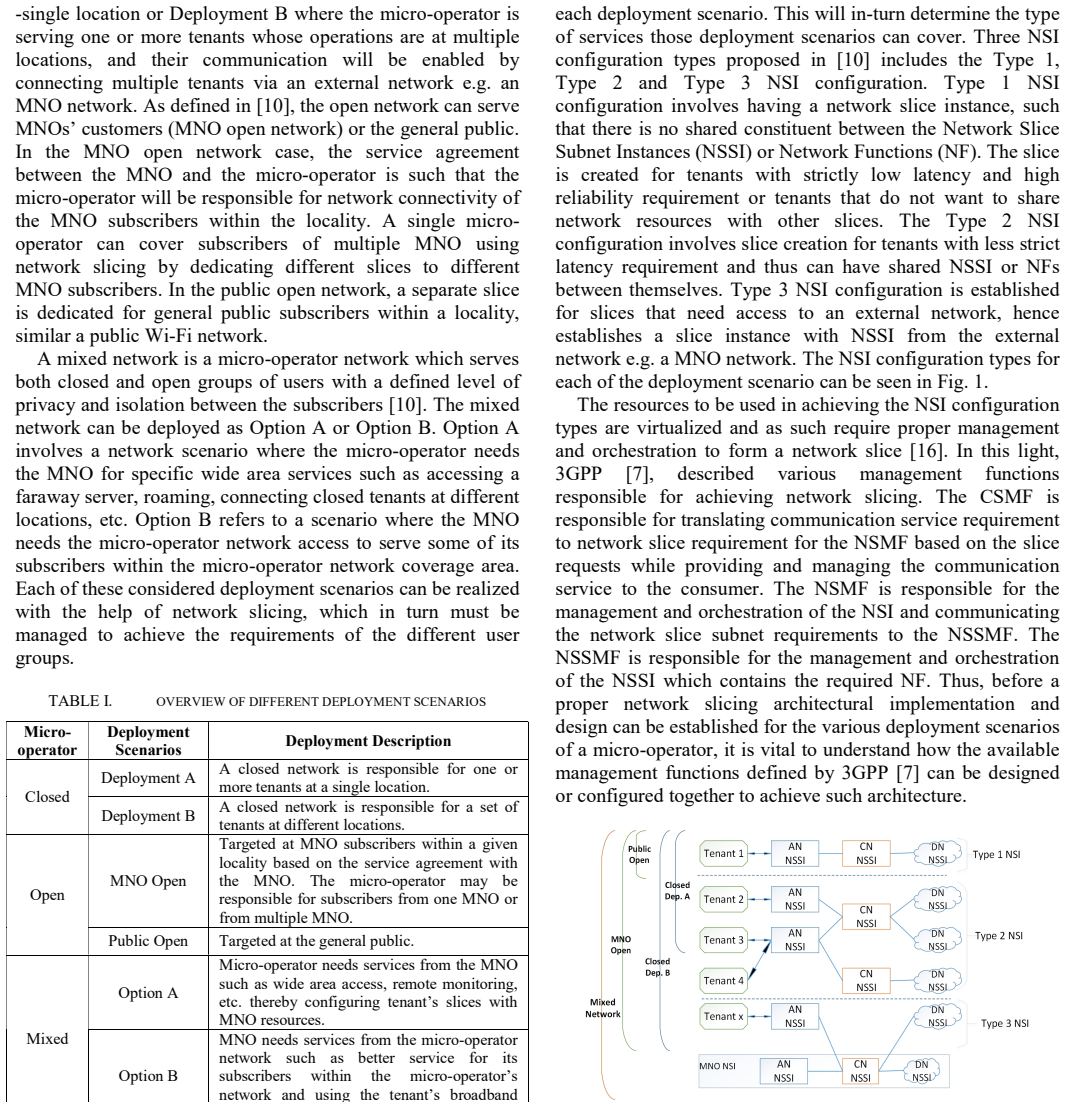
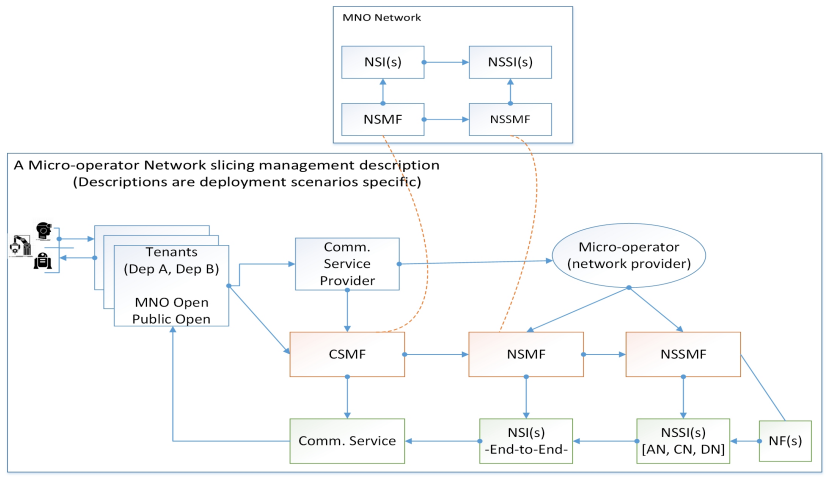
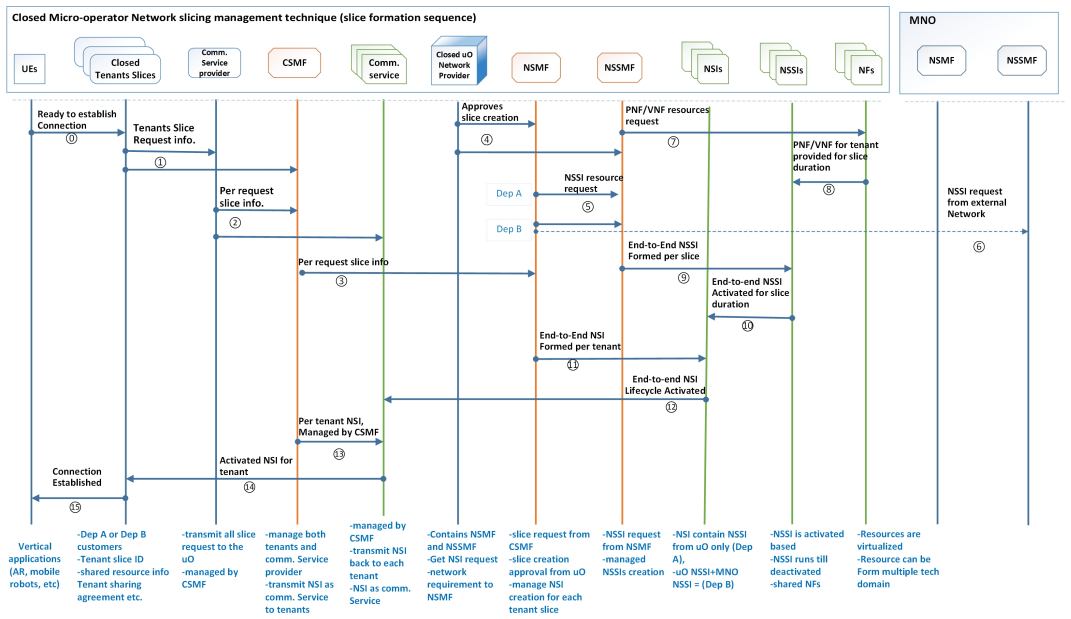
The paper proposes a descriptive technique by which different network slicing management functionalities defined by 3GPP can be used in coordination to create, orchestrate and manage network slicing for different deployment scenarios of a micro-operator. This is based on the network slice instance configuration type that can exist for each scenario. A network slice formation sequence is developed for the closed micro operator network to illustrate the tasks of the management functions.
What carries the argument
Network slice instance configuration type, which selects and coordinates the 3GPP management functions for each deployment scenario.
If this is right
- One local micro-operator network can serve multiple verticals and tenants with differing requirements.
- Management functions are coordinated differently according to whether customer groups are closed, open, or mixed.
- The formation sequence assigns concrete tasks to each management function in the closed scenario.
Where Pith is reading between the lines
- The same coordination pattern might lower the cost of serving industrial or campus verticals that currently require dedicated infrastructure.
- If the configuration types suffice, micro-operator deployments could proceed without waiting for further 3GPP releases.
- Field trials that run the formation sequence in mixed scenarios would test whether the coordination works end-to-end.
Load-bearing premise
The network slice instance configuration type defined by 3GPP can be applied directly to coordinate management functions across closed, open, and mixed micro-operator scenarios without extra standardization or changes.
What would settle it
A concrete case in which the 3GPP configuration types cannot produce working slice instances for a mixed micro-operator deployment without new specifications or modifications would falsify the technique.
Figures
read the original abstract
Local 5G networks are expected to emerge to serve different vertical sectors specific requirements. These networks can be deployed by traditional mobile network operators or entrant local operators. With a large number of verticals with different service requirements, while considering the network deployment cost in a single local area, it will not be economically feasible to deploy separate networks for each vertical. Thus, locally deployed 5G networks (aka micro operator networks) that can serve multiple verticals with multiple tenants in a location have gained increasing attention. Network slicing will enable a 5G micro-operator network to efficiently serve the multiple verticals and their tenants with different network requirements. This paper addresses how network slicing management functions can be used to implement, orchestrate and manage network slicing in different deployments of a local 5G micro-operator including the serving of closed, open and mixed customer groups. The paper proposes a descriptive technique by which different network slicing management functionalities defined by 3GPP can be used in coordination to create, orchestrate and manage network slicing for different deployment scenarios of a micro-operator. This is based on the network slice instance configuration type that can exist for each scenario. A network slice formation sequence is developed for the closed micro operator network to illustrate the tasks of the management functions. The results indicate that network slicing management plays a key role in designing local 5G networks that can serve different customer groups in the verticals.
Editorial analysis
A structured set of objections, weighed in public.
Referee Report
Summary. The paper proposes a descriptive technique for coordinating 3GPP-defined network slicing management functions (via network slice instance configuration types) to create, orchestrate, and manage slices in local 5G micro-operator deployments serving closed, open, and mixed customer groups. It develops an explicit formation sequence only for the closed case to illustrate management tasks and concludes that such management is key to enabling multi-vertical local 5G networks.
Significance. If the coordination technique can be shown to apply without modification across deployment modes, the work would offer a standards-grounded framework for cost-effective multi-tenant local 5G infrastructure. The explicit grounding in 3GPP slice configuration types is a positive feature, but the absence of any validation, implementation details, or cross-scenario demonstration limits the result to a high-level proposal whose practical utility remains untested.
major comments (2)
- [Abstract and the section describing the network slice formation sequence] The central claim requires that 3GPP network slice instance configuration types enable coordination across closed, open, and mixed micro-operator scenarios without additional standardization. However, the manuscript develops the formation sequence and management function tasks only for the closed case (as stated in the abstract); applicability to open and mixed cases is asserted from the existence of the corresponding config types but is not demonstrated via sequence, mapping, or example.
- [Abstract and conclusion] No empirical validation, simulation, or implementation detail is provided to confirm that the described coordination of management functions actually succeeds in the stated scenarios. The soundness assessment therefore rests entirely on the unexamined assumption that direct application of 3GPP types suffices.
minor comments (2)
- [Abstract] The abstract refers to 'the results' and 'the results indicate,' yet the work is purely descriptive with no quantitative or empirical results; this phrasing should be revised for accuracy.
- [Introduction and technique description] Specific 3GPP document references (e.g., TS 28.530 or equivalent for slice instance configuration types) are not cited when the config types are introduced; adding these would improve traceability.
Simulated Author's Rebuttal
We thank the referee for the constructive comments. Our manuscript is a descriptive proposal showing how 3GPP network slicing management functions can be coordinated via existing network slice instance configuration types. We respond to each major comment below.
read point-by-point responses
-
Referee: [Abstract and the section describing the network slice formation sequence] The central claim requires that 3GPP network slice instance configuration types enable coordination across closed, open, and mixed micro-operator scenarios without additional standardization. However, the manuscript develops the formation sequence and management function tasks only for the closed case (as stated in the abstract); applicability to open and mixed cases is asserted from the existence of the corresponding config types but is not demonstrated via sequence, mapping, or example.
Authors: The detailed formation sequence is provided only for the closed case as an explicit illustration of management tasks using the configuration types. Applicability to open and mixed cases follows from the 3GPP definitions of the corresponding configuration types, which specify the same management functions (NSMF, NSSMF, etc.) without requiring new standardization. We agree that explicit mappings would strengthen clarity and will add high-level mappings for open and mixed cases in the revision. revision: partial
-
Referee: [Abstract and conclusion] No empirical validation, simulation, or implementation detail is provided to confirm that the described coordination of management functions actually succeeds in the stated scenarios. The soundness assessment therefore rests entirely on the unexamined assumption that direct application of 3GPP types suffices.
Authors: The paper is a conceptual proposal grounded directly in 3GPP specifications for network slice management. Its contribution is the coordination technique via configuration types; empirical validation or simulation lies outside the stated scope and would constitute separate implementation work. Soundness derives from the standards themselves defining these configuration types and functions for the scenarios. revision: no
Circularity Check
No circularity: purely descriptive mapping to external 3GPP standards with no derivations or self-referential predictions
full rationale
The manuscript is a descriptive proposal that maps 3GPP-defined network slice instance configuration types and management functions to closed/open/mixed micro-operator scenarios. It develops an explicit formation sequence only for the closed case and states that the same 3GPP types apply to the other cases by virtue of their existence in the standard. There are no equations, fitted parameters, predictions, or internal derivations that reduce to the paper's own inputs. All load-bearing content references external 3GPP specifications rather than self-citations or ansatzes introduced by the authors. The cross-scenario applicability claim rests on an unshown mapping assumption, but this is a limitation of demonstration, not a circular reduction. The work is therefore self-contained against external benchmarks and receives score 0.
Axiom & Free-Parameter Ledger
axioms (1)
- domain assumption 3GPP-defined network slicing management functions are sufficient and directly applicable to micro-operator network deployments for closed, open, and mixed customer groups.
Reference graph
Works this paper leans on
-
[1]
Micro Operators to Boost Local Service Delivery in 5G,
M. Matinmikko, M. Latva-aho, P. Ahokangas, S. Yrjölä, and T. Koivumäki, “Micro Operators to Boost Local Service Delivery in 5G,” Wirel. Pers. Commun., vol. 95, no. 1, pp. 69–82, 2017
work page 2017
-
[2]
Micro operators accelerating 5G deployment,
M. Matinmikko-Blue and M. Latva-aho, “Micro operators accelerating 5G deployment,” in 2017 IEEE International Conference on Industrial and Information Systems (ICIIS), 2017, pp. 1–5
work page 2017
-
[3]
Network Slicing and Softwarization: A Survey on Principles, Enabling Technologies, and Solutions,
I. Afolabi, T. Taleb, K. Samdanis, A. Ksentini, and H. Flinck, “Network Slicing and Softwarization: A Survey on Principles, Enabling Technologies, and Solutions,” IEEE Commun. Surv. Tutorials, vol. 20, no. 3, pp. 2429–2453, 2018
work page 2018
- [4]
-
[5]
Description of Network Slicing Concept,
NGMN Alliance, “Description of Network Slicing Concept,” white Pap., 2016
work page 2016
-
[6]
Management and orchestration; Provisioning,
3GPP TS 28.531 V16.1.0, “Management and orchestration; Provisioning,” 2019
work page 2019
-
[7]
3GPP TR 28.801, “Telecommunication management;Study on management and orchestration of network slicing for next generation network,” 2018
work page 2018
-
[8]
NESMO: Network slicing management and orchestration framework,
A. Devlic, A. Hamidian, D. Liang, M. Eriksson, A. Consoli, and J. Lundstedt, “NESMO: Network slicing management and orchestration framework,” in 2017 IEEE International Conference on Communications Workshops (ICC Workshops), 2017, pp. 1202–1208
work page 2017
-
[9]
Network slicing in 5G: An auction-based model,
M. Jiang, M. Condoluci, and T. Mahmoodi, “Network slicing in 5G: An auction-based model,” in 2017 IEEE International Conference on Communications (ICC), 2017, pp. 1–6
work page 2017
-
[10]
Network Slice Instantiation for 5G Micro-Operator Deployment Scenarios,
I. Badmus, M. Matinmikko-blue, J. S. Walia, and T. Taleb, “Network Slice Instantiation for 5G Micro-Operator Deployment Scenarios,” To Appear 2019 Eur. Conf. Networks Commun., p. 1–6, 2019
work page 2019
-
[11]
5G Micro-operators for the future campus: A techno-economic study,
J. S. Walia, H. Hämmäinen, and M. Matinmikko, “5G Micro-operators for the future campus: A techno-economic study,” Jt. 13th CTTE 10th C. Conf. Internet Things - Bus. Model. Users, Networks, Janua, 2018
work page 2018
-
[12]
Micro-Operator driven Local 5G Network Architecture for Industrial Internet,
Y. Siriwardhana, P. Porambage, M. Liyanage, J. S. Walia, M. Matinmikko-Blue, and M. Ylianttila, “Micro-Operator driven Local 5G Network Architecture for Industrial Internet,” IEEE Wireless Communications and Networking Conference April 2019
work page 2019
-
[13]
SDN for 5G Mobile Networks: NORMA Perspective,
B. Sayadi et al., “SDN for 5G Mobile Networks: NORMA Perspective,” Springer, Cham, 2016, pp. 741–753
work page 2016
-
[14]
On regulations for 5G: Micro licensing for locally operated networks,
M. Matinmikko, M. Latva-aho, P. Ahokangas, and V. Seppänen, “On regulations for 5G: Micro licensing for locally operated networks,” Telecomm. Policy, vol. 42, no. 8, pp. 622–635, Sep. 2018
work page 2018
-
[15]
D. Schulz, “Intent-based automation networks: Toward a common reference model for the self-orchestration of industrial intranets,” in IECON 2016 - 42nd Annual Conference of the IEEE Industrial Electronics Society, 2016, pp. 4657–4664
work page 2016
-
[16]
Network slicing management & prioritization in 5G mobile systems,
M. Jiang, M. Condoluci, and T. Mahmoodi, “Network slicing management & prioritization in 5G mobile systems,” Eur. Wirel. 2016; 22th Eur. Wirel. Conf., pp. 197–202, 2016
work page 2016
-
[17]
Towards 5G Network Slicing over Multiple-Domains,
I. Afolabi, A. Ksentini, M. Bagaa, T. Taleb, M. Corici, and A. Nakao, “Towards 5G Network Slicing over Multiple-Domains,” IEICE Trans. Commun., vol. E100.B, no. 11, pp. 1992–2006, 2017
work page 1992
-
[18]
On Multi-domain Network Slicing Orchestration Architecture & Federated Resource Control
T. Taleb, I. Afolabi, K. Samdanis, and F. Z. Yousaf, “On Multi-domain Network Slicing Orchestration Architecture & Federated Resource Control.” To appear in IEEE Network Mag
-
[19]
From network sharing to multi-tenancy: The 5G network slice broker,
K. Samdanis, X. Costa-Perez, and V. Sciancalepore, “From network sharing to multi-tenancy: The 5G network slice broker,” IEEE Commun. Mag., vol. 54, no. 7, pp. 32–39, 2016
work page 2016
-
[20]
ETSI, “GR NFV-IFA 022 - V3.1.1 - Network Functions Virtualisation (NFV) Release 3; Management and Orchestration; Report on Management and Connectivity for Multi-Site Services,” 2018
work page 2018
discussion (0)
Sign in with ORCID, Apple, or X to comment. Anyone can read and Pith papers without signing in.