High-precision calculations of the 1s² 2s 2p ¹P₁ to 1s² 2s² ¹S₀ spin-allowed E1 transition in C {small III}
Pith reviewed 2026-05-25 14:54 UTC · model grok-4.3
The pith
Relativistic calculations benchmark the E1 line strength for the ¹P₁ to ¹S₀ transition in Be-like carbon.
A machine-rendered reading of the paper's core claim, the machinery that carries it, and where it could break.
Core claim
Large-scale relativistic calculations are performed for the transition energy and line strength of the 1s² 2s 2p ¹P₁ - 1s² 2s² ¹S₀ transition in Be-like carbon. Based on the multiconfiguration Dirac-Hartree-Fock approach, different correlation models are developed to account for all major electron-electron correlation contributions. These correlation models are tested with various sets of the initial and the final state wave functions. The uncertainty of the predicted line strength due to missing correlation effects is estimated from the differences between the results obtained with those models. The finite nuclear mass effect is accurately calculated taking into account the energy, wave, as
What carries the argument
Multiconfiguration Dirac-Hartree-Fock approach using multiple tested correlation models whose spread supplies the uncertainty estimate.
If this is right
- The calculated line strength serves as a reference for high-precision lifetime experiments on the 1s² 2s 2p ¹P₁ state.
- Finite nuclear mass contributions are folded into the line strength via energy, wave-function, and operator terms.
- Uncertainty on the line strength is obtained directly from the variation across the tested correlation models.
Where Pith is reading between the lines
- The model-testing procedure could be applied to other few-electron ions to generate consistent benchmarks.
- The benchmark value may be used to cross-check independent lifetime or transition-rate measurements in carbon ions.
Load-bearing premise
The uncertainty due to missing correlation effects can be reliably estimated from the differences between results obtained with the various correlation models developed and tested.
What would settle it
A high-precision lifetime measurement of the 1s² 2s 2p ¹P₁ state whose implied line strength lies outside the uncertainty interval derived from the model differences would falsify the benchmark.
Figures
read the original abstract
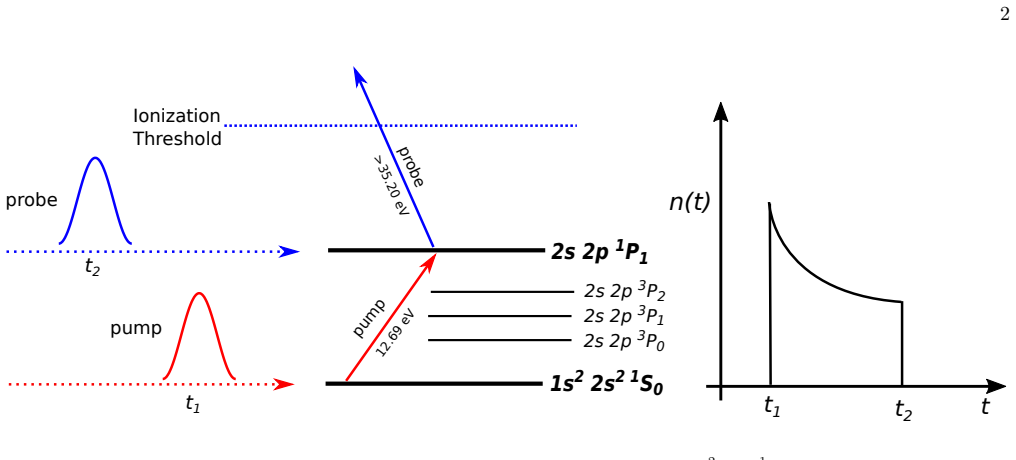
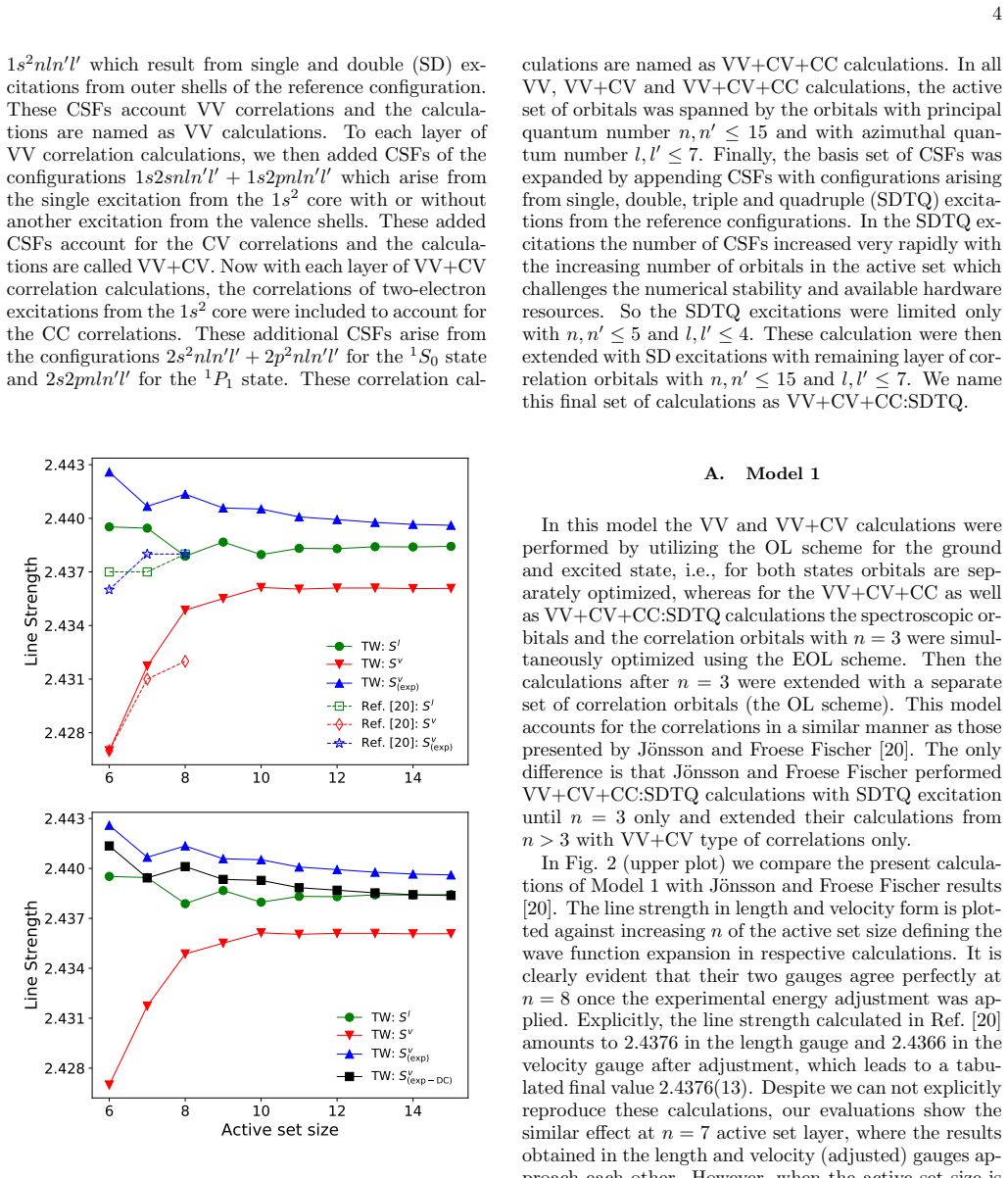
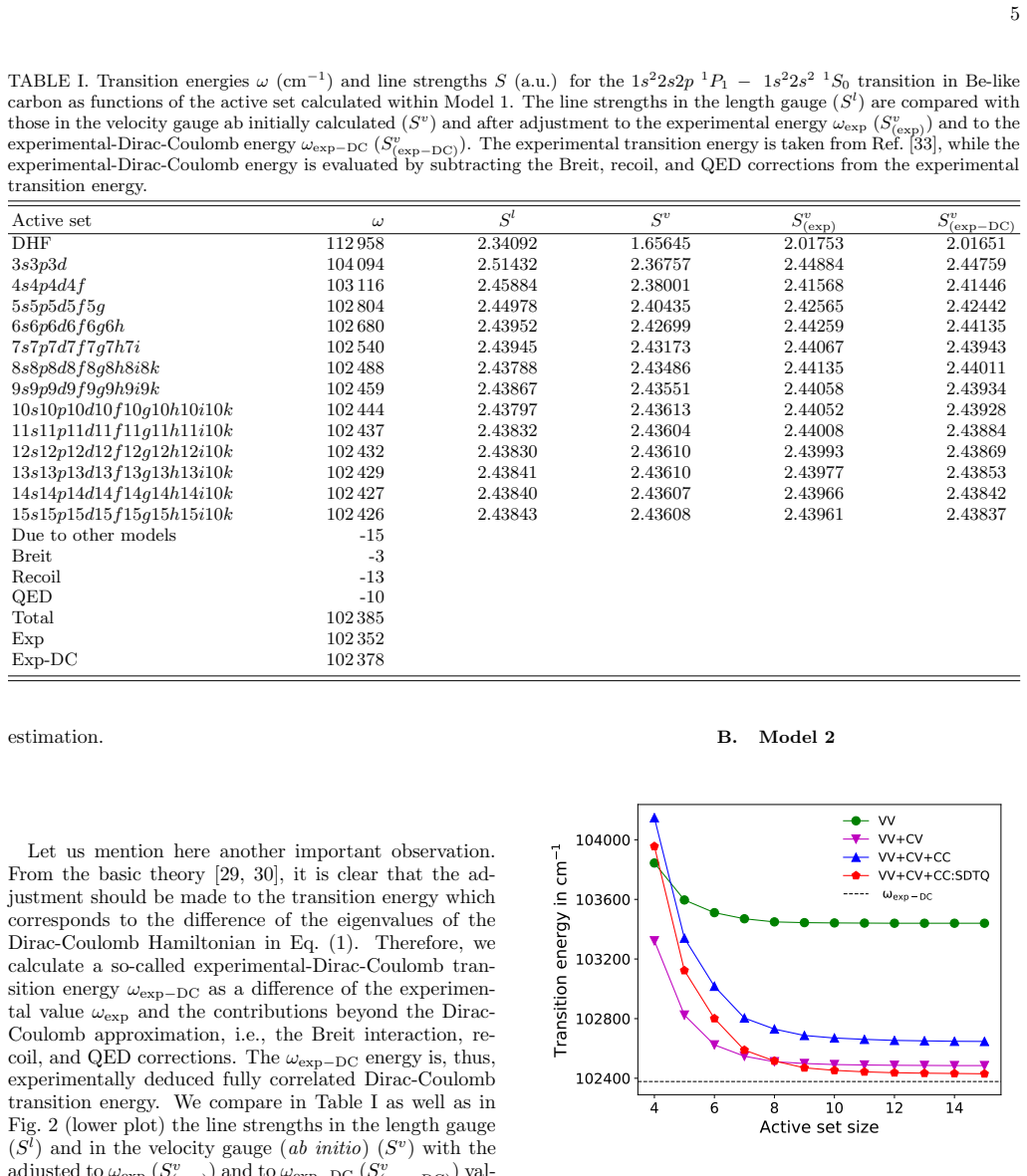
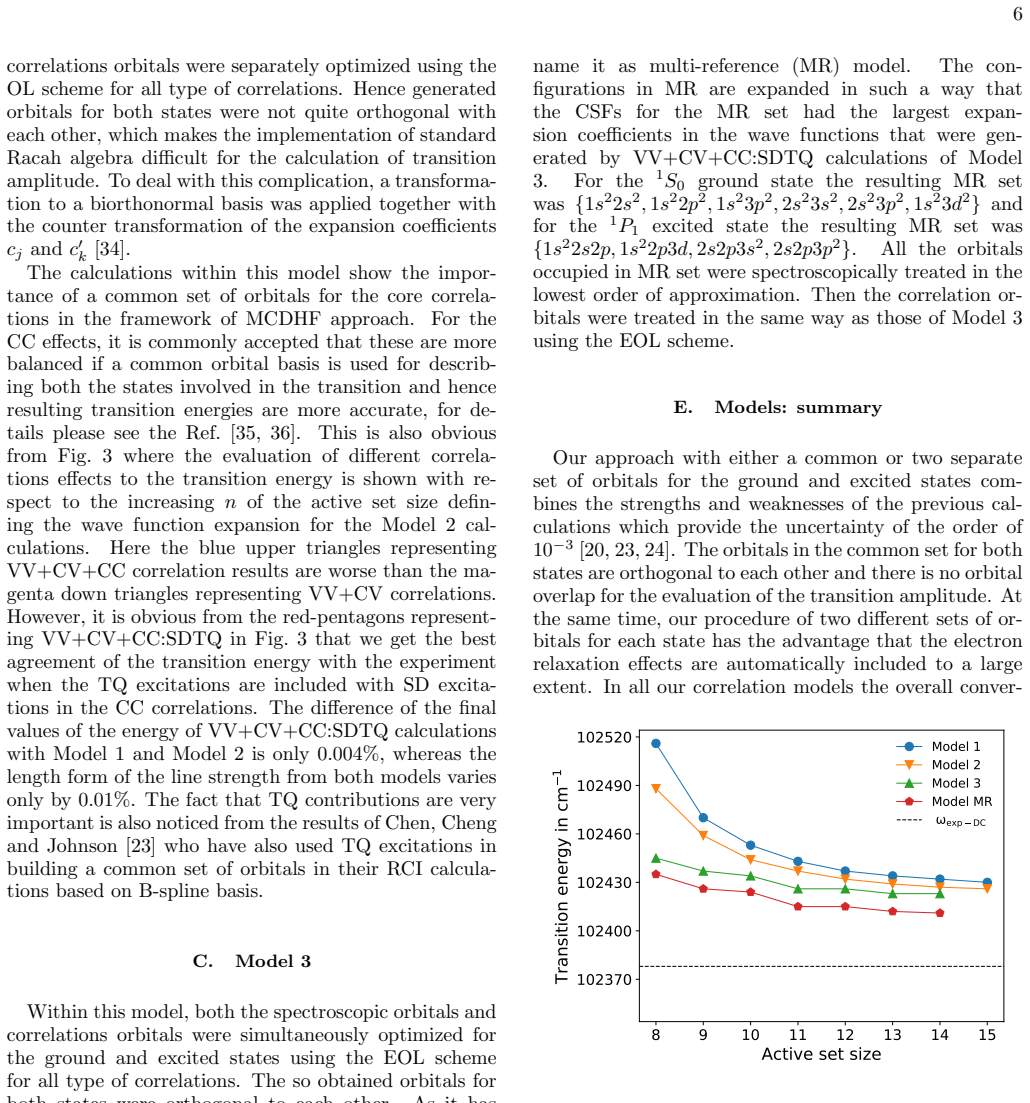
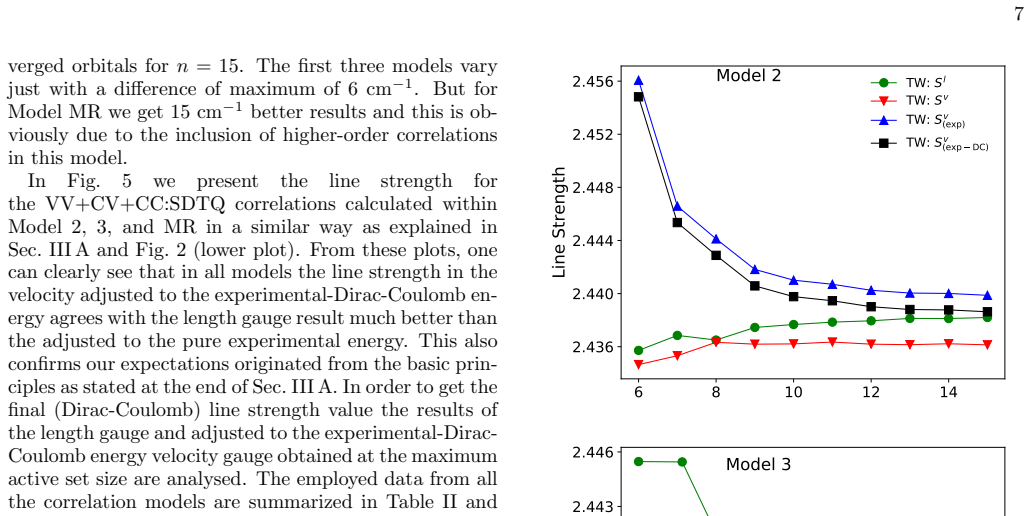
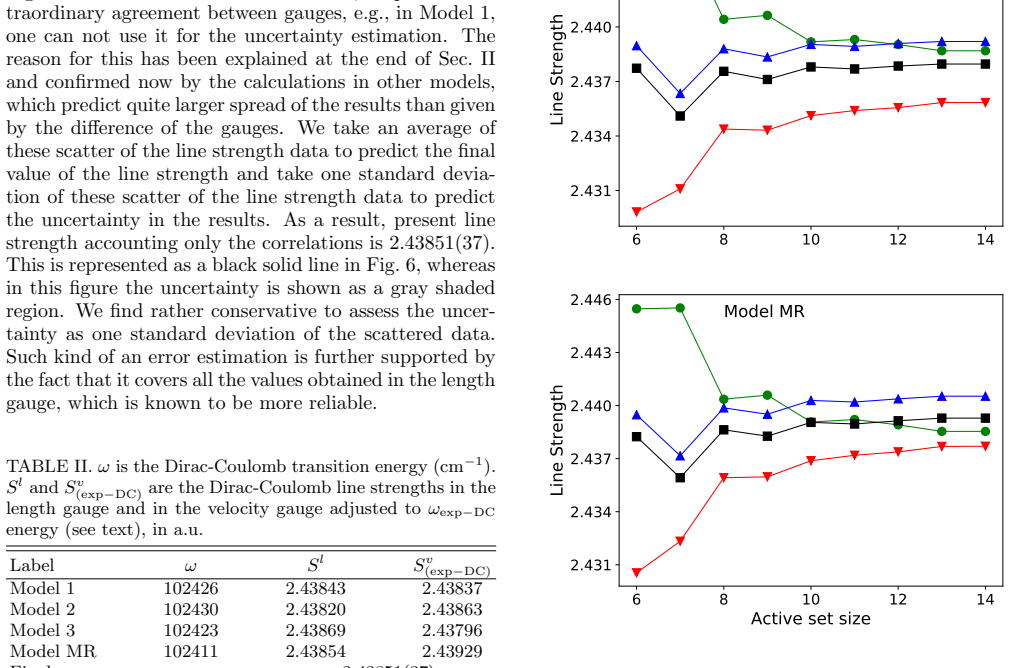
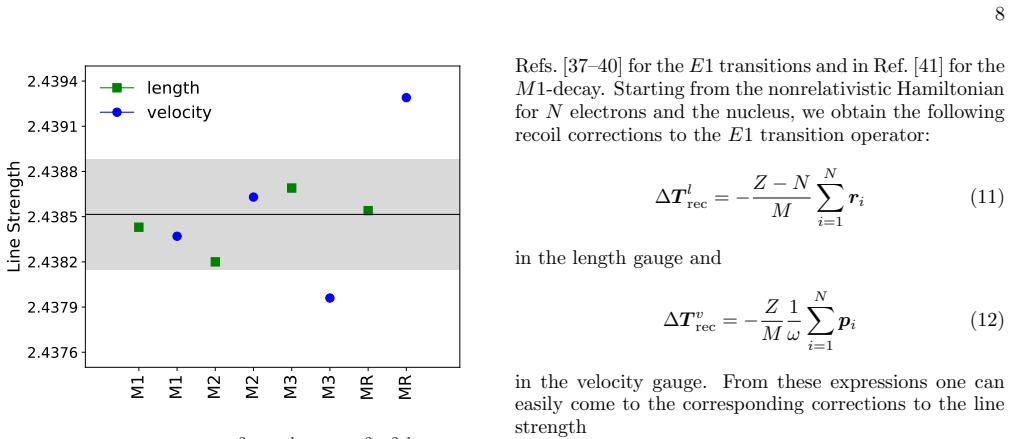
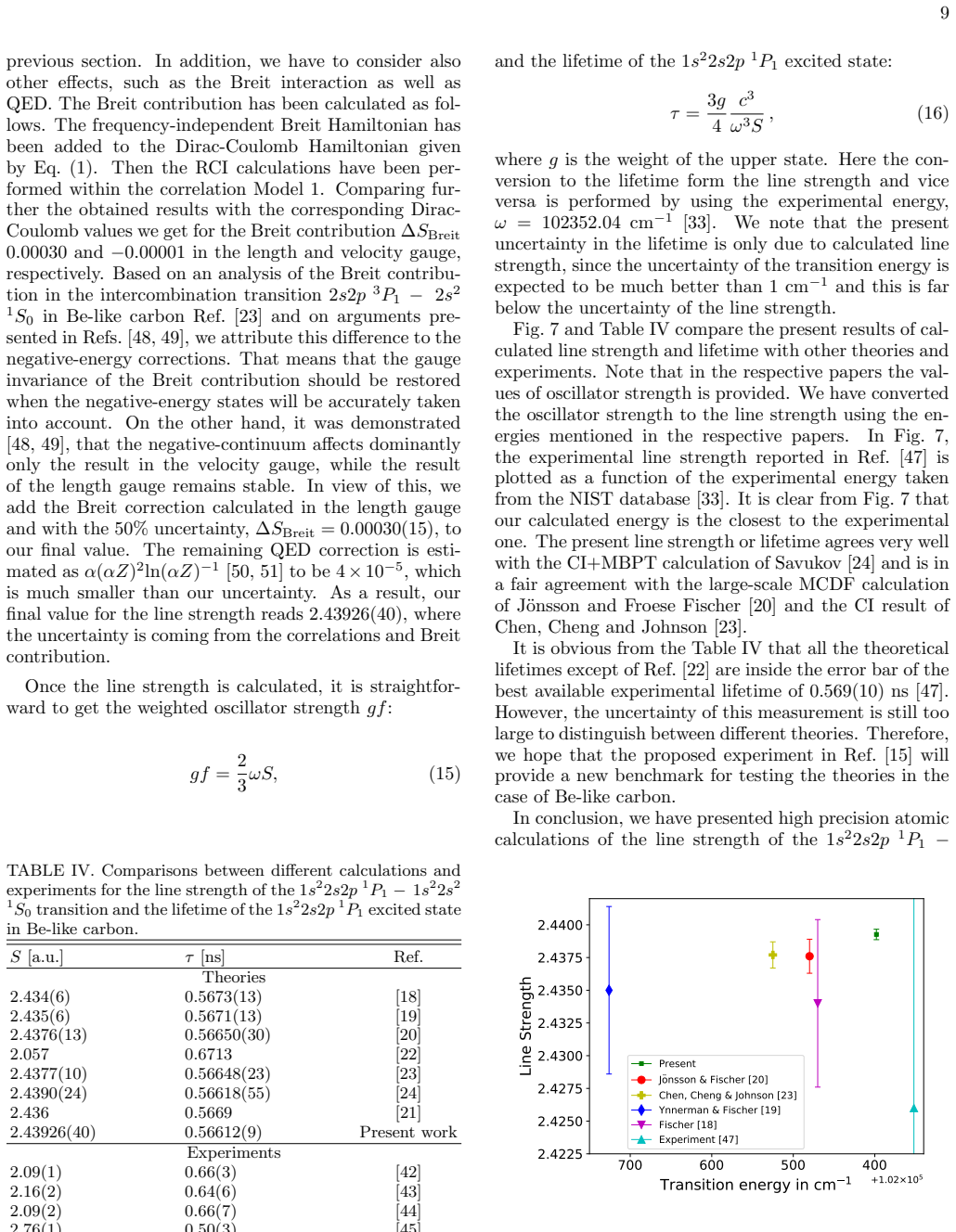
Large-scale relativistic calculations are performed for the transition energy and line strength of the $ 1s^{2} 2s 2p$ $^1P_{1} \,-\ 1s^{2} 2s^{2}$ $^1S_{0} $ transition in Be-like carbon. Based on the multiconfiguration Dirac-Hartree-Fock~(MCDHF) approach, different correlation models are developed to account for all major electron-electron correlation contributions. These correlation models are tested with various sets of the initial and the final state wave functions. The uncertainty of the predicted line strength due to missing correlation effects is estimated from the differences between the results obtained with those models. The finite nuclear mass effect is accurately calculated taking into account the energy, wave functions as well as operator contributions. As a result, a reliable theoretical benchmark of the $E1$ line strength is provided to support high precision lifetime measurement of the $ 1s^{2} 2s 2p$ $^1P_{1} $ state in Be-like carbon.
Editorial analysis
A structured set of objections, weighed in public.
Referee Report
Summary. The manuscript performs large-scale relativistic MCDHF calculations of the transition energy and E1 line strength for the 1s²2s2p ¹P₁ → 1s²2s² ¹S₀ transition in Be-like carbon. Multiple correlation models are constructed and tested with different initial- and final-state wave functions; the uncertainty from omitted correlation is taken from the spread across these models. Finite-nuclear-mass corrections (energy, wave-function, and operator) are evaluated explicitly. The central claim is that the resulting line-strength value constitutes a reliable theoretical benchmark for high-precision lifetime measurements of the ¹P₁ state.
Significance. If the uncertainty estimate is robust, the work supplies a high-precision, ab-initio E1 line strength for an astrophysically and metrologically relevant transition in C III. The explicit inclusion of finite-mass effects and the systematic exploration of correlation models are strengths that align with current standards in precision atomic theory.
major comments (2)
- [Abstract and §3] Abstract and §3 (correlation models): The claim that 'the uncertainty of the predicted line strength due to missing correlation effects is estimated from the differences between the results obtained with those models' is load-bearing for the 'reliable benchmark' assertion. No demonstration is given that the chosen active sets and orbital bases are sufficiently independent to bound higher-order excitations, core-valence effects beyond the largest set, or QED contributions; shared truncations could make the observed spread smaller than the true truncation error.
- [§4] §4 (results tables): The line-strength values and their quoted uncertainties are presented only as inter-model spreads. Without an independent cross-check (e.g., comparison with all-order MBPT, experiment, or an explicit estimate of the next-order correction), it is unclear whether the reported uncertainty interval is conservative.
minor comments (3)
- [§2] The definition of the active sets and the precise orbital optimization strategy should be stated more explicitly (e.g., which orbitals are varied at each step) to allow reproducibility.
- [Tables and figures] Table captions and axis labels in the figures should include the precise units and the definition of the 'spread' used for the uncertainty bars.
- [§5] A short paragraph comparing the final recommended value with the most recent experimental lifetime data would strengthen the manuscript even if the comparison is only indicative.
Simulated Author's Rebuttal
We thank the referee for the careful reading and constructive comments. We address each major comment below and indicate where revisions will be made.
read point-by-point responses
-
Referee: [Abstract and §3] The claim that 'the uncertainty of the predicted line strength due to missing correlation effects is estimated from the differences between the results obtained with those models' is load-bearing for the 'reliable benchmark' assertion. No demonstration is given that the chosen active sets and orbital bases are sufficiently independent to bound higher-order excitations, core-valence effects beyond the largest set, or QED contributions; shared truncations could make the observed spread smaller than the true truncation error.
Authors: We agree that further justification of model independence is warranted. In the revised manuscript we will expand §3 with explicit details on how the active sets and orbital bases were constructed to include distinct classes of excitations (e.g., different n-maxima and core-valence partitions) and why the observed spread is expected to bound the dominant truncation error. We will also add a brief statement noting that QED effects are omitted from the uncertainty budget because they are estimated to be well below the reported spread for this transition. revision: partial
-
Referee: [§4] The line-strength values and their quoted uncertainties are presented only as inter-model spreads. Without an independent cross-check (e.g., comparison with all-order MBPT, experiment, or an explicit estimate of the next-order correction), it is unclear whether the reported uncertainty interval is conservative.
Authors: We acknowledge the value of an independent cross-check. In the revised §4 we will include a comparison of our line strength with existing lower-precision theoretical results from the literature (MBPT and CI calculations) to provide additional context. An explicit next-order correction or all-order MBPT calculation at the same level of precision is beyond the scope of the present MCDHF study; the inter-model spread remains our primary uncertainty estimate, consistent with standard practice in large-scale relativistic calculations when systematic correlation models are employed. revision: partial
Circularity Check
No circularity: ab initio MCDHF line strength computed from wave functions with uncertainty from model spread
full rationale
The derivation chain consists of standard MCDHF calculations of wave functions for initial and final states, followed by direct evaluation of the E1 line strength operator on those wave functions. Different correlation models are constructed by varying active sets and tested by comparing results; the quoted uncertainty is the observed spread across those models. No equation reduces the target line strength to a fitted parameter of itself, no prediction is a renamed input, and no load-bearing step relies on a self-citation chain whose content is unverified. The procedure is self-contained against external benchmarks (measured lifetimes) and does not exhibit any of the enumerated circularity patterns.
Axiom & Free-Parameter Ledger
axioms (2)
- domain assumption Differences between results from distinct correlation models provide a reliable estimate of uncertainty from omitted electron correlation.
- domain assumption The multiconfiguration Dirac-Hartree-Fock method with sufficient configurations captures the dominant relativistic and correlation effects for this transition.
Reference graph
Works this paper leans on
-
[1]
For the 1S0 ground state the resulting MR set was{1s22s2, 1s22p2, 1s23p2, 2s23s2, 2s23p2, 1s23d2} and for the 1P1 excited state the resulting MR set was {1s22s2p, 1s22p3d, 2s2p3s2, 2s2p3p2}. All the orbitals occupied in MR set were spectroscopically treated in the lowest order of approximation. Then the correlation or- bitals were treated in the same way ...
- [2]
-
[3]
J. R. C. L´ opez-Urrutia, Journal of Physics: Conference Series 723, 012052 (2016)
work page 2016
-
[4]
S. Kraft-Bermuth, D. Hengstler, P. Egelhof, C. Enss, A. Fleischmann, M. Keller, and T. St¨ ohlker, Atoms 6, 040059 (2018)
work page 2018
-
[5]
A. V. Volotka, D. A. Glazov, G. Plunien, and V. M. Shabaev, Annalen der Physik 525, 636 (2013)
work page 2013
-
[6]
V. M. Shabaev, A. I. Bondarev, D. A. Glazov, M. Y. Kaygorodov, Y. S. Kozhedub, I. A. Maltsev, A. V. Maly- shev, R. V. Popov, I. I. Tupitsyn, and N. A. Zubova, Hyperfine Interactions 239, 60 (2018)
work page 2018
-
[7]
M. S. Safronova, D. Budker, D. DeMille, D. F. J. Kimball, A. Derevianko, and C. W. Clark, Rev. Mod. Phys. 90, 025008 (2018)
work page 2018
- [8]
-
[9]
Tr¨ abert, Journal of Physics B: Atomic, Molecular and Optical Physics 43, 074034 (2010)
E. Tr¨ abert, Journal of Physics B: Atomic, Molecular and Optical Physics 43, 074034 (2010)
work page 2010
-
[10]
A. Lapierre, U. D. Jentschura, J. R. Crespo L´ opez- Urrutia, J. Braun, G. Brenner, H. Bruhns, D. Fischer, A. J. Gonz´ alez Mart´ ınez, Z. Harman, W. R. Johnson, C. H. Keitel, V. Mironov, C. J. Osborne, G. Sikler, R. So- ria Orts, V. Shabaev, H. Tawara, I. I. Tupitsyn, J. Ull- rich, and A. Volotka, Phys. Rev. Lett. 95, 183001 (2005)
work page 2005
-
[11]
G. Brenner, J. R. C. L´ opez-Urrutia, Z. Harman, P. H. Mokler, and J. Ullrich, Phys. Rev. A 75, 032504 (2007)
work page 2007
-
[12]
A. H. Zewail, The Journal of Physical Chemistry A 104, 5660 (2000)
work page 2000
-
[13]
J. F. Sell, B. M. Patterson, T. Ehrenreich, G. Brooke, J. Scoville, and R. J. Knize, Phys. Rev. A 84, 010501 (2011)
work page 2011
-
[14]
B. M. Patterson, J. F. Sell, T. Ehrenreich, M. A. Gearba, G. M. Brooke, J. Scoville, and R. J. Knize, Phys. Rev. A 91, 012506 (2015)
work page 2015
-
[15]
Tr¨ abert, Applied Physics B114, 167 (2014)
E. Tr¨ abert, Applied Physics B114, 167 (2014)
work page 2014
-
[16]
J. Rothhardt, M. Bilal, R. Beerwerth, A. V. Volotka, V. Hilbert, T. St¨ ohlker, S. Fritzsche, and J. Limpert, X-Ray Spectrometry (In Press 2019)
work page 2019
-
[17]
S. Demmler, J. Rothhardt, S. H¨ adrich, M. Krebs, A. Hage, J. Limpert, and A. T¨ unnermann, Opt. Lett. 38, 5051 (2013)
work page 2013
-
[18]
J. Rothhardt, S. H¨ adrich, S. Demmler, M. Krebs, S. Fritzsche, J. Limpert, and A. T¨ unnermann, Phys. Rev. Lett. 112, 233002 (2014)
work page 2014
-
[19]
C. F. Fischer, Physica Scripta 49, 323 (1994)
work page 1994
- [20]
- [21]
-
[22]
K. Wang, Z. B. Chen, C. Y. Zhang, R. Si, P. Jnsson, H. Hartman, M. F. Gu, C. Y. Chen, and J. Yan, Astro- phys. J. Suppl. Ser. 234, 40 (2018)
work page 2018
-
[23]
U. I. Safronova, W. R. Johnson, M. S. Safronova, and A. Derevianko, Physica Scripta 59, 286 (1999)
work page 1999
-
[24]
M. H. Chen, K. T. Cheng, and W. R. Johnson, Phys. Rev. A 64, 042507 (2001)
work page 2001
-
[25]
I. M. Savukov, Phys. Rev. A 70, 042502 (2004)
work page 2004
-
[26]
P. J¨ onsson, G. Gaigalas, J. Biero´ n, C. F. Fischer, and I. Grant, Comput. Phys. Commun. 184, 2197 (2013)
work page 2013
-
[27]
I. P. Grant, Relativistic Quantum Theory of Atoms and Molecules: Theory and Computation (Springer, New York, 2007)
work page 2007
-
[28]
C. F. Fischer, M. Godefroid, T. Brage, P. J¨ onsson, and G. Gaigalas, Journal of Physics B: Atomic, Molecular and Optical Physics 49, 182004 (2016)
work page 2016
- [29]
-
[30]
I. M. Savukov and W. R. Johnson, Phys. Rev. A 62, 052506 (2000)
work page 2000
-
[31]
P. Indelicato, V. M. Shabaev, and A. V. Volotka, Phys. Rev. A 69, 062506 (2004)
work page 2004
-
[32]
C. F. Fischer, Physica Scripta T134, 014019 (2009)
work page 2009
-
[33]
C. F. Fischer, Journal of Physics B: Atomic, Molecular and Optical Physics 43, 074020 (2010)
work page 2010
-
[34]
A. Kramida, Yu. Ralchenko, J. Reader, and and NIST ASD Team, NIST Atomic Spectra Database (ver. 5.6.1), [Online]. Available: https://physics.nist.gov/asd [2019, February 18]. National Institute of Standards and Technology, Gaithersburg, MD. (2018)
work page 2019
- [35]
-
[36]
J. Biero´ n, L. Filippin, G. Gaigalas, M. Godefroid, P. J¨ onsson, and P. Pyykk¨ o, Phys. Rev. A 97, 062505 (2018)
work page 2018
-
[37]
L. Filippin, R. Beerwerth, J. Ekman, S. Fritzsche, M. Godefroid, and P. J¨ onsson, Phys. Rev. A94, 062508 (2016)
work page 2016
- [38]
- [39]
-
[40]
S. G. Karshenboim, Phys. Rev. A 56, 4311 (1997)
work page 1997
-
[41]
Z.-C. Yan, M. Tambasco, and G. W. F. Drake, Phys. Rev. A 57, 1652 (1998)
work page 1998
-
[42]
A. V. Volotka, D. A. Glazov, G. Plunien, V. M. Shabaev, and I. I. Tupitsyn, The European Physical Journal D 48, 167 (2008)
work page 2008
- [43]
-
[44]
M. C. Poulizac and J. P. Buchet, Physica Scripta 4, 191 (1971)
work page 1971
-
[45]
M. C. Buchet-Poulizac and J. P. Buchet, Physica Scripta 8, 40 (1973)
work page 1973
-
[46]
Chang, The Astrophysical Journal 211, 300 (1977)
M.-W. Chang, The Astrophysical Journal 211, 300 (1977)
work page 1977
-
[47]
N. Reistad, R. Hutton, A. E. Nilsson, I. Martinson, and S. Mannervik, Physica Scripta 34, 151 (1986)
work page 1986
- [48]
-
[49]
W. Johnson, D. Plante, and J. Sapirstein (Academic Press, 1995) pp. 255 – 329
work page 1995
-
[50]
A. Derevianko, I. M. Savukov, W. R. Johnson, and D. R. Plante, Phys. Rev. A 58, 4453 (1998)
work page 1998
-
[51]
V. G. Ivanov and S. G. Karshenboim, Physics Letters A 210, 313 (1996)
work page 1996
-
[52]
J. Sapirstein, K. Pachucki, and K. T. Cheng, Phys. Rev. A 69, 022113 (2004)
work page 2004
discussion (0)
Sign in with ORCID, Apple, or X to comment. Anyone can read and Pith papers without signing in.