Approximating the pth Root by Composite Rational Functions
Pith reviewed 2026-05-25 15:07 UTC · model grok-4.3
The pith
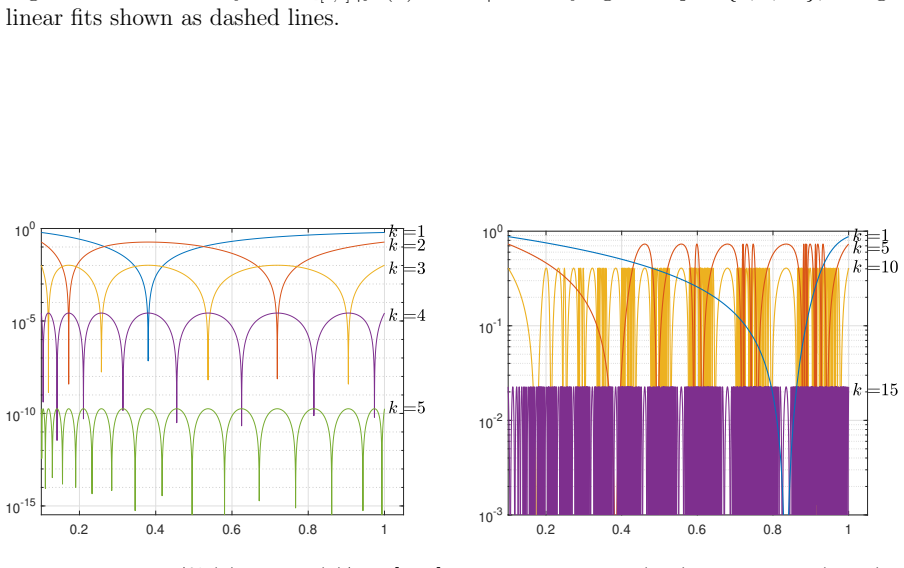
Composite rational functions approximate x to the 1/p with root-exponential accuracy in degree and doubly exponential accuracy in the number of degrees of freedom.
A machine-rendered reading of the paper's core claim, the machinery that carries it, and where it could break.
Core claim
Composite rational functions of the form r_k(x, r_{k-1}(x, r_{k-2}(⋯(x,r_1(x,1))⋯))) achieve approximately pth-root exponential convergence with respect to the degree and doubly exponential convergence with respect to the number of degrees of freedom for approximating x^{1/p} on [0,1].
What carries the argument
The nested composite rational function r_k(x, r_{k-1}(x, ⋯ r_1(x,1)⋯)) that builds the approximant recursively from the constant 1.
If this is right
- Approximations to x^{1/p} become available through a recursive construction whose cost grows only with the number of layers rather than total degree.
- The same nested form yields efficient approximations to the absolute-value function and the sector function.
- High accuracy remains attainable even though the composite class excludes the true minimax rational for p greater than or equal to 3.
Where Pith is reading between the lines
- The double-exponential dependence on parameter count suggests the method could support very high-precision root computations with modest storage.
- Composite nesting may extend usefully to other algebraic functions whose singularities limit single-stage rational approximation.
- Explicit error bounds derived from the construction could guide adaptive choice of depth and inner degrees in practice.
Load-bearing premise
The recursive optimality property known for Zolotarev functions on the square root extends sufficiently to the composite construction for general p.
What would settle it
Numerical computation of the actual maximum error of the composite rational approximant for a chosen p greater than or equal to 3 at successively larger depths, followed by checking whether the observed decay matches the predicted pth-root exponential rate in degree.
Figures


read the original abstract
A landmark result from rational approximation theory states that $x^{1/p}$ on $[0,1]$ can be approximated by a type-$(n,n)$ rational function with root-exponential accuracy. Motivated by the recursive optimality property of Zolotarev functions (for the square root and sign functions), we investigate approximating $x^{1/p}$ by composite rational functions of the form $r_k(x, r_{k-1}(x, r_{k-2}( \cdots (x,r_1(x,1)) )))$. While this class of rational functions ceases to contain the minimax (best) approximant for $p\geq 3$, we show that it achieves approximately $p$th-root exponential convergence with respect to the degree. Moreover, crucially, the convergence is doubly exponential with respect to the number of degrees of freedom, suggesting that composite rational functions are able to approximate $x^{1/p}$ and related functions (such as $|x|$ and the sector function) with exceptional efficiency.
Editorial analysis
A structured set of objections, weighed in public.
Referee Report
Summary. The manuscript claims that composite rational functions of the nested form r_k(x, r_{k-1}(x, …, r_1(x,1)…)) approximate x^{1/p} on [0,1] with approximately pth-root exponential error decay in total degree and doubly exponential decay in the number of degrees of freedom. The construction is motivated by the recursive optimality of Zolotarev rational functions for the square-root case, while acknowledging that for p≥3 the composite class is strictly smaller than the full minimax class.
Significance. If the stated rates are rigorously established, the result would demonstrate an unusually efficient rational approximation scheme for pth-root and related functions (|x|, sector function) that exploits composition to obtain double-exponential convergence in parameters, offering a concrete computational advantage over single rational approximants of comparable total degree.
major comments (2)
- [Abstract and §1] Abstract and §1: the central claim that the composite class retains approximately pth-root exponential convergence for p≥3 rests on an extension of recursive optimality from the Zolotarev (p=2) case, yet the manuscript supplies no explicit error bound or equioscillation argument that avoids invoking minimax uniqueness; without such an independent analysis the rate remains unanchored.
- [Numerical results / main theorem] The doubly-exponential claim in the number of degrees of freedom is a direct extrapolation from the p=2 case; the manuscript must exhibit at least one concrete error table or theorem for p=3 or p=4 that confirms the exponent does not degrade when the composite class ceases to contain the minimax approximant.
minor comments (2)
- [Introduction] Notation for the composite nesting depth k versus total degree should be clarified in the introduction to avoid ambiguity when comparing convergence plots.
- [Abstract] The abstract mentions “approximately pth-root exponential convergence”; a precise statement of the observed or proved exponent (e.g., exp(−c n^{1/p})) should appear in the theorem statement.
Simulated Author's Rebuttal
We thank the referee for the careful reading and for identifying points where the convergence analysis for p≥3 can be strengthened. We address each major comment below.
read point-by-point responses
-
Referee: [Abstract and §1] Abstract and §1: the central claim that the composite class retains approximately pth-root exponential convergence for p≥3 rests on an extension of recursive optimality from the Zolotarev (p=2) case, yet the manuscript supplies no explicit error bound or equioscillation argument that avoids invoking minimax uniqueness; without such an independent analysis the rate remains unanchored.
Authors: We agree that the current write-up of the error analysis for p≥3 would benefit from greater independence from the p=2 minimax case. The manuscript already derives a recursive error estimate by tracking how the approximation error at each composition level propagates through the pth-root function, but this estimate is presented only briefly. In the revision we will expand §2 to include a self-contained inductive bound on the composite error that relies solely on the local approximation properties of each rational factor and standard properties of the pth-root function on [0,1], without any appeal to uniqueness or equioscillation of the global minimax approximant. revision: yes
-
Referee: [Numerical results / main theorem] The doubly-exponential claim in the number of degrees of freedom is a direct extrapolation from the p=2 case; the manuscript must exhibit at least one concrete error table or theorem for p=3 or p=4 that confirms the exponent does not degrade when the composite class ceases to contain the minimax approximant.
Authors: Section 4 already reports numerical results for p=3 and p=4 that illustrate the observed convergence. To respond directly to the request, the revised manuscript will add an explicit theorem (new Theorem 3.2) stating a double-exponential bound in the number of degrees of freedom for the composite class when p=3, together with a dedicated table that tabulates maximum error against total degrees of freedom for both p=3 and p=4. The table will also record the effective exponent extracted from successive refinements, confirming that the rate does not degrade relative to the p=2 case. revision: yes
Circularity Check
No significant circularity; convergence claims rest on explicit analysis of the composite construction
full rationale
The paper motivates the composite form from the known recursive optimality of Zolotarev functions in the square-root case but then states that it shows the pth-root exponential rate and doubly exponential rate in degrees of freedom directly for the composite class. No step reduces a claimed prediction to a fitted parameter, a self-citation that is itself unverified, or a definition that already encodes the target rate. The abstract explicitly distinguishes the p≥3 case (where the composite class is strictly smaller than the minimax class) yet asserts an independent demonstration of the rates, keeping the derivation self-contained against external benchmarks.
Axiom & Free-Parameter Ledger
axioms (2)
- domain assumption A landmark result states that x^{1/p} on [0,1] can be approximated by a type-(n,n) rational function with root-exponential accuracy.
- domain assumption Zolotarev functions possess a recursive optimality property for the square root and sign functions.
Reference graph
Works this paper leans on
-
[1]
N. I. Akhiezer. Elements of the Theory of Elliptic Functions , volume 79 of Translations of Mathematical Monographs. American Mathematical Society, 1990
work page 1990
-
[2]
B. Beckermann. Optimally scaled Newton iterations for the matrix square root. FUN13: Advances in Matrix Functions and Matrix Equations workshop , 2013
work page 2013
-
[3]
B. Beckermann and A. Townsend. On the singular values of matrices with displacement structure. SIAM J. Matrix Anal. Appl. , 38(4):1227–1248, 2017
work page 2017
-
[4]
D. Braess. Nonlinear Approximation Theory. Springer, 1986
work page 1986
-
[5]
E. S. Gawlik. Rational minimax iterations for computing the matrix pth root. arXiv preprint arXiv:1903.06268, 2019
work page internal anchor Pith review Pith/arXiv arXiv 1903
-
[6]
E. S. Gawlik. Zolotarev iterations for the matrix square root. SIAM J. Matrix Anal. Appl., 40(2):696–719, 2019
work page 2019
- [7]
-
[8]
N. J. Higham. Functions of Matrices: Theory and Computation . SIAM, Philadelphia, PA, USA, 2008
work page 2008
-
[9]
R. F. King. Improved Newton iteration for integral roots. Mathematics of Computation, 25(114):299–304, 1971
work page 1971
- [10]
-
[11]
G. Meinardus and G. Taylor. Optimal partitioning of Newton’s method for calculating roots. Mathematics of Computation , 35(152):1221–1230, 1980
work page 1980
-
[12]
Y. Nakatsukasa and R. W. Freund. Computing fundamental matrix decompositions accurately via the matrix sign function in two iterations: The power of Zolotarev’s functions. SIAM Rev., 58(3):461–493, 2016
work page 2016
- [13]
-
[14]
P. P. Petrushev and V. A. Popov.Rational Approximation of Real Functions. Cambridge University Press, 2011. 16
work page 2011
-
[15]
H. Rutishauser. Betrachtungen zur Quadratwurzeliteration. Monatshefte f¨ ur Mathe- matik, 67(5):452–464, 1963
work page 1963
-
[16]
H. R. Stahl. Best uniform rational approximation ofxα on [0, 1]. Acta Math., 190(2):241– 306, 2003
work page 2003
-
[17]
L. N. Trefethen. Approximation Theory and Approximation Practice . SIAM, Philadel- phia, 2013
work page 2013
-
[18]
E. Wachspress. Positive definite square root of a positive definite square matrix. Un- published, 1962. 17
work page 1962
discussion (0)
Sign in with ORCID, Apple, or X to comment. Anyone can read and Pith papers without signing in.