Global manifold structure of a continuous-time heterodimensional cycle
Pith reviewed 2026-05-25 14:52 UTC · model grok-4.3
The pith
In a four-dimensional calcium model, the manifolds of a heterodimensional cycle follow three-dimensional diffeomorphism theory locally but display more intricate global structure.
A machine-rendered reading of the paper's core claim, the machinery that carries it, and where it could break.
Core claim
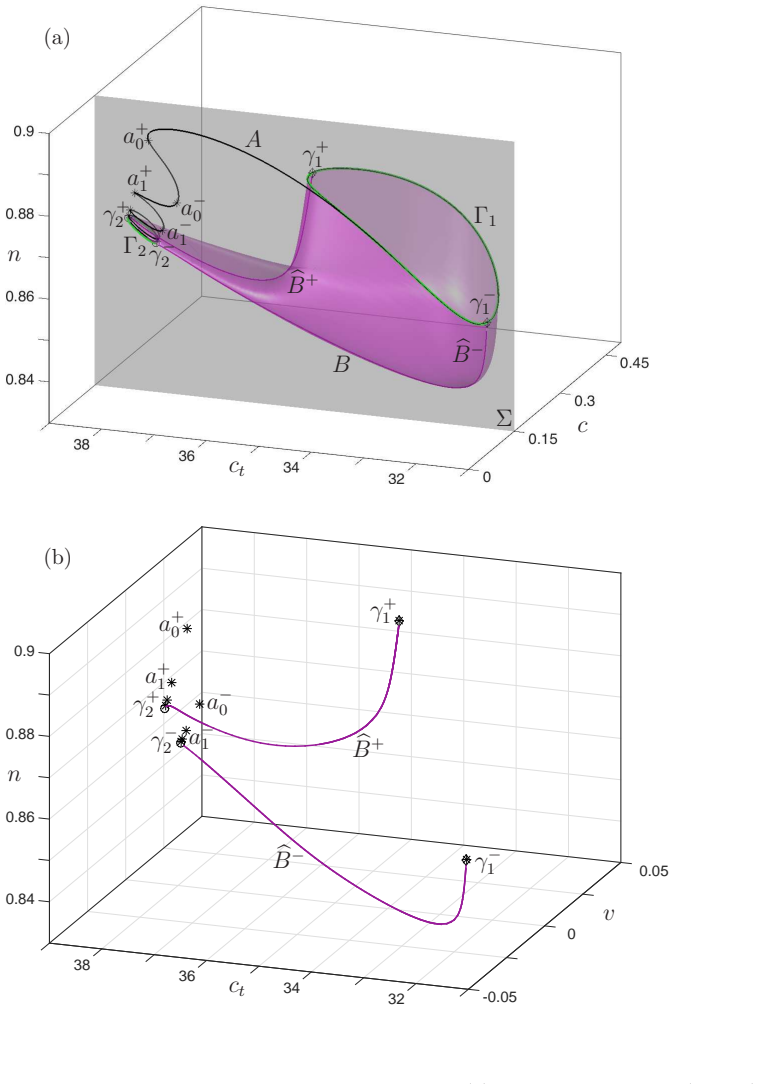
A heterodimensional cycle in the calcium model consists of one codimension-one connecting orbit and a cylinder of structurally stable connecting orbits. Locally near the intersection set the associated stable and unstable manifolds interact as described by the theory for three-dimensional diffeomorphisms. Their global structure is more intricate because it is impossible to find a Poincaré section transverse to the flow everywhere.
What carries the argument
The heterodimensional cycle (pair of heteroclinic connections between saddle periodic orbits with unstable manifolds of different dimensions) together with its stable and unstable manifolds computed via boundary-value problems.
If this is right
- Local manifold geometry near the cycle intersection matches the predictions of three-dimensional discrete-time theory.
- Global manifold structure in continuous time must be analyzed without assuming a globally transverse section.
- Heterodimensional cycles can be located and visualized numerically in concrete application models such as calcium dynamics.
- The abstract notion of a heterodimensional cycle is realized and studyable in four-dimensional flows from applications.
Where Pith is reading between the lines
- Continuous-time systems may require additional geometric tools beyond those sufficient for discrete maps when studying global manifold arrangements.
- Numerical continuation methods for manifolds in flows should incorporate checks for regions where transversality to a section breaks down.
- Similar global intricacies could appear in other high-dimensional application models once heterodimensional cycles are located.
Load-bearing premise
The heterodimensional cycle and its connecting orbits exist in the model exactly as located earlier, and the chosen boundary-value problem plus Poincaré section capture the true manifold geometry without significant numerical artifacts.
What would settle it
A computation or observation showing that the manifolds near the intersection set fail to interact as predicted by three-dimensional diffeomorphism theory, or that a single Poincaré section transverse to the flow can be constructed everywhere.
Figures




read the original abstract
A heterodimensional cycle consists of a pair of heteroclinic connections between two saddle periodic orbits with unstable manifolds of different dimensions. Recent theoretical work on chaotic dynamics beyond the uniformly hyperbolic setting has shown that heterodimensional cycles may occur robustly in diffeomorphisms of dimension at least three. We study a concrete example of a heterodimensional cycle in the continuous-time setting, specifically in a four-dimensional vector field model of intracellular calcium dynamics. By employing advanced numerical techniques, Zhang, Krauskopf and Kirk [Discr. Contin. Dynam. Syst. A 32(8) 2825--2851 (2012)] found that a heterodimensional cycle exists in this model. We investigate the geometric structure of the associated stable and unstable manifolds in the neighbourhood of this heterodimensional cycle, consisting of a single connecting orbit of codimension one and an entire cylinder of structurally stable connecting orbits between two saddle periodic orbits. We employ a boundary-value problem set-up to compute their stable and unstable manifolds, which we visualize in different projections of phase space and as intersection sets with a suitable three-dimensional Poincar\'e section. We show that, locally near the intersection set of the heterodimensional cycle, the manifolds interact as described by the theory for three-dimensional diffeomorphisms. On the other hand, their global structure is more intricate, which is due to the fact that it is not possible to find a Poincar\'e section that is transverse to the flow everywhere. Our results show that the abstract concept of a heterodimensional cycle arises and can be studied in continuous-time models from applications.
Editorial analysis
A structured set of objections, weighed in public.
Referee Report
Summary. The paper numerically studies the stable and unstable manifolds of a heterodimensional cycle in a four-dimensional continuous-time model of intracellular calcium dynamics. Relying on the cycle previously located by Zhang, Krauskopf and Kirk (2012), the authors employ boundary-value problem methods to compute the manifolds associated with a codimension-one connecting orbit and a cylinder of structurally stable connections. These are visualized in phase-space projections and as intersections with a chosen three-dimensional Poincaré section. The central claim is that, locally near the cycle, the manifolds interact as predicted by theory for three-dimensional diffeomorphisms, while the global structure is more intricate because no Poincaré section can be transverse to the flow everywhere.
Significance. If the computations are accurate, the work supplies a concrete continuous-time example from an applied model that illustrates both the local validity of discrete-time heterodimensional cycle theory and the additional geometric complexities induced by the flow. The explicit use of BVP techniques for global manifold computation and the direct comparison of local versus global behavior constitute a useful case study bridging abstract theory and applications.
major comments (1)
- [Numerical methods and results sections (around the BVP setup and Poincaré section description)] The BVP formulation and Poincaré section are central to all reported manifold geometry, yet the manuscript provides no convergence checks, tolerance settings, mesh adaptation details, or validation by recovering the known heteroclinic connections from Zhang et al. (2012). This absence is load-bearing for the claim of an 'intricate' global structure, as discretization artifacts could alter the reported intersection sets.
minor comments (1)
- [Abstract and §1] The abstract and introduction could more explicitly state the dimension of the vector field and the precise codimensions of the connecting orbits to aid readers unfamiliar with the 2012 reference.
Simulated Author's Rebuttal
We thank the referee for the positive assessment and the constructive comment on the numerical methods. We address the point below.
read point-by-point responses
-
Referee: [Numerical methods and results sections (around the BVP setup and Poincaré section description)] The BVP formulation and Poincaré section are central to all reported manifold geometry, yet the manuscript provides no convergence checks, tolerance settings, mesh adaptation details, or validation by recovering the known heteroclinic connections from Zhang et al. (2012). This absence is load-bearing for the claim of an 'intricate' global structure, as discretization artifacts could alter the reported intersection sets.
Authors: We agree that the manuscript would benefit from explicit documentation of the numerical parameters and validation steps. In the revised version we will add a short subsection (or appendix) that specifies the collocation tolerances (absolute and relative), the mesh-adaptation strategy employed by the BVP solver, residual-norm convergence checks performed under successive mesh refinements, and a direct numerical recovery of the codimension-one and cylinder connections reported by Zhang et al. (2012). These additions will confirm that the reported intersection sets are not discretization artifacts and thereby strengthen the distinction between local and global manifold geometry. revision: yes
Circularity Check
No significant circularity
full rationale
The paper is a numerical case study that computes stable/unstable manifolds of a pre-located heterodimensional cycle via boundary-value problems and Poincaré sections. It cites Zhang et al. (2012) only for cycle existence and location; the geometric claims about local interaction (matching 3D diffeomorphism theory) and global intricacy (due to non-transverse sections) are obtained directly from the independent computations without any fitted parameters renamed as predictions, self-definitional reductions, or load-bearing self-citations that collapse the result to its inputs. The derivation chain is self-contained.
Axiom & Free-Parameter Ledger
axioms (2)
- standard math Stable and unstable manifolds of hyperbolic periodic orbits exist and can be computed via boundary-value problems.
- domain assumption The heterodimensional cycle consisting of one codimension-one connection and a cylinder of connections exists in the calcium model as located by Zhang et al. (2012).
Lean theorems connected to this paper
-
IndisputableMonolith/Foundation/AlexanderDuality.leanalexander_duality_circle_linking unclear?
unclearRelation between the paper passage and the cited Recognition theorem.
We investigate the geometric structure of the associated stable and unstable manifolds in the neighbourhood of this heterodimensional cycle, consisting of a single connecting orbit of codimension one and an entire cylinder of structurally stable connecting orbits between two saddle periodic orbits.
What do these tags mean?
- matches
- The paper's claim is directly supported by a theorem in the formal canon.
- supports
- The theorem supports part of the paper's argument, but the paper may add assumptions or extra steps.
- extends
- The paper goes beyond the formal theorem; the theorem is a base layer rather than the whole result.
- uses
- The paper appears to rely on the theorem as machinery.
- contradicts
- The paper's claim conflicts with a theorem or certificate in the canon.
- unclear
- Pith found a possible connection, but the passage is too broad, indirect, or ambiguous to say the theorem truly supports the claim.
Reference graph
Works this paper leans on
-
[1]
Anosov D V 1967 Geodesic flows on closed Riemannian manifo lds with negative curvature Proc. Inst. Steklov 90 1–235
work page 1967
-
[2]
Atri A, Amundsen J, Clapham D and Sneyd J 1993 A single-poo l model for intracellular calcium oscillations and waves in the Xenopus laevis oocyte Biophysical Journal 65 1727– 1739
work page 1993
-
[3]
Bam´ on R, Kiwi J and Rivera-Letelier J 2006 Wild Lorenz-l ike attractors Preprint, arXiv:0508045
work page 2006
-
[4]
Beyn W-J 1990 The numerical computation of connecting or bits in dynamical systems IMA J. Numer. Anal. 10(3) 379–405
work page 1990
-
[5]
Beyn W-J 1994 On well-posed problems for connecting orbi ts in dynamical systems Chaotic Numerics Contemporary mathematics 172 ed P E Kloeden (Providence, RI: American Mathematical Society) pp 131–168
work page 1994
-
[6]
Birkhoff G D 1917 Dynamical systems with two degrees of fre edom Trans. Amer. Math. Soc. 18 199-300
work page 1917
-
[7]
Bonatti C and Crovisier S 2004 R´ ecurrence et g´ en´ ericit´ eInvent. Math. 158(1) 33–104
work page 2004
-
[8]
Bonatti C, Crovisier S D ´ ıaz L J and Wilkinson A 2016 What i s. . . a blender? Notices Amer. Math. Soc. 63(10) 1175–1178 23
work page 2016
-
[9]
Bonatti C and D ´ ıaz L J 1996 Persistent nonhyperbolic tra nsitive diffeomorphisms Ann. of Math. 2nd Series 143(2) 357–396
work page 1996
-
[10]
Bonatti C and D ´ ıaz L J 2008 Robust heterodimensional cycles and C 1-generic consequences J. Inst. Math. Jussieu 7 469-525
work page 2008
-
[11]
A Global Geometric and Probabilistic Perspective Encyclopaedia Math
Bonatti C, D ´ ıaz L J and Viana M 2005 Dynamics Beyond Uniform Hyperbolicity. A Global Geometric and Probabilistic Perspective Encyclopaedia Math. Sci. 102 (Berlin Heidelberg: Springer-Verlag)
work page 2005
-
[12]
Champneys A R, Kuznetsov Yu A and Sandstede B 1996 A numer ical toolbox for homoclinic bifurcation analysis Int. J. Bifurcation and Chaos 6(5) 867–887
work page 1996
-
[13]
Christov I C, Lueptow R M, Ottino J M and Sturman R 2014 A st udy in three-dimensional chaotic dynamics: granular flow and transport in a bi-axial s pherical tumbler SIAM J. Appl. Dynam. Syst. 13(2) 901–943
work page 2014
-
[14]
Crovisier S and Pujals E R 2015 Essential hyperbolicity and homoclinic bifurcations: a dichotomy phenomenon/mechanism for diffeomorphisms. Invent. Math. 201(2) 385–517
work page 2015
-
[15]
D ´ ıaz L J 1995 Robust nonhyperbolic dynamics and heterodimensional cycles. Ergod. Theory Dyn. Syst. 15 291-315
work page 1995
-
[16]
D ´ ıaz L J, Kiriki S and Shinohara K 2014 Blenders in centr e unstable H´ enon-like families: with an application to heterodimensional bifurcations Nonlinearity 27(3) 353–378
work page 2014
-
[17]
Dieci L and Rebaza J 2004 Point-to-periodic and periodi c-to-periodic connections BIT Numerical Mathematics 44(1) 4162; with erratum in 44(3) 617–618
work page 2004
-
[18]
Doedel E J 1981 Auto, a program for the automatic bifurcation analysis of autono mous systems Congr. Numer. 30 265–384
work page 1981
-
[19]
Doedel E J 2007 Auto-07P: Continuation and bifurcation software for ordinary differe ntial equations, with major contributions from Champneys A R, Fai rgrieve T F, Kuznetsov Yu A, Oldeman B E, Paffenroth R C, Sandstede B, Wang X J and Zhang C; a vailable at http://cmvl.cs.concordia.ca/auto/
work page 2007
-
[20]
Doedel E J, Kooi B W, van Voorn G A K and Kuznetsov Yu A 2008 C ontinuation of connecting orbits in 3D-ODEs: (I) Point-to-cycle connecti ons Int. J. Bifurcation and Chaos 18(7) 1889–1903
work page 2008
-
[21]
Doedel E J, Kooi B W, van Voorn G A K and Kuznetsov Yu A 2009 C ontinuation of connecting orbits in 3D-ODEs: (II) Cycle-to-cycle connect ions Int. J. Bifurcation and Chaos 19(1) 159–169
work page 2009
-
[22]
Doedel E J, Krauskopf, B and Osinga, H M 2015 Global organ ization of phase space in the transition to chaos in the Lorenz system Nonlinearity 28(11) R113-R139
work page 2015
-
[23]
Dullin H R and Wittek A 1995 Complete Poincar´ e sections and tangent sets J. Phys. A 28 7157-7180
work page 1995
-
[24]
Edelstein-Keshet L 1988 Mathematical Models in Biology Birk¨ auser Mathematics Series (Boston: McGraw-Hill)
work page 1988
-
[25]
Ermentrout G B and Terman D H 2010 Mathematical Foundations of Neuroscience Inter- disciplinary Applied Mathematics 35 (New York: Springer-Verlag) 24
work page 2010
-
[26]
England J P, Krauskopf B and Osinga H M 2005 Bifurcations of stable sets in noninvertible planar maps Int. J. Bifurcation and Chaos 15(3) 891–904
work page 2005
-
[27]
England J P, Krauskopf B and Osinga H M 2005 Computing one -dimensional global man- ifolds of Poincar´ e maps by continuation SIAM J. Appl. Dynam. Syst. 4(4) 1008–1041
work page 2005
-
[28]
Galias Z 1997 Positive topological entropy of Chua’s ci rcuit: a computer assisted proof Int. J. Bifurcation and Chaos 7(2) 331–349
work page 1997
-
[29]
Gonchenko S V, Meiss J D and Ovsyannikov I I 1006 Chaotic d ynamics of three-dimensional H´ enon maps that originate from a homoclinic bifurcation Regular and Chaotic Dynamics 11(2) (2006) 191–212
work page 2006
-
[30]
Gonchenko S V, Ovsyannikov I I, Sim´ o C and Turaev D 2005 T hree-dimensional H´ enon-like map and wild Lorenz-like attractors Int. J. Bifurcation and Chaos 15(11) 3493–3508
work page 2005
-
[31]
Gonchenko S V, Shilnikov L P and Turaev D 2009 On global bi furcations in three- dimensional diffeomorphisms leading to wild Lorenz-like att ractors Regular and Chaotic Dynamics 14(1) 137–147
work page 2009
-
[32]
Guckenheimer J and Holmes P 1983 Nonlinear Oscillations, Dynamical Systems and Bi- furcations of Vector Fields (New York: Springer-Verlag)
work page 1983
-
[33]
Hittmeyer S, Krauskopf B and Osinga H M 2013 Interacting global invariant sets in a planar map model of wild chaos SIAM J. Appl. Dynam. Syst. 12(3) 1280–1329
work page 2013
-
[34]
Hittmeyer S, Krauskopf B, Osinga H M and Shinohara K 2018 Existence of blenders in a Hnon-like family: geometric insights from invariant mani fold computations Nonlinearity 31(10) R239-R267
work page 2018
-
[35]
Hobbs C A and Osinga H M 2008 Bifurcations of the global st able set of a planar endo- morphism near a cusp singularity Int. J. Bifurcation and Chaos 18(8) 2207–2222
work page 2008
-
[36]
Homburg A J and Sandstede B 2010 Homoclinic and heterocl inic bifurcations in vector fields Handbook of Dynamical Systems III ed B Hasselblatt, H W Broer and F Takens (North Holland: Elsevier) pp 379–524
work page 2010
-
[37]
Jackson T and Radunskaya A 2015 Applications of Dynamical Systems in Biology and Medicine The IMA Volumes in Mathematics and its Applications 158 (New York: Springer- Verlag)
work page 2015
-
[38]
Just W and Kantz H 2000, Some considerations on Poincar´ e maps for chaotic flows J. Phys. A 33 163-170
work page 2000
-
[39]
Kostelich E J, Kan I, Grebogi C, Ott E and Yorke J A 1997 Uns table dimension variability: a source of nonhyperbolicity in chaotic systems Physica D 109(1–2) 81–90
work page 1997
-
[40]
Krauskopf B and Osinga H M 2007 Computing invariant mani folds via the continuation of orbit segments; Numerical Continuation Methods for Dynamical Systems ed B Krauskopf, H M Osinga and J Gal´ an-Vioque (Springer Netherlands) pp 117 –154
work page 2007
-
[41]
Krauskopf B, Osinga H M, Doedel E J, Henderson M E, Gucken heimer J, Vladimirsky A, Dellnitz M and Junge O 2005 A survey of methods for computing ( un)stable manifolds of vector fields Int. J. Bifurcation and Chaos 15(3) 763–791 25
work page 2005
-
[42]
Krauskopf B, Osinga H M and Peckham P 2007 Unfolding the c usp-cusp bifurcation of planar endomorphisms SIAM J. Appl. Dynam. Syst. 6(2) 403–440
work page 2007
-
[43]
Krauskopf B and Rieß T 2008 A Lin’s method approach to find ing and continuing hetero- clinic connections involving periodic orbits Nonlinearity 21(8) 1655–1690
work page 2008
-
[44]
Kuznetsov Yu A 2004 Elements of Applied Bifurcation Theory 3rd edition (New York: Springer-Verlag)
work page 2004
-
[45]
Lee C M, Collins P J, Krauskopf B and Osinga H M 2008 Tangen cy bifurcations of global Poincar´ e mapsSIAM J. Appl. Dynam. Syst. 7(3) 712–754
work page 2008
-
[46]
Lin X-B 1990 Using Melnikovs method to solve Shilnikovs problems Proc. R. Soc. Edinb. A 116(3–4) 295–325
work page 1990
-
[47]
Oldeman B E, Champneys A R and Krauskopf B 2003 Homoclini c branch switching: a numerical implementation of Lin’s method. Int. J. Bifurcation and Chaos 13(10) 2977–2999
work page 2003
-
[48]
Palis J 1991 Homoclinic bifurcations, sensitive-chao tic dynamics and strange attractors; Dynamical systems and related topics (Nagoya, 1990) Advanced Series in Dynamical Sys- tems 9 ed K Shiraiwa (Singapore: World Scientific Publishing) pp 46 6–473
work page 1991
-
[49]
Palis J and de Melo W 1982 Geometric Theory of Dynamical Systems (New York: Springer- Verlag)
work page 1982
-
[50]
Palis J and Takens F 1993 Hyperbolicity & Sensitive Chaotic Dynamics at Homoclinic Bifurcations (Cambridge: Cambridge University Press)
work page 1993
-
[51]
Rademacher J D M 2005 Homoclinic orbits near heteroclin ic cycles with one equilibrium and one periodic orbit J. Diff. Eqns. 218(2) 390–443
work page 2005
-
[52]
Rademacher J D M 2010 Lyapunov-Schmidt reduction for un folding heteroclinic networks of equilibria and periodic orbits with tangencies J. Diff. Eqns. 249(2) 305–348
work page 2010
-
[53]
Roeder R K W, Rapoport B I and Evans T E 2003 Explicit calcu lations of homoclinic tangles in tokamaks Phys. Plasmas 10(9) 3796–3799
work page 2003
-
[54]
Smale S 1967 Differentiable dynamical systems Bull. Amer. Math. Soc. 73 747–817
work page 1967
-
[55]
Turaev D and Shilnikov L P 1998 An example of a wild strang e attractor Sbornik: Mathe- matics 189(2) 291–314
work page 1998
-
[56]
Viana R L, Da Silva E C, Kroetz T, Caldas I L, Roberto M and S anju´ an M A F 2011 Fractal structures in nonlinear plasma physics Philos. Trans. Royal Soc. A 369(1935) 371–395
work page 2011
-
[57]
Zhang W B 2006 Discrete Dynamical Systems, Bifurcations and Chaos in Econo mics Math- ematics in Science and Engineering 204 (North Holland: Elsevier)
work page 2006
-
[58]
Zhang W, Krauskopf B and Kirk V 2012 How to find a codimensi on-one heteroclinic cycle between two periodic orbits Discrete Contin. Dyn. Syst. Ser. A 32(8) 2825–2851 26
work page 2012
discussion (0)
Sign in with ORCID, Apple, or X to comment. Anyone can read and Pith papers without signing in.