Structural Contracts -- Contracts for Type Construction & Dependent Types to Ensure Consistency of Extra-Functional Reasoning
Pith reviewed 2026-05-25 15:12 UTC · model grok-4.3
The pith
Type constraints and dependent types ensure consistent top-down decomposition of contracts for extra-functional properties with respect to a specifiable type constructor.
A machine-rendered reading of the paper's core claim, the machinery that carries it, and where it could break.
Core claim
Structural Contracts use type constraints and dependent types to enforce correct and consistent top-down decomposition of contracts with respect to a specifiable type constructor, thereby solving the composition problem for extra-functional properties.
What carries the argument
Structural Contracts, the mechanism that binds contract decomposition to type constructors through dependent types and type constraints.
If this is right
- Contracts for extra-functional properties can be refined consistently in a top-down manner.
- Inconsistencies in extra-functional properties are prevented during type decomposition.
- The method applies once a type constructor is made specifiable within the type system.
Where Pith is reading between the lines
- The approach could be tested by encoding a small example type constructor and checking contract consistency in an existing dependent type checker.
- It may connect to broader questions of how contracts interact with module systems or refinement types.
Load-bearing premise
A specifiable type constructor exists for which dependent types and type constraints can enforce consistent contract decomposition without introducing inconsistencies in extra-functional properties.
What would settle it
A concrete type constructor and set of contracts where applying the proposed dependent-type constraints still produces inconsistent extra-functional reasoning after decomposition.
Figures
read the original abstract
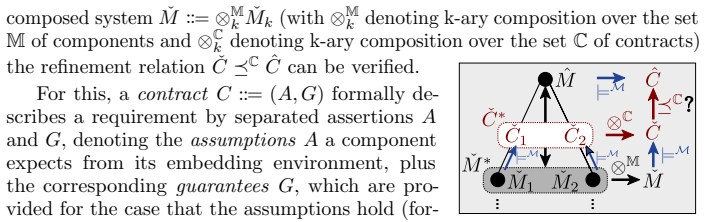
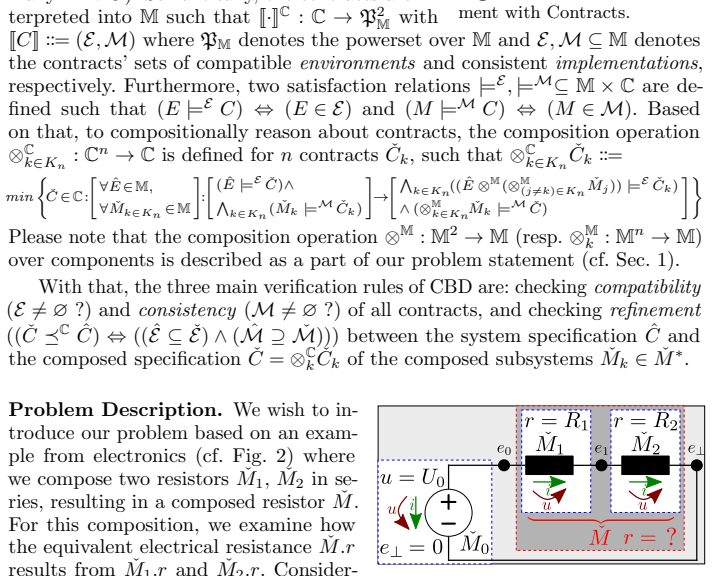
Targeting to use contract-based design for the specification and refinement of extra-functional properties, this research abstract suggests to use type constraints and dependent types to ensure correct and consistent top-down decomposition of contracts with respect to a specifiable type constructor. For this, we summarize the composition problem and give a short draft of our approach, called Structural Contracts.
Editorial analysis
A structured set of objections, weighed in public.
Referee Report
Summary. The manuscript is a short research abstract that identifies a composition problem in using contract-based design for extra-functional properties and proposes an approach called Structural Contracts. It suggests employing type constraints and dependent types to ensure correct and consistent top-down decomposition of contracts with respect to a specifiable type constructor, while summarizing the problem and providing a brief draft of the approach.
Significance. If a concrete formalization were developed and shown to preserve consistency without introducing inconsistencies in extra-functional properties, the idea could contribute to reliable contract refinement in dependently typed settings. As presented, however, the manuscript contains only a high-level suggestion with no formal model, example type constructor, encoding, or consistency argument, so the potential significance remains speculative.
major comments (1)
- [approach draft (abstract)] The central claim that type constraints and dependent types can ensure consistent top-down contract decomposition is stated in the abstract but supported by neither a formal definition of the specifiable type constructor, an encoding of contracts, nor any consistency argument. This is load-bearing for the contribution, as the manuscript consists entirely of this unevaluated suggestion.
minor comments (1)
- [Abstract] The sentence beginning 'Targeting to use' is grammatically awkward and could be rephrased for clarity.
Simulated Author's Rebuttal
We thank the referee for their review of our short research abstract. We agree that the submission is a high-level proposal without a complete formalization and address this point directly below.
read point-by-point responses
-
Referee: [approach draft (abstract)] The central claim that type constraints and dependent types can ensure consistent top-down contract decomposition is stated in the abstract but supported by neither a formal definition of the specifiable type constructor, an encoding of contracts, nor any consistency argument. This is load-bearing for the contribution, as the manuscript consists entirely of this unevaluated suggestion.
Authors: We acknowledge that the manuscript provides only a high-level sketch of the Structural Contracts approach and does not include a formal definition of the type constructor, an encoding of contracts, or a consistency argument. As explicitly described in the abstract, the purpose of this short research abstract is to summarize the composition problem in contract-based design for extra-functional properties and to give a brief draft of the proposed solution using dependent types and type constraints. A full formal model and proofs would require a longer technical paper, which is outside the scope of this abstract format. revision: no
Circularity Check
No circularity; high-level abstract only
full rationale
The paper is explicitly a short research abstract summarizing a composition problem and sketching an approach called Structural Contracts. It contains no equations, derivations, formal type constructors, consistency proofs, or self-citations. The central claim is a high-level suggestion to employ type constraints and dependent types for contract decomposition; without any developed construction or load-bearing argument, no step reduces to its own inputs by definition or citation. The derivation chain is absent, making the work self-contained at the level of an idea sketch.
Axiom & Free-Parameter Ledger
Reference graph
Works this paper leans on
-
[1]
Foundations and Trends in Electronic Design Automation 12(2-3), 124--400 (2018)
Benveniste, A., Caillaud, B., Nickovic, D., Passerone, R., Raclet, J., Reinkemeier, P., Sangiovanni - Vincentelli, A.L., Damm, W., Henzinger, T.A., Larsen, K.G.: Contracts for system design. Foundations and Trends in Electronic Design Automation 12(2-3), 124--400 (2018). doi:10.1561/1000000053
-
[2]
Nitsche, G., G \" o rgen, R., Gr \" u ttner, K., Nebel, W.: Structural contracts - motivating contracts to ensure extra-functional semantics (2015). doi:10.1007/978-3-319-90023-0\_7
-
[3]
In: Principles of Modeling - Essays Dedicated to Edward A
Nuzzo, P., Sangiovanni - Vincentelli, A.L.: Hierarchical system design with vertical contracts. In: Principles of Modeling - Essays Dedicated to Edward A. Lee on the Occasion of His 60th Birthday. pp. 360--382 (2018). doi:10.1007/978-3-319-95246-8\_22
-
[4]
Systems Engineering 20(3), 220--234 (2017)
Pinto, A., Sangiovanni - Vincentelli, A.L.: CSL4P: A contract specification language for platforms. Systems Engineering 20(3), 220--234 (2017). doi:10.1002/sys.21386
-
[5]
Sapienza, G., Sentilles, S., Crnkovic, I., Seceleanu, T.: Extra-functional properties composability for embedded systems partitioning. In: 19th International ACM SIGSOFT Symposium on Component-Based Software Engineering, CBSE 2016, Venice, Italy, April 5-8, 2016. pp. 69--78 (2016). doi:10.1109/CBSE.2016.19
-
[6]
Stanford Encyclopedia of Philosophy : Intuitionistic type theory, https://plato.stanford.edu/entries/type-theory-intuitionistic/
-
[7]
Vanherpen, K., Denil, J., D \' a vid, I., Meulenaere, P.D., Mosterman, P.J., T \" o rngren, M., Qamar, A., Vangheluwe, H.: Ontological reasoning for consistency in the design of cyber-physical systems. In: 1st International Workshop on Cyber-Physical Production Systems, CPPS@CPSWeek 2016, Vienna, Austria, April 12, 2016. pp. 1--8 (2016). doi:10.1109/CPPS....
-
[8]
, " * write output.state after.block = add.period write
ENTRY address author booktitle chapter doi edition editor eid howpublished institution journal key month note number organization pages publisher school series title type url volume year label INTEGERS output.state before.all mid.sentence after.sentence after.block FUNCTION init.state.consts #0 'before.all := #1 'mid.sentence := #2 'after.sentence := #3 '...
-
[9]
" write newline "" before.all 'output.state := FUNCTION n.dashify 't := "" t empty not t #1 #1 substring "-" = t #1 #2 substring "--" = not "--" * t #2 global.max substring 't := t #1 #1 substring "-" = "-" * t #2 global.max substring 't := while if t #1 #1 substring * t #2 global.max substring 't := if while FUNCTION word.in bbl.in capitalize ":" * " " *...
discussion (0)
Sign in with ORCID, Apple, or X to comment. Anyone can read and Pith papers without signing in.