Bidirectional Type Class Instances (Extended Version)
Pith reviewed 2026-05-25 13:08 UTC · model grok-4.3
The pith
Haskell type class instances can be interpreted as logical bi-implications rather than unidirectional implications.
A machine-rendered reading of the paper's core claim, the machinery that carries it, and where it could break.
Core claim
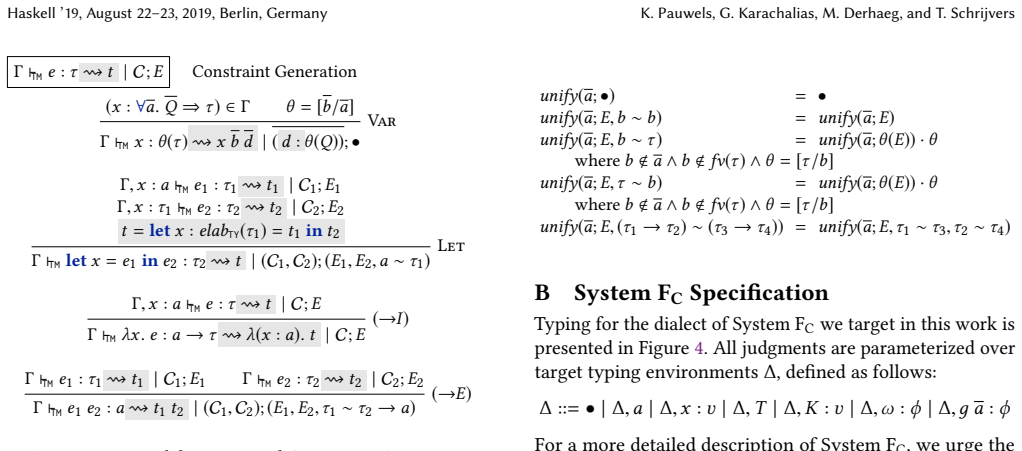
Under the bidirectional interpretation, class instances correspond to logical bi-implications. This reading yields a fully specified set of typing rules and an elaboration into System FC together with a type-inference algorithm. The resulting system is a conservative extension: every program that was well-typed before remains well-typed, and the meta-theoretic properties of the original type-class mechanism (soundness, coherence) continue to hold.
What carries the argument
Bidirectional type class instances, which are interpreted as logical bi-implications and equipped with typing rules and an elaboration to System FC.
If this is right
- Instances for GADTs that were previously impossible become expressible.
- All existing well-typed Haskell programs remain well-typed without modification.
- Type inference and elaboration continue to be decidable and produce System FC terms.
- The coherence and soundness guarantees of the original type-class system are retained.
Where Pith is reading between the lines
- The same bi-implication view might simplify other interactions between GADTs and functional dependencies or type families.
- Programmers could deliberately write symmetric instance declarations to document reversible relationships.
- Similar bidirectional extensions could be explored for other unidirectional constructs such as functional dependencies.
Load-bearing premise
The bidirectional reading can be realized as a conservative extension whose typing rules and elaboration preserve soundness, coherence and the other meta-theoretic properties of existing type classes.
What would settle it
A concrete program that is accepted by the bidirectional rules, elaborates to a well-typed System FC term, yet produces an incoherent or unsound result at runtime, or a simple GADT for which no instance can still be written even after the extension.
Figures
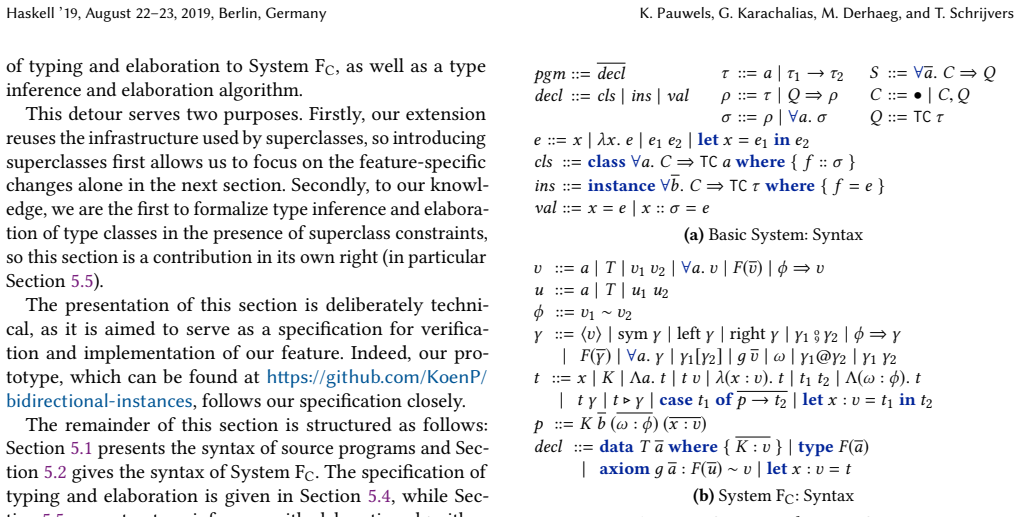
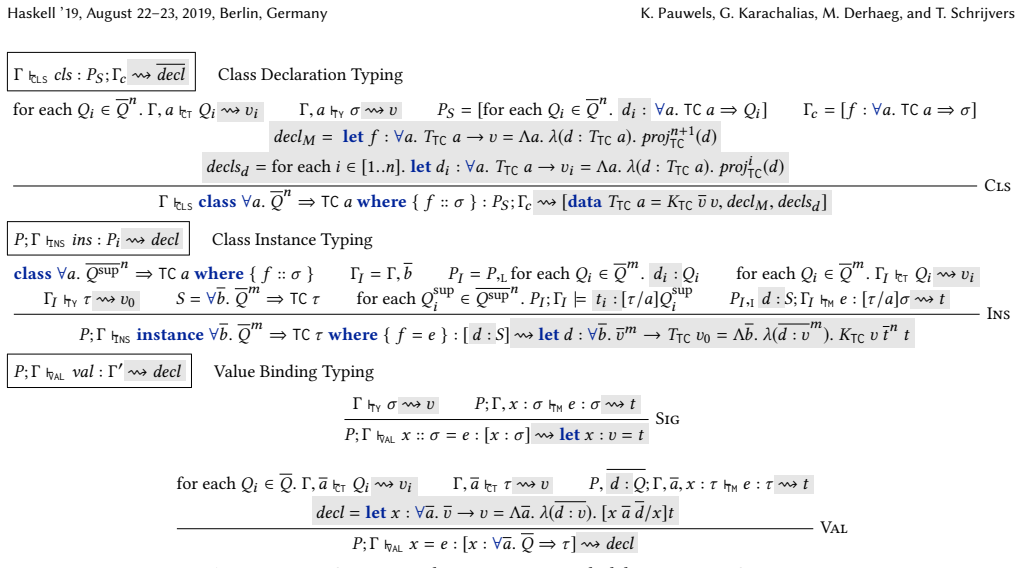
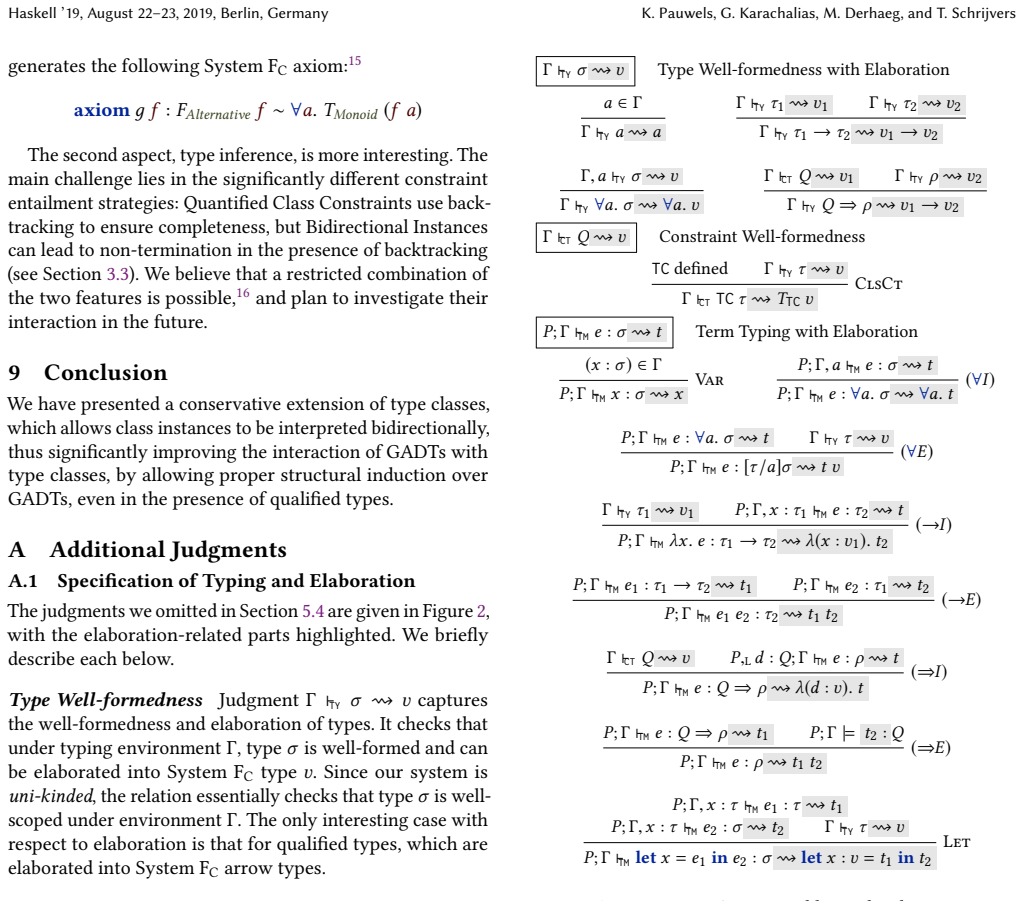
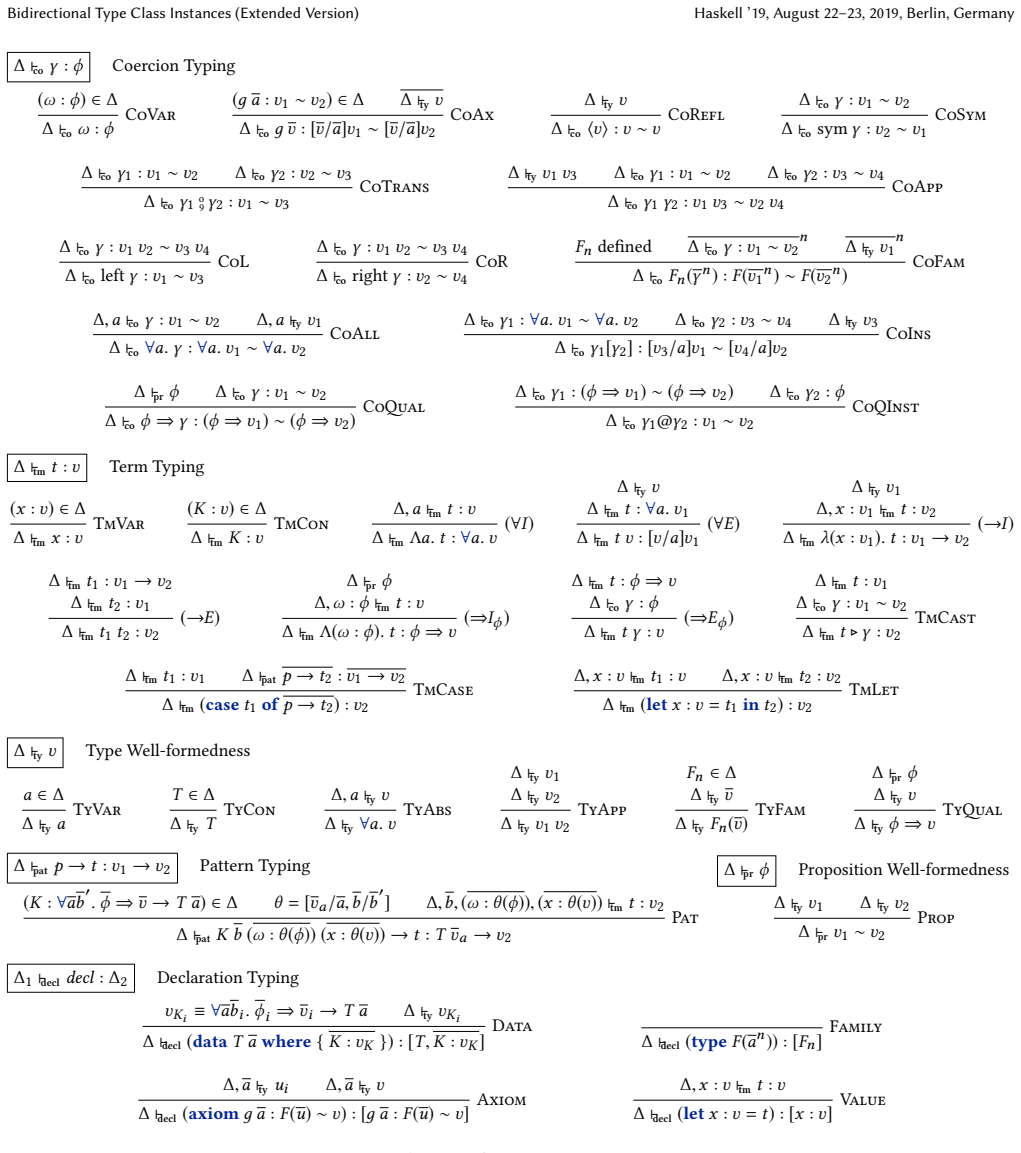
read the original abstract
GADTs were introduced in Haskell's eco-system more than a decade ago, but their interaction with several mainstream features such as type classes and functional dependencies has a lot of room for improvement. More specifically, for some GADTs it can be surprisingly difficult to provide an instance for even the simplest of type classes. In this paper we identify the source of this shortcoming and address it by introducing a conservative extension to Haskell's type classes: Bidirectional Type Class Instances. In essence, under our interpretation class instances correspond to logical bi-implications, in contrast to their traditional unidirectional interpretation. We present a fully-fledged design of bidirectional instances, covering the specification of typing and elaboration into System FC, as well as an algorithm for type inference and elaboration. We provide a proof-of-concept implementation of our algorithm, and revisit the meta-theory of type classes in the presence of our extension.
Editorial analysis
A structured set of objections, weighed in public.
Referee Report
Summary. The paper proposes bidirectional type class instances as a conservative extension to Haskell's type classes for better interaction with GADTs. Under this interpretation, class instances correspond to logical bi-implications rather than the traditional unidirectional implications. It presents a full design including typing rules and elaboration to System FC, a type inference and elaboration algorithm, a proof-of-concept implementation, and a revisit of the meta-theory of type classes in the presence of the extension.
Significance. If the claims hold, the extension would address a practical difficulty in providing instances for some GADTs, which has persisted since their introduction over a decade ago. The abstract highlights a proof-of-concept implementation and meta-theoretic revisit as part of the contribution.
major comments (1)
- The abstract asserts that bidirectional instances can be realized as a conservative extension whose typing rules and elaboration to System FC preserve meta-theoretic properties such as soundness and coherence, but the submission provides only the abstract with no typing rules, elaboration details, or proof sketches visible, making it impossible to assess whether the central claim is supported by the development.
Simulated Author's Rebuttal
We thank the referee for their comments. We respond to the major comment below.
read point-by-point responses
-
Referee: The abstract asserts that bidirectional instances can be realized as a conservative extension whose typing rules and elaboration to System FC preserve meta-theoretic properties such as soundness and coherence, but the submission provides only the abstract with no typing rules, elaboration details, or proof sketches visible, making it impossible to assess whether the central claim is supported by the development.
Authors: The provided manuscript consists only of the abstract, which summarizes the contributions but does not include the typing rules, System FC elaboration, inference algorithm, implementation, or meta-theoretic proofs. The full extended paper on arXiv:1906.12242 contains these elements as described in the abstract. Since the details are not visible in the given text, we cannot exhibit them here. revision: no
- The referee's observation that only the abstract is visible, preventing assessment of the typing rules, elaboration, and meta-theoretic claims.
Circularity Check
No circularity detectable from abstract alone
full rationale
Only the abstract is available for analysis. It asserts a conservative extension with bidirectional instances interpreted as bi-implications, along with typing rules, elaboration to System FC, an inference algorithm, and meta-theoretic preservation, but presents no equations, derivations, fitted parameters, or self-citations that could be inspected for reduction to inputs by construction. No load-bearing steps of any enumerated kind are quotable, so the derivation chain cannot be walked and no circularity is identified. This matches the expectation that papers without visible self-referential reductions receive score 0.
Axiom & Free-Parameter Ledger
Reference graph
Works this paper leans on
-
[1]
Coherence of Type Class Resolution. Proc. ACM Program. Lang. (2019). Accepted. Manuel M. T. Chakravarty, Gabriele Keller, and Simon Peyton Jones. 2005a. Associated Type Synonyms. SIGPLAN Not. 40, 9 (2005), 241–253. Manuel M. T. Chakravarty, Gabriele Keller, Simon Peyton Jones, and Simon Marlow. 2005b. Associated Types with Class. In POPL ’05. ACM, 1–13. L...
work page 2019
-
[2]
Concepts: Linguistic Support for Generic Programming in C++. SIGPLAN Not. 41, 10 (2006), 291–310. Cordelia V. Hall, Kevin Hammond, Simon L. Peyton Jones, and Philip L. Wadler
work page 2006
-
[3]
Type Classes in Haskell. TOPLAS 18, 2 (March 1996). Thomas Hallgren
work page 1996
- [4]
-
[5]
The Principal Type-Scheme of an Object in Combinatory Logic. Trans. Amer. Math. Soc. 146 (1969), 29–60. Bidirectional Type Class Instances (Extended Version) Haskell ’19, August 22–23, 2019, Berlin, Germany Patricia Johann and Neil Ghani
work page 1969
-
[6]
Foundations for Structured Program- ming with GADTs. SIGPLAN Not. 43, 1 (Jan. 2008), 297–308. Mark P. Jones
work page 2008
-
[7]
Elaboration on Functional Dependencies: Functional Dependencies Are Dead, Long Live Functional Dependencies! SIGPLAN Not. 52, 10 (Sept. 2017), 133–147. Robert Kowalski
work page 2017
-
[8]
A Simple Semantics for Haskell Overloading. SIG- PLAN Not. 49, 12 (2014), 107–118. J. Garrett Morris and Richard A. Eisenberg
work page 2014
-
[9]
Simple Unification-based Type Inference for GADTs. SIGPLAN Not. 41, 9 (2006), 50–61. Norman Ramsey, João Dias, and Simon Peyton Jones
work page 2006
-
[10]
Hoopl: A Modular, Reusable Library for Dataflow Analysis and Transformation. SIGPLAN Not. 45, 11 (Sept. 2010), 121–134. John C. Reynolds
work page 2010
-
[11]
In Program- ming Symposium, Proceedings Colloque Sur La Programmation
Towards a Theory of Type Structure. In Program- ming Symposium, Proceedings Colloque Sur La Programmation . 408–423. John C. Reynolds. 1983a. Types, Abstraction, and Parametric Polymorphism. In Information Processing 83, R.E.A. Mason (Ed.). 513–523. John C. Reynolds. 1983b. Types, abstraction and parametric polymorphism. (1983). Tom Schrijvers, Simon Peyt...
work page 1983
-
[12]
Type Checking with Open Type Functions. In ICFP ’08. ACM, 51–62. M. Sulzmann, M. M. T. Chakravarty, S. Peyton Jones, and K. Donnelly. 2007a. System F with Type Equality Coercions. In TLDI ’07. ACM. Martin Sulzmann, Gregory J. Duck, Simon Peyton-Jones, and Peter J. Stuckey. 2007b. Understanding Functional Dependencies via Constraint Handling Rules. J. Func...
work page 2007
-
[13]
Outsidein(x) Modular Type Inference with Local Assump- tions. J. Funct. Program. 21, 4-5 (Sept. 2011), 333–412. P. Wadler and S. Blott
work page 2011
discussion (0)
Sign in with ORCID, Apple, or X to comment. Anyone can read and Pith papers without signing in.