Inclusive Upsilon production in p--Pb collisions at sqrt{s_(rm NN)} = 8.16 TeV with ALICE at the LHC
Pith reviewed 2026-05-25 13:00 UTC · model grok-4.3
The pith
ALICE measures Υ(1S) production in p-Pb at 8.16 TeV and reports suppression at forward rapidity relative to binary-scaled pp yields.
A machine-rendered reading of the paper's core claim, the machinery that carries it, and where it could break.
Core claim
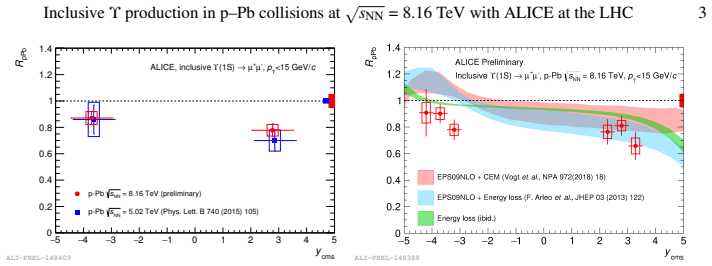
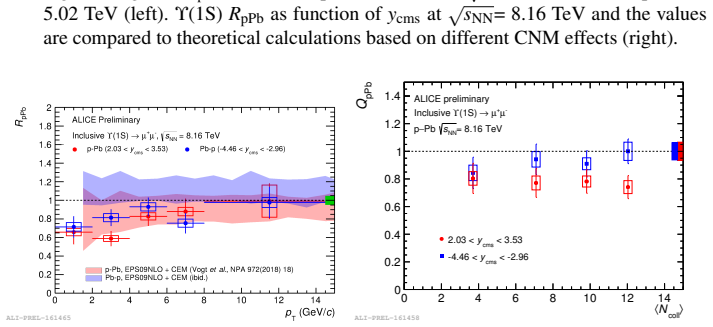
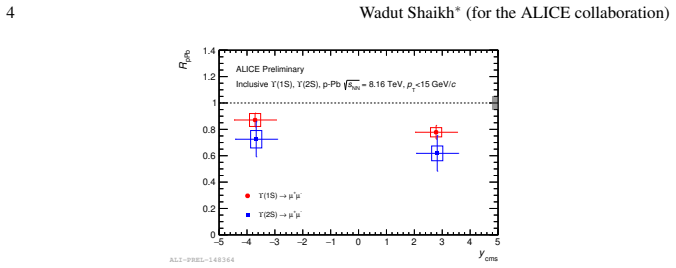
At forward rapidity, Υ(1S) production in p-Pb collisions is suppressed compared with the binary-scaled pp reference in the same kinematic range, whereas at backward rapidity no significant suppression or enhancement is observed within uncertainties. The rapidity, pT and centrality dependence at 8.16 TeV is consistent with the pattern measured at 5.02 TeV. Υ(2S) exhibits stronger integrated suppression than Υ(1S).
What carries the argument
The nuclear modification factor R_pPb, formed as the ratio of the measured p-Pb yield to the binary-collision-scaled pp reference yield, which isolates deviations attributable to cold nuclear matter.
If this is right
- The forward-backward asymmetry in R_pPb constrains the magnitude of nuclear shadowing or coherent energy loss acting on bottomonium.
- Agreement between the 8.16 TeV and 5.02 TeV data sets indicates that the cold nuclear matter effects vary only weakly with collision energy in this range.
- The stronger suppression observed for Υ(2S) relative to Υ(1S) implies that binding-energy differences or final-state interactions affect the two states differently.
- Model comparisons as functions of y_cms and pT can be used to extract constraints on nuclear parton distribution functions.
Where Pith is reading between the lines
- If the suppression originates from nuclear PDFs, analogous patterns should appear in other heavy-flavor observables measured in the same rapidity window.
- Extending the measurement to higher pT could test whether the effect weakens once the quarkonium momentum exceeds typical nuclear scales.
- Direct comparison of these p-Pb results with Pb-Pb data at similar energies would help isolate additional hot-medium contributions.
Load-bearing premise
That the pp reference data can be scaled directly by the number of binary collisions without residual nuclear modifications or unaccounted experimental biases in acceptance, efficiency or luminosity.
What would settle it
A high-statistics forward-rapidity measurement in which the p-Pb yield matches the binary-scaled pp reference within a few percent would falsify the reported suppression.
Figures
read the original abstract
In order to disentangle CNM effects from the ``hot'' QGP effects, quarkonium production is studied in p--Pb collisions in which QGP formation is not expected. ALICE has measured the $\Upsilon$ production in p--Pb collisions at $\sqrt{s_{\rm NN}}$ = 5.02 TeV at backward ($-$4.46 $<y_{\rm cms}<$ $-$2.96) and forward (2.03 $< y_{\rm cms}<$ 3.53) rapidity down to zero transverse momentum. At forward rapidity, a suppression of $\Upsilon$(1S) production in p--Pb collisions is observed compared to the binary-scaled yield in pp collisions in the same kinematic domain while at backward rapidity no significant suppression or enhancement is found within the experimental uncertainties. In 2016, the LHC delivered p--Pb collisions at $\sqrt{s_{\rm NN}}$ = 8.16 TeV with higher integrated luminosity compared to the data collected at $\sqrt{s_{\rm NN}}$ = 5.02 TeV, which allowed a more detailed study of the bottomonium production in p--Pb collisions. We report on the inclusive $\Upsilon$(1S) production as a function of rapidity, transverse momentum ($p_{\rm T}$) and centrality of the collision and compare the results with those obtained at $\sqrt{s_{\rm NN}}$ = 5.02 TeV. Theoretical model predictions as a function of $y_{\rm cms}$ and $p_{\rm T}$ are also discussed. The results of $\Upsilon$(2S) suppression integrated over $y_{\rm cms}$, $p_{\rm T}$ and centrality are also reported and compared to the corresponding $\Upsilon$(1S) measurement.
Editorial analysis
A structured set of objections, weighed in public.
Referee Report
Summary. The manuscript reports measurements of inclusive Υ(1S) production in p-Pb collisions at √s_NN = 8.16 TeV with ALICE. The nuclear modification factor R_pPb is presented versus rapidity, p_T and centrality, showing suppression at forward rapidity relative to binary-scaled pp yields while remaining consistent with unity at backward rapidity within uncertainties. Results are compared to the 5.02 TeV data set and to theoretical models; integrated Υ(2S) suppression relative to Υ(1S) is also reported.
Significance. If the measurements hold, the higher-luminosity 8.16 TeV data set supplies differential constraints on cold-nuclear-matter effects for bottomonium that are directly relevant to the interpretation of Pb-Pb quarkonium suppression. The p_T, centrality and energy-dependence comparisons, together with the Υ(2S)/Υ(1S) ratio, strengthen the experimental input available to nuclear-PDF and energy-loss models.
major comments (1)
- [Results section (comparison to pp reference)] The central claim rests on the comparison of the p-Pb yield to a binary-scaled pp reference at the same √s_NN = 8.16 TeV. The manuscript must explicitly state (in the results or analysis section) the origin of the pp cross-section (direct measurement, interpolation, or extrapolation), the functional form used, and the size of the associated uncertainty; without this information the quoted R_pPb values cannot be fully assessed.
minor comments (2)
- [Abstract] The abstract would be more informative if it quoted at least the integrated R_pPb values (with statistical and systematic uncertainties) at forward and backward rapidity.
- [Figures and captions] Figure captions and axis labels should consistently indicate whether the pp reference is evaluated at exactly 8.16 TeV or interpolated; any interpolation uncertainty should appear in the systematic-uncertainty breakdown.
Simulated Author's Rebuttal
We thank the referee for the positive evaluation and the constructive comment. We address the single major comment below and will revise the manuscript to incorporate the requested clarification.
read point-by-point responses
-
Referee: [Results section (comparison to pp reference)] The central claim rests on the comparison of the p-Pb yield to a binary-scaled pp reference at the same √s_NN = 8.16 TeV. The manuscript must explicitly state (in the results or analysis section) the origin of the pp cross-section (direct measurement, interpolation, or extrapolation), the functional form used, and the size of the associated uncertainty; without this information the quoted R_pPb values cannot be fully assessed.
Authors: We agree that the origin, method, and uncertainty of the pp reference cross section must be stated explicitly for full assessment of the R_pPb results. In the revised manuscript we will add a concise paragraph in the results section (and cross-reference the analysis section) specifying that the √s = 8.16 TeV pp cross section is obtained by interpolation of LHCb data at nearby energies, the functional form employed, and the numerical size of the associated uncertainty. revision: yes
Circularity Check
No significant circularity in experimental measurement
full rationale
This is a standard experimental paper reporting inclusive Υ(1S) yields and nuclear modification factors R_pPb from ALICE p-Pb data at 8.16 TeV. The central results are obtained via direct reconstruction, efficiency/acceptance corrections, and comparison to external pp reference data using the conventional binary-collision scaling definition of R_pPb. No load-bearing derivations, parameter fits, or self-citation chains reduce the reported suppression (or lack thereof) to inputs by construction. External benchmarks (pp data, models) are independent of the present dataset. Score 0 is the appropriate finding for a self-contained experimental report.
Axiom & Free-Parameter Ledger
Lean theorems connected to this paper
-
IndisputableMonolith/Foundation/RealityFromDistinction.leanreality_from_one_distinction unclear?
unclearRelation between the paper passage and the cited Recognition theorem.
RpPb = NΥ / (⟨TpPb⟩ × A×ε × NMB × BR × σppΥ) … measured RpPb values indicate Υ(1S) suppression … compared to NLO CEM with EPS09 and parton energy-loss models
-
IndisputableMonolith/Cost/FunctionalEquation.leanwashburn_uniqueness_aczel unclear?
unclearRelation between the paper passage and the cited Recognition theorem.
The results of Υ(2S) suppression integrated over ycms, pT and centrality … compatible within 1σ
What do these tags mean?
- matches
- The paper's claim is directly supported by a theorem in the formal canon.
- supports
- The theorem supports part of the paper's argument, but the paper may add assumptions or extra steps.
- extends
- The paper goes beyond the formal theorem; the theorem is a base layer rather than the whole result.
- uses
- The paper appears to rely on the theorem as machinery.
- contradicts
- The paper's claim conflicts with a theorem or certificate in the canon.
- unclear
- Pith found a possible connection, but the passage is too broad, indirect, or ambiguous to say the theorem truly supports the claim.
Reference graph
Works this paper leans on
- [1]
-
[2]
ALICE Collaboration, Phys. Lett. B 740 (2015) 105
work page 2015
-
[3]
Particle Data Group Collaboration, Chin. Phys. C40 (2016) 100001
work page 2016
-
[4]
LHCb Collaboration, EPJC 74 (2014) 2835, JHEP 11 (2015) 103
work page 2014
-
[5]
ALICE Collaboration, CERN-ALICE-PUBLIC-2018-008
work page 2018
-
[6]
ALICE Collaboration, JHEP 11 (2015) 127
work page 2015
-
[7]
ALICE Collaboration, CERN-ALICE-PUBLIC-2017-007
work page 2017
- [8]
-
[9]
J. L. Albacete et al., Nucl. Phys. A972 (2018) 18
work page 2018
- [10]
-
[11]
CMS Collaboration, JHEP 04 (2014) 103
work page 2014
-
[12]
ATLAS Collaboration, EPJC 78 (2018) 1717
work page 2018
-
[13]
LHCb Collaboration, JHEP 11 (2018) 194
work page 2018
discussion (0)
Sign in with ORCID, Apple, or X to comment. Anyone can read and Pith papers without signing in.