Thermoacoustic Tomography with Circular Integrating Detectors and Variable Wave Speed
Pith reviewed 2026-05-25 11:28 UTC · model grok-4.3
The pith
The measurement operator in thermoacoustic tomography with circular integrating detectors and variable wave speed is a Fourier integral operator whose canonical relation determines visible singularities from partial data.
A machine-rendered reading of the paper's core claim, the machinery that carries it, and where it could break.
Core claim
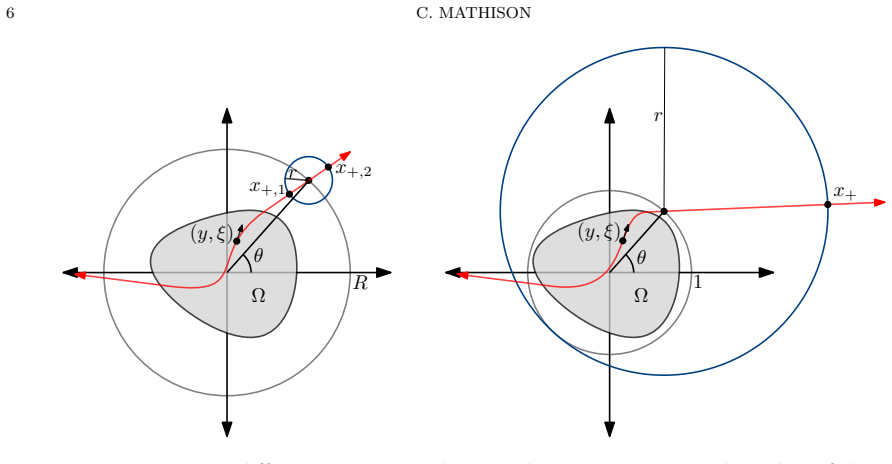
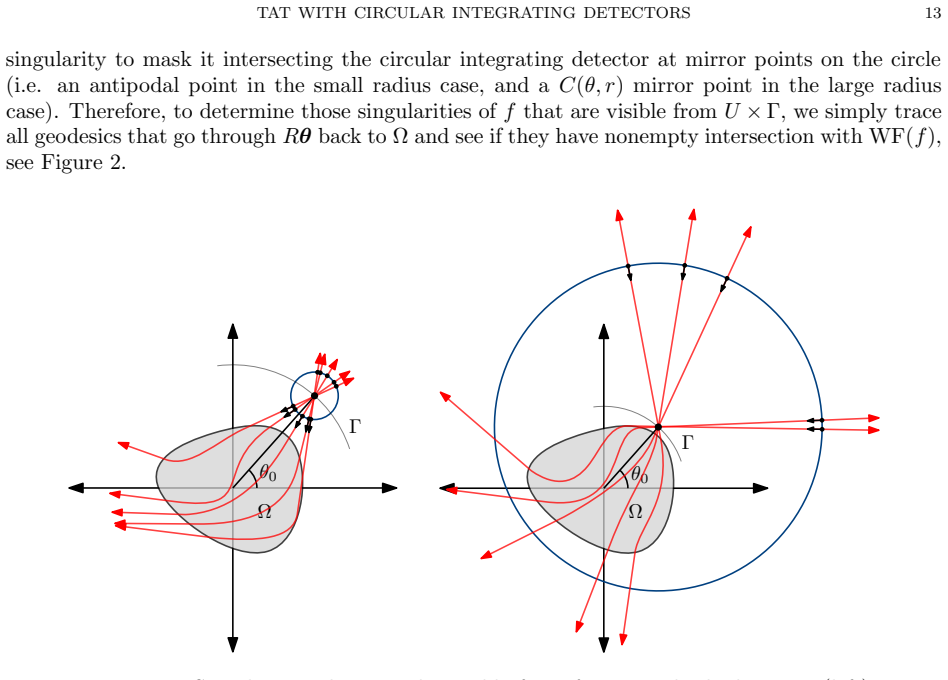
We show that the measurement operator in this case is a Fourier Integral Operator and examine how the singularities in initial data and measured data are related through the canonical relation of this operator. We prove which of those singularities in the initial data are visible from a fixed open subset of the set on which measurements are taken.
What carries the argument
The canonical relation of the Fourier integral operator defined by the circular-integrating measurement operator, which encodes the propagation of wavefront sets from initial pressure to detector signals.
If this is right
- Singularities whose covectors lie in the image of the canonical relation are stably recoverable from any open subset of the detector circle.
- Singularities outside that image produce no visible trace in the measurements and cannot be recovered from partial data.
- The same operator analysis applies to both full-circle and limited-arc data sets.
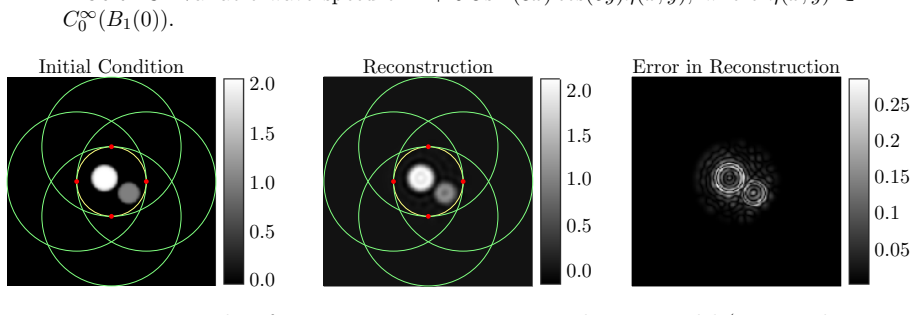
- Numerical reconstructions of visible singularities match the microlocal predictions for variable wave speeds.
Where Pith is reading between the lines
- The same canonical-relation method could be applied to other detector geometries whose measurement operators remain Fourier integral operators.
- If the wave speed loses smoothness, the operator may cease to be an FIO and the visibility classification would require different tools.
Load-bearing premise
The wave speed is known, smooth, and positive so that the wave equation admits a well-defined propagation of singularities that can be analyzed via standard microlocal techniques for Fourier Integral Operators.
What would settle it
A concrete initial pressure with a wavefront whose image under the canonical relation lies outside the measured wavefront set, yet appears in the actual measurements from an open detector arc, would falsify the visibility statement.
Figures
read the original abstract
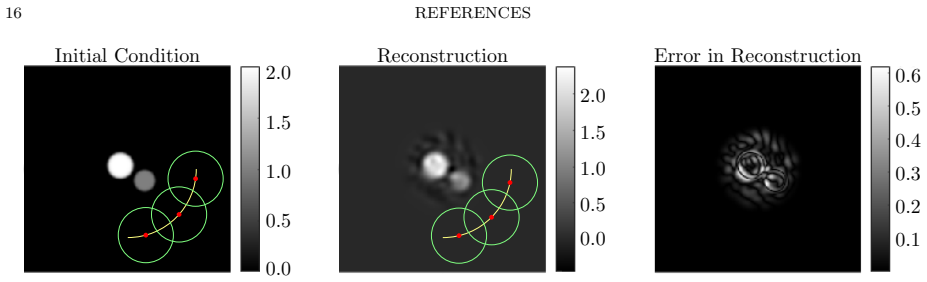
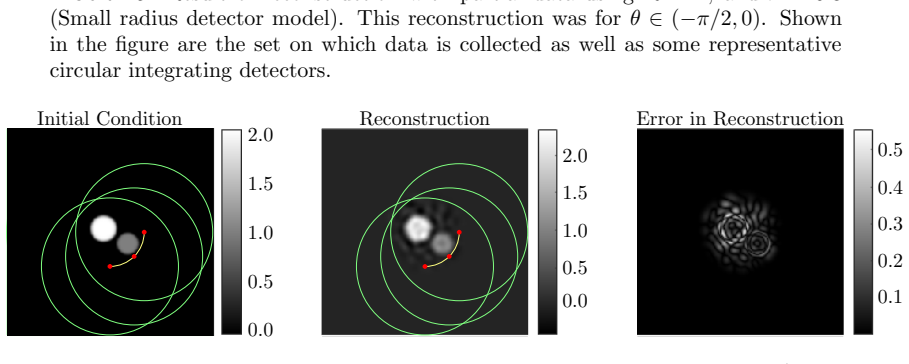
We explore Thermoacoustic Tomography with circular integrating detectors assuming variable, smooth wave speed. We show that the measurement operator in this case is a Fourier Integral Operator and examine how the singularities in initial data and measured data are related through the canonical relation of this operator. We prove which of those singularities in the initial data are visible from a fixed open subset of the set on which measurements are taken. In addition, numerical results are shown for both full and partial data.
Editorial analysis
A structured set of objections, weighed in public.
Referee Report
Summary. The manuscript studies thermoacoustic tomography with circular integrating detectors in the presence of a known, smooth, positive variable wave speed. It establishes that the measurement operator (solution of the wave equation composed with circular integration) is a Fourier integral operator, determines the canonical relation that maps singularities of the initial pressure to singularities in the data, proves a visibility criterion identifying which initial-data singularities are stably recoverable from measurements on a fixed open subset of the detector surface, and presents numerical reconstructions for both full and partial data.
Significance. If the central claims hold, the work supplies a precise microlocal description of visible and invisible singularities for a detector geometry that is experimentally relevant yet analytically non-standard. The combination of an FIO analysis with explicit visibility statements and numerical illustrations for variable-speed media is a concrete contribution to the TAT literature; the numerical experiments constitute a verifiable check on the theoretical predictions.
minor comments (3)
- The statement of the main visibility theorem (presumably Theorem 3.4 or its analogue) should explicitly list the geometric assumptions on the open measurement set relative to the bicharacteristic flow; the current wording leaves the precise non-trapping condition implicit.
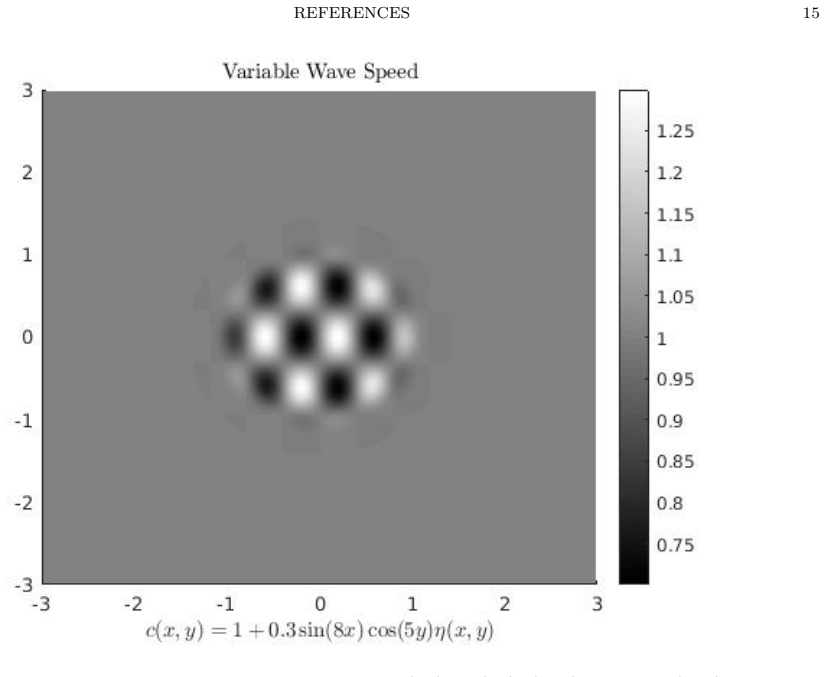
- In the numerical section, the captions and text should state the precise form of the variable wave speed used in each experiment and whether the same speed is employed for both forward simulation and reconstruction.
- Notation for the circular integration operator (radius, center parametrization) is introduced without a dedicated display equation; adding one would improve readability when the canonical relation is later computed.
Simulated Author's Rebuttal
We thank the referee for the positive assessment of our manuscript on thermoacoustic tomography with circular integrating detectors and variable wave speed. The referee's summary accurately reflects the main results: the measurement operator is shown to be an FIO, its canonical relation is determined, a visibility criterion is proved for singularities from a fixed open subset of measurements, and numerical examples are provided. We appreciate the recommendation for minor revision.
Circularity Check
No significant circularity; standard FIO analysis
full rationale
The central claim applies the standard theory of Fourier Integral Operators to the wave equation (with smooth positive speed) composed with circular integration. The visibility of singularities follows from the canonical relation in the usual way; no step reduces by definition to a fitted parameter, self-citation chain, or ansatz smuggled from prior work by the same author. The argument is self-contained against external microlocal analysis benchmarks.
Axiom & Free-Parameter Ledger
axioms (2)
- domain assumption The wave speed c(x) is smooth and strictly positive.
- standard math Standard composition and canonical-relation calculus for Fourier Integral Operators applies to the measurement operator.
Reference graph
Works this paper leans on
-
[1]
Efficient PML for the wave equation
Marcus J Grote and Imbo Sim. “Efficient PML for the wave equation”. In: arXiv preprint arXiv:1001.0319 (2010)
work page internal anchor Pith review Pith/arXiv arXiv 2010
-
[2]
Thermoacoustic computed tomography with large planar receivers
M Haltmeier. “Thermoacoustic computed tomography with large planar receivers”. eng. In: Inverse Problems 20.5 (2004), pp. 1663–1673. issn: 0266-5611
work page 2004
-
[3]
Lars H¨ ormander. “Fourier integral operators. I”. In: Acta Math. 127 (1971), pp. 79–183. doi: 10.1007/BF02392052
-
[4]
The analysis of linear partial differential operators IV: Fourier integral operators
Lars H¨ ormander. The analysis of linear partial differential operators IV: Fourier integral operators. Springer, 2009. REFERENCES 15 Figure 3. Variable wave speed of 1 + 0 .3 sin(8x) cos(5y)η(x,y ), where η(x,y )∈ C∞ 0 (B1(0)). Initial Condition Reconstruction Error in Reconstruction 2.0 1.5 1.0 0.5 0.0 2.0 1.5 1.0 0.5 0.0 0.25 0.2 0.15 0.1 0.05 Figure 4...
work page 2009
-
[5]
Thermoacoustic computed tomography using a conventional linear transducer array
Robert A. Kruger et al. “Thermoacoustic computed tomography using a conventional linear transducer array”. In: Medical Physics 30.5 (2003), pp. 856–860. issn: 0094-2405
work page 2003
-
[6]
Mathematics of thermoacoustic tomography
Peter Kuchment and Leonid Kunyansky. “Mathematics of thermoacoustic tomography”. In: European Journal of Applied Mathematics 19.2 (2008), pp. 191–224. issn: 0956-7925
work page 2008
-
[7]
Laser-based optoacoustic imaging in biological tissues
Alexander A Oraevsky et al. “Laser-based optoacoustic imaging in biological tissues”. In: Laser-Tissue Interaction V; and Ultraviolet Radiation Hazards . Vol. 2134. International So- ciety for Optics and Photonics. 1994, pp. 122–129. 16 REFERENCES 0.6 0.5 0.4 0.3 0.2 0.1 2.0 1.5 1.0 0.5 0.0 2.0 1.5 1.0 0.5 0.0 Initial Condition Reconstruction Error in Rec...
work page 1994
-
[8]
Radon Transforms on Curves in the Plane
Eric Quinto. “Radon Transforms on Curves in the Plane”. eng. In: Tomography, impedance imaging, and integral geometry : 1993 AMS-SIAM Summer Seminar on the Mathematics of Tomography, Impedance Imaging, and Integral Geometry, June 7-18, 1993, Mount Holyoke College, Massachusetts (1994)
work page 1993
-
[9]
Thermoacoustic tomography with variable sound speed
Plamen Stefanov and Gunther Uhlmann. “Thermoacoustic tomography with variable sound speed”. In: Inverse Problems 25.7 (2009), p. 075011
work page 2009
-
[10]
Thermo- and Photoacoustic Tomography with Variable Speed and Planar Detectors
Plamen Stefanov and Yang Yang. “Thermo- and Photoacoustic Tomography with Variable Speed and Planar Detectors”. In: SIAM Journal on Mathematical Analysis 49.1 (2017), pp. 297–310. doi: 10.1137/16M1073716
-
[11]
Geometrical Optics and Fourier Integral Operators
Michael E. Taylor. “Geometrical Optics and Fourier Integral Operators”. In: Pseudodifferen- tial Operators (PMS-34). Princeton University Press, 1981, pp. 146–191
work page 1981
-
[12]
Photoacoustic imaging in biomedicine
Minghua Xu and Lihong V. Wang. “Photoacoustic imaging in biomedicine”. eng. In: Review of Scientific Instruments 77.4 (2006). issn: 0034-6748
work page 2006
-
[13]
Circular integrating detectors in photo and thermoacoustic tomography
Gerhard Zangerl, Otmar Scherzer, and Markus Haltmeier. “Circular integrating detectors in photo and thermoacoustic tomography”. In: 17.1 (2009), pp. 133–142. issn: 1741-5977. REFERENCES 17
work page 2009
-
[14]
Exact series reconstruction in photoacoustic tomography with circular integrating detectors
Gerhard Zangerl, Otmar Scherzer, Markus Haltmeier, et al. “Exact series reconstruction in photoacoustic tomography with circular integrating detectors”. In: Communications in Math- ematical Sciences 7.3 (2009), pp. 665–678. Department of Mathematics, Purdue University, West Lafayette, IN 47907
work page 2009
discussion (0)
Sign in with ORCID, Apple, or X to comment. Anyone can read and Pith papers without signing in.