Modelling the electron cyclotron emission below the fundamental resonance in ITER
Pith reviewed 2026-05-25 02:07 UTC · model grok-4.3
The pith
Ensemble ray tracing through randomized wall reflections predicts X-mode ECE below 100 eV below 70 GHz in ITER baseline plasma but keV levels in hybrid scenarios.
A machine-rendered reading of the paper's core claim, the machinery that carries it, and where it could break.
Core claim
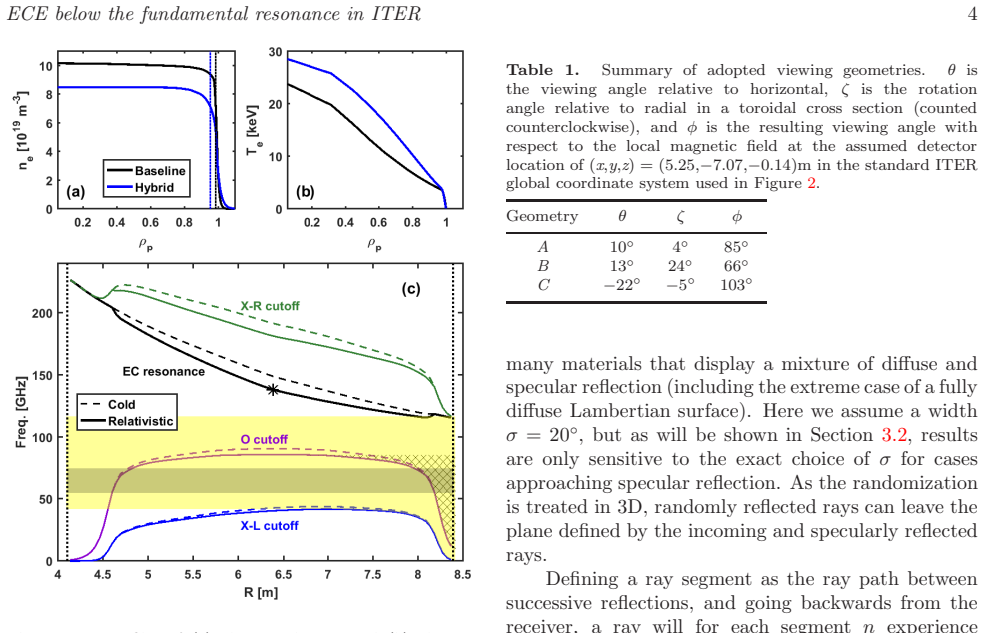
By ensemble-averaging rays traced through randomized wall reflections, ECE spectra can be estimated in the optically thin regime below the fundamental resonance. For ITER, this yields X-mode levels below 100 eV at frequencies smaller than 70 GHz in the baseline plasma scenario, while corresponding intensities reach keV levels in the hotter hybrid plasma scenario. The method shows good agreement with the SPECE raytracing code and produces X-mode to O-mode conversion strengths consistent with estimates from existing fusion devices.
What carries the argument
Ensemble-averaging of rays traced through many randomized wall reflections, which captures the vacuum vessel geometry, multiple reflections, and cross-polarization changes.
If this is right
- ECE levels increase strongly with frequency and plasma temperature in the 55-75 GHz range.
- X-mode ECE remains below 100 eV below 70 GHz in the ITER baseline scenario.
- Intensities reach keV levels in the hotter hybrid plasma scenario.
- The strength of X-mode to O-mode conversion induced by wall reflections is consistent with estimates from existing devices.
- Benchmarking shows good agreement with the SPECE raytracing code under relevant conditions.
Where Pith is reading between the lines
- The framework could be used to estimate interference levels in specific channels of ITER microwave diagnostics.
- The statistical uncertainty from the ensemble averaging offers a built-in way to evaluate reliability of background predictions.
- Applying the same randomized-reflection approach to other tokamaks could show how vessel shape affects low-frequency ECE.
- If wall reflection properties vary more than assumed, the predicted mode conversion rates could shift.
Load-bearing premise
Ensemble-averaging of rays through randomized wall reflections sufficiently captures the effects of overall vessel geometry, multiple reflections, and cross-polarization changes without needing detailed surface property modeling.
What would settle it
Direct measurement of X-mode ECE intensity at 60 GHz in an ITER baseline-like plasma that yields values significantly above 100 eV (or much below keV in a hybrid scenario) would contradict the predictions.
Figures


read the original abstract
The electron cyclotron emission (ECE) in fusion devices is non-trivial to model in detail at frequencies well below the fundamental resonance where the plasma is optically thin. However, doing so is important for evaluating the background for microwave diagnostics operating in this frequency range. Here we present a general framework for estimating the ECE levels of fusion plasmas at such frequencies using ensemble-averaging of rays traced through many randomized wall reflections. This enables us to account for the overall vacuum vessel geometry, self-consistently include cross-polarization, and quantify the statistical uncertainty on the resulting ECE spectra. Applying this to ITER conditions, we find simulated ECE levels that increase strongly with frequency and plasma temperature in the considered range of 55-75 GHz. At frequencies smaller than 70 GHz, we predict an X-mode ECE level below 100 eV in the ITER baseline plasma scenario, but with corresponding intensities reaching keV levels in the hotter hybrid plasma scenario. Benchmarking against the SPECE raytracing code reveals good agreement under relevant conditions, and the predicted strength of X-mode to O-mode conversion induced by wall reflections is consistent with estimates from existing fusion devices. We discuss possible implications of our findings for ITER microwave diagnostics such as ECE, reflectometry, and collective Thomson scattering.
Editorial analysis
A structured set of objections, weighed in public.
Referee Report
Summary. The paper develops a ray-tracing framework for estimating electron cyclotron emission (ECE) at frequencies well below the fundamental resonance (55-75 GHz) in optically thin ITER plasmas. It employs ensemble averaging over many randomized wall reflections to incorporate overall vacuum vessel geometry, multiple bounces, and cross-polarization scrambling, while quantifying statistical uncertainty. Applied to ITER baseline and hybrid scenarios, the work predicts X-mode ECE levels below 100 eV for frequencies <70 GHz in the baseline case but reaching keV levels in the hotter hybrid case. The approach is benchmarked against the SPECE code with reported good agreement, and the modeled X-to-O conversion strength is stated to be consistent with existing devices. Implications for ITER diagnostics (ECE, reflectometry, CTS) are discussed.
Significance. If validated, the framework supplies quantitative background estimates needed for microwave diagnostics in the optically thin regime, where standard optically thick approximations fail. The ability to include statistical uncertainty and self-consistent cross-polarization via randomized reflections is a practical strength, and the reported agreement with an independent code (SPECE) under relevant conditions lends support to the central predictions. The scenario-dependent contrast (baseline vs. hybrid) is potentially useful for diagnostic design.
major comments (1)
- [Abstract / modeling framework description] The quantitative claims (X-mode ECE <100 eV below 70 GHz in baseline; keV levels in hybrid) rest directly on the assumption, stated in the abstract, that ensemble averaging over randomized wall reflections adequately reproduces the net effect of ITER vacuum-vessel geometry, multiple bounces, and polarization scrambling without explicit surface-property modeling. In the optically thin limit the effective emissivity integrates over long paths, so any systematic bias in the reflection operator propagates into the intensity. The manuscript reports statistical uncertainty from the ensemble and good agreement with SPECE, but does not demonstrate convergence against deterministic tracing through the actual ITER CAD geometry with measured wall reflectivities or angle-dependent polarization conversion.
minor comments (2)
- [Abstract] The abstract states the central predictions but supplies no plasma-parameter inputs, reflection-model details, or error-propagation information, making independent verification of the numerical results difficult.
- [Abstract] Notation for polarization modes (X-mode, O-mode) and frequency ranges should be defined at first use for readers outside the immediate sub-field.
Simulated Author's Rebuttal
We thank the referee for the careful review and the constructive comment on the modeling assumptions. We respond to the major comment below.
read point-by-point responses
-
Referee: The quantitative claims (X-mode ECE <100 eV below 70 GHz in baseline; keV levels in hybrid) rest directly on the assumption, stated in the abstract, that ensemble averaging over randomized wall reflections adequately reproduces the net effect of ITER vacuum-vessel geometry, multiple bounces, and polarization scrambling without explicit surface-property modeling. In the optically thin limit the effective emissivity integrates over long paths, so any systematic bias in the reflection operator propagates into the intensity. The manuscript reports statistical uncertainty from the ensemble and good agreement with SPECE, but does not demonstrate convergence against deterministic tracing through the actual ITER CAD geometry with measured wall reflectivities or angle-dependent polarization conversion.
Authors: We agree that the quantitative predictions depend on the validity of the randomized reflection operator as a representation of the net effect of the vessel geometry and multiple bounces. The ensemble approach was developed specifically to capture the statistical average behavior and polarization scrambling without requiring explicit surface-property data, which are not available in sufficient detail for ITER. Convergence of the ensemble-averaged intensities with respect to the number of realizations is demonstrated in the manuscript, and the reported statistical uncertainty quantifies the variability inherent to the randomization. The good agreement obtained with the independent SPECE code under comparable conditions provides supporting evidence that the results are not strongly sensitive to the precise implementation of the reflection model. A direct benchmark against deterministic ray tracing through the full ITER CAD geometry with measured, angle-dependent reflectivities would be a valuable additional validation step. However, the required wall-property data are not publicly available, and the computational cost of such a deterministic calculation for the optically thin, multi-bounce regime is prohibitive within the scope of the present work. We will revise the manuscript to include an expanded discussion of these modeling assumptions and limitations. revision: partial
Circularity Check
No significant circularity detected
full rationale
The derivation relies on a forward ray-tracing simulation with ensemble averaging over randomized reflections to compute ECE spectra from given plasma profiles and vessel geometry. This is benchmarked against the independent SPECE code and produces predictions for specific ITER scenarios without any fitted parameters drawn from the target ECE data itself or self-referential definitions. No load-bearing step reduces to a self-citation chain, ansatz smuggled via prior work, or renaming of known results; the central quantitative claims follow directly from the described computational procedure.
Axiom & Free-Parameter Ledger
axioms (2)
- domain assumption The plasma is optically thin at frequencies well below the fundamental resonance
- ad hoc to paper Randomized wall reflections adequately represent multiple bounces and polarization scrambling
Reference graph
Works this paper leans on
- [1]
- [2]
-
[3]
et al 2016 High power microwave di- agnostic for the fusion energy experiment ITER Conf
Korsholm S.B. et al 2016 High power microwave di- agnostic for the fusion energy experiment ITER Conf. Proc. for 41st Int. Conf. on Infrared, Mil- limeter and Terahertz Waves (IRMMW-THz) (https://ieeexplore.ieee.org/abstract/document/7758537/)
- [4]
- [5]
- [6]
- [7]
- [8]
- [9]
- [10]
- [11]
- [12]
-
[13]
Sillen R.M.J., Allaart M.A.F., Goedheer W.J. and Katte n- berg A. 1987 Rijnhuizen Report 86–165, FOM Institute for Plasma Physics, Nieuwegein, The Netherlands
work page 1987
- [14]
- [15]
- [16]
- [17]
- [18]
-
[19]
I. Fidone I., Giruzzi G. and Granata G. 1996 Phys. Plasmas 3 1612
work page 1996
-
[20]
1966 Radiation Processes in Plasmas (Wiley, Ne w York)
Bekefi G. 1966 Radiation Processes in Plasmas (Wiley, Ne w York)
work page 1966
-
[21]
Hartfuß H.-J. and Geist T. 2013 Fusion Plasma Diagnosti cs with mm-W aves (W einheim: Wiley-VCH Verlag)
work page 2013
- [22]
- [23]
-
[24]
Shkarofsky I.P. 1986 J. Plasma Phys. 35 319
work page 1986
- [25]
-
[26]
Stejner M. 2017 Summary report on the benchmarking of ray tracing and beam tracing software codes, ITER IDM document ID ITER D VFXWH8 v1.0 Technical Report https://user.iter.org/?uid=VFXWH8
work page 2017
- [27]
- [28]
- [29]
-
[30]
Pinches S. et al 2018 Progress in the ITER Integrated Modelling Programme and the ITER Scenario Database Preprint: 2018 IAEA Fusion Energy Conf. (Gandhina- gar, India) [TH/P6-7]
work page 2018
-
[31]
David E. 2015 Poloidal curves coordinates, ITER IDM document ID ITER D 2N9J75 v1.7 Technical Report https://user.iter.org/?uid=2N9J75
work page 2015
- [32]
- [33]
- [34]
-
[35]
et al 2015 Evaluation of EC stray radiation in ITER and its implication for diagnostics Proc
Sirinelli A. et al 2015 Evaluation of EC stray radiation in ITER and its implication for diagnostics Proc. of 1st EPS conference on Plasma Diagnostics (ECPD2015) , https://pos.sissa.it/cgi-bin/reader/conf.cgi?confid=240
work page 2015
-
[36]
et al 2012 in 6th European Conference on Antennas and Propaga- tion (EUCAP) , Prague, 2012, pp
Kasparek W. et al 2012 in 6th European Conference on Antennas and Propaga- tion (EUCAP) , Prague, 2012, pp. 585–589 (https://ieeexplore.ieee.org/document/6206543/)
- [37]
- [38]
- [39]
- [40]
- [41]
- [42]
-
[43]
Austin M.E., Ellis R.F. and Luce T.C. 1997 Proc. Of The 10th Joint Workshop On Electron Cyclotron Emission and Electron Cyclotron Heating , eds. T. Donne, T. Verhoeven (Singapore: W orld Scientific Publishing) p. 249 ECE below the fundamental resonance in ITER 16
work page 1997
- [44]
- [45]
- [46]
- [47]
- [48]
- [49]
- [50]
- [51]
-
[52]
Heidbrink W.W. et al 2007 Plasma Phys. Control. Fusion 49 1457
work page 2007
- [53]
-
[54]
2002 Principles of Plasma Diagnostics , 2nd ed., (Cambridge: Cambridge University Press)
Hutchinson I.H. 2002 Principles of Plasma Diagnostics , 2nd ed., (Cambridge: Cambridge University Press)
work page 2002
- [55]
- [56]
-
[57]
Bindslev H. 1992 On the Theory of Thomson Scattering and Reflectometry in a Relativistic Magnetized Plasma PhD Thesis Risø National Laboratory, Roskilde, Denmark, Risø-R-663
work page 1992
- [58]
- [59]
- [60]
discussion (0)
Sign in with ORCID, Apple, or X to comment. Anyone can read and Pith papers without signing in.