Electromagnetic Formalism of the Propagation and Amplification of Light
Pith reviewed 2026-05-24 21:20 UTC · model grok-4.3
The pith
The linear electromagnetic wave equation in dielectrics yields all standard results on pulse propagation, group velocity, and laser amplification.
A machine-rendered reading of the paper's core claim, the machinery that carries it, and where it could break.
Core claim
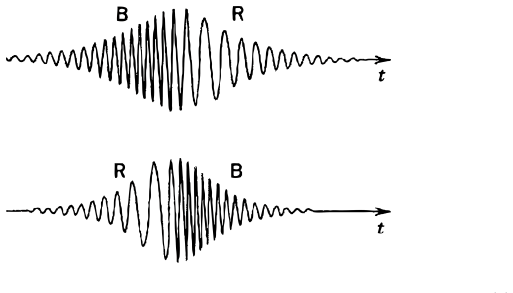
Beginning from the linear wave equation with a frequency-dependent susceptibility, the propagation constant determines both the phase velocity and the group velocity of the pulse envelope; in regions of anomalous dispersion the group velocity can exceed c or become negative while the underlying information transfer remains causal; the same formalism, when the susceptibility includes gain, produces the threshold condition for oscillation in an active cavity.
What carries the argument
The linear electromagnetic wave equation in Fourier space with complex susceptibility, which supplies the dispersion relation and the envelope propagation equation.
If this is right
- Group velocity governs envelope motion but does not transmit information faster than c.
- Superluminal or negative group velocities appear naturally in anomalous-dispersion regions without violating causality.
- Laser oscillation occurs when the round-trip gain from the imaginary part of the susceptibility exceeds cavity losses.
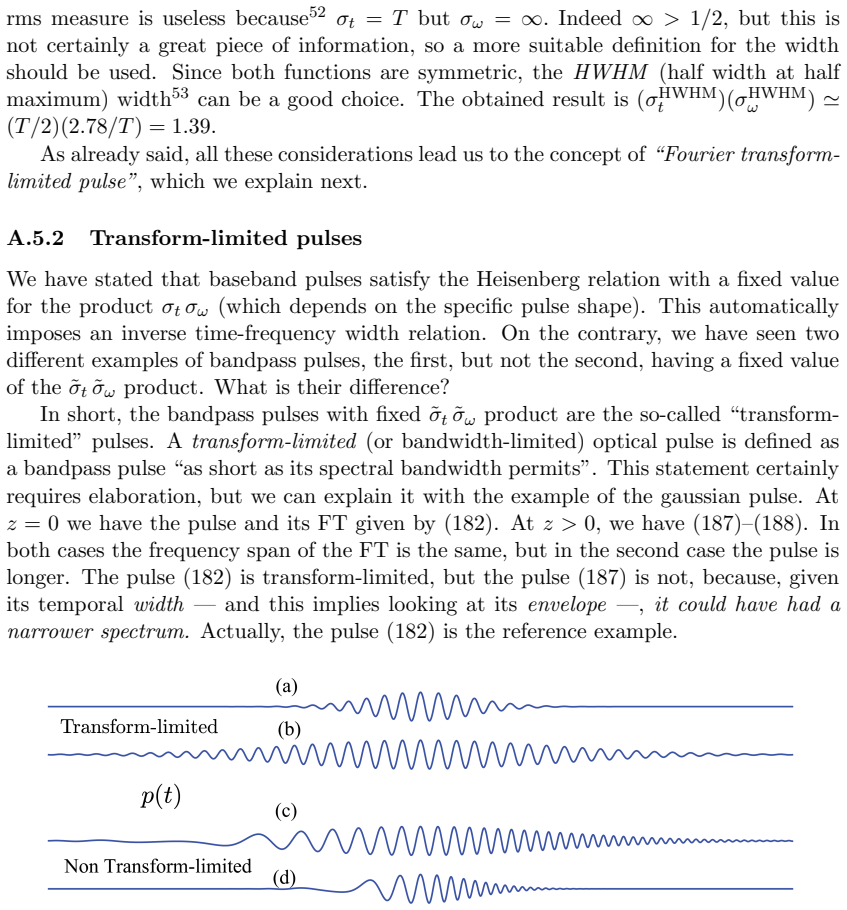
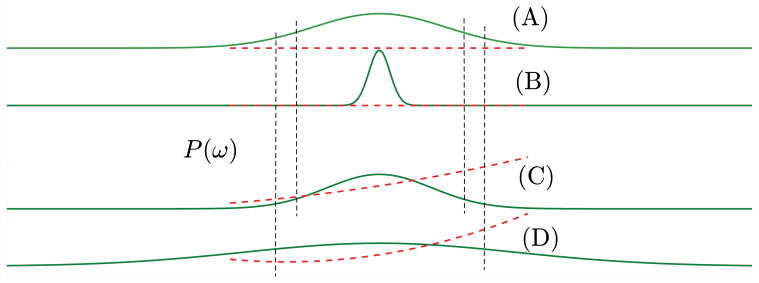
- Transform-limited pulses achieve the shortest duration allowed by their spectral width.
Where Pith is reading between the lines
- The same starting equation could be used to compare pulse behavior across different linear media such as fibers and gases.
- The derivation supplies a baseline against which weakly nonlinear corrections can be added perturbatively.
- Similar envelope equations appear in other linear wave systems, suggesting the formalism transfers to acoustic or matter-wave pulses.
Load-bearing premise
The medium response is taken to be linear, local in time, and fully characterized by a frequency-dependent susceptibility without nonlinear or nonlocal corrections.
What would settle it
An experiment that measures a pulse envelope velocity in a linear dielectric that deviates from the value predicted by the real part of the wave number at the carrier frequency.
Figures
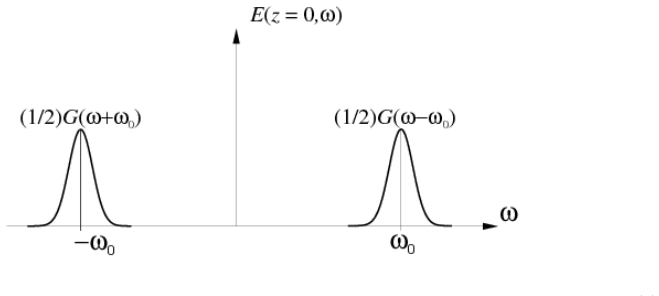
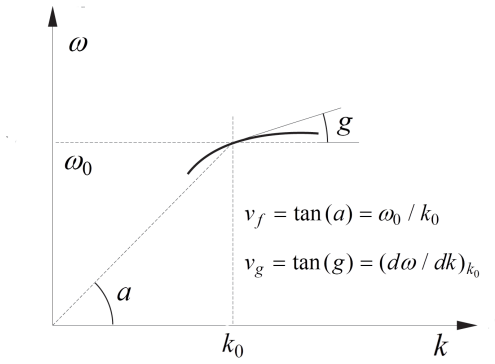
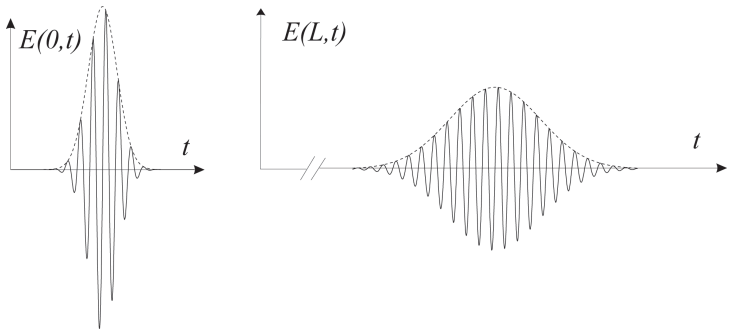
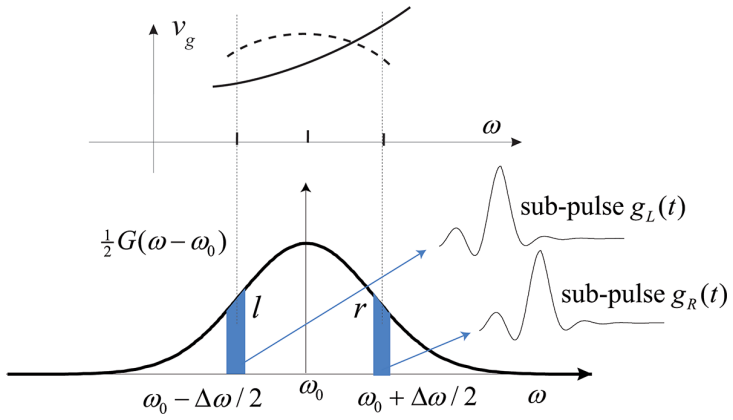
read the original abstract
In this work, we present a simplified but comprehensive derivation of all the key concepts and main results concerning light pulse propagation in dielectric media, including a brief extension to the case of active media and laser oscillation. Clarifications of the concepts of slow light and "superluminality" are provided, and a detailed discussion on the concept of transform-limited pulses is also included in the Appendix.
Editorial analysis
A structured set of objections, weighed in public.
Referee Report
Summary. The manuscript presents a simplified but comprehensive derivation, starting from the linear electromagnetic wave equation, of the principal results on light pulse propagation in dielectric media. This includes group velocity, envelope propagation, slow light, apparent superluminality, transform-limited pulses (detailed in an appendix), together with a brief extension to active media and laser oscillation, while clarifying that information velocity remains subluminal.
Significance. If the derivations are free of algebraic or conceptual errors, the work supplies a self-contained, parameter-free pedagogical treatment of standard linear-optics results that begins directly from Maxwell’s equations. Such resources are useful for teaching and for dispelling common misconceptions about slow light and superluminality; the explicit first-principles approach is a strength.
minor comments (3)
- [Abstract] Abstract: the phrase “all the key concepts and main results” is broad; an explicit enumeration of the quantities derived (group velocity, envelope equation, etc.) would improve precision.
- The linear-response assumption (χ(ω) independent of field strength) is implicit throughout but never stated as a limitation; a single sentence in the introduction or §2 would clarify the regime of validity.
- [Appendix] Appendix: the discussion of transform-limited pulses would benefit from a brief comparison with the time-bandwidth product definition used in standard references (e.g., Saleh & Teich).
Simulated Author's Rebuttal
We thank the referee for the supportive summary, significance assessment, and recommendation of minor revision. No specific major comments or requested changes are listed in the report.
Circularity Check
Derivation is self-contained from Maxwell equations
full rationale
The paper presents a re-derivation of standard linear-optics results (group velocity, pulse propagation, slow light, superluminality, transform-limited pulses) starting explicitly from the linear electromagnetic wave equation in a dielectric medium. No load-bearing step reduces by construction to a fitted parameter, self-citation chain, or ansatz imported from the authors' prior work; the derivation chain remains independent of its own outputs and is externally verifiable against textbook Maxwell-equation results.
Axiom & Free-Parameter Ledger
axioms (1)
- domain assumption Maxwell's equations with linear constitutive relations hold for the media considered
Lean theorems connected to this paper
-
IndisputableMonolith/Cost/FunctionalEquation.leanwashburn_uniqueness_aczel (J(x) = ½(x + x⁻¹) − 1 uniqueness) unclear?
unclearRelation between the paper passage and the cited Recognition theorem.
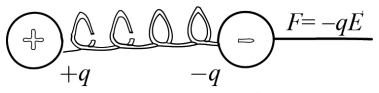
Derivation begins from Maxwell equations (1)–(4), introduces linear susceptibility via Lorentz model (13)–(16), obtains wave equation (21) with n(ω) = √(1+χ(ω)), then group velocity (53) and Kramers-Kronig (87)–(88).
-
IndisputableMonolith/Foundation/RealityFromDistinction.leanreality_from_one_distinction unclear?
unclearRelation between the paper passage and the cited Recognition theorem.
No reference to recognition cost, golden-ratio fixed points, 8-tick clocks, or distinction-forced spacetime.
What do these tags mean?
- matches
- The paper's claim is directly supported by a theorem in the formal canon.
- supports
- The theorem supports part of the paper's argument, but the paper may add assumptions or extra steps.
- extends
- The paper goes beyond the formal theorem; the theorem is a base layer rather than the whole result.
- uses
- The paper appears to rely on the theorem as machinery.
- contradicts
- The paper's claim conflicts with a theorem or certificate in the canon.
- unclear
- Pith found a possible connection, but the passage is too broad, indirect, or ambiguous to say the theorem truly supports the claim.
Reference graph
Works this paper leans on
-
[1]
N. W. Ashcroft and N. D. Mermin, Solid state physics . New York: Holt, Rinehart and Winston, 1976. 59
work page 1976
-
[2]
Cho, Reconstruction of macroscopic Maxwell equations a single susceptibility theory
K. Cho, Reconstruction of macroscopic Maxwell equations a single susceptibility theory. Heidelberg; New York: Springer, 2010
work page 2010
-
[3]
S. L. Chuang, Physics of Optoelectronic Devices. Wiley, 1995
work page 1995
-
[4]
E. D. Palik, Handbook of Optical Constants of Solids . Academic Press, 1998
work page 1998
-
[5]
Fox, Optical Properties of Solids , 2nd ed
M. Fox, Optical Properties of Solids , 2nd ed. Oxford ; New York: OUP Oxford, 2010
work page 2010
-
[6]
M. Bass, E. W. V. Stryland, D. R. Williams, and W. L. Wolfe, Handbook of Optics Volume II Devices, Measurements, and Properties 2nd edition , 1995
work page 1995
-
[7]
F. d. Coulon, Signal theory and processing. Dedham, MA : Artech House, 1986
work page 1986
-
[8]
L. D. Landau, E. M. Lifshitz, V. B. Berestetskii, and L. P. Pitaevskii, Electrody- namics of continuous media . Oxford: Butterworth-Heinemann, 1995
work page 1995
-
[9]
D. L. Mills, Nonlinear Optics: Basic Concepts, 2nd ed. Berlin ; New York: Springer, 1998
work page 1998
-
[10]
Superluminal propagation in resonant dissipative media,
P. Chamorro-Posada and F. J. Fraile-Pelaez, “Superluminal propagation in resonant dissipative media,” Optics Communications, vol. 282, no. 6, pp. 1095–1098, Mar. 2009
work page 2009
-
[11]
Ob- servation of backward pulse propagation through a medium with a negative group velocity,
G. M. Gehring, A. Schweinsberg, C. Barsi, N. Kostinski, and R. W. Boyd, “Ob- servation of backward pulse propagation through a medium with a negative group velocity,” Science, vol. 312, no. 5775, pp. 895–897, 2006
work page 2006
-
[12]
Fast and slow light in zigzag microring resonator chains,
P. Chamorro-Posada and F. J. Fraile-Pelaez, “Fast and slow light in zigzag microring resonator chains,” Optics Letters, vol. 34, no. 5, p. 626, Feb. 2009
work page 2009
-
[13]
I. Cestier, V. Eckhouse, G. Eisenstein, S. Combri´ e, P. Colman, and A. D. Rossi, “Resonance enhanced large third order nonlinear optical response in slow light GaInP photonic-crystal waveguides,” Optics Express, vol. 18, no. 6, pp. 5746–5753, Mar. 2010
work page 2010
-
[14]
Applications of slow light in telecom- munications,
R. W. Boyd, D. J. Gauthier, and A. L. Gaeta, “Applications of slow light in telecom- munications,” Optics and Photonics News , vol. 17, no. 4, pp. 18–23, Apr. 2006
work page 2006
-
[15]
A. Yariv and P. Yeh, Photonics: optical electronics in modern communications , 6th ed. Oxford: Oxford University Press, 2007
work page 2007
-
[16]
A. E. Siegman, Lasers. Mill Valley, California: University Science Books, 1990. 60
work page 1990
discussion (0)
Sign in with ORCID, Apple, or X to comment. Anyone can read and Pith papers without signing in.