Constructive interference in a network of elastically-bounded flapping plates
Pith reviewed 2026-05-24 20:07 UTC · model grok-4.3
The pith
Side-by-side elastically anchored flapping plates extract up to twice the power per device through constructive fluid interference.
A machine-rendered reading of the paper's core claim, the machinery that carries it, and where it could break.
Core claim
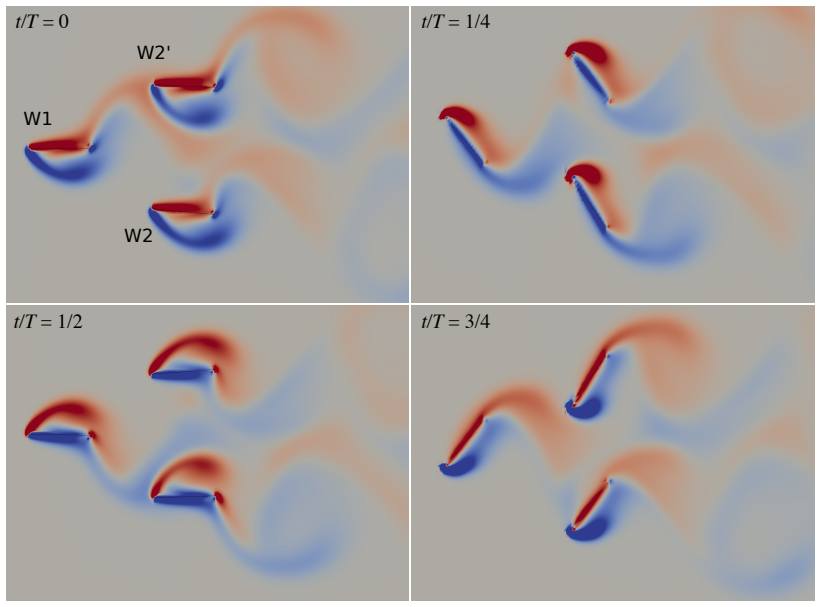
In the side-by-side arrangement the mutual hydrodynamic interactions between neighboring plates produce constructive interference that increases extracted power by up to 100 percent relative to the single-device case; downstream plates in the in-line arrangement recover performance when their elastic stiffness is adjusted; both outcomes are obtained with three-dimensional direct numerical simulation of the Navier-Stokes equations coupled to an immersed-boundary representation of the moving plates and are corroborated by wind-tunnel measurements.
What carries the argument
The nonlinear mutual hydrodynamic interactions between neighboring elastically anchored plates, which alter each plate's limit-cycle flapping amplitude and frequency and thereby change the net power extracted from the flow.
If this is right
- In-line arrays regain downstream performance by retuning the elastic stiffness of each successive plate.
- Side-by-side spacing can be chosen to produce net power gains of up to 100 percent per device.
- Adding more plates in a two-dimensional lattice can further increase total network output if the local constructive pattern persists.
- The regular limit-cycle regime remains stable across the explored spacings, supporting reliable energy extraction.
Where Pith is reading between the lines
- The same interference mechanism may allow three-dimensional stacking of plates to multiply output without proportional growth in footprint.
- Turbulent inflow or flexible-plate compliance could either strengthen or weaken the observed gains and would require separate verification.
- Power electronics that synchronize the electrical load across neighboring plates might convert the hydrodynamic cooperation into still higher net yield.
Load-bearing premise
The rigid-plate, uniform-laminar-flow model with simple elastic anchoring captures the dominant interactions that produce the reported power gains when real plates operate in larger arrays or in natural flows.
What would settle it
A controlled side-by-side wind-tunnel experiment at the numerically optimal spacing that records average power per plate no higher than the isolated-plate baseline.
Figures




read the original abstract
Aeroelastic phenomena are gaining significant attention from the perspective of energy harvesting (EH) with promising applications in supplying low-power remote sensors. Besides the development of individual EH devices, further issues are posed when considering multiple objects for realizing arrays of devices and magnifying the extracted power. Due to nonlinear mutual interactions, the resulting dynamics is generally different from that of single devices and the setup optimisation turns out to be nontrivial. In this work, we investigate the problem focusing on a flutter-based EH system consisting of a rigid plate anchored by elastic elements and invested by a uniform laminar flow, undergoing regular limit-cycle oscillations and flapping motions of finite amplitude. We consider a simplified, yet general, physical model and employ three-dimensional direct numerical simulations based on a finite-difference Navier-Stokes solver combined with a moving-least-squares immersed boundary method. Focusing on main kinematic and performance-related quantities, we first report on the dynamics of the single device and then on multiple devices. A parametric exploration is performed by varying the mutual distance between the devices. For the in-line arrangement, a recovery in performance for downstream devices is achieved by tuning their elasticity. Moreover, cooperative effects in the side-by-side arrangement are found to be substantially beneficial in terms of resulting power, with increases (i.e. constructive interference) up to 100% with respect to the single-device configuration. In order to confirm this numerical evidence, complementary results from wind-tunnel experiments are presented. Finally, we describe the system behaviour when increasing further the number of devices, outlining the ultimate goal of developing a high-performance EH network of numerous aeroelastic energy harvesters.
Editorial analysis
A structured set of objections, weighed in public.
Referee Report
Summary. The paper claims that in arrays of rigid plates with elastic anchoring undergoing limit-cycle flapping in uniform laminar flow, side-by-side configurations produce constructive hydrodynamic interference yielding power gains up to 100% relative to isolated devices. This is obtained from 3D DNS (finite-difference NS solver with moving-least-squares immersed-boundary method) with parametric variation of inter-device spacing; in-line arrangements recover performance via elasticity tuning. Complementary wind-tunnel experiments are presented as confirmation, and the behavior for larger arrays is outlined.
Significance. If the reported power gains prove robust, the work would be significant for aeroelastic energy-harvesting array design, as it quantifies how device spacing can more than double output via cooperative effects. The combination of 3D DNS and experimental confirmation, together with the parametric spacing study, supplies direct evidence for the interaction mechanisms without analytic fitting.
major comments (3)
- [Abstract] Abstract: the headline claim of power increases 'up to 100%' is presented without error bars, grid-convergence data, or the exact spacing/stiffness values at which the maximum occurs, leaving the quantitative central result without visible uncertainty quantification.
- [Numerical results sections] Sections describing the 3D DNS results: no grid-convergence studies or spatial/temporal resolution details are supplied to establish that the reported power coefficients are numerically converged, which is load-bearing for the 100% gain figure.
- [Multiple-device results] Section on side-by-side arrangements: all quantitative gains are obtained under uniform laminar inflow; the manuscript contains no sensitivity tests to inflow turbulence or Reynolds-number variations that could alter the dominance of the hydrodynamic coupling.
minor comments (2)
- [Abstract] The abstract would be clearer if it stated the Reynolds-number range and the precise definition of the power metric used for the single-device baseline.
- Figure captions for the side-by-side cases should explicitly label the single-device reference power for direct visual comparison.
Simulated Author's Rebuttal
We thank the referee for the constructive comments. We address each major comment below.
read point-by-point responses
-
Referee: [Abstract] Abstract: the headline claim of power increases 'up to 100%' is presented without error bars, grid-convergence data, or the exact spacing/stiffness values at which the maximum occurs, leaving the quantitative central result without visible uncertainty quantification.
Authors: We agree that the abstract would be strengthened by specifying the exact spacing and stiffness values at which the maximum gain is observed. In the revised manuscript we will update the abstract to include these parameters from the parametric study. Uncertainty quantification and convergence details are addressed in the response to the next comment. revision: partial
-
Referee: [Numerical results sections] Sections describing the 3D DNS results: no grid-convergence studies or spatial/temporal resolution details are supplied to establish that the reported power coefficients are numerically converged, which is load-bearing for the 100% gain figure.
Authors: The referee correctly notes the absence of explicit grid-convergence studies. While the resolutions were selected after validation against single-device experiments, we will add a subsection (or appendix) presenting grid-convergence data for the power coefficient, including comparisons across at least three resolutions, together with explicit spatial and temporal resolution values. revision: yes
-
Referee: [Multiple-device results] Section on side-by-side arrangements: all quantitative gains are obtained under uniform laminar inflow; the manuscript contains no sensitivity tests to inflow turbulence or Reynolds-number variations that could alter the dominance of the hydrodynamic coupling.
Authors: We acknowledge that all reported gains are for uniform laminar inflow. The study isolates the hydrodynamic interference mechanism under these conditions, with wind-tunnel confirmation at a fixed Re under low-turbulence conditions. We will expand the discussion to address expected robustness to mild turbulence and Re variations based on the identified mechanisms, while noting that dedicated sensitivity tests lie beyond the present scope. revision: partial
Circularity Check
No circularity: results are direct simulation and experiment outputs
full rationale
The paper presents power gains (up to 100%) as direct numerical outputs from 3D DNS of the Navier-Stokes equations with immersed-boundary treatment of rigid elastically-anchored plates, plus confirmatory wind-tunnel data. No analytic derivation chain, fitted parameters renamed as predictions, or self-citation load-bearing steps appear in the described workflow. The central claim therefore does not reduce to its inputs by construction; it is an emergent numerical result under the stated uniform-laminar-flow model.
Axiom & Free-Parameter Ledger
free parameters (2)
- plate spacing
- elastic stiffness
axioms (2)
- domain assumption Flow is uniform and laminar.
- domain assumption Single device exhibits regular limit-cycle flapping of finite amplitude.
Lean theorems connected to this paper
-
IndisputableMonolith/Cost/FunctionalEquation.leanwashburn_uniqueness_aczel unclear?
unclearRelation between the paper passage and the cited Recognition theorem.
three-dimensional direct numerical simulations based on a finite-difference Navier-Stokes solver combined with a moving-least-squares immersed boundary method
-
IndisputableMonolith/Foundation/DimensionForcing.leanalexander_duality_circle_linking unclear?
unclearRelation between the paper passage and the cited Recognition theorem.
cooperative effects in the side-by-side arrangement … increases … up to 100 %
What do these tags mean?
- matches
- The paper's claim is directly supported by a theorem in the formal canon.
- supports
- The theorem supports part of the paper's argument, but the paper may add assumptions or extra steps.
- extends
- The paper goes beyond the formal theorem; the theorem is a base layer rather than the whole result.
- uses
- The paper appears to rely on the theorem as machinery.
- contradicts
- The paper's claim conflicts with a theorem or certificate in the canon.
- unclear
- Pith found a possible connection, but the passage is too broad, indirect, or ambiguous to say the theorem truly supports the claim.
Reference graph
Works this paper leans on
-
[1]
D. Li, Y . Wu, A. D. Ronch, J. Xiang, Energy harvesting by me ans of flow-induced vibrations on aerospace vehicles, Progr ess in Aerospace Sciences 86 (2016) 28 – 62. doi:https://doi.org/10.1016/j.paerosci.2016.08.001. URL http://www.sciencedirect.com/science/article/pii/S0376042116300057
-
[2]
J. McCarthy, S. Watkins, A. Deivasigamani, S. John, Flut tering energy harvesters in the wind: A review, Journal of So und and Vibration 361 (2016) 355 – 377. doi:https://doi.org/10.1016/j.jsv.2015.09.043. URL http://www.sciencedirect.com/science/article/pii/S0022460X1500783X
-
[3]
L. Tang, M. P . Païdoussis, J. Jiang, Cantilevered flexibl e plates in axial flow: Energy transfer and the concept of flutt er-mill, Journal of Sound and Vibration 326 (1) (2009) 263 – 276. doi:https://doi.org/10.1016/j.jsv.2009.04.041. URL http://www.sciencedirect.com/science/article/pii/S0022460X09004076
-
[4]
S. Michelin, O. Doaré, Energy harvesting e fficiency of piezoelectric flags in axial flows, Journal of Fluid Mechanics 714 (2013) 489–504. doi:10.1017/jfm.2012.494
-
[5]
K. Shoele, R. Mittal, Energy harvesting by flow-induced fl utter in a simple model of an inverted piezoelectric flag, Journal of Fluid Mechanics 790 (2016) 582–606. doi:10.1017/jfm.2016.40
-
[6]
Q. Xiao, Q. Zhu, A review on flow energy harvesters based on flapping foils, Journal of Fluids and Structures 46 (2014) 17 4 – 191. doi:https://doi.org/10.1016/j.jfluidstructs.2014.01.002. URL http://www.sciencedirect.com/science/article/pii/S0889974614000140
-
[7]
J. Y oung, J. Lai, M. F. Platzer, A review of progress and ch allenges in flapping foil power generation, Progress in Aero space Sciences 67 (2014) 2–28. doi:10.1016/j.paerosci.2013.11.001
-
[8]
Z. Peng, Q. Zhu, Energy harvesting through flow-induced o scillations of a foil, Physics of Fluids 21 (12) (2009) 12360 2. arXiv:https://doi.org/10.1063/1.3275852, doi:10.1063/1.3275852. URL https://doi.org/10.1063/1.3275852
-
[9]
Q. Zhu, Energy harvesting by a purely passive flapping foi l from shear flows, Journal of Fluids and Structures 34 (2012) 157 – 169. doi:https://doi.org/10.1016/j.jfluidstructs.2012.05.013. URL http://www.sciencedirect.com/science/article/pii/S088997461200117X
-
[10]
Z. Wang, L. Du, J. Zhao, X. Sun, Structural response and e nergy extraction of a fully passive flapping foil, Journal of Fluids and Structures 72 (2017) 96 – 113. doi:https://doi.org/10.1016/j.jfluidstructs.2017.05.002 . URL http://www.sciencedirect.com/science/article/pii/S0889974617300312
- [11]
-
[12]
J.-C. V eilleux, G. Dumas, Numerical optimization of a f ully-passive flapping-airfoil turbine, Journal of Fluids a nd Structures 70 (2017) 102 – 130. doi:https://doi.org/10.1016/j.jfluidstructs.2017.01.019. URL http://www.sciencedirect.com/science/article/pii/S0889974616303917
-
[13]
K. Ramesh, J. Murua, A. Gopalarathnam, Limit-cycle osc illations in unsteady flows dominated by intermittent leadi ng-edge vortex shedding, Journal of Fluids and Structures 55 (2015) 84 – 105. doi:https://doi.org/10.1016/j.jfluidstructs.2015.02.005. URL http://www.sciencedirect.com/science/article/pii/S0889974615000468
-
[14]
E. Wang, K. Ramesh, S. Killen, I. M. Viola, On the nonline ar dynamics of self-sustained limit-cycle oscillations in a flapping-foil energy harvester, Journal of Fluids and Structures 83 (2018) 339 – 357. doi:https://doi.org/10.1016/j.jfluidstructs.2018.09.005. URL http://www.sciencedirect.com/science/article/pii/S0889974618303475
-
[15]
M. Boudreau, G. Dumas, M. Rahimpour, P . Oshkai, Experimental investigation of the energy extraction by a fully-pas sive flapping-foil hydrokinetic turbine prototype, Journal of Fluids and Structures 82 (2018) 446 – 472. doi:https://doi.org/10.1016/j.jfluidstructs.2018.07.014. URL http://www.sciencedirect.com/science/article/pii/S0889974618302287
-
[16]
L. Pigolotti, C. Mannini, G. Bartoli, Destabilizing e ffect of damping on the post-critical flutter oscillations of fl at plates, Meccanica 52 (13) (2017) 3149–3164. doi:10.1007/s11012-016-0604-y . URL https://doi.org/10.1007/s11012-016-0604-y
-
[17]
L. Pigolotti, C. Mannini, G. Bartoli, K. Thiele, Critic al and post-critical behaviour of two-degree-of-freedom fl utter-based generators, Journal of Sound and Vibration 404 (2017) 116 – 140. doi:https://doi.org/10.1016/j.jsv.2017.05.024. URL http://www.sciencedirect.com/science/article/pii/S0022460X17304030
-
[18]
L. Pigolotti, C. Mannini, G. Bartoli, Experimental stu dy on the flutter-induced motion of two-degree-of-freedom p lates, Journal of Fluids and Structures 75 (2017) 77 – 98. doi:https://doi.org/10.1016/j.jfluidstructs.2017.07.014. URL http://www.sciencedirect.com/science/article/pii/S0889974617300786
-
[19]
M. Bryant, R. L. Mahtani, E. Garcia, Wake synergies enha nce performance in aeroelastic vibration energy harvestin g, Journal of Intelligent Material Systems and Structures 23 (10) (2012) 1131–1141. doi:10.1177/1045389X12443599
-
[20]
B. Kirschmeier, M. Bryant, Experimental investigatio n of wake-induced aeroelastic limit cycle oscillations in t andem wings, Journal of Flu- ids and Structures 81 (2018) 309 – 324. doi:https://doi.org/10.1016/j.jfluidstructs.2018.04.015. URL http://www.sciencedirect.com/science/article/pii/S0889974617306242
-
[21]
J. McCarthy, A. Deivasigamani, S. John, S. Watkins, F. Coman, P . Petersen, Downstream flow structures of a fluttering piezoelectric energy harvester, Experimental Thermal and Fluid Science 51 (2013) 279 – 290. doi:https://doi.org/10.1016/j.expthermflusci.2013.08.010 . URL http://www.sciencedirect.com/science/article/pii/S0894177713001854
-
[22]
J. McCarthy, A. Deivasigamani, S. Watkins, S. John, F. Coman, P . Petersen, On the visualisation of flow structures downstream of fluttering piezoelectric energy harvesters in a tandem configuration, Experimental Thermal and Fluid Science 57 (2014) 407 – 419. doi:https://doi.org/10.1016/j.expthermflusci.2014.05.017 . URL http://www.sciencedirect.com/science/...
-
[23]
J. Zhang, S. Childress, A. Libchaber, M. Shelley, Flexi ble filaments in a flowing soap film as a model for one-dimension al flags in a two-dimensional wind, 22 Nature 408 (6814) (2000) 835. doi:10.1038/35048530. URL http://dx.doi.org/10.1038/35048530
-
[24]
J. Favier, A. Revell, A. Pinelli, Numerical study of flap ping filaments in a uniform fluid flow, Journal of Flu- ids and Structures 53 (2015) 26 – 35, special Issue on Unstead y Separation in Fluid-Structure Interaction–II. doi:https://doi.org/10.1016/j.jfluidstructs.2014.11.010. URL http://www.sciencedirect.com/science/article/pii/S0889974614002643
-
[25]
C. Huertas-Cerdeira, B. Fan, M. Gharib, Coupled motion of two side-by-side inverted flags, Journal of Fluids and Str uctures 76 (2018) 527 –
work page 2018
-
[26]
URL http://www.sciencedirect.com/science/article/pii/S0889974617303973
doi:https://doi.org/10.1016/j.jfluidstructs.2017.11.005. URL http://www.sciencedirect.com/science/article/pii/S0889974617303973
-
[27]
C. Boragno, R. Festa, A. Mazzino, Elastically bounded fl apping wing for energy harvesting, Applied Physics Letters 100 (25) (2012) 253906. arXiv:https://doi.org/10.1063/1.4729936, doi:10.1063/1.4729936. URL https://doi.org/10.1063/1.4729936
-
[28]
A. Orchini, A. Mazzino, J. Guerrero, R. Festa, C. Boragn o, Flapping states of an elastically anchored plate in a unif orm flow with applications to energy harvesting by fluid-stru cture interaction, Physics of Fluids 25 (9) (2013) 097105. arXiv:https://doi.org/10.1063/1.4821808, doi:10.1063/1.4821808. URL https://doi.org/10.1063/1.4821808
-
[29]
S. Olivieri, G. Boccalero, A. Mazzino, C. Boragno, Flut tering conditions of an energy harvester for autonomous pow ering, Renewable En- ergy 105 (2017) 530 – 538. doi:https://doi.org/10.1016/j.renene.2016.12.067. URL http://www.sciencedirect.com/science/article/pii/S0960148116311260
-
[30]
S. Olivieri, G. Boccalero, A. Mazzino, C. Boragno, FLut tering Energy Harvester for Autonomous Powering (FLEHAP): aeroelastic characterisation and preliminary performanc e evaluation, Procedia Engineering 199 (2017) 3474 – 3479, X Internationa l Conference on Structural Dynamics, EURODYN 2017. doi:https://doi.org/10.1016/j.proeng.2017.09.456. URL http://w...
-
[31]
G. Boccalero, S. Olivieri, A. Mazzino, C. Boragno, Powe r harvesting by electromagnetic coupling from wind-induce d limit cycle oscillations, Smart Materials and Structures 26 (9) (2017) 095031. URL http://stacks.iop.org/0964-1726/26/i=9/a=095031
work page 2017
-
[32]
J. H. Ferziger, M. Peric, Computational methods for flui d dynamics, Springer Science & Business Media, 2012
work page 2012
-
[33]
R. Mittal, G. Iaccarino, Immersed boundary methods, An nual Review of Fluid Mechanics 37 (1) (2005) 239–261. arXiv:https://doi.org/10.1146/annurev.fluid.37.061903.175743, doi:10.1146/annurev.fluid.37.061903.175743. URL https://doi.org/10.1146/annurev.fluid.37.061903.175743
-
[34]
M. de Tullio, G. Pascazio, A moving-least-squares imme rsed boundary method for simulating the fluid-structure int eraction of elastic bodies with arbitrary thickness, Journal of Computational Physics 325 (2016) 201 – 225. doi:https://doi.org/10.1016/j.jcp.2016.08.020. URL http://www.sciencedirect.com/science/article/pii/S0021999116303692
-
[35]
R. V erzicco, P . Orlandi, A finite-difference scheme for three-dimensional incompressible flows i n cylindrical coordinates, Journal of Compu- tational Physics 123 (2) (1996) 402 – 414. doi:https://doi.org/10.1006/jcph.1996.0033. URL http://www.sciencedirect.com/science/article/pii/S0021999196900339
-
[36]
V . Spandan, V . Meschini, R. Ostilla-Mónico, D. Lohse, G . Querzoli, M. D. de Tullio, R. V erzicco, A parallel interaction potential approach coupled with the immersed boundary method for fully resolved simulations of deformable interfaces and membranes, Journal of Computational Physics 348 (2017) 567 – 590. doi:https://doi.org/10.1016/j.jcp.2017.07.036....
-
[37]
A moving-least-squares reconstruction for embedded-boundary formulations
M. V anella, E. Balaras, A moving-least-squares recons truction for embedded-boundary formulations, Journal of C omputational Physics 228 (18) (2009) 6617 – 6628. doi:https://doi.org/10.1016/j.jcp.2009.06.003. URL http://www.sciencedirect.com/science/article/pii/S0021999109003246
-
[38]
URL http://www.openfoam.com 23
OpenFOAM, The open source CFD toolbox. URL http://www.openfoam.com 23
discussion (0)
Sign in with ORCID, Apple, or X to comment. Anyone can read and Pith papers without signing in.