Power-Consumption Outage Challenge in Next-Generation Cellular Networks
Pith reviewed 2026-05-24 18:57 UTC · model grok-4.3
The pith
Power-consumption outage interrupts mmWave massive MIMO links even with good channels
A machine-rendered reading of the paper's core claim, the machinery that carries it, and where it could break.
Core claim
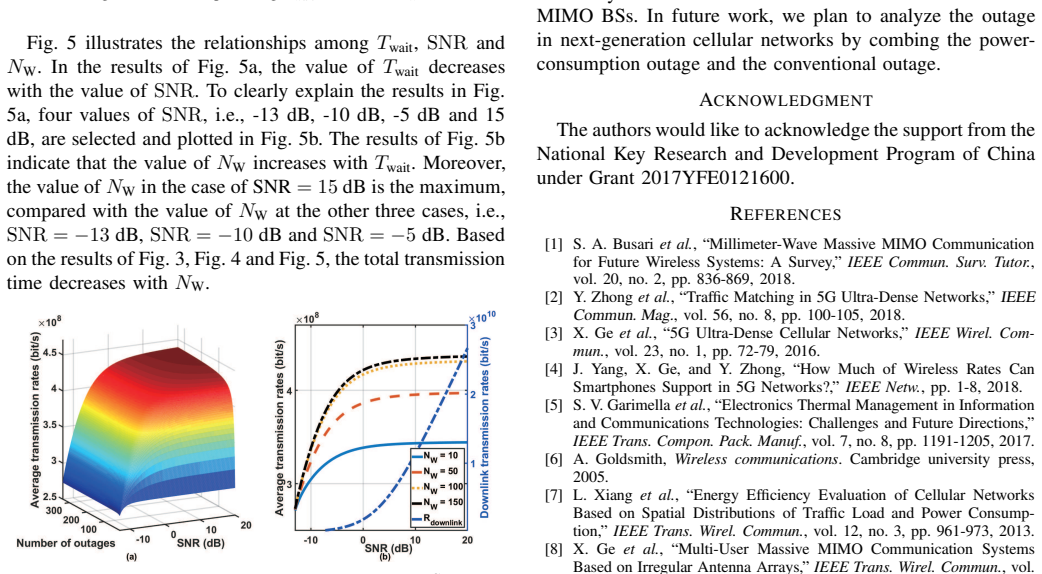
Based on both communication and heat transfer theories, a power-consumption outage in the wireless communication between millimeter wave (mmWave) massive multiple-input multiple-output (MIMO) base stations (BSs) and smartphones has been modeled and analyzed. Moreover, the total transmission time model with respect to the number of power-consumption outages is derived for mmWave massive MIMO communication systems. Simulation results indicate that the total transmission time is extended by the power-consumption outage, which deteriorates the average transmission rate of mmWave massive MIMO BSs.
What carries the argument
Power-consumption outage model derived from combined communication and heat transfer theories, which determines transmission interruptions due to device power limits
Load-bearing premise
The combined communication and heat transfer model accurately captures when power consumption in a smartphone triggers an outage that interrupts mmWave massive MIMO communication even under good channel conditions.
What would settle it
Direct measurements of smartphone power consumption and transmission continuity during mmWave massive MIMO sessions under strong channel conditions that show no interruptions would contradict the outage model.
Figures


read the original abstract
The conventional outage in wireless communication systems is caused by the deterioration of the wireless communication link, i.e., the received signal power is less than the minimum received signal power. Is there a possibility that the outage occurs in wireless communication systems with a good channel state? Based on both communication and heat transfer theories, a power-consumption outage in the wireless communication between millimeter wave (mmWave) massive multiple-input multiple-output (MIMO) base stations (BSs) and smartphones has been modeled and analyzed. Moreover, the total transmission time model with respect to the number of power-consumption outages is derived for mmWave massive MIMO communication systems. Simulation results indicate that the total transmission time is extended by the power-consumption outage, which deteriorates the average transmission rate of mmWave massive MIMO BSs.
Editorial analysis
A structured set of objections, weighed in public.
Referee Report
Summary. The manuscript introduces the concept of 'power-consumption outage' in mmWave massive MIMO systems, arguing that outages can occur due to smartphone thermal/power limits even under good channel conditions. It claims to combine communication and heat-transfer theories to model this phenomenon, derives an expression for total transmission time as a function of the number of such outages, and reports simulation results showing extended transmission times and reduced average rates at the base stations.
Significance. If the model and simulations are robust, the work identifies a device-side constraint that could affect practical deployment of mmWave massive MIMO. The derivation of the transmission-time model from established theories is a positive element. However, the absence of any reported empirical validation or sensitivity analysis for the heat-transfer component substantially reduces the result's immediate significance for network design.
major comments (2)
- The central simulation claim (extended transmission time and degraded rate due to power-consumption outages) rests on the accuracy of the combined communication/heat-transfer model for determining outage thresholds. The manuscript supplies no equations, parameter values, or thresholds for the heat-transfer component, nor any comparison against measured thermal or power limits of actual mmWave handsets. This prevents verification that the reported outage counts are not artifacts of arbitrary modeling choices.
- No validation steps, error analysis, or sensitivity study are described for the outage model. Without these, it is impossible to assess whether the simulated rate degradation is load-bearing or an artifact of the chosen parameters.
Simulated Author's Rebuttal
We thank the referee for the constructive comments on our manuscript. We address each major comment below and indicate the revisions that will be incorporated.
read point-by-point responses
-
Referee: The central simulation claim (extended transmission time and degraded rate due to power-consumption outages) rests on the accuracy of the combined communication/heat-transfer model for determining outage thresholds. The manuscript supplies no equations, parameter values, or thresholds for the heat-transfer component, nor any comparison against measured thermal or power limits of actual mmWave handsets. This prevents verification that the reported outage counts are not artifacts of arbitrary modeling choices.
Authors: We acknowledge the need for greater transparency in the heat-transfer component. Although the manuscript derives the power-consumption outage from combined communication and heat-transfer theories, the explicit heat-transfer equations, parameter table (including thermal resistance, capacitance, and smartphone power limits), and outage thresholds were not presented with sufficient detail. In the revised manuscript we will add these equations, a dedicated parameter table with values drawn from standard heat-transfer references and device specifications, and the resulting outage thresholds. Direct empirical measurements on commercial mmWave handsets lie outside the scope of this theoretical modeling paper; the parameters follow established literature values, which will now be explicitly cited. revision: yes
-
Referee: No validation steps, error analysis, or sensitivity study are described for the outage model. Without these, it is impossible to assess whether the simulated rate degradation is load-bearing or an artifact of the chosen parameters.
Authors: We agree that a sensitivity study strengthens the results. The revised version will include a new subsection reporting sensitivity analysis on the key thermal and power parameters (e.g., maximum allowable temperature and power consumption) and will discuss the impact on outage probability and transmission time. Model assumptions and their potential influence on the reported rate degradation will also be addressed. revision: yes
Circularity Check
No circularity: derivation rests on external theories and simulation, not self-referential fits or citations
full rationale
The abstract states the power-consumption outage is modeled from communication and heat transfer theories, with a total transmission time model derived from the outage count; simulation then shows rate degradation. No equations, fitted parameters, or self-citations appear in the provided text that would make any prediction equivalent to its inputs by construction. The central claim therefore remains independent of the paper's own outputs.
Axiom & Free-Parameter Ledger
axioms (1)
- domain assumption Heat transfer theory can be directly combined with wireless communication models to predict when device power consumption causes an outage.
Reference graph
Works this paper leans on
-
[1]
Millimeter-Wave Massive MIMO Communication for Future Wireless Systems: A Survey,
S. A. Busari et al. , “Millimeter-Wave Massive MIMO Communication for Future Wireless Systems: A Survey,” IEEE Commun. Surv. Tutor . , vol. 20, no. 2, pp. 836-869, 2018
work page 2018
-
[2]
Traffic Matching in 5G Ultra-Dense Networks,
Y . Zhong et al., “Traffic Matching in 5G Ultra-Dense Networks,” IEEE Commun. Mag., vol. 56, no. 8, pp. 100-105, 2018
work page 2018
-
[3]
5G Ultra-Dense Cellular Networks,
X. Ge et al. , “5G Ultra-Dense Cellular Networks,” IEEE Wirel. Com- mun., vol. 23, no. 1, pp. 72-79, 2016
work page 2016
-
[4]
How Much of Wireless Rates Ca n Smartphones Support in 5G Networks?,
J. Y ang, X. Ge, and Y . Zhong, “How Much of Wireless Rates Ca n Smartphones Support in 5G Networks?,” IEEE Netw., pp. 1-8, 2018
work page 2018
-
[5]
S. V . Garimella et al., “Electronics Thermal Management in Information and Communications Technologies: Challenges and Future Di rections,” IEEE Trans. Compon. Pack. Manuf. , vol. 7, no. 8, pp. 1191-1205, 2017
work page 2017
-
[6]
Goldsmith, Wireless communications
A. Goldsmith, Wireless communications. Cambridge university press, 2005
work page 2005
-
[7]
L. Xiang et al. , “Energy Efficiency Evaluation of Cellular Networks Based on Spatial Distributions of Traffic Load and Power Cons ump- tion,” IEEE Trans. Wirel. Commun. , vol. 12, no. 3, pp. 961-973, 2013
work page 2013
-
[8]
Multi-User Massive MIMO Communication Systems Based on Irregular Antenna Arrays,
X. Ge et al. , “Multi-User Massive MIMO Communication Systems Based on Irregular Antenna Arrays,” IEEE Trans. Wirel. Commun. , vol. 15, no. 8, pp. 5287-5301, 2016
work page 2016
-
[9]
Spatial Spectrum and Energy Efficiency of Ra ndom Cellular Networks,
X. Ge et al., “Spatial Spectrum and Energy Efficiency of Ra ndom Cellular Networks,” IEEE Trans. Commun. , vol. 63, no. 3, pp. 1019- 1030, 2015
work page 2015
-
[10]
Outage Analysis of Co-Operative Two-Path Relay Chan- nels,
Q. Li et al. , “Outage Analysis of Co-Operative Two-Path Relay Chan- nels,” IEEE Trans. Wirel. Commun., vol. 15, no. 5, pp. 3157-3169, 2016
work page 2016
-
[11]
Performance Analysis of V ehicular Device-to-Device Underlay Communication,
N. Cheng et al. , “Performance Analysis of V ehicular Device-to-Device Underlay Communication,” IEEE Trans. V eh. Technol., vol. 66, no. 6, pp. 5409-5421, 2017
work page 2017
-
[12]
T. L. Bergman et al. , Fundamentals of heat and mass transfer . John Wiley & Sons, 2011
work page 2011
-
[13]
Notes on Landauer’s principle, reversi ble computation, and Maxwell’s Demon,
C. H. Bennett, “Notes on Landauer’s principle, reversi ble computation, and Maxwell’s Demon,” Studies in History and Philosophy of Modern Physics, vol. 34B, no. 3, pp. 501-510, Sep 2003
work page 2003
-
[14]
Y . A. Cengel and M. A. Boles, Thermodynamics: an engineering approach, 5th ed. Boston : McGraw-Hill, 2002
work page 2002
-
[15]
Scaling carbon nanotube complementary transistors to 5-nm gate lengths,
C. Qiu et al. , “Scaling carbon nanotube complementary transistors to 5-nm gate lengths,” Science, vol. 355, no. 6322, pp. 271-276, 2017
work page 2017
-
[16]
F. Paterna, J. Zanotelli, and T. S. Rosing, “Ambient var iation-tolerant and inter components aware thermal management for mobile sy stem on chips,” presented at the Proceedings of the conference on Design, Automation & Test in Europe , Dresden, Germany, 2014
work page 2014
discussion (0)
Sign in with ORCID, Apple, or X to comment. Anyone can read and Pith papers without signing in.