Modeling and Performance Analysis of Spatially Distributed LTE-U and Wi-Fi Networks
Pith reviewed 2026-05-24 18:22 UTC · model grok-4.3
The pith
An analytical model estimates throughputs of spatially distributed LTE-U and Wi-Fi networks with mean normalized error below 1 percent in balanced 40-node cases.
A machine-rendered reading of the paper's core claim, the machinery that carries it, and where it could break.
Core claim
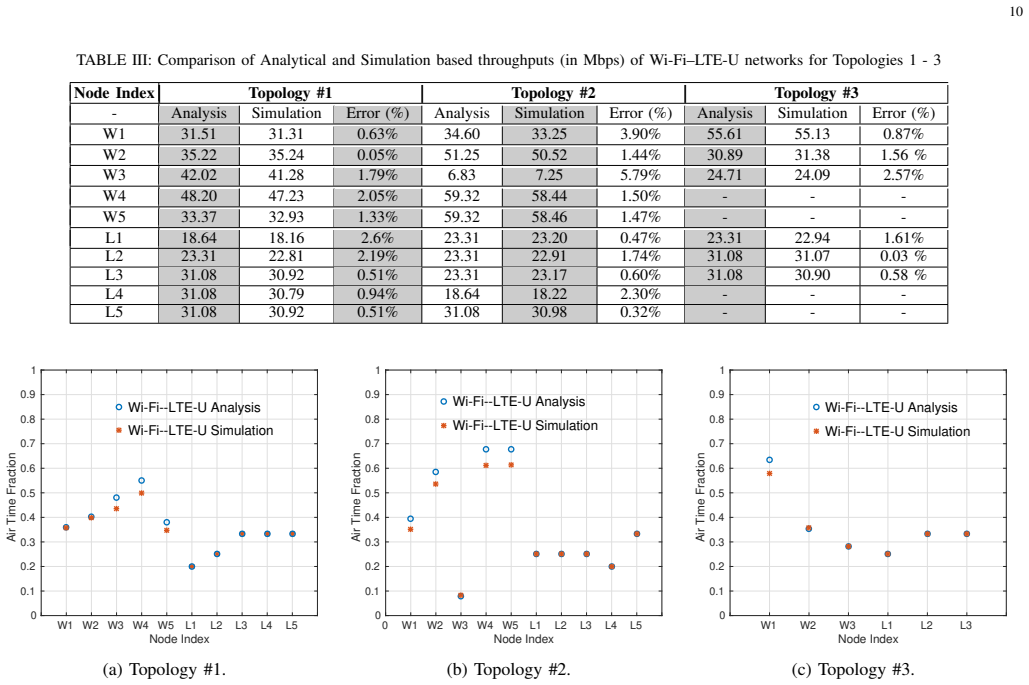
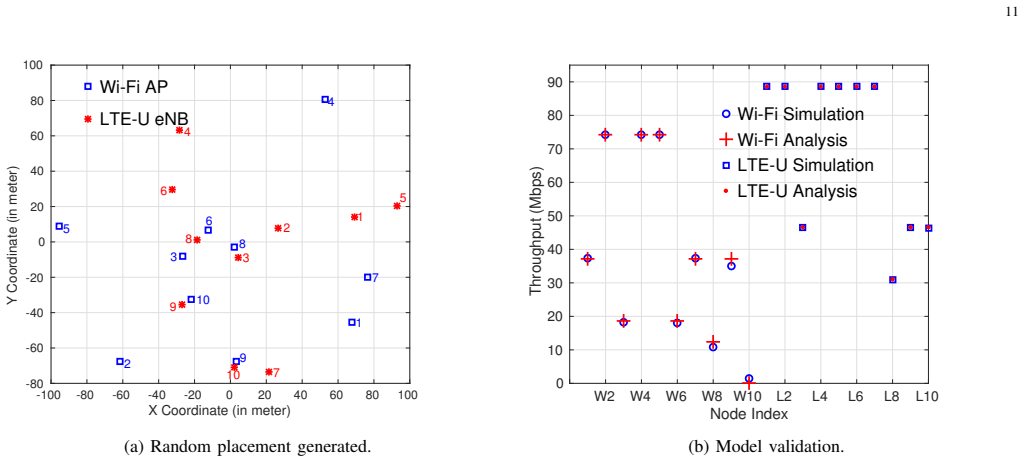
We present an analytical model for characterization of achievable throughputs of Wi-Fi and LTE-U networks in spatially distributed high-density scenarios. The proposed model is used to study how LTE-U and Wi-Fi coexist with each other in different deployment scenarios. Our extensive simulation results prove it to be a reliable model for estimating throughput of both Wi-Fi and LTE-U. We record a very good accuracy in throughput estimation and the mean normalized error is less than 1% for 40-node scenario in which 50% of nodes belong to each of Wi-Fi and LTE-U.
What carries the argument
Analytical model combining Wi-Fi listen-before-talk and LTE-U on-off duty cycling with spatial node distribution to compute throughputs.
If this is right
- The model enables quantitative prediction of throughput for both technologies under varying densities and placements.
- Coexistence studies become feasible by varying the relative numbers and locations of LTE-U and Wi-Fi nodes.
- High accuracy holds specifically for the 40-node balanced case and extends to other high-density scenarios tested.
- Throughput estimates support design choices for fair sharing on unlicensed bands.
Where Pith is reading between the lines
- If accurate, the model could serve as a planning tool for operators deploying LTE-U alongside existing Wi-Fi.
- Incorporating hidden-terminal effects would be a natural next test of the model's boundaries.
- The same structure might extend to other duty-cycled or listen-before-talk technologies sharing spectrum.
- Real-world testbed validation beyond simulation would reveal whether unmodeled factors alter the reported error rates.
Load-bearing premise
The model assumes that listen-before-talk, on-off cycling, and spatial distribution alone suffice to determine throughputs without hidden terminals or detailed channel effects becoming dominant.
What would settle it
Measurements or simulations of a 40-node mixed network (20 Wi-Fi, 20 LTE-U) yielding mean normalized throughput error above 5 percent would falsify the reliability claim.
Figures
read the original abstract
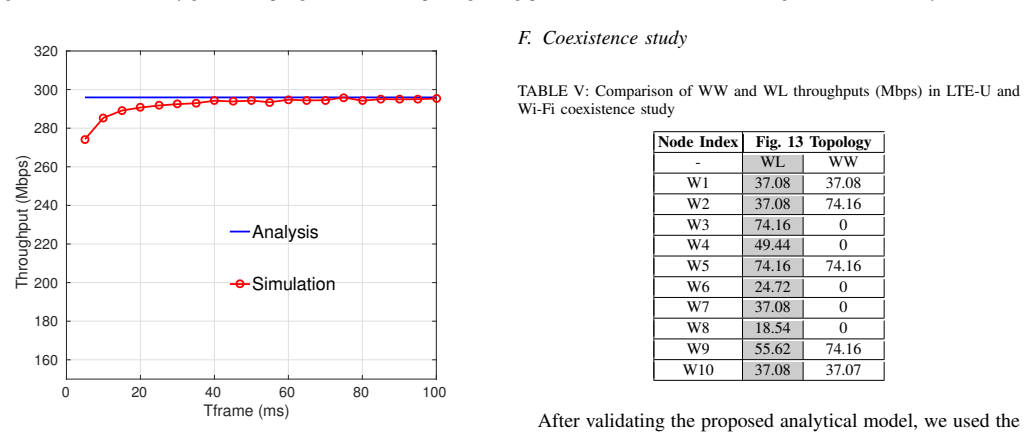
To access an unlicensed channel Wi-Fi follows Listen Before Talk (LBT) mechanism whereas LTE-U adopts ON-OFF duty cycled mechanism to fairly share the channel with Wi-Fi. These contrasting mechanisms result in quite different performance for Wi-Fi and LTE-U based on their relative deployment and density in the environment. In this work, we present an analytical model for characterization of achievable throughputs of Wi-Fi and LTE-U networks in spatially distributed high-density scenarios. The proposed model is used to study how LTE-U and Wi-Fi coexist with each other in different deployment scenarios. Our extensive simulation results prove it to be a reliable model for estimating throughput of both Wi-Fi and LTE-U. We record a very good accuracy in throughput estimation and the mean normalized error is less than 1% for 40-node scenario in which 50% of nodes belong to each of Wi-Fi and LTE-U. Finally, we use the analytical model to conduct coexistence studies of LTE-U and Wi-Fi.
Editorial analysis
A structured set of objections, weighed in public.
Referee Report
Summary. The paper presents an analytical model for the achievable throughputs of spatially distributed LTE-U and Wi-Fi networks that employ contrasting access mechanisms (LBT for Wi-Fi, ON-OFF duty cycling for LTE-U). The model is validated via simulations reporting a mean normalized error below 1% for a single 40-node scenario with 50% nodes from each technology, and is then applied to coexistence studies across deployment scenarios.
Significance. If the model accurately incorporates spatial distribution effects without hidden parameters or simulation-tuned values, it would offer a useful tool for performance prediction and coexistence analysis in unlicensed spectrum. The reported low error in the tested case supports potential utility, but the narrow validation scope limits the strength of the reliability claim.
major comments (2)
- [Abstract] Abstract (simulation validation paragraph): the claim that the model is 'reliable' for throughput estimation rests on mean normalized error <1% reported only for the 40-node 50/50 case. This single-point validation does not address whether accuracy holds at other densities or proportions, where effects such as hidden terminals or path loss may become dominant; additional validation cases are needed to support the central reliability assertion.
- [Abstract] Abstract (proposed model paragraph): the description does not specify how spatial distribution is mathematically incorporated (e.g., via point processes or distance distributions) or whether the throughput expressions are derived in closed form without fitted parameters. This omission makes it impossible to verify if the model is fully analytical or reduces to simulation-tuned values, which is load-bearing for the accuracy claim.
minor comments (1)
- [Abstract] The abstract states 'extensive simulation results' but provides no indication of the range of node counts, duty cycles, or topologies tested beyond the single 40-node case; a table summarizing error across scenarios would improve clarity.
Simulated Author's Rebuttal
We thank the referee for the constructive comments on the abstract. We address each major comment below and indicate revisions to strengthen the manuscript.
read point-by-point responses
-
Referee: [Abstract] Abstract (simulation validation paragraph): the claim that the model is 'reliable' for throughput estimation rests on mean normalized error <1% reported only for the 40-node 50/50 case. This single-point validation does not address whether accuracy holds at other densities or proportions, where effects such as hidden terminals or path loss may become dominant; additional validation cases are needed to support the central reliability assertion.
Authors: The abstract highlights one representative case, but the manuscript reports extensive simulations across multiple densities, proportions, and scenarios (including those where hidden terminals and path loss are relevant), all with mean normalized error below 1%. We will revise the abstract to explicitly note validation across a range of densities and proportions to better support the reliability claim. revision: yes
-
Referee: [Abstract] Abstract (proposed model paragraph): the description does not specify how spatial distribution is mathematically incorporated (e.g., via point processes or distance distributions) or whether the throughput expressions are derived in closed form without fitted parameters. This omission makes it impossible to verify if the model is fully analytical or reduces to simulation-tuned values, which is load-bearing for the accuracy claim.
Authors: Spatial distribution is modeled via Poisson point processes for node locations, with closed-form derivations of distance distributions to capture path loss and interference; throughput expressions for LBT (Wi-Fi) and duty-cycled (LTE-U) access are obtained analytically from these without any fitted parameters. We will revise the abstract to state this modeling approach explicitly. revision: yes
Circularity Check
Analytical model derived from mechanisms then validated by independent simulation; no circularity.
full rationale
The paper constructs an analytical throughput model from the contrasting LBT and ON-OFF access rules plus spatial node distribution (abstract). It then reports simulation-based mean normalized error <1% as external validation for one 40-node case. This validation step occurs after derivation and does not feed back into the model equations or parameter values. No self-citations, fitted inputs renamed as predictions, or self-definitional reductions are present in the provided text. The derivation chain remains self-contained against the stated assumptions.
Axiom & Free-Parameter Ledger
Reference graph
Works this paper leans on
-
[1]
Cisco Visual Networking Index: Global Mobile Data Traffic Forecast Update, 2017-2022
Cisco, “Cisco Visual Networking Index: Global Mobile Data Traffic Forecast Update, 2017-2022.” Cisco White Paper, Feb 2019
work page 2017
-
[2]
TSGRAN; Study on Licensed-Assisted Access to Unlicensed Spectrum,
3GPP, “TSGRAN; Study on Licensed-Assisted Access to Unlicensed Spectrum,” Tech. Rep. TR 36.889 V13.0.0, June 2015
work page 2015
-
[3]
LTE in Unlicensed Spectrum: Harmonious Coexistence with Wi-Fi
Qualcomm, “LTE in Unlicensed Spectrum: Harmonious Coexistence with Wi-Fi.” Qualcomm White Paper, June 2014
work page 2014
-
[4]
LTE-U Forum, “LTE-U Technical Report.” [Online] http://www. lteuforum.org/documents.html, 2015
work page 2015
-
[5]
On the Impact of Duty Cycled LTE-U on Wi-Fi Users: An Experimental Study,
A. M. Baswade, T. A. Atif, B. R. Tamma, and A. A. Franklin, “On the Impact of Duty Cycled LTE-U on Wi-Fi Users: An Experimental Study,” in Proc. of International Conference on Communication Systems and Networks , pp. 196–219, Springer, 2018
work page 2018
-
[6]
Performance Analysis of the IEEE 802.11 Distributed Coordination Function,
G. Bianchi, “Performance Analysis of the IEEE 802.11 Distributed Coordination Function,” IEEE Journal on selected areas in communi- cations, vol. 18, no. 3, pp. 535–547, 2000
work page 2000
-
[7]
Back-of-the-Envelope Computation of Throughput Distributions in CSMA Wireless Networks,
S. C. Liew, C. Kai, H. C. Leung, and P. Wong, “Back-of-the-Envelope Computation of Throughput Distributions in CSMA Wireless Networks,” IEEE Transactions on Mobile Computing , vol. 9, no. 9, pp. 1319–1331, 2010
work page 2010
-
[8]
Harmonious Coexistence and Efficient Spectrum Sharing for LTE-U and Wi-Fi,
Z. Jiang and S. Mao, “Harmonious Coexistence and Efficient Spectrum Sharing for LTE-U and Wi-Fi,” in Proc. of International Conference on Mobile Ad Hoc and Sensor Systems (MASS) , pp. 275–283, IEEE, 2017
work page 2017
-
[9]
Modeling and Performance Analysis of Wi-Fi Networks Coexisting with LTE-U,
A. Abdelfattah and N. Malouch, “Modeling and Performance Analysis of Wi-Fi Networks Coexisting with LTE-U,” in Proc. of Conference on Computer Communications (INFOCOM) , pp. 1–9, IEEE, 2017
work page 2017
-
[10]
Modeling the coexistence of lte and wifi heterogeneous networks in dense deployment scenarios,
S. Sagari, I. Seskar, and D. Raychaudhuri, “Modeling the coexistence of lte and wifi heterogeneous networks in dense deployment scenarios,” in Proc. of International Conference on Communication Workshop (ICCW), pp. 2301–2306, IEEE, 2015
work page 2015
-
[11]
System perfor- mance of lte and ieee 802.11 coexisting on a shared frequency band,
T. Nihtil ¨a, V . Tykhomyrov, O. Alanen, M. A. Uusitalo, A. Sorri, M. Moisio, S. Iraji, R. Ratasuk, and N. Mangalvedhe, “System perfor- mance of lte and ieee 802.11 coexisting on a shared frequency band,” in Proc. of IEEE Wireless Communications and Networking Conference (WCNC), pp. 1038–1043, IEEE, 2013
work page 2013
-
[12]
License-exempt lte deployment in heterogeneous network,
R. Ratasuk, M. A. Uusitalo, N. Mangalvedhe, A. Sorri, S. Iraji, C. Wi- jting, and A. Ghosh, “License-exempt lte deployment in heterogeneous network,” in Proc. of International Symposium on Wireless Communi- cation Systems (ISWCS) , pp. 246–250, IEEE, 2012
work page 2012
-
[13]
Coordinated Dynamic Spectrum Management of LTE-U and Wi- Fi Networks,
S. Sagari, S. Baysting, D. Saha, I. Seskar, W. Trappe, and D. Raychaud- huri, “Coordinated Dynamic Spectrum Management of LTE-U and Wi- Fi Networks,” in Proc. of IEEE International Symposium on Dynamic Spectrum Access Networks (DySPAN) , pp. 209–220, September 2015
work page 2015
-
[14]
Performance Evaluation of LTE and Wi-Fi Coexistence in Unlicensed Bands,
A. M. Cavalcante, E. Almeida, R. D. Vieira, S. Choudhury, E. Tuomaala, K. Doppler, F. Chaves, R. C. Paiva, and F. Abinader, “Performance Evaluation of LTE and Wi-Fi Coexistence in Unlicensed Bands,” inProc. of V ehicular Technology Conference (VTC Spring), pp. 1–6, IEEE, 2013
work page 2013
-
[15]
Enabling LTE/WiFi coexistence by LTE blank subframe allocation,
E. Almeida, A. M. Cavalcante, R. C. Paiva, F. S. Chaves, F. M. Abinader, R. D. Vieira, S. Choudhury, E. Tuomaala, and K. Doppler, “Enabling LTE/WiFi coexistence by LTE blank subframe allocation,” in Proc. of International Conference on Communications (ICC) , pp. 5083–5088, IEEE, 2013
work page 2013
-
[16]
Mod- eling and analyzing the coexistence of Wi-Fi and LTE in unlicensed spectrum,
Y . Li, F. Baccelli, J. G. Andrews, T. D. Novlan, and J. C. Zhang, “Mod- eling and analyzing the coexistence of Wi-Fi and LTE in unlicensed spectrum,” IEEE Transactions on Wireless Communications , vol. 15, no. 9, pp. 6310–6326, 2016
work page 2016
-
[17]
Coexistence of WiFi and LTE in unlicensed bands: A proportional fair allocation scheme,
C. Cano and D. J. Leith, “Coexistence of WiFi and LTE in unlicensed bands: A proportional fair allocation scheme,” in Proc. of International Conference on Communication Workshop (ICCW) , pp. 2288–2293, IEEE, 2015. 14
work page 2015
-
[18]
Throughput analysis of ieee802.11 multi-hop adhoc networks,
P. C. Ng and S. C. Liew, “Throughput analysis of ieee802.11 multi-hop adhoc networks,” IEEE/ACM Transactions on networking, vol. 15, no. 2, pp. 309–322, 2007
work page 2007
-
[19]
Determining the end-to-end Throughput Capacity in Multi-hop Networks: Methodology and Applications,
Y . Gao, D.-M. Chiu, and J. Lui, “Determining the end-to-end Throughput Capacity in Multi-hop Networks: Methodology and Applications,” in ACM SIGMETRICS Performance Evaluation Review , vol. 34, pp. 39– 50, ACM, 2006
work page 2006
-
[20]
C. Chen, R. Ratasuk, and A. Ghosh, “Downlink performance analysis of LTE and WiFi coexistence in unlicensed bands with a simple listen- before-talk scheme,” in Proc. of V ehicular Technology Conference (VTC) Spring, pp. 1–5, IEEE, 2015
work page 2015
-
[21]
Performance analysis of laa and wifi coexistence in unlicensed spectrum based on markov chain,
Y . Gao, X. Chu, and J. Zhang, “Performance analysis of laa and wifi coexistence in unlicensed spectrum based on markov chain,” in Proc. of Global Communications Conference (GLOBECOM) , pp. 1–6, IEEE, 2016
work page 2016
-
[22]
Modelling and analysis of wi-fi and laa coexistence with priority classes,
A. M. Baswade, L. Beltramelli, F. A. Antony, M. Gidlund, B. R. Tamma, and L. Guntupalli, “Modelling and analysis of wi-fi and laa coexistence with priority classes,” in Proc. of International Conference on Wireless and Mobile Computing, Networking and Communications (WiMob), pp. 1–8, IEEE, 2018
work page 2018
-
[23]
3GPP-TSG-RAN-WG1; Evolved Universal Terrestrial Radio Access (E-UTRA),
3GPP, “3GPP-TSG-RAN-WG1; Evolved Universal Terrestrial Radio Access (E-UTRA),” Tech. Rep. TR 36.814 V9.0.0, March 2010
work page 2010
discussion (0)
Sign in with ORCID, Apple, or X to comment. Anyone can read and Pith papers without signing in.