REVIEW 3 major objections 4 minor 5 cited by
Sparsening Algorithm for Multi-Hadron Lattice QCD Correlation Functions
T0 review · 3 major / 4 minor · reviewed 2026-08-14 · deepseek-v4-flash
Pith's one-line read This paper claims that correlation functions built from quark propagators sampled on a coarsened spatial lattice—one site per 4^3 block—give ground-state masses and binding energies statistically indistinguishable from full propagator…
desk verdict Solid, carefully analyzed algorithmic paper with a real consistency check at one parameter point, but the advertised speedup is unmeasured and the Section II guarantee is overbroad due to momentum aliasing. read the letter →
The pith
A machine-rendered reading of the paper's core claim, the machinery that carries it, and where it could break.
The reading
What carries the argument
The central object is the sparsened propagator: on a lattice blocked by $N^{3}$ in the spatial directions, only the value at the first site of each block is retained, defining a propagator on the coarsened sublattice $\tilde{\Lambda}^3(N)$. Correlation functions are then built by summing only over this sublattice, which reduces the cost of the Fourier transforms and contractions that dominate multi-hadron calculations. The blocking scale N = 4 is chosen from the estimated spatial coherence length of hadronic two-point functions, $(a m_\pi/2)^{-1} \approx 3.4$ lattice units; the construction is justified by noting that sparsening is equivalent to replacing the sink interpolating operator.
What would settle it
Repeat the comparison of sparsened and full correlation functions on an ensemble with m_pi near the physical pion mass (about 140 MeV) and a finer lattice spacing, extracting the nucleon and deuteron ground-state energies from both; if the sparsened results differ from the full results by more than the combined statistical uncertainty, the method's central claim is refuted. A cheaper check is to increase the blocking factor on the existing ensemble until the effective masses disagree.
Extended reading notes
Core claim
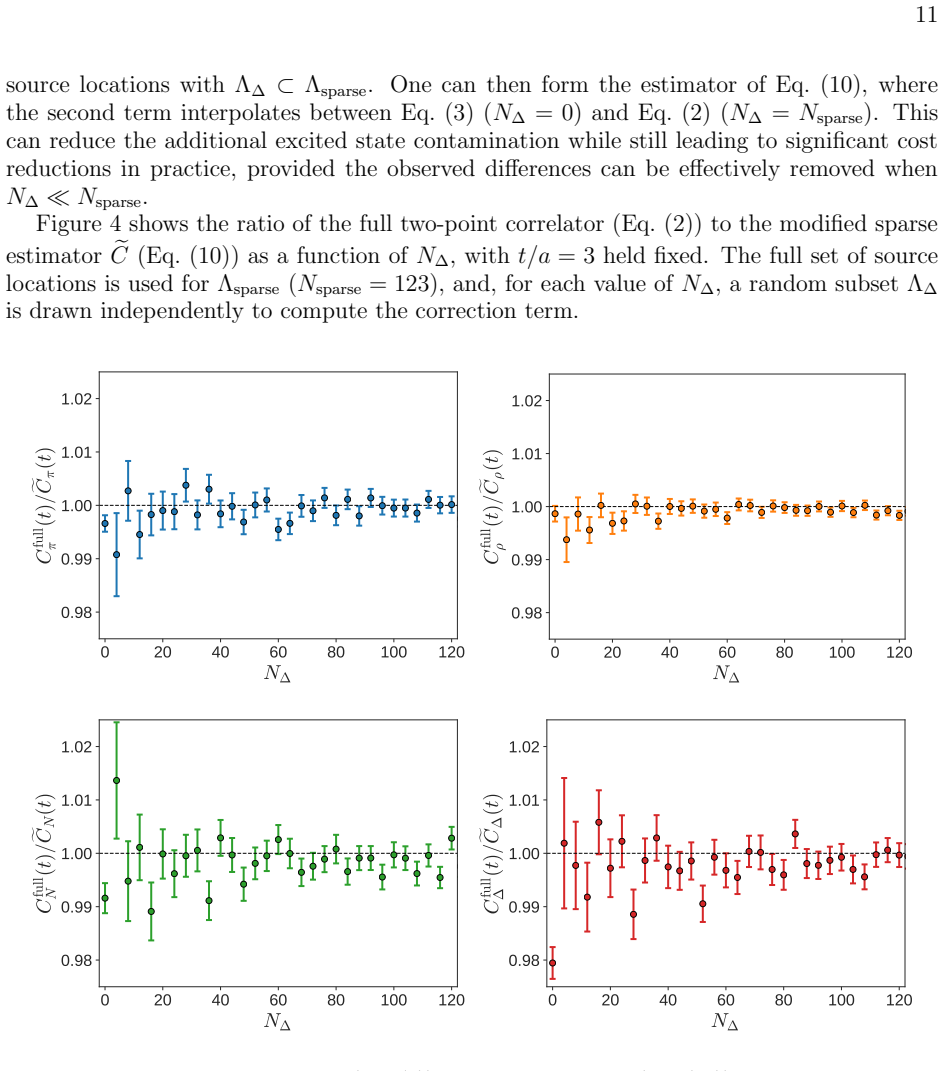
The central claim is that a simple spatial blocking prescription—uniformly blocking the lattice by a factor N = 4 and taking the propagator value at the first site of each block—produces a sparsened correlation function whose ground-state plateau, extracted energy, and jackknife uncertainty are consistent with those of the full correlation function, for pions, rho mesons, nucleons, $\Delta$ baryons, and the NN, 3He, and 4He systems. The authors argue this is guaranteed at the level of the theory because sparsening only changes the sink interpolating operator, and any operator with the right quantum numbers probes the same finite-volume spectrum; the practical question is whether the overlaps and statistical noise are preserved. They find that excited-state couplings are modified at early Euclidean times, especially at higher momentum, but that a modified estimator with a small number of full-propagator correction sources removes this contamination.
Load-bearing premise
The load-bearing premise is that quark propagators are smooth enough that sampling one site per $4^{3}$ block preserves the ground-state signal; this has only been demonstrated on a single ensemble with a heavy pion mass, so it could fail at physical quark masses or finer lattice spacings.
Editorial extensions
If this is right
- Contraction-stage cost for multi-nucleon systems drops by roughly the block volume factor, enabling calculations of heavier nuclei or larger variational bases at fixed computational budget.
- The modified estimator with a small number of full-propagator sources removes the sparsening-induced excited-state contamination, so the method can be used in spectroscopy with large operator bases.
- Because the allowed blocking factor grows as the lattice spacing shrinks relative to the hadronic scale, the speedup increases toward the continuum limit.
- The same sparsening principle should apply to three-point functions and background-field calculations, where block construction currently dominates the cost.
Reading between the lines
- If the coherence-length estimate scales inversely with the pion mass, then at physical quark mass the safe blocking factor could be larger than 4, making sparsening even more effective—but the short-distance structure of heavier nuclei may set a stricter limit.
- The correction term in the modified estimator is essentially an all-mode-averaging correction applied in position space; combining sparsening with low-mode deflation of the Dirac operator could give a systematic hierarchy of approximations with controlled bias.
- Sparsening could also be applied at the source rather than the sink, or used to compress stored propagators, reducing both memory and I/O, though the paper does not explore this.
- A practical test for future ensembles is to check that the ratio of sparsened to full effective masses approaches unity within errors at every plateau time; if the residual deviates at larger momenta, the blocking scale must be reduced.
Signed reviews
Editorial analysis
A structured set of objections, weighed in public.
Referee Report
Summary. This paper proposes a 'sparsening' algorithm for lattice QCD correlation functions: quark propagators are retained only on a coarsened spatial sublattice (one site per N^3 block), and correlators are assembled from these sparsened propagators. Using one 32^3 x 48 Wilson-clover ensemble at m_pi ~ 806 MeV and a ~ 0.145 fm, with N = 4, the authors compare effective energies and single-exponential ground-state fits for the pion, rho, nucleon, Delta, and for two-nucleon, 3He, and 4He channels, finding full and sparsened results statistically consistent in central values and jackknife uncertainties. They further propose a hybrid estimator (Eq. (10)) that corrects modified excited-state couplings using a small number of full-propagator source locations, and claim O(10-100) speedups in the contraction stage.
Significance. If the consistency holds beyond the tested ensemble and blocking factor, the method is a practical and welcome tool: contraction costs in multi-hadron calculations are often dominant, and a reduction by roughly N^3 in the number of sink sites would be valuable. The paper's statistical analysis is careful: correlated single-exponential fits, jackknife errors, condition numbers, scatter regressions with R^2, and effective-mass plateaus are all reported, and the hybrid estimator is a sensible adaptation of all-mode-averaging ideas. The central caveats are that the advertised speedup is not measured and the consistency result rests on a single blocking factor at a single heavy-pion ensemble.
major comments (3)
- [Section II, after Eq. (3)] The statement that sparsening is 'guaranteed to preserve' physical observables because any interpolating operator with the correct quantum numbers is equally valid is too strong. The sparsened sink is not a definite-momentum operator: Eq. (3) couples to the momentum comb p + 2 pi m / (N a). For the momenta tested, |n| <= sqrt(5), p is indeed the lowest state in this comb, but for larger momenta the lowest state can be an aliased momentum, so the extracted ground state would not be the intended one. The consistency claim should either be restricted to the tested kinematic window or supplemented by a demonstration with larger momenta (or other N values) showing that aliased states do not contaminate the extracted energies.
- [Tables II-IV and Figures 2-5] All consistency results are at the single blocking factor N = 4, chosen from the correlation-length estimate (a m_pi / 2)^{-1} ~ 3.4. Because N is the only free parameter in the method, the absence of an N-scan (e.g., N = 2, 6, 8) leaves open the possibility that the agreement is a tuned coincidence. A scan over N would show whether the plateau consistency and fit results vary smoothly with N and would establish robustness; without it, the claim that sparsening preserves ground-state energies is not supported beyond this one parameter point on this one ensemble.
- [Section IV (Conclusions)] The claim that the method enables O(10-100) fold speedups in the contraction stage is not supported by any timing measurement, operation count, or benchmark in the paper. The reduction in sink sites is a factor of N^3 = 64 for N = 4, but actual contraction speed depends on implementation, memory access, and the overhead of sparse data structures. Please report measured timings for the contractions used here, or rephrase the conclusion as an expected asymptotic speedup based on site reduction with appropriate caveats.
minor comments (4)
- [Section III B, Eq. (10)] The cost-effectiveness of the hybrid estimator is not quantified; please report the number of full-propagator source locations N_Delta needed to reach a given bias/error target, and state whether this is small compared with N_sparse for the ensemble studied.
- [Section II] The word 'sophisticted' in the paragraph on blocking procedures should be corrected to 'sophisticated', and the terminology 'sparsified' in Section IV should be made consistent with the 'sparsened' used elsewhere.
- [Section III A 1] The text states that the scale of correlations is supported by a numerical study in companion proceedings Ref. [60]; a brief summary of that study in the main text would make the choice of N = 4 more self-contained.
- [Section III B, Figure 4] The convergence of the hybrid estimator in N_Delta is shown only for sources on a single time slice; the authors note this in the text, but a short discussion of how the required N_Delta would scale with a more distributed source ensemble would help readers assess the practical cost reduction.
Circularity Check
No circular derivation: sparsened and full correlator consistency is an empirical comparison on the same ensemble, and the blocking factor N=4 is chosen from a physical scale, not fitted to the reported energies.
full rationale
The central claim is that ground-state masses and binding energies extracted from sparsened correlation functions match those from full correlation functions. This is a direct numerical consistency check on the same ensemble, not a quantity derived from a fitted parameter: the only tunable input is the blocking factor N, fixed to 4 using the physical correlation-length estimate (a m_pi/2)^{-1} ~ 3.4 in Sec. III, and no parameter is adjusted to bring the Tables II-IV results into agreement. The late-time proportionality between C_sparse and C_full for the lowest state is a spectral consequence of using an interpolating operator with the right quantum numbers (Sec. II), and the paper explicitly frames the modified excited-state couplings as an empirical question. The hybrid estimator Eq. (10) does interpolate to the full correlator when N_Delta = N_sparse, but that is stated as its design, and the paper's use at small N_Delta is tested empirically, not assumed. Self-citations (Refs. [59] and [60]) motivate the coherence scale for choosing N but are not load-bearing for the validation; the paper's own comparisons on the ensemble substantiate the claim. The single-ensemble, N=4-only validation and the absence of an N-scan are scope and robustness limitations, not circularity. No step in the derivation reduces by construction to its own input, so the circularity score is correspondingly low.
Assumptions & free parameters
free parameters (1)
- spatial blocking factor N =
4
assumptions (3)
- domain assumption Hadronic two-point functions are locally coherent at the spacing scale N a, so sampling one site per N-block captures the low-energy physics.
- domain assumption Any interpolating operator with the correct quantum numbers couples to the same finite-volume spectrum, so replacing the full sink with a sparsened sink preserves the ground-state energies.
- domain assumption The gauge ensemble, quark propagators, and baryon block contractions, taken from the NPLQCD program and Ref. [9], are correct inputs.
Cite this review
Pith. "Pith review of Sparsening Algorithm for Multi-Hadron Lattice QCD Correlation Functions." pith.science (2026). https://pith.science/paper/KQZAHBHT
@misc{pith2026190807050,
  author       = {Pith},
  title        = {Pith review of: Sparsening Algorithm for Multi-Hadron Lattice QCD Correlation Functions},
  year         = {2026},
  howpublished = {\url{https://pith.science/paper/KQZAHBHT}},
  note         = {Machine review of arXiv:1908.07050}
}
abstract
Modern advances in algorithms for lattice QCD calculations have steadily driven down the resources required to generate gauge field ensembles and calculate quark propagators, such that, in cases relevant to nuclear physics, performing quark contractions to assemble correlation functions from propagators has become the dominant cost. This work explores a propagator sparsening algorithm for forming correlation functions describing multi-hadron systems, such as light nuclei, with reduced computational cost. The algorithm constructs correlation functions from sparsened propagators defined on a coarsened lattice geometry, where the sparsened propagators are obtained from propagators computed on the full lattice. This algorithm is used to study the low-energy QCD ground-state spectrum using a single Wilson-clover lattice ensemble with $m_{\pi} \approx 800$ MeV. It is found that the extracted ground state masses and binding energies, as well as their statistical uncertainties, are consistent when determined from correlation functions constructed from sparsened and full propagators. In addition, while evidence of modified couplings to excited states is observed in sparsened correlation functions, it is demonstrated that these effects can be removed, if desired, with an inexpensive modification to the sparsened estimator.
Figures


Figures from the paper (3 more)


Forward citations
Cited by 5 Pith papers
-
Results on meson-meson scattering at large $N_\text{c}$
Using lattice QCD with 3 to 6 colors and four quark flavors, the paper measures pion-pion scattering phase shifts and finds evidence consistent with a virtual bound state in one channel at three colors.
-
Distillation and position-space sampling for local multiquark interpolators
Randomly displaced sparse grids inside distillation produce an unbiased estimator that makes local tetraquark operators affordable, with sampling noise already negligible at every-eighth-point spacing.
-
Wavefunction-based operator optimization for two-hadron systems in lattice QCD
Wavefunction-based operator optimization with Z3-noise smearing isolates two nearly degenerate two-hadron states in lattice QCD, demonstrated on Omega_ccc Omega_ccc.
-
Decoding Two-Particle States in QCD with Spatial Wavefunctions
A lattice QCD method using spatial wavefunctions and Z3-noise quark smearing resolves two Omega_ccc pair states separated by about 5 MeV.
-
Aspects of Propagator Sparsening in Lattice QCD
Repeated gauge-covariant averaging (blocking) before decimation reproduces unsparsened two- and three-point correlation functions more faithfully than plain decimation, but with larger statistical uncertainties and a ...
Reference graph
Works this paper leans on
-
[1]
(3), against the corresponding full two-point correla- tion functions, Eq
Consistency of Full and Sparsened Two-Point Correlation Functions To understand correlations between measurements, linear regressions of the sparsened two-point correlation functions, Eq. (3), against the corresponding full two-point correla- tion functions, Eq. (2), are computed and summarized in Table I and Figure 1. For each gauge field configuration use...
-
[2]
Effective Energies Figure 2 depicts the effective energy function aEeff(t) = cosh−1 [C(t− 1) +C(t + 1) 2C(t) ] , mesons sinh−1 [C(t− 1)−C(t + 1) 2C(t) ] , baryons (6) of hadrons with lattice momenta |⃗ n| ∈ {0, √ 2, 2}. At large Euclidean time separations, t/a≫ 1, the effective mass asymptotically approaches the energy of the ground state with the q...
-
[3]
Ground State Energy Extraction Ground state energies can be extracted from two-point correlation functions by deter- mining the parameters ⃗β minimizing χ2(⃗β) = ∑ ti∈Tfit ∑ tj∈Tfit ( C(⃗ p,ti)−f(ti;⃗β) )( Σ−1) ij ( C(⃗ p,tj)−f(tj;⃗β) ) , (7) where Σij = ⟨ (Cα(⃗ p,ti)−C(⃗ p,ti)) (Cα(⃗ p,tj)−C(⃗ p,tj)) ⟩ α (8) is the covariance matrix describing correlations...
-
[4]
S. R. Beane, W. Detmold, H.-W. Lin, T. C. Luu, K. Orginos, M. J. Savage, A. Torok, and A. Walker-Loud (NPLQCD), Phys. Rev. D81, 054505 (2010), arXiv:0912.4243 [hep-lat]
arXiv 2010
-
[5]
While sparsening offers no significant calculational speedup for correlation functions describing single hadrons, these are the simplest and most statistically precise quantities available to study in lattice QCD, and thus a natural starting point to examine the impact of sparsening. Similar studies of more complicated matrix elements involving these states...
-
[6]
B. Jo, C. Jung, N. H. Christ, W. Detmold, R. Edwards, M. Savage, and P. Shanahan (USQCD), (2019), arXiv:1904.09725 [hep-lat]
work page Pith review arXiv 2019
-
[7]
S. Aoki, T. Doi, T. Hatsuda, Y. Ikeda, T. Inoue, N. Ishii, K. Murano, H. Nemura, and K. Sasaki (HAL QCD), PTEP 2012, 01A105 (2012), arXiv:1206.5088 [hep-lat]
arXiv 2012
-
[8]
S. R. Beane, P. F. Bedaque, K. Orginos, and M. J. Savage, Phys. Rev. Lett. 97, 012001 (2006), arXiv:hep-lat/0602010 [hep-lat]
arXiv 2006
Show all 66 references
-
[9]
S. R. Beane, W. Detmold, T. C. Luu, K. Orginos, A. Parre˜ no, M. J. Savage, A. Torok, and A. Walker-Loud, Phys. Rev. D80, 074501 (2009), arXiv:0905.0466 [hep-lat]
2009 arXiv
-
[10]
S. R. Beane et al. (NPLQCD), Phys. Rev. Lett. 106, 162001 (2011), arXiv:1012.3812 [hep-lat]
2011 arXiv
-
[11]
S. R. Beane, W. Detmold, K. Orginos, and M. J. Savage, Prog. Part. Nucl. Phys. 66, 1 (2011), arXiv:1004.2935 [hep-lat]
2011 arXiv
-
[12]
S. R. Beane, E. Chang, W. Detmold, H. W. Lin, T. C. Luu, K. Orginos, A. Parreno, M. J. Savage, A. Torok, and A. Walker-Loud (NPLQCD), Phys. Rev. D85, 054511 (2012), arXiv:1109.2889 [hep-lat]
2012 arXiv
-
[13]
S. R. Beane, E. Chang, S. D. Cohen, W. Detmold, H. W. Lin, T. C. Luu, K. Orginos, A. Parre˜ no, M. J. Savage, and A. Walker-Loud (NPLQCD), Phys. Rev.D87, 034506 (2013), arXiv:1206.5219 [hep-lat]
2013 arXiv
-
[14]
S. R. Beane, E. Chang, S. D. Cohen, W. Detmold, H. W. Lin, T. C. Luu, K. Orginos, A. Par- 16 reno, M. J. Savage, and A. Walker-Loud, Phys. Rev. Lett.109, 172001 (2012), arXiv:1204.3606 [hep-lat]
2012 arXiv
-
[15]
S. R. Beane et al. (NPLQCD), Phys. Rev. C88, 024003 (2013), arXiv:1301.5790 [hep-lat]
2013 arXiv
-
[16]
S. R. Beane, E. Chang, S. Cohen, W. Detmold, H. W. Lin, K. Orginos, A. Parreno, M. J. Savage, and B. C. Tiburzi, Phys. Rev. Lett. 113, 252001 (2014), arXiv:1409.3556 [hep-lat]
2014 arXiv
-
[17]
Berkowitz, T
E. Berkowitz, T. Kurth, A. Nicholson, B. Joo, E. Rinaldi, M. Strother, P. M. Vranas, and A. Walker-Loud, Phys. Lett. B765, 285 (2017), arXiv:1508.00886 [hep-lat]
2017 arXiv
-
[18]
S. R. Beane, E. Chang, W. Detmold, K. Orginos, A. Parreo, M. J. Savage, and B. C. Tiburzi (NPLQCD), Phys. Rev. Lett. 115, 132001 (2015), arXiv:1505.02422 [hep-lat]
2015 arXiv
-
[19]
Berkowitz, A
E. Berkowitz, A. Nicholson, C. C. Chang, E. Rinaldi, M. A. Clark, B. Jo, T. Kurth, P. Vranas, and A. Walker-Loud, Proceedings, 35th International Symposium on Lattice Field Theory (Lattice 2017): Granada, Spain, June 18-24, 2017 , EPJ Web Conf. 175, 05029 (2018), arXiv:1710.05...
2018 arXiv
-
[20]
E. Berkowitz et al., Proceedings, 36th International Symposium on Lattice Field Theory (Lat- tice 2018): East Lansing, MI, United States, July 22-28, 2018 , PoS LATTICE2018, 003 (2018), arXiv:1902.09416 [hep-lat]
2018 arXiv
-
[21]
Chang, W
E. Chang, W. Detmold, K. Orginos, A. Parre˜ no, M. J. Savage, B. C. Tiburzi, and S. R. Beane (NPLQCD), Phys. Rev. D92, 114502 (2015), arXiv:1506.05518 [hep-lat]
2015 arXiv
-
[22]
Chang, Z
E. Chang, Z. Davoudi, W. Detmold, A. S. Gambhir, K. Orginos, M. J. Savage, P. E. Shana- han, M. L. Wagman, and F. Winter (NPLQCD), Phys. Rev. Lett. 120, 152002 (2018), arXiv:1712.03221 [hep-lat]
2018 arXiv
-
[23]
Doi and M
T. Doi and M. G. Endres, Comput. Phys. Commun. 184, 117 (2013), arXiv:1205.0585 [hep- lat]
2013 arXiv
-
[24]
Francis, C
A. Francis, C. Miao, T. D. Rae, and H. Wittig, Proceedings, 31st International Symposium on Lattice Field Theory (Lattice 2013): Mainz, Germany, July 29-August 3, 2013 , PoS LAT- TICE2013, 440 (2014), arXiv:1311.3933 [hep-lat]
2014 arXiv
-
[25]
Francis, J
A. Francis, J. R. Green, P. M. Junnarkar, C. Miao, T. D. Rae, and H. Wittig, Phys. Rev. D99, 074505 (2019), arXiv:1805.03966 [hep-lat]
2019 arXiv
-
[26]
Ishii, S
N. Ishii, S. Aoki, T. Doi, T. Hatsuda, Y. Ikeda, T. Inoue, K. Murano, H. Nemura, and K. Sasaki (HAL QCD), Phys. Lett. B712, 437 (2012), arXiv:1203.3642 [hep-lat]
2012 arXiv
-
[27]
Hanlon, A
A. Hanlon, A. Francis, J. Green, P. Junnarkar, and H. Wittig, Proceedings, 36th International Symposium on Lattice Field Theory (Lattice 2018): East Lansing, MI, United States, July 22-28, 2018, PoS LATTICE2018, 081 (2018), arXiv:1810.13282 [hep-lat]
2018 arXiv
-
[28]
Iritani, S
T. Iritani, S. Aoki, T. Doi, S. Gongyo, T. Hatsuda, Y. Ikeda, T. Inoue, N. Ishii, H. Nemura, and K. Sasaki (HAL QCD), Phys. Rev. D99, 014514 (2019), arXiv:1805.02365 [hep-lat]
2019 arXiv
-
[29]
Iritani et al
T. Iritani et al. (HAL QCD), Phys. Lett. B792, 284 (2019), arXiv:1810.03416 [hep-lat]
2019 arXiv
-
[30]
Ishii, S
N. Ishii, S. Aoki, and T. Hatsuda, Phys. Rev. Lett. 99, 022001 (2007), arXiv:nucl-th/0611096 [nucl-th]
2007 arXiv
-
[31]
Nemura et al
H. Nemura et al. , Proceedings, 34th International Symposium on Lattice Field Theory (Lattice 2016): Southampton, UK, July 24-30, 2016 , PoS LATTICE2016, 101 (2017), arXiv:1702.00734 [hep-lat]
2017 arXiv
-
[32]
Orginos, A
K. Orginos, A. Parreno, M. J. Savage, S. R. Beane, E. Chang, and W. Detmold, Phys. Rev. D92, 114512 (2015), arXiv:1508.07583 [hep-lat]
2015 arXiv
-
[33]
M. J. Savage, P. E. Shanahan, B. C. Tiburzi, M. L. Wagman, F. Winter, S. R. Beane, E. Chang, Z. Davoudi, W. Detmold, and K. Orginos, Phys. Rev. Lett. 119, 062002 (2017), arXiv:1610.04545 [hep-lat]. 17
2017 arXiv
-
[34]
P. E. Shanahan, B. C. Tiburzi, M. L. Wagman, F. Winter, E. Chang, Z. Davoudi, W. Detmold, K. Orginos, and M. J. Savage, Phys. Rev. Lett.119, 062003 (2017), arXiv:1701.03456 [hep-lat]
2017 arXiv
-
[35]
B. C. Tiburzi, M. L. Wagman, F. Winter, E. Chang, Z. Davoudi, W. Detmold, K. Orginos, M. J. Savage, and P. E. Shanahan, Phys. Rev.D96, 054505 (2017), arXiv:1702.02929 [hep-lat]
2017 arXiv
-
[36]
M. L. Wagman, F. Winter, E. Chang, Z. Davoudi, W. Detmold, K. Orginos, M. J. Savage, and P. E. Shanahan, Phys. Rev. D96, 114510 (2017), arXiv:1706.06550 [hep-lat]
2017 arXiv
-
[37]
Winter, W
F. Winter, W. Detmold, A. S. Gambhir, K. Orginos, M. J. Savage, P. E. Shanahan, and M. L. Wagman, Phys. Rev. D96, 094512 (2017), arXiv:1709.00395 [hep-lat]
2017 arXiv
-
[38]
Yamazaki, Y
T. Yamazaki, Y. Kuramashi, and A. Ukawa (PACS-CS), Phys. Rev. D81, 111504 (2010), arXiv:0912.1383 [hep-lat]
2010 arXiv
-
[39]
Yamazaki, Y
T. Yamazaki, Y. Kuramashi, and A. Ukawa (PACS-CS), Phys. Rev. D84, 054506 (2011), arXiv:1105.1418 [hep-lat]
2011 arXiv
-
[40]
Yamazaki, K.-i
T. Yamazaki, K.-i. Ishikawa, Y. Kuramashi, and A. Ukawa, Phys. Rev. D86, 074514 (2012), arXiv:1207.4277 [hep-lat]
2012 arXiv
-
[41]
Yamazaki, K.-i
T. Yamazaki, K.-i. Ishikawa, Y. Kuramashi, and A. Ukawa, Phys. Rev. D92, 014501 (2015), arXiv:1502.04182 [hep-lat]
2015 arXiv
-
[42]
T. Yamazaki (PACS), Proceedings, 33rd International Symposium on Lattice Field The- ory (Lattice 2015): Kobe, Japan, July 14-18, 2015 , PoS LATTICE2015, 081 (2016), arXiv:1511.09179 [hep-lat]
2016 arXiv
-
[43]
Yamazaki, K.-i
T. Yamazaki, K.-i. Ishikawa, and Y. Kuramashi (PACS), Proceedings, 35th International Sym- posium on Lattice Field Theory (Lattice 2017): Granada, Spain, June 18-24, 2017 , EPJ Web Conf. 175, 05019 (2018), arXiv:1710.08066 [hep-lat]
2018 arXiv
-
[44]
Duane, A
S. Duane, A. D. Kennedy, B. J. Pendleton, and D. Roweth, Phys. Lett. B195, 216 (1987)
1987
-
[45]
Babich, J
R. Babich, J. Brannick, R. C. Brower, M. A. Clark, T. A. Manteuffel, S. F. McCormick, J. C. Osborn, and C. Rebbi, Phys. Rev. Lett. 105, 201602 (2010), arXiv:1005.3043 [hep-lat]
2010 arXiv
-
[46]
J. C. Osborn, R. Babich, J. Brannick, R. C. Brower, M. A. Clark, S. D. Cohen, and C. Rebbi, Proceedings, 28th International Symposium on Lattice field theory (Lattice 2010): Villasimius, Italy, June 14-19, 2010 , PoS LATTICE2010, 037 (2010), arXiv:1011.2775 [hep-lat]
2010 arXiv
-
[47]
P. A. Boyle, (2014), arXiv:1402.2585 [hep-lat]
2014 arXiv
-
[48]
M. G. Endres, R. C. Brower, W. Detmold, K. Orginos, and A. V. Pochinsky, Phys. Rev. D 92, 114516 (2015)
2015
-
[49]
Detmold and M
W. Detmold and M. G. Endres, Phys. Rev. D94, 114502 (2016), arXiv:1605.09650 [hep-lat]
2016 arXiv
-
[50]
M. A. Clark, B. Jo, A. Strelchenko, M. Cheng, A. Gambhir, and R. Brower, (2016), arXiv:1612.07873 [hep-lat]
2016 arXiv
-
[51]
Yamaguchi and P
A. Yamaguchi and P. Boyle, Proceedings, 34th International Symposium on Lattice Field The- ory (Lattice 2016): Southampton, UK, July 24-30, 2016 , PoS LATTICE2016, 374 (2016), arXiv:1611.06944 [hep-lat]
2016 arXiv
-
[52]
Bacchio, C
S. Bacchio, C. Alexandrou, and J. Finkerath, Proceedings, 35th International Symposium on Lattice Field Theory (Lattice 2017): Granada, Spain, June 18-24, 2017 , EPJ Web Conf. 175, 02002 (2018), arXiv:1710.06198 [hep-lat]
2018 arXiv
-
[53]
R. C. Brower, M. A. Clark, A. Strelchenko, and E. Weinberg, Phys. Rev. D97, 114513 (2018), arXiv:1801.07823 [hep-lat]
2018 arXiv
-
[54]
Richtmann, P
D. Richtmann, P. A. Boyle, and T. Wettig, in 36th International Symposium on Lattice Field Theory (Lattice 2018) East Lansing, MI, United States, July 22-28, 2018 (2019) arXiv:1904.08678 [hep-lat]
2019 arXiv
-
[55]
M. A. Clark, C. Jung, and C. Lehner, Proceedings, 35th International Symposium on Lattice 18 Field Theory (Lattice 2017): Granada, Spain, June 18-24, 2017 , EPJ Web Conf. 175, 14023 (2018), arXiv:1710.06884 [hep-lat]
2018 arXiv
-
[56]
Basak, R
S. Basak, R. Edwards, G. T. Fleming, U. M. Heller, C. Morningstar, D. Richards, I. Sato, and S. J. Wallace (Lattice Hadron Physics (LHPC)), Phys. Rev. D72, 074501 (2005), arXiv:hep- lat/0508018 [hep-lat]
2005
-
[57]
S. R. Beane, P. F. Bedaque, K. Orginos, and M. J. Savage (NPLQCD), Phys. Rev. D73, 054503 (2006), arXiv:hep-lat/0506013 [hep-lat]
2006 arXiv
-
[58]
S. R. Beane, K. Orginos, and M. J. Savage, Int. J. Mod. Phys. E17, 1157 (2008), arXiv:0805.4629 [hep-lat]
2008 arXiv
-
[59]
Detmold and K
W. Detmold and K. Orginos, Phys. Rev. D87, 114512 (2013), arXiv:1207.1452 [hep-lat]
2013 arXiv
-
[60]
Sheikholeslami and R
B. Sheikholeslami and R. Wohlert, Nucl. Phys. B259, 572 (1985)
1985
-
[61]
L¨ uscher and P
M. L¨ uscher and P. Weisz, Commun. Math. Phys. 97, 59 (1985), [Erratum: Commun. Math. Phys.98,433(1985)]
1985
-
[62]
Albanese et al
M. Albanese et al. (APE), Phys. Lett. B192, 163 (1987)
1987
-
[63]
M. L. Wagman and M. J. Savage, Phys. Rev. D96, 114508 (2017), arXiv:1611.07643 [hep-lat]
2017 arXiv
-
[64]
Detmold, D
W. Detmold, D. J. Murphy, A. V. Pochinsky, M. J. Savage, P. E. Shanahan, and M. L. Wagman, Proceedings, 37th International Symposium on Lattice Field Theory (Lattice 2019): Wuhan, China, June 16-22, 2019 , PoS LATTICE2019, 104 (2019)
2019
-
[65]
Shintani, R
E. Shintani, R. Arthur, T. Blum, T. Izubuchi, C. Jung, and C. Lehner, Phys. Rev. D91, 114511 (2015), arXiv:1402.0244 [hep-lat]
2015 arXiv
-
[66]
R. G. Edwards and B. Jo´ o (SciDAC, LHPC, UKQCD),Lattice field theory. Proceedings, 22nd International Symposium, Lattice 2004, Batavia, USA, June 21-26, 2004 , Nucl. Phys. Proc. Suppl. 140, 832 (2005), [,832(2004)], arXiv:hep-lat/0409003 [hep-lat]
2005 arXiv
Reviewed August 14, 2026 · model on record in the stance chip above.
Discussion (0). Continue with ORCID to comment.