REVIEW 3 major objections 5 minor 84 references
Tvarak: Software-managed hardware offload for DAX NVM storage redundancy
T0 review · 3 major / 5 minor · reviewed 2026-08-14 · deepseek-v4-flash
Pith's one-line read A hardware controller beside the last-level cache can protect DAX NVM data from firmware corruption with a 3% slowdown.
desk verdict Worth a serious referee: a genuinely new hardware offload for DAX NVM redundancy, with one unstated correctness detail (diff accumulation) that should be pinned down before publication. read the letter →
The pith
A machine-rendered reading of the paper's core claim, the machinery that carries it, and where it could break.
The reading
What carries the argument
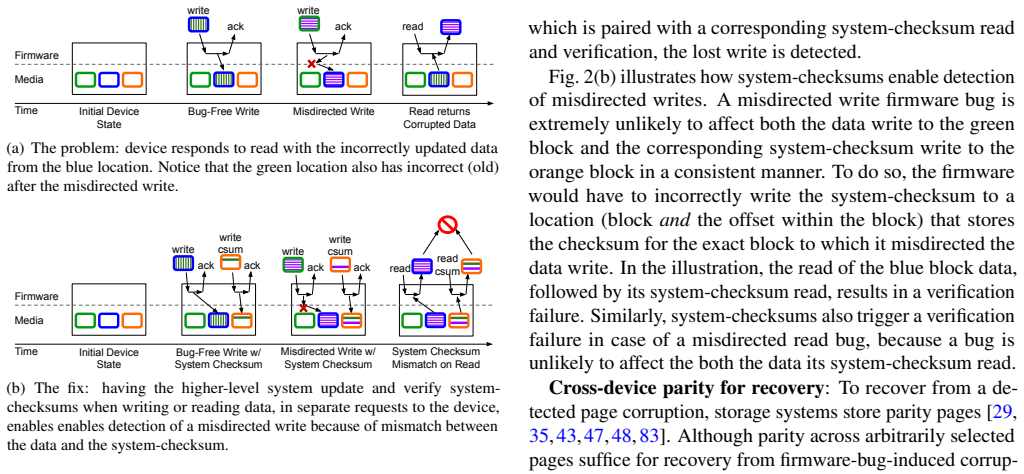
The argument is carried by three mechanisms working together. First, DAX-CL-checksums: 4-byte per-cache-line checksums, packed 16 to a 64-byte line, maintained only while a page is DAX-mapped, which cut read verification from reading a whole 4KB page plus its checksum (65x amplification) to reading one data line plus one checksum line (2x). Second, redundancy caching: a 4KB on-controller cache plus reserved LLC ways for checksum and parity lines, exploiting data access locality so updates rarely require extra NVM writes. Third, data-diff reuse: the LLC already holds the pre-update value of a dirty line, so TVARAK computes the checksum and parity delta from that diff instead of re-reading old data from NVM. The paper's evaluation uses a cycle-level simulator of a multicore system with NVM timing derived from published phase-change memory parameters.
What would settle it
Take a DAX-mapped region under TVARAK, perform acknowledged writes, then cut power without allowing any cache flush; if the NVM still contains the old data, checksum, or parity for any acknowledged write, the redundancy invariant is broken. A less destructive test is to fault-inject a lost-write or misdirected-write bug in simulated NVM and check that TVARAK's checksum mismatch is always reported and recoverable from parity.
Extended reading notes
Core claim
The central discovery is that the redundancy metadata that makes DAX NVM safe against firmware bugs can be maintained in hardware, inside the cache hierarchy, without adding software to the data path. TVARAK is a controller co-located with LLC bank controllers; the file system tells it which physical page ranges are DAX-mapped, and TVARAK then verifies each NVM cache-line read against a newly introduced cache-line-granular checksum (a DAX-CL-checksum) and updates system-checksums and cross-DIMM parity on each cache-line write-back. Because DAX-CL-checksums exist only for mapped regions, space overhead stays limited, and because checksum and parity cache lines are cached in a small on-controller cache plus reserved LLC partitions, most redundancy updates never reach NVM. In simulation, TVARAK slows the write-heavy key-value workload by 3% versus 50% for a software-only transactional library, verifies every read, and keeps energy overhead in line with runtime.
Load-bearing premise
TVARAK's correctness depends on the server having backup power that flushes CPU caches to NVM when power fails, because updated checksums and parity may be sitting in its on-controller cache or the LLC partition rather than in NVM at the moment of a crash.
Editorial extensions
If this is right
- Applications can keep using plain load/store DAX access and still get detection of lost writes and misdirected reads or writes, with no library API or transaction requirement.
- Every NVM read is verified inline, closing the detection window that background scrubbing leaves open.
- Redundancy space overhead is bounded: DAX-CL-checksums are allocated only while a file is mapped, and recovery still uses page-granular system-checksums that survive unmapping.
- Workloads with sequential or local access pay near-zero overhead, while random-write workloads are the worst case, still far better than software-only alternatives.
- Because the overhead is mostly NVM traffic rather than CPU instructions, TVARAK's benefit grows as NVM bandwidth and DIMM counts improve.
Reading between the lines
- A testable extension left implicit by the paper: the same DAX-CL-checksum mechanism could carry other per-cache-line metadata, such as encryption tags or wear-leveling counters, since it already solves the fine-granularity-update problem.
- The sensitivity results suggest that an adaptive LLC partition policy, which the paper names as future work, could recover the worst-case random-write losses by shrinking redundancy partitions when data locality is poor.
- Given the backup-power assumption, TVARAK implies that a RAID-like parity update can be made nearly free on the write path, which may change how NVM file systems trade write amplification against durability.
- On real NVM hardware, the key prediction is that read-heavy DAX workloads with high locality will run near baseline throughput while write-heavy random workloads will degrade by roughly a third; measuring that split would validate or refute the simulation.
Signed reviews
Editorial analysis
A structured set of objections, weighed in public.
Referee Report
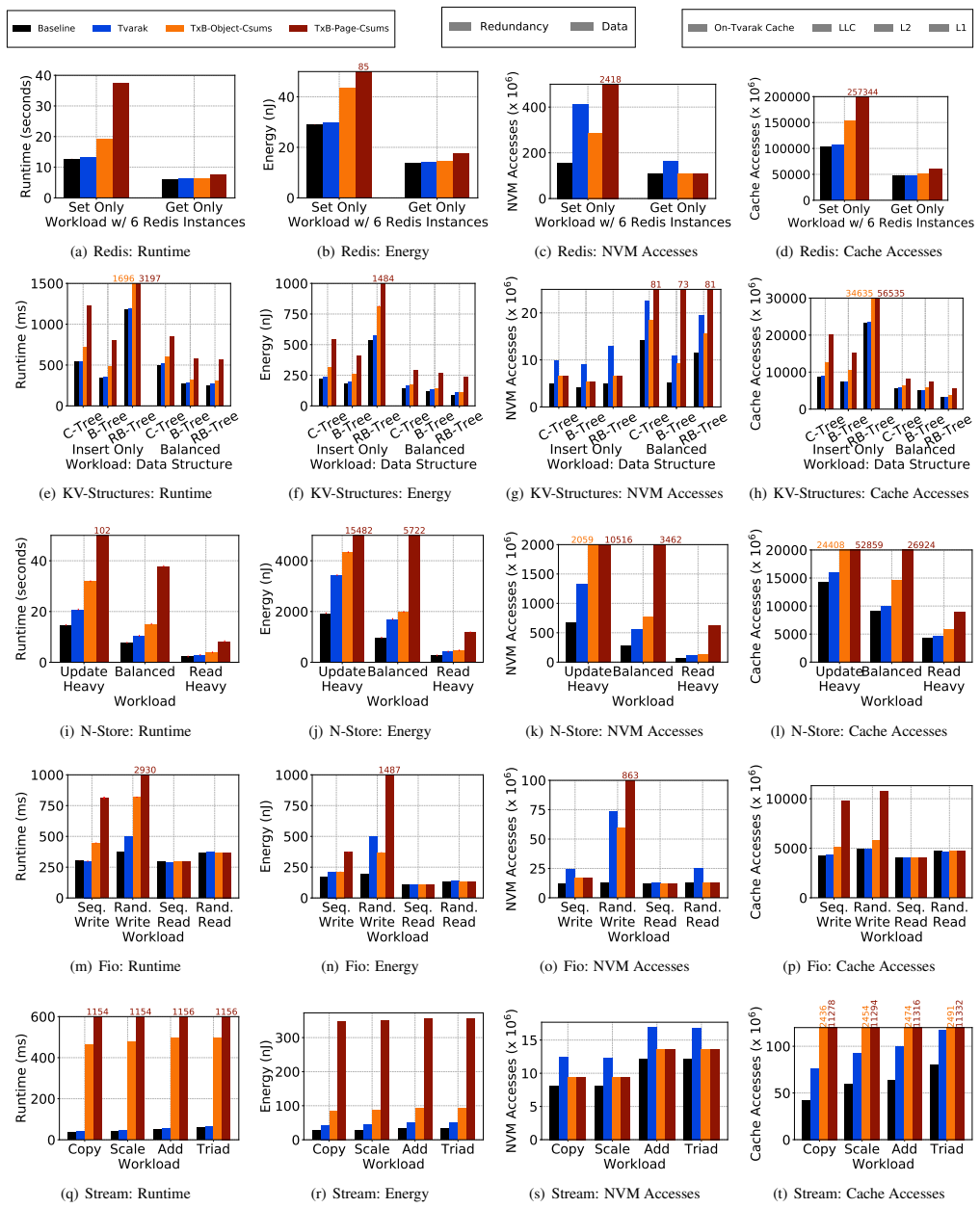
Summary. The paper proposes TVARAK, a hardware controller co-located with last-level cache (LLC) bank controllers, to maintain system-level redundancy (per-page system-checksums and cross-DIMM parity) for DAX-mapped NVM data. The design introduces DAX-CL-checksums for efficient on-read verification, caches redundancy information in an on-controller cache and LLC partitions, and stores data diffs in an LLC partition to avoid reading old data on write-back. The paper also assumes backup power to flush caches on power failure. Using zsim simulation of a Westmere-like 12-core system, the authors compare TVARAK against a no-redundancy baseline and two software-only redundancy approaches (TxB-Object-Csums based on Pangolin, and TxB-Page-Csums based on Mojim/HotPot) across seven applications. Headline results include a 3% slowdown for Redis set-only versus 50% for TxB-Object-Csums, and 1.5% overhead for insert-only tree key-value workloads.
Significance. The paper targets a real and timely problem: protecting DAX-mapped NVM data against device-firmware bugs (lost writes and misdirected reads/writes) without incurring the large performance cost of software-only redundancy maintenance. If the design is correct, TVARAK would be a practical architectural contribution, since it provides continuous verification on reads and updates on write-backs with modest overheads. The evaluation is unusually broad, covering seven applications with multiple workloads, a sensitivity analysis over LLC partition sizes, and comparison with representative software baselines. The authors also include a design-choice breakdown that usefully isolates the contribution of each optimization. The main correctness-relevant assumption, backup power for cache flushing, is explicitly stated and is common in production systems. However, a key implementation detail of the data-diff mechanism is underspecified and, as written, can produce incorrect checksums and parity; this must be fixed before the paper's central claim can be accepted.
major comments (3)
- [§3.4 and Fig. 6] The data-diff mechanism is not fully specified for lines that are dirtied more than once before their LLC write-back. When a dirty line is evicted from L2 into the LLC, the paper says TVARAK computes the diff using the LLC's 'soon-to-be-old data value' and 'stores this diff in a LLC partition.' After this first eviction, the LLC copy is itself dirty and no longer equals the NVM value. On a second L2→LLC eviction of the same line, the computed diff is only the delta since the last LLC update; unless the new diff is XOR-accumulated into the previously stored diff entry, the final system-checksum/parity update at write-back will be computed from an incorrect total delta, silently breaking the redundancy invariant. The text must specify that the stored diff is a cumulative accumulator (and that the checksum/parity update uses the accumulated value), or it must specify an alternative protocol (e.g., forcing a write-back on the second eviction). This is load-bearing because maintaining correct checksums and parity is the paper's central purpose.
- [§4.4] N-Store results are reported from a single run with no error bars, in contrast to the stated methodology of averaging three runs. The N-Store numbers (27% and 41% overhead for TVARAK on read-heavy and update-heavy workloads) are used to demonstrate behavior under a random write-ahead log pattern, so this exception materially weakens the evidence for that workload class. Please provide multiple runs (or a statistical justification for the single run) before claiming these specific overhead figures.
- [§4.7 and Fig. 9] The design-choice analysis shows that the full TVARAK design is not Pareto-optimal for the evaluated workloads: for N-Store and fio random writes, enabling the redundancy cache and data-diff storage degrades performance compared to the intermediate EVU/EV configurations, because the reserved LLC partitions displace application data. The paper acknowledges this and defers adaptive partitioning to future work, but the main evaluation and abstract present 'TVARAK' with a fixed configuration (2 ways redundancy, 1 way data diffs). To support the generality of the central claim, the paper should either report the best per-workload configuration, implement a simple adaptive partition-sizing mechanism (e.g., set dueling, which it mentions), or restrict the headline claims to workloads where the full design is beneficial. As written, the 'complete TVARAK' configuration is not consistently the best design point.
minor comments (5)
- [§2.3] The phrase 'do to redundancy updates/verifications in software' should read 'due to redundancy updates/verifications in software.'
- [§4.7 and Fig. 9 caption] The text contains a garbled phrase: 'for N-Store and fio random writes:w —their random access patterns...' Please rephrase to improve readability.
- [Abstract and §1] The acronym TVARAK is used in the abstract before it is defined in a footnote; consider defining it at first use in the abstract or at the start of the introduction.
- [§4.4] The sentence 'N-Store is a NVM-optimized relational DBMS' should be 'an NVM-optimized relational DBMS.'
- [Table 3] The table lists 1-cycle latency for checksum/parity computation and verification; it would be helpful to state whether these operations are pipelined and whether the 4KB on-controller cache is accessed in parallel with the LLC tag lookup.
Circularity Check
No circularity: the design and performance claims are evaluated against independent simulation baselines, with no fitted parameters or self-citation chains carrying the derivation.
full rationale
TVARAK's contribution is a hardware design plus an evaluation; there is no derivation of a predicted quantity from a fitted parameter. The redundancy mechanisms (system-checksums, DAX-CL-checksums, cross-DIMM parity) are defined as design elements and evaluated in simulation against baseline, TxB-Object-Csums (Pangolin-based), and TxB-Page-Csums (Mojim/HotPot-based) approaches. No parameter is fitted to a subset of the reported data and then presented as a prediction; the 3% Redis overhead, for example, is a simulated runtime measurement against an external baseline, not an output forced by construction. The one self-citation, [34] (Anon), appears only in the related-work comparison in Table 1 and is not a load-bearing premise; it is used as a point of contrast regarding delayed/batched redundancy, and the paper's central correctness argument does not rely on it. The explicit backup-power assumption in Section 3.2 is a stated scope condition, and the data-diff mechanism in Section 3.4, while it may raise a correctness question about accumulating multiple deltas to a dirty line, is not an instance of a circular derivation: the paper does not define the checksum update 'in terms of' the result it claims to predict. The evaluation is self-contained against external benchmarks and prior published systems, so the appropriate finding is no significant circularity.
Assumptions & free parameters
free parameters (3)
- LLC redundancy cache partition size =
2 ways out of 16
- LLC data diff partition size =
1 way out of 16
- On-controller redundancy cache size =
4 KB per LLC bank
assumptions (5)
- domain assumption NVM firmware is prone to corruption-inducing bugs (lost writes, misdirected reads/writes).
- domain assumption System-checksums stored in separate I/O requests from data detect firmware-bug corruption.
- domain assumption Servers have backup power to flush CPU caches on power failure.
- domain assumption zsim simulation with Westmere-like cores and NVM parameters from Lee et al. accurately captures performance.
- standard math CRC-32C is a suitable incremental checksum.
Cite this review
Pith. "Pith review of Tvarak: Software-managed hardware offload for DAX NVM storage redundancy." pith.science (2026). https://pith.science/paper/IMITG4ZC
@misc{pith2026190809922,
  author       = {Pith},
  title        = {Pith review of: Tvarak: Software-managed hardware offload for DAX NVM storage redundancy},
  year         = {2026},
  howpublished = {\url{https://pith.science/paper/IMITG4ZC}},
  note         = {Machine review of arXiv:1908.09922}
}
read the original abstract
Tvarak efficiently implements system-level redundancy for direct-access (DAX) NVM storage. Production storage systems complement device-level ECC (which covers media errors) with system-checksums and cross-device parity. This system-level redundancy enables detection of and recovery from data corruption due to device firmware bugs (e.g., reading data from the wrong physical location). Direct access to NVM penalizes software-only implementations of system-level redundancy, forcing a choice between lack of data protection or significant performance penalties. Offloading the update and verification of system-level redundancy to Tvarak, a hardware controller co-located with the last-level cache, enables efficient protection of data from such bugs in memory controller and NVM DIMM firmware. Simulation-based evaluation with seven data-intensive applications shows Tvarak's performance and energy efficiency. For example, Tvarak reduces Redis set-only performance by only 3%, compared to 50% reduction for a state-of-the-art software-only approach.
Figures


Figures from the paper (4 more)



Reference graph
Works this paper leans on
-
[1]
In 2019 USENIX Annual Technical Conference (USENIX ATC 19) , Renton, W A, 2019
Pangolin: A Fault-Tolerant Persistent Memory Programming Library. In 2019 USENIX Annual Technical Conference (USENIX ATC 19) , Renton, W A, 2019. USENIX Association
2019
-
[2]
In 11th USENIX Workshop on Hot Topics in Storage and File Systems (HotStorage 19), Renton, W A, July 2019
Respecting the block interface – computational storage using virtual objects. In 11th USENIX Workshop on Hot Topics in Storage and File Systems (HotStorage 19), Renton, W A, July 2019. USENIX Associa- tion
2019
-
[3]
http://www.intel.com/ content/www/us/en/architecture-and-technology/non- volatile-memory.html
Intel Optane/Micron 3d-XPoint Memory. http://www.intel.com/ content/www/us/en/architecture-and-technology/non- volatile-memory.html
-
[4]
http://www.agigatech.com/ agigaram.php
AGIGARAM Non-Volatile System. http://www.agigatech.com/ agigaram.php
-
[5]
A Scalable Processing-in-memory Accelerator for Parallel Graph Processing
Junwhan Ahn, Sungpack Hong, Sungjoo Yoo, Onur Mutlu, and Kiy- oung Choi. A Scalable Processing-in-memory Accelerator for Parallel Graph Processing. In Proceedings of the 42Nd Annual International Symposium on Computer Architecture, ISCA ’15, pages 105–117, New York, NY , USA, 2015. ACM
work page 2015
-
[6]
PIM- enabled Instructions: A Low-overhead, Locality-aware Processing-in- memory Architecture
Junwhan Ahn, Sungjoo Yoo, Onur Mutlu, and Kiyoung Choi. PIM- enabled Instructions: A Low-overhead, Locality-aware Processing-in- memory Architecture. In Proceedings of the 42Nd Annual International Symposium on Computer Architecture, ISCA ’15, pages 336–348, New York, NY , USA, 2015. ACM
work page 2015
-
[7]
Joy Arulraj, Andrew Pavlo, and Subramanya R. Dulloor. Let’s Talk About Storage & Recovery Methods for Non-V olatile Memory Database Systems. In Proceedings of the 2015 ACM SIGMOD Inter- national Conference on Management of Data, SIGMOD ’15, pages 707–722, New York, NY , USA, 2015. ACM
work page 2015
-
[8]
Joy Arulraj, Matthew Perron, and Andrew Pavlo. Write-behind Log- ging. Proc. VLDB Endow., 10(4):337–348, November 2016
work page 2016
Show all 84 references
-
[9]
Fio-flexible I/O tester
Jens Axboe. Fio-flexible I/O tester. URL https://github.com/axboe/fio, 2014
2014
-
[10]
Bairavasundaram, Andrea C
Lakshmi N. Bairavasundaram, Andrea C. Arpaci-Dusseau, Remzi H. Arpaci-Dusseau, Garth R. Goodson, and Bianca Schroeder. An Analy- sis of Data Corruption in the Storage Stack. Trans. Storage, 4(3):8:1– 8:28, November 2008
2008
-
[11]
Mary Baker, Mehul Shah, David S. H. Rosenthal, Mema Roussopoulos, Petros Maniatis, TJ Giuli, and Prashanth Bungale. A Fresh Look at the Reliability of Long-term Digital Storage. In Proceedings of the 1st ACM SIGOPS/EuroSys European Conference on Computer Systems 2006, EuroSys ...
2006
-
[12]
Cho and H
S. Cho and H. Lee. Flip-N-Write: A simple deterministic technique to improve PRAM write performance, energy and endurance. In 2009 42nd Annual IEEE/ACM International Symposium on Microarchitec- ture (MICRO), pages 347–357, Dec 2009
2009
-
[13]
Sangyeun Cho, Chanik Park, Hyunok Oh, Sungchan Kim, Young- min Yi, and Gregory R. Ganger. Active Disk Meets Flash: A Case for Intelligent SSDs. In Proceedings of the 27th International ACM Conference on International Conference on Supercomputing, ICS ’13, pages 91–102, New Yor...
2013
-
[14]
L.O. Chua. Memristor-the missing circuit element. Circuit Theory, IEEE Transactions on, 18(5):507–519, Sep 1971
1971
-
[15]
Caulfield, Ameen Akel, Laura M
Joel Coburn, Adrian M. Caulfield, Ameen Akel, Laura M. Grupp, Ra- jesh K. Gupta, Ranjit Jhala, and Steven Swanson. NV-Heaps: Making Persistent Objects Fast and Safe with Next-generation, Non-volatile Memories. In Proceedings of the Sixteenth International Conference on Architec...
2011
-
[16]
Nightingale, Christopher Frost, Engin Ipek, Benjamin Lee, Doug Burger, and Derrick Coetzee
Jeremy Condit, Edmund B. Nightingale, Christopher Frost, Engin Ipek, Benjamin Lee, Doug Burger, and Derrick Coetzee. Better I/O Through Byte-addressable, Persistent Memory. In Proceedings of the ACM SIGOPS 22Nd Symposium on Operating Systems Principles , SOSP ’09, pages 133–14...
2009
-
[17]
A white paper on the benefits of chipkill-correct ecc for pc server main memory
Timothy J Dell. A white paper on the benefits of chipkill-correct ecc for pc server main memory. IBM Microelectronics Division, 11:1–23, 1997
1997
-
[18]
Nightin- gale, Matthew Renzelmann, Alex Shamis, Anirudh Badam, and Miguel Castro
Aleksandar Dragojevi´c, Dushyanth Narayanan, Edmund B. Nightin- gale, Matthew Renzelmann, Alex Shamis, Anirudh Badam, and Miguel Castro. No Compromises: Distributed Transactions with Consistency, Availability, and Performance. In Proceedings of the 25th Symposium on Operating ...
2015
-
[19]
Dulloor, Sanjay Kumar, Anil Keshavamurthy, Philip Lantz, Dheeraj Reddy, Rajesh Sankaran, and Jeff Jackson
Subramanya R. Dulloor, Sanjay Kumar, Anil Keshavamurthy, Philip Lantz, Dheeraj Reddy, Rajesh Sankaran, and Jeff Jackson. System Software for Persistent Memory. In Proceedings of the Ninth European Conference on Computer Systems , EuroSys ’14, pages 15:1–15:15, New York, NY , U...
2014
-
[20]
Farmahini-Farahani, J
A. Farmahini-Farahani, J. H. Ahn, K. Morrow, and N. S. Kim. NDA: Near-DRAM acceleration architecture leveraging commodity DRAM devices and standard memory modules. In 2015 IEEE 21st Inter- national Symposium on High Performance Computer Architecture (HPCA), pages 283–295, Feb 2015
2015
-
[21]
Ferreira, Miao Zhou, Santiago Bock, Bruce Childers, Rami Melhem, and Daniel Mossé
Alexandre P. Ferreira, Miao Zhou, Santiago Bock, Bruce Childers, Rami Melhem, and Daniel Mossé. Increasing PCM Main Memory Lifetime. In Proceedings of the Conference on Design, Automation and Test in Europe, DATE ’10, pages 914–919, 3001 Leuven, Belgium, Belgium, 2010. Europea...
2010
-
[22]
The google file system
Sanjay Ghemawat, Howard Gobioff, and Shun-Tak Leung. The google file system. In Proceedings of the Nineteenth ACM Symposium on Operating Systems Principles, SOSP ’03, pages 29–43, New York, NY , USA, 2003. ACM
2003
-
[23]
File system design for an nfs file server appliance
Dave Hitz, James Lau, and Michael Malcolm. File system design for an nfs file server appliance. In Proceedings of the USENIX Winter 1994 Technical Conference on USENIX Winter 1994 Technical Confer- ence, WTEC’94, pages 19–19, Berkeley, CA, USA, 1994. USENIX Association
1994
-
[24]
https://icl.utk.edu/hpcc/
HPC Challenge Benchmark. https://icl.utk.edu/hpcc/
-
[25]
Hsieh, S
K. Hsieh, S. Khan, N. Vijaykumar, K. K. Chang, A. Boroumand, S. Ghose, and O. Mutlu. Accelerating pointer chasing in 3d-stacked memory: Challenges, mechanisms, evaluation. In 2016 IEEE 34th International Conference on Computer Design (ICCD), pages 25–32, Oct 2016
2016
-
[26]
https://newsroom.intel.com/news-releases/intel-and- micron-produce-breakthrough-memory-technology/
Intel and Micron Produce Breakthrough Memory Tehcnology . https://newsroom.intel.com/news-releases/intel-and- micron-produce-breakthrough-memory-technology/
-
[27]
http://pmem.io
PMDK: Intel Persistent Memory Development Kit. http://pmem.io
-
[28]
Dulloor, Jishen Zhao, and Steven Swanson
Joseph Izraelevitz, Jian Yang, Lu Zhang, Juno Kim, Xiao Liu, Amir- saman Memaripour, Yun Joon Soh, Zixuan Wang, Yi Xu, Subra- manya R. Dulloor, Jishen Zhao, and Steven Swanson. Basic Per- formance Measurements of the Intel Optane DC Persistent Memory Module. CoRR, abs/1903.05714, 2019
1903 arXiv
-
[29]
Seneca: remote mir- roring done write
Minwen Ji, Alistair C Veitch, and John Wilkes. Seneca: remote mir- roring done write. In USENIX Annual Technical Conference, General Track, ATC’03, pages 253–268, 2003
2003
-
[30]
Jian and R
X. Jian and R. Kumar. Adaptive Reliability Chipkill Correct (ARCC). In 2013 IEEE 19th International Symposium on High Performance Computer Architecture (HPCA), pages 270–281, Feb 2013
2013
-
[31]
Are Disks the Dominant Contributor for Storage Failures?: A Com- prehensive Study of Storage Subsystem Failure Characteristics
Weihang Jiang, Chongfeng Hu, Yuanyuan Zhou, and Arkady Kanevsky. Are Disks the Dominant Contributor for Storage Failures?: A Com- prehensive Study of Storage Subsystem Failure Characteristics. Trans. Storage, 4(3):7:1–7:25, November 2008
2008
-
[32]
Arpaci-Dusseau, Remzi H
Sudarsun Kannan, Andrea C. Arpaci-Dusseau, Remzi H. Arpaci- Dusseau, Yuangang Wang, Jun Xu, and Gopinath Palani. Designing a True Direct-access File System with DevFS. In Proceedings of the 16th USENIX Conference on File and Storage Technologies, FAST’18, pages 241–255, Berkel...
2018
-
[33]
Viyojit: Decoupling Battery and DRAM Capacities for Battery-Backed DRAM
Rajat Kateja, Anirudh Badam, Sriram Govindan, Bikash Sharma, and Greg Ganger. Viyojit: Decoupling Battery and DRAM Capacities for Battery-Backed DRAM. In Proceedings of the 44th Annual In- ternational Symposium on Computer Architecture, ISCA ’17, pages 613–626, New York, NY , ...
2017
-
[34]
Lazy redundancy for nvm storage: Handing the performance-reliability tradeoff to applications
Rajat Kateja, Andy Pavlo, and Greg Ganger. Lazy redundancy for nvm storage: Handing the performance-reliability tradeoff to applications. Parallel Data Lab Technical Report CMU-PDL-19-101. https:// www.pdl.cmu.edu/PDL-FTP/NVM/CMU-PDL-19-101.pdf
-
[35]
Designing for Disasters
Kimberly Keeton, Cipriano Santos, Dirk Beyer, Jeffrey Chase, and John Wilkes. Designing for Disasters. In Proceedings of the 3rd USENIX Conference on File and Storage Technologies, FAST’04, pages 5–5, Berkeley, CA, USA, 2004. USENIX Association
2004
-
[36]
FOEDUS: OLTP Engine for a Thousand Cores and NVRAM
Hideaki Kimura. FOEDUS: OLTP Engine for a Thousand Cores and NVRAM. In Proceedings of the 2015 ACM SIGMOD International Conference on Management of Data, SIGMOD ’15, pages 691–706, New York, NY , USA, 2015. ACM
2015
-
[37]
High-performance Metadata Integrity Protection in the W AFL Copy- on-write File System
Harendra Kumar, Yuvraj Patel, Ram Kesavan, and Sumith Makam. High-performance Metadata Integrity Protection in the W AFL Copy- on-write File System. In Proceedings of the 15th Usenix Conference on File and Storage Technologies, FAST’17, pages 197–211, Berkeley, CA, USA, 2017. ...
2017
-
[38]
Lee, Engin Ipek, Onur Mutlu, and Doug Burger
Benjamin C. Lee, Engin Ipek, Onur Mutlu, and Doug Burger. Archi- tecting Phase Change Memory As a Scalable Dram Alternative. In Proceedings of the 36th Annual International Symposium on Computer Architecture, ISCA ’09, pages 2–13, New York, NY , USA, 2009. ACM
2009
-
[39]
https://web.archive.org/web/ 20131005191108/http://lwn.net/Articles/322777/
LWN: Linux and 4K disk sectors. https://web.archive.org/web/ 20131005191108/http://lwn.net/Articles/322777/. 12
-
[40]
https://lwn.net/ Articles/610174/
Supporting filesystems in persistent memory . https://lwn.net/ Articles/610174/
-
[41]
Janus: Optimizing Memory and Storage Support for Non-volatile Memory Systems
Sihang Liu, Korakit Seemakhupt, Gennady Pekhimenko, Aasheesh Kolli, and Samira Khan. Janus: Optimizing Memory and Storage Support for Non-volatile Memory Systems. In Proceedings of the 46th International Symposium on Computer Architecture, ISCA ’19, pages 143–156, New York, NY...
2019
-
[42]
Marathe, Margo Seltzer, Steve Byan, and Tim Harris
Virendra J. Marathe, Margo Seltzer, Steve Byan, and Tim Harris. Persis- tent Memcached: Bringing Legacy Code to Byte-addressable Persistent Memory. In Proceedings of the 9th USENIX Conference on Hot Topics in Storage and File Systems, HotStorage’17, pages 4–4, Berkeley, CA, US...
2017
-
[43]
P. J. Meaney, L. A. Lastras-Montanõ, V . K. Papazova, E. Stephens, J. S. Johnson, L. C. Alves, J. A. O’Connor, and W. J. Clarke. Ibm zenterprise redundant array of independent memory subsystem. IBM J. Res. Dev., 56(1):43–53, January 2012
2012
-
[44]
Muralimanohar, R
N. Muralimanohar, R. Balasubramonian, and N. Jouppi. Optimizing NUCA Organizations and Wiring Alternatives for Large Caches with CACTI 6.0. In 40th Annual IEEE/ACM International Symposium on Microarchitecture (MICRO 2007), pages 3–14, Dec 2007
2007
-
[45]
Chandy, Samuel Lang, Philip Carns, and Robert Ross
Sumit Narayan, John A. Chandy, Samuel Lang, Philip Carns, and Robert Ross. Uncovering Errors: The Cost of Detecting Silent Data Corruption. In Proceedings of the 4th Annual Workshop on Petascale Data Storage, PDSW ’09, pages 37–41, New York, NY , USA, 2009. ACM
2009
-
[46]
Whole-system Persistence
Dushyanth Narayanan and Orion Hodson. Whole-system Persistence. In Proceedings of the Seventeenth International Conference on Archi- tectural Support for Programming Languages and Operating Systems, ASPLOS XVII, pages 401–410, New York, NY , USA, 2012. ACM
2012
-
[47]
Patterson, Garth Gibson, and Randy H
David A. Patterson, Garth Gibson, and Randy H. Katz. A Case for Redundant Arrays of Inexpensive Disks (RAID). In Proceedings of the 1988 ACM SIGMOD International Conference on Management of Data, SIGMOD ’88, pages 109–116, New York, NY , USA, 1988. ACM
1988
-
[48]
Hugo Patterson, Stephen Manley, Mike Federwisch, Dave Hitz, Steve Kleiman, and Shane Owara
R. Hugo Patterson, Stephen Manley, Mike Federwisch, Dave Hitz, Steve Kleiman, and Shane Owara. SnapMirror: File-System-Based Asynchronous Mirroring for Disaster Recovery. In Proceedings of the 1st USENIX Conference on File and Storage Technologies, FAST ’02, Berkeley, CA, USA,...
2002
-
[49]
https://software
Deprecating the PCOMMIT instruction . https://software. intel.com/en-us/blogs/2016/09/12/deprecate-pcommit- instruction
2016
-
[50]
http://nvmw.ucsd
Plexistore keynote presentation at NVMW 2018. http://nvmw.ucsd. edu/nvmw18-program/unzip/current/nvmw2018-paper97- presentations-slides.pptx
2018
-
[51]
https://github.com/pmem/ pmse
Persistent Memory Storage Engine. https://github.com/pmem/ pmse
-
[52]
Bairavasundaram, Nitin Agrawal, Haryadi S
Vijayan Prabhakaran, Lakshmi N. Bairavasundaram, Nitin Agrawal, Haryadi S. Gunawi, Andrea C. Arpaci-Dusseau, and Remzi H. Arpaci- Dusseau. IRON File Systems. In Proceedings of the Twentieth ACM Symposium on Operating Systems Principles, SOSP ’05, pages 206– 220, New York, NY ,...
2005
-
[53]
M. K. Qureshi, A. Seznec, L. A. Lastras, and M. M. Franceschini. Practical and secure PCM systems by online detection of malicious write streams. In 2011 IEEE 17th International Symposium on High Performance Computer Architecture, pages 478–489, Feb 2011
2011
-
[54]
Qureshi, Aamer Jaleel, Yale N
Moinuddin K. Qureshi, Aamer Jaleel, Yale N. Patt, Simon C. Steely, and Joel Emer. Adaptive Insertion Policies for High Performance Caching. In Proceedings of the 34th Annual International Symposium on Computer Architecture, ISCA ’07, pages 381–391, New York, NY , USA, 2007. ACM
2007
-
[55]
Qureshi, John Karidis, Michele Franceschini, Vijayalak- shmi Srinivasan, Luis Lastras, and Bulent Abali
Moinuddin K. Qureshi, John Karidis, Michele Franceschini, Vijayalak- shmi Srinivasan, Luis Lastras, and Bulent Abali. Enhancing Lifetime and Security of PCM-based Main Memory with Start-gap Wear Lev- eling. In Proceedings of the 42Nd Annual IEEE/ACM International Symposium on ...
2009
-
[56]
Qureshi, Vijayalakshmi Srinivasan, and Jude A
Moinuddin K. Qureshi, Vijayalakshmi Srinivasan, and Jude A. Rivers. Scalable High Performance Main Memory System Using Phase-change Memory Technology. In Proceedings of the 36th Annual International Symposium on Computer Architecture, ISCA ’09, pages 24–33, New York, NY , USA,...
2009
-
[57]
http://redis.io/
Redis: in-memory key value store. http://redis.io/
-
[58]
https: //github.com/pmem/redis
Redis PMEM: Redis, enhanced to use PMDK’s libpmemobj. https: //github.com/pmem/redis
-
[59]
Gibson, and David Nagle
Erik Riedel, Christos Faloutsos, Garth A. Gibson, and David Nagle. Active Disks for Large-Scale Data Processing. Computer, 34(6):68–74, June 2001
2001
-
[60]
Gibson, and Christos Faloutsos
Erik Riedel, Garth A. Gibson, and Christos Faloutsos. Active Storage for Large-Scale Data Mining and Multimedia. In Proceedings of the 24rd International Conference on Very Large Data Bases, VLDB ’98, pages 62–73, San Francisco, CA, USA, 1998. Morgan Kaufmann Publishers Inc
1998
-
[61]
BTRFS: The Linux B-Tree Filesystem
Ohad Rodeh, Josef Bacik, and Chris Mason. BTRFS: The Linux B-Tree Filesystem. Trans. Storage, 9(3):9:1–9:32, August 2013
2013
-
[62]
ZSim: Fast and Accurate Mi- croarchitectural Simulation of Thousand-core Systems
Daniel Sanchez and Christos Kozyrakis. ZSim: Fast and Accurate Mi- croarchitectural Simulation of Thousand-core Systems. In Proceedings of the 40th Annual International Symposium on Computer Architecture, ISCA ’13, pages 475–486, New York, NY , USA, 2013. ACM
2013
-
[63]
Nak Hee Seong, Dong Hyuk Woo, and Hsien-Hsin S. Lee. Security Refresh: Prevent Malicious Wear-out and Increase Durability for Phase- change Memory with Dynamically Randomized Address Mapping. In Proceedings of the 37th Annual International Symposium on Computer Architecture, I...
2010
-
[64]
Distributed Shared Persistent Memory
Yizhou Shan, Shin-Yeh Tsai, and Yiying Zhang. Distributed Shared Persistent Memory. In Proceedings of the 2017 Symposium on Cloud Computing, SoCC ’17, pages 323–337, New York, NY , USA, 2017. ACM
2017
-
[65]
Wright, and Erez Zadok
Gopalan Sivathanu, Charles P. Wright, and Erez Zadok. Ensuring data integrity in storage: Techniques and applications. In Proceedings of the 2005 ACM Workshop on Storage Security and Survivability, StorageSS ’05, pages 26–36, New York, NY , USA, 2005. ACM
2005
-
[66]
http://www.cs.virginia
Stream Memory Bandwidth Benchmark. http://www.cs.virginia. edu/stream/
-
[67]
https://storage.toshiba.com/docs/ services-support-documents/toshiba_4kwhitepaper.pdf
4K Sector Disk Drives: Transitioning to the Future with Advanced Format Technologies. https://storage.toshiba.com/docs/ services-support-documents/toshiba_4kwhitepaper.pdf
-
[68]
A. N. Udipi, N. Muralimanohar, R. Balsubramonian, A. Davis, and N. P. Jouppi. LOT-ECC: Localized and tiered reliability mechanisms for commodity memory systems. In 2012 39th Annual International Symposium on Computer Architecture (ISCA), pages 285–296, June 2012
2012
-
[69]
Haris V olos, Sanketh Nalli, Sankarlingam Panneerselvam, Venkatanathan Varadarajan, Prashant Saxena, and Michael M. Swift. Aerie: Flexible file-system interfaces to storage-class memory. In Proceedings of the Ninth European Conference on Computer Systems, EuroSys ’14, pages 14:...
2014
-
[70]
Haris V olos, Andres Jaan Tack, and Michael M. Swift. Mnemosyne: Lightweight Persistent Memory. In Proceedings of the Sixteenth In- ternational Conference on Architectural Support for Programming Languages and Operating Systems, ASPLOS XVI, pages 91–104, New York, NY , USA, 2011. ACM
2011
-
[71]
J. Wang, D. Park, Y . Papakonstantinou, and S. Swanson. Ssd in-storage computing for search engines. IEEE Transactions on Computers, pages 1–1, 2016
2016
-
[72]
https://www.seagate.com/tech-insights/advanced- format-4k-sector-hard-drives-master-ti/
Transition to Advanced Format 4K Sector Hard Drives . https://www.seagate.com/tech-insights/advanced- format-4k-sector-hard-drives-master-ti/
-
[73]
Xiaojian Wu and A. L. Narasimha Reddy. SCMFS: A File System for Storage Class Memory. In Proceedings of 2011 International Conference for High Performance Computing, Networking, Storage and Analysis, SC ’11, pages 39:1–39:11, New York, NY , USA, 2011. ACM
2011
-
[74]
NOV A: A Log-structured File System for Hybrid V olatile/Non-volatile Main Memories
Jian Xu and Steven Swanson. NOV A: A Log-structured File System for Hybrid V olatile/Non-volatile Main Memories. In 14th USENIX Conference on File and Storage Technologies (FAST 16), pages 323– 338, Santa Clara, CA, 2016. USENIX Association
2016
-
[75]
NOV A-Fortis: A Fault-Tolerant Non-V olatile Main Memory File System
Jian Xu, Lu Zhang, Amirsaman Memaripour, Akshatha Gangadharaiah, Amit Borase, Tamires Brito Da Silva, Steven Swanson, and Andy Rudoff. NOV A-Fortis: A Fault-Tolerant Non-V olatile Main Memory File System. In Proceedings of the 26th Symposium on Operating Systems Principles, SO...
-
[76]
Nair, and Moinuddin K
Vinson Young, Prashant J. Nair, and Moinuddin K. Qureshi. DEUCE: Write-Efficient Encryption for Non-V olatile Memories. InProceedings of the Twentieth International Conference on Architectural Support for Programming Languages and Operating Systems, ASPLOS ’15, pages 33–44, New...
2015
-
[77]
Exploring and optimizing chipkill-correct for persistent memory based on high-density nvrams
Da Zhang, Vilas Sridharan, and Xun Jian. Exploring and optimizing chipkill-correct for persistent memory based on high-density nvrams. In 2018 51st Annual IEEE/ACM International Symposium on Microar- chitecture (MICRO), pages 710–723. IEEE, 2018
2018
-
[78]
Greathouse, Lifan Xu, and Michael Ignatowski
Dongping Zhang, Nuwan Jayasena, Alexander Lyashevsky, Joseph L. Greathouse, Lifan Xu, and Michael Ignatowski. TOP-PIM: Throughput-oriented Programmable Processing in Memory. In Pro- ceedings of the 23rd International Symposium on High-performance 13 Parallel and Distributed Co...
2014
-
[79]
Zhang, D
Y . Zhang, D. S. Myers, A. C. Arpaci-Dusseau, and R. H. Arpaci- Dusseau. Zettabyte reliability with flexible end-to-end data integrity. In 2013 IEEE 29th Symposium on Mass Storage Systems and Technologies (MSST), pages 1–14, May 2013
2013
-
[80]
Mojim: A Reliable and Highly-Available Non-V olatile Memory System
Yiying Zhang, Jian Yang, Amirsaman Memaripour, and Steven Swan- son. Mojim: A Reliable and Highly-Available Non-V olatile Memory System. In Proceedings of the Twentieth International Conference on Architectural Support for Programming Languages and Operating Systems, ASPLOS ’1...
2015
-
[81]
Arpaci-Dusseau, and Remzi H
Yupu Zhang, Abhishek Rajimwale, Andrea C. Arpaci-Dusseau, and Remzi H. Arpaci-Dusseau. End-to-end Data Integrity for File Systems: A ZFS Case Study. In Proceedings of the 8th USENIX Conference on File and Storage Technologies, FAST’10, pages 3–3, Berkeley, CA, USA, 2010. USENI...
2010
-
[82]
Jishen Zhao, Sheng Li, Doe Hyun Yoon, Yuan Xie, and Norman P. Jouppi. Kiln: Closing the Performance Gap Between Systems with and Without Persistence Support. In Proceedings of the 46th Annual IEEE/ACM International Symposium on Microarchitecture, MICRO- 46, pages 421–432, New ...
2013
-
[83]
Ruohuang Zheng and Michael C. Huang. Redundant memory array architecture for efficient selective protection. In Proceedings of the 44th Annual International Symposium on Computer Architecture, ISCA ’17, pages 214–227, New York, NY , USA, 2017. ACM
2017
-
[84]
Improving the Performance and Endurance of Encrypted Non-volatile Main Memory Through Deduplicating Writes
Pengfei Zuo, Yu Hua, Ming Zhao, Wen Zhou, and Yuncheng Guo. Improving the Performance and Endurance of Encrypted Non-volatile Main Memory Through Deduplicating Writes. In Proceedings of the 51st Annual IEEE/ACM International Symposium on Microarchitec- ture, MICRO-51, pages 44...
2018
Reviewed August 14, 2026 · model on record in the stance chip above.
Discussion (0). Continue with ORCID to comment.