REVIEW 1 major objections 5 minor 25 references
Failed power domination on graphs
T0 review · 1 major / 5 minor · reviewed 2026-08-14 · deepseek-v4-flash
Pith's one-line read The paper proves that deciding whether a graph has a failed power dominating set of size at least $k$ is NP-complete, and gives the first structural results for the failed power domination number.
desk verdict The failed power domination parameter is natural and the extremal results mostly hold up, but Section 3 proves NP-hardness for proper stalled subsets, not for arbitrary failed sets, and the transfer is not a formality. read the letter →
The pith
A machine-rendered reading of the paper's core claim, the machinery that carries it, and where it could break.
The reading
What carries the argument
The load-bearing object is the stalled power dominating set (SPDS): a set $S$ satisfying $P^\infty(S) = P^0(S) = N[S]$, so that after the domination step the monitored set is already terminal. The reduction gadget for NP-hardness replaces each edge $e$ of the input graph $G$ with a subdivided path $P(e)$ of $n^2$ edges, adds a new vertex $x$ adjacent to all first subdivision vertices, and relies on Lemma 3.1 to force large stalled sets to touch each path heavily. Counting then shows any stalled set of size at least $n^2|E| + k$ consists of the path vertices plus an independent set of the original graph of size $k$, so the INDEPENDENT SET instance is encoded exactly. The same SPDS notion underlies the structural theorems, where the absence of propagation is what lets a set of $n-3$ vertices fail while almost all of the graph is monitored.
What would settle it
Run an exhaustive search over all graphs with at most seven vertices: for each subset, check whether it is failed, whether it is an inclusion-maximal failed set (no larger set containing it is also failed), and whether it is stalled (no propagation ever occurs). If some inclusion-maximal failed set is not stalled, the reduction's bridge from the stalled-subset decision problem to $\bar\gamma_p(G)$ fails; if none exists, the implicit lemma survives this test on small graphs.
Extended reading notes
Core claim
The central claim is that $\bar\gamma_p(G)$ is NP-hard to compute. The paper proves this by showing the decision problem FAILED POWER DOMINATING SET — does $G$ have a properly stalled subset of cardinality at least $m$? — is NP-complete, via a polynomial reduction from INDEPENDENT SET in which each edge of the input graph is replaced by a long subdivided path and a new vertex is attached to the subdivision vertices. A stalled set is one for which no propagation step occurs after domination, and the paper's treatment regards such sets as representing general failed sets at maximal size. On the structural side, the paper proves that $\bar\gamma_p(G) = n-1$ exactly when $G$ has an isolated vertex, $\bar\gamma_p(G) = n-2$ exactly when $G$ has a $K_2$ component and no isolated vertices, and $\bar\gamma_p(G) = n-3$ exactly when a specific induced $P_3$ or $K_3$ configuration is present. It further lists graph families with $\bar\gamma_p = 0$, shows that a graph with this property and a leaf or cut-vertex must be a path, and gives exact formulas for $K_{m,n}$, $P_k \square P_2$, and $K_k \square P_\ell$.
Load-bearing premise
The load-bearing assumption is the unstated claim that any failed set can be enlarged to a maximal failed set, and every maximal failed set is stalled; if that claim failed, the hardness proof would only cover sets that stop propagating immediately.
Editorial extensions
If this is right
- If $\mathrm{P} \ne \mathrm{NP}$, no polynomial-time algorithm can compute $\bar\gamma_p(G)$ exactly on arbitrary graphs, so worst-case failed monitoring can never be certified efficiently in general.
- Since any set of more than $\bar\gamma_p(G)$ vertices is a power dominating set, the number $\bar\gamma_p(G)+1$ is the smallest monitor count that guarantees full observation no matter where the monitors are placed; NP-hardness of $\bar\gamma_p$ makes that guaranteed count hard to determine as well.
- The classifications of values $n-1$, $n-2$, and $n-3$ give a complete description of the three largest possible failure sizes in terms of components and small induced subgraphs.
- If $\bar\gamma_p(G) = 0$, every nonempty set of vertices is a power dominating set; the paper's results imply that any such graph that is not a path is 2-connected.
- Closed-form values for complete bipartite graphs, ladders, and $K_k \square P_\ell$ allow the exact worst-case failure size to be read off for these structured network families.
Reading between the lines
- Supplying the missing maximality lemma would complete the reduction: if $w$ is the first vertex forced at step 1 by $v \notin S$, then $P^0(S \cup \{v\}) = P^1(S)$, so a maximal failed set cannot propagate; with this lemma, the NP-completeness of the stalled-subset problem becomes NP-hardness of $\bar\gamma_p(G)$ itself.
- On the reduction gadget the same counting actually gives the exact identity $\bar\gamma_p(G') = n^2|E| + \alpha(G)$, so the construction is an exact gadget for the independence number, not just a one-way reduction.
- A full characterization of $\bar\gamma_p = 0$ graphs is left open; Theorem 4.8 constrains the unknown cases to be 2-connected, so searching for minimal 2-connected graphs in which every single vertex is a PDS, beyond the chorded cycles of Theorem 4.6, is a natural next step.
- Because $\bar\gamma_p(G) \le F(G)$, exact values for product graphs give lower bounds on failed zero forcing numbers, and any improved upper bound on failed zero forcing would transfer to an upper bound on $\bar\gamma_p$.
Signed reviews
Editorial analysis
A structured set of objections, weighed in public.
Referee Report
Summary. The paper introduces the failed power domination number 𝛾̄p(G), the largest cardinality of a set that is not a power dominating set (PDS). It claims that computing 𝛾̄p(G) is NP-hard, characterizes graphs with 𝛾̄p(G) ≥ n−3, studies graphs with 𝛾̄p(G)=0, and computes 𝛾̄p for complete bipartite graphs and certain Cartesian products. The complexity proof reduces INDEPENDENT SET to a decision problem about the existence of a proper stalled subset of size at least m, using a construction that subdivides edges and attaches paths to each subdivision vertex.
Significance. If the NP-hardness claim were established, it would be the main contribution and would settle the computational complexity of a natural graph parameter related to power domination. The paper also contains structural results—characterizations of graphs with high 𝛾̄p, a partial list of graphs with 𝛾̄p=0, and exact values for special families—that are of independent interest. The zero-forcing connections and the poster list from [24] are useful. However, the central complexity claim is currently unsupported because the proof addresses a different decision problem than the one stated in the abstract.
major comments (1)
- [Section 3, first paragraph] The sentence 'In this section, we show that it is NP-hard to determine whether G has a failed power dominating set of cardinality at least k' is immediately followed by a formal problem definition that asks for a proper stalled subset. This is an inconsistency within Section 3 itself, independent of the abstract. The problem statement should match the claimed complexity result.
minor comments (5)
- [Title page] The author name 'Stanis/suppress law Radziszowski1' appears corrupted; it should read 'Stanisław Radziszowski'.
- [Section 4.1, Theorem 4.6] Items 3 and 4 in Theorem 4.6 are hard to parse, especially the definitions of P1 and P2 and the conditions i≥3, i≥5, and i+k≤n−1. The notation 'P1' and 'P2' conflicts with the use of Pi(S) for monitored sets; renaming these paths would improve clarity.
- [Section 5, Theorem 5.3] The proof uses both 'l' and 'ℓ' for the number of vertices in the path factor, and the inequality 'l ≥ 5' appears with lowercase l; the notation should be unified.
- [Section 4, Observation 4.1] Observation 4.1 states that P0(S)\S is a zero forcing set of G[V\S]. This is plausible but not proved; a one-line justification would help, since the observation is used in Theorem 4.8.
- [Section 2, Observation 2.2] The inequality 𝛾̄p(G) ≤ F(G) is stated without proof. A brief explanation that every failed PDS is also a failed zero forcing set would make the observation self-contained.
Circularity Check
No significant circularity; the derivation is self-contained, and cited external facts are standard and not equivalent to the claimed results.
full rationale
The paper's central complexity reduction, Lemma 3.2, reduces INDEPENDENT SET directly to the existence of a maximal properly stalled subset of a constructed graph, using standard external facts such as the domination number of a path, polynomial-time PDS verification, and Shitov's reduction template for failed zero forcing. The problem statement in Section 3 explicitly defines FAILED POWER DOMINATING SET as the proper-stalled-subset decision problem, so the NP-completeness proof is internally tied to that stated problem. Any mismatch between that formal decision problem and the informal phrase 'failed power dominating set' would be a proof gap, not a circular reduction: nothing in the proof assumes the conclusion it is trying to establish. The extreme-value characterizations in Sections 4 and 5 are proved directly from the definitions of PDS and FPDS, with no fitted parameters. The list attributed to a poster [24] is included and independently proved in Theorem 4.4. Citations to earlier power domination and zero forcing work are used for context, standard definitions, and known complexity tools, not as load-bearing self-citations that substitute for the argument. No parameter is fitted and then renamed as a prediction, and no uniqueness theorem is imported from the authors' prior work to force a choice. Therefore no circular step can be exhibited, and the appropriate score is 0.
Assumptions & free parameters
assumptions (4)
- standard math The domination number of a path on k vertices is ceil(k/3)
- standard math Path cover number is at most zero forcing number (Hogben, Theorem 2.13 in [18])
- standard math Whether a set is a PDS can be verified in polynomial time ([16])
- ad hoc to paper Every failed power dominating set can be extended to a maximal failed set, and maximal failed sets are stalled
Cite this review
Pith. "Pith review of Failed power domination on graphs." pith.science (2026). https://pith.science/paper/KFCCXS2A
@misc{pith2026190902057,
  author       = {Pith},
  title        = {Pith review of: Failed power domination on graphs},
  year         = {2026},
  howpublished = {\url{https://pith.science/paper/KFCCXS2A}},
  note         = {Machine review of arXiv:1909.02057}
}
abstract
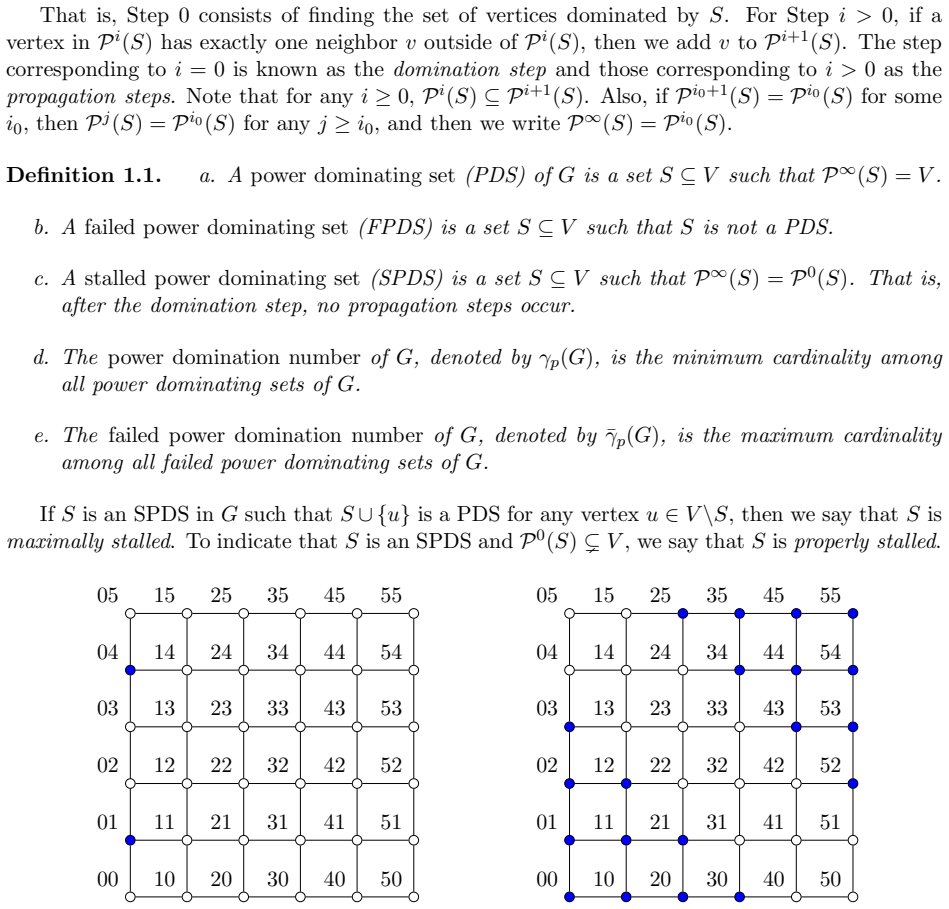
Let $G$ be a simple graph with vertex set $V$ and edge set $E$, and let $S \subseteq V$. The \emph{open neighborhood} of $v \in V$, $N(v)$, is the set of vertices adjacent to $v$; the \emph{closed neighborhood} is given by $N[v] = N(v) \cup \{v\}$. The \emph{open neighborhood} of $S$, $N(S)$, is the union of the open neighborhoods of vertices in $S$, and the \emph{closed neighborhood} of $S$ is $N[S] = S \cup N(S)$. The sets $ \mathcal{P}^i(S), i \geq 0$, of vertices \emph{monitored} by $S$ at the $i^{\ {th}}$ step are given by $\mathcal{P}^0(S) = N[S]$ and $\mathcal{P}^{i+1}(S) = \mathcal{P}^i(S) \bigcup\left\{ w : \{ w \} = N[v] \backslash \mathcal{P}^i(S) \ { for some } v \in \mathcal{P}^i(S) \right\}$. If there exists $j$ such that $\mathcal{P}^j(S) = V$, then $S$ is called a \emph{power dominating set}, PDS, of $G$. We introduce and discuss the \emph{failed power domination number} of a graph $G$, $\bar{\gamma}_p(G)$, the largest cardinality of a set that is not a PDS. We prove that $\bar{\gamma}_p(G)$ is NP-hard to compute, determine graphs in which every vertex is a PDS, and compare $\bar{\gamma}_p(G)$ to similar parameters.
Figures


Figures from the paper (2 more)


Reference graph
Works this paper leans on
-
[24]
Jonathan Tostado-Marquez. Failed power domination. I n Society for Advancement of Chi- canos/Hispanics and Native Americans in Science (SACNAS) Na tional Diversity in STEM Conference, October 2017
work page 2017
-
[1]
Domination in graphs with bounded propag ation: algorithms, formulations and hardness results
Ashkan Aazami. Domination in graphs with bounded propag ation: algorithms, formulations and hardness results. Journal of Combinatorial Optimization , 19(4):429–456, 2010
work page 2010
-
[2]
Zero forcin g sets and the minimum rank of graphs
AIM Minimum Rank-Special Graphs Work Group. Zero forcin g sets and the minimum rank of graphs. Linear Algebra and its Applications , 428(7):1628–1648, 2008
work page 2008
-
[3]
American Institute of Mathematics Workshop. Spectra of Families of Matrices described by Graphs, Digraphs, and Sign Patterns , Palo Alto, CA, October 2006. Webpage: http://aimath.org/pastworkshops/matrixspectrum.html
work page 2006
-
[4]
Failed skew zero forcing on a graph
Thomas Ansill, Bonnie Jacob, Jaime Penzellna, and Danie l Saavedra. Failed skew zero forcing on a graph. Linear Algebra and its Applications , 509:40–63, 2016
work page 2016
-
[5]
T.L. Baldwin, L. Mili, M.B. Boisen, and R. Adapa. Power sy stem observability with minimal phasor measurement placement. IEEE Transactions on Power Systems , 8(2):707–715, 1993
work page 1993
- [6]
- [7]
Show all 25 references
-
[8]
Benson, Daniela Ferrero, Mary Flagg, Veron ika Furst, Leslie Hogben, Violeta Vasilevska, and Brian Wissman
Katherine F. Benson, Daniela Ferrero, Mary Flagg, Veron ika Furst, Leslie Hogben, Violeta Vasilevska, and Brian Wissman. Zero forcing and power domin ation for graph products. The Australasian Journal of Combinatorics , 70:221–235, 2018
2018
-
[9]
Local controlla- bility of quantum networks
Daniel Burgarth, Sougato Bose, Christoph Bruder, and Vi ttorio Giovannetti. Local controlla- bility of quantum networks. Physical Review A , 79(6):060305, 2009
2009
-
[10]
Zero forcing, linear and quantum controllability fo r systems evolving on networks
Daniel Burgarth, Domenico D’Alessandro, Leslie Hogbe n, Simone Severini, and Michelle Young. Zero forcing, linear and quantum controllability fo r systems evolving on networks. IEEE Transactions on Automatic Control , 58(9):2349–2354, 2013
2013
-
[11]
Full contro l by locally induced relaxation
Daniel Burgarth and Vittorio Giovannetti. Full contro l by locally induced relaxation. Physical Review Letters, 99(10):100501, 2007
2007
-
[12]
Indirect Hamiltoni an identification through a small gateway
Daniel Burgarth and Koji Maruyama. Indirect Hamiltoni an identification through a small gateway. New Journal of Physics , 11(10):103019, 2009
2009
-
[13]
Daniela Ferrero, Leslie Hogben, Franklin H. J. Kenter, and Michael Young. Note on power propagation time and lower bounds for the power domination n umber. Journal of Combina- torial Optimization , 34(3):736–741, 2017
2017
-
[14]
T he failed zero forcing number of a graph
Katherine Fetcie, Bonnie Jacob, and Daniel Saavedra. T he failed zero forcing number of a graph. Involve, pages 99–117, 2015
2015
-
[15]
Henning, Bert Randerath, an d Preben Dahl Vestergaard
Allan Frendrup, Michael A. Henning, Bert Randerath, an d Preben Dahl Vestergaard. An upper bound on the domination number of a graph with minimum degree 2. Discrete Mathematics , 309(4):639–646, 2009
2009
-
[16]
Haynes, Sandra M
Teresa W. Haynes, Sandra M. Hedetniemi, Stephen T. Hede tniemi, and Michael A. Henning. Domination in graphs applied to electric power networks. SIAM Journal on Discrete Mathe- matics, 15(4):519–529, 2002
2002
-
[17]
Heydt, Chen-Ching Liu, A.G
G.T. Heydt, Chen-Ching Liu, A.G. Phadke, and Vijay Vitt al. Solution for the crisis in electric power supply. IEEE Computer applications in Power , 14(3):22–30, 2001
2001
-
[18]
Minimum rank problems
Leslie Hogben. Minimum rank problems. Linear Algebra and its Applications , 432(8):1961– 1974, 2010
1961
-
[19]
Parameterized power domination complexity
Joachim Kneis, Daniel M¨ olle, Stefan Richter, and Pete r Rossmanith. Parameterized power domination complexity. Information Processing Letters , 98(4):145–149, 2006
2006
-
[20]
Nuqui and Arun G
Reynaldo F. Nuqui and Arun G. Phadke. Phasor measuremen t unit placement techniques for complete and incomplete observability. IEEE Transactions on Power Delivery , 20(4):2381– 2388, 2005
2005
-
[21]
Darren D. Row. A technique for computing the zero forcin g number of a graph with a cut- vertex. Linear Algebra and its Applications , 436(12):4423–4432, 2012
2012
-
[22]
Nondiscriminatory propagation on tr ees
Simone Severini. Nondiscriminatory propagation on tr ees. Journal of Physics A: Mathematical and Theoretical, 41(48):482002, 2008. 12
2008
-
[23]
On the complexity of failed zero forci ng
Yaroslav Shitov. On the complexity of failed zero forci ng. Theoretical Computer Science , 660:102–104, 2017
2017
-
[25]
Vijayakumar, and Andreas M
Seethu Varghese, A. Vijayakumar, and Andreas M. Hinz. P ower domination in Kn¨ odel graphs and Hanoi graphs. Discussiones Mathematicae Graph Theory , 38(1):63–74, 2018. 13
2018
Reviewed August 14, 2026 · model on record in the stance chip above.
Discussion (0). Continue with ORCID to comment.