An infinite family of knots whose hexagonal mosaic number is only realized in non-reduced projections
Pith reviewed 2026-05-24 15:00 UTC · model grok-4.3
The pith
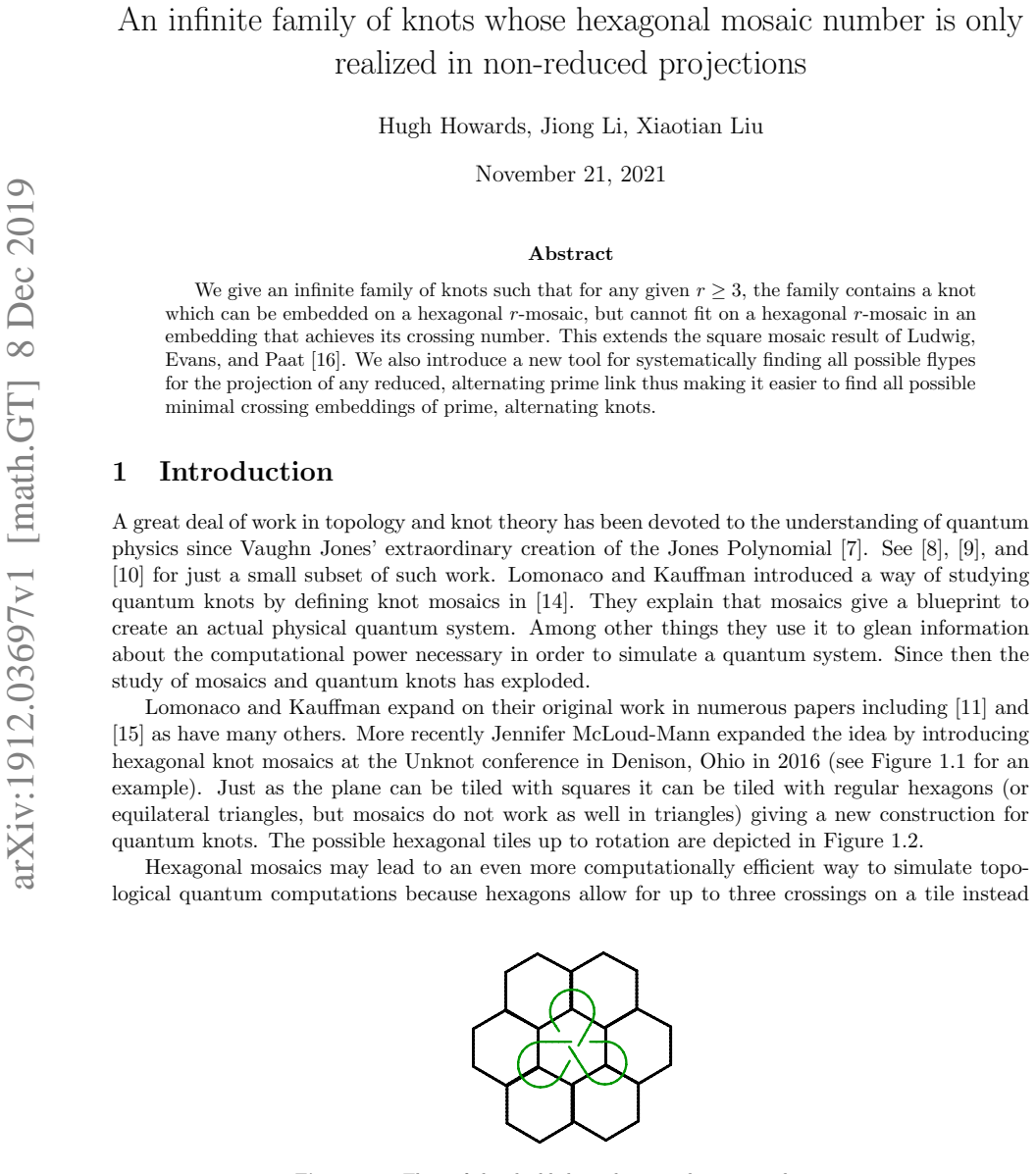
An infinite family of knots achieves its hexagonal mosaic number only in non-reduced projections.
A machine-rendered reading of the paper's core claim, the machinery that carries it, and where it could break.
Core claim
The authors establish an infinite family of knots such that for any given r greater than or equal to 3 the family contains a knot which can be embedded on a hexagonal r-mosaic but cannot fit on a hexagonal r-mosaic in an embedding that achieves its crossing number.
What carries the argument
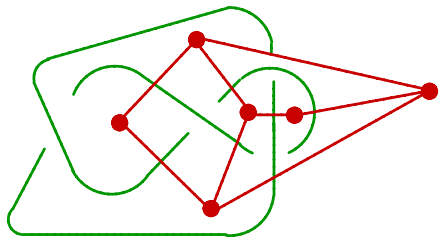
The infinite family of knots constructed to force non-reduced projections on every hexagonal r-mosaic, together with the new flype enumeration tool that generates all minimal-crossing diagrams of prime alternating knots.
If this is right
- For every r at least 3 there exists at least one knot whose hexagonal mosaic number is realized only by a non-reduced diagram.
- The hexagonal mosaic number can exceed the value implied by the crossing number alone.
- The flype tool provides a complete enumeration of minimal-crossing diagrams for any prime alternating knot.
- The same separation between mosaic number and crossing number holds in the hexagonal case as was previously shown for rectangular mosaics.
Where Pith is reading between the lines
- Algorithms that search for mosaic embeddings may need to consider diagrams with extra crossings even when the crossing number is known.
- The construction technique could be adapted to produce similar families in other regular tilings or grid types.
- The flype enumeration method might be used to certify that a given mosaic embedding is minimal for other knot invariants.
Load-bearing premise
The specific knots in the family have no reduced diagram that fits inside a hexagonal r-mosaic.
What would settle it
Exhibit one knot from the family together with a reduced diagram that tiles a hexagonal r-mosaic, or show that the flype tool misses a minimal-crossing diagram for a known prime alternating knot.
Figures




read the original abstract
We give an infinite family of knots such that for any given $r \geq 3$, the family contains a knot which can be embedded on a hexagonal $r$-mosaic, but cannot fit on a hexagonal $r$-mosaic in an embedding that achieves its crossing number. This extends the rectangular mosaic result of Ludwig, Evans, and Paat. We also introduce a new tool for systematically finding all possible flypes for the diagram of any link thus making it easier to find all possible minimal crossing embeddings of prime, alternating knots.
Editorial analysis
A structured set of objections, weighed in public.
Referee Report
Summary. The paper constructs an infinite family of knots such that, for every r ≥ 3, at least one member embeds on a hexagonal r-mosaic but none of its minimal-crossing diagrams do. It also introduces a flype-based enumeration procedure claimed to generate all minimal-crossing diagrams of any prime alternating knot.
Significance. If the construction and the completeness of the enumeration hold, the result supplies the first explicit infinite family separating hexagonal mosaic number from crossing number, extending the rectangular-mosaic examples of Ludwig-Evans-Paat. The flype tool is presented as a systematic aid for exhaustive diagram enumeration and could be reusable for other alternating-knot problems.
major comments (2)
- [flype enumeration procedure] The completeness argument for the flype enumeration procedure (introduced after the abstract and used to verify the family) rests on a finite case analysis of flype configurations. It is not shown that every configuration arising in the infinite family constructed later is covered by this analysis; omission of even one minimal diagram would falsify the claim that no minimal-crossing embedding fits on the r-mosaic.
- [construction of the infinite family] The existence statement for the family requires, for each r, both an explicit r-mosaic embedding of the chosen knot and a verification that every minimal-crossing diagram fails to embed. The manuscript presents the family and invokes the enumeration tool, but does not supply an independent check that the tool output is exhaustive for the specific diagrams of the family members.
minor comments (2)
- Notation for mosaic tiles and boundary conditions should be defined once in a preliminary section rather than reintroduced when the family is presented.
- The abstract states that the tool makes it 'easier' to find all minimal embeddings; a precise statement of what the tool guarantees (exhaustive enumeration versus heuristic search) would clarify its scope.
Simulated Author's Rebuttal
We thank the referee for the careful reading and the detailed comments on the completeness of the flype enumeration and the verification for the infinite family. We address each point below and indicate where revisions will be made for added clarity.
read point-by-point responses
-
Referee: The completeness argument for the flype enumeration procedure (introduced after the abstract and used to verify the family) rests on a finite case analysis of flype configurations. It is not shown that every configuration arising in the infinite family constructed later is covered by this analysis; omission of even one minimal diagram would falsify the claim that no minimal-crossing embedding fits on the r-mosaic.
Authors: The finite case analysis enumerates all possible flype configurations that can occur in any prime alternating diagram, based solely on the local crossing and tangle structures permitted by alternating projections. This classification is universal and does not depend on the global knot or the particular infinite family. Every knot in the family is prime and alternating, and its minimal-crossing diagrams arise exclusively from flypes within the enumerated configurations; no new configurations are introduced by the construction. revision: no
-
Referee: The existence statement for the family requires, for each r, both an explicit r-mosaic embedding of the chosen knot and a verification that every minimal-crossing diagram fails to embed. The manuscript presents the family and invokes the enumeration tool, but does not supply an independent check that the tool output is exhaustive for the specific diagrams of the family members.
Authors: We agree that the manuscript would benefit from an explicit statement confirming that the enumerated diagrams for the family members have been checked against the mosaic constraints. In the revision we will insert a short paragraph (or subsection) that, for each r, lists the output of the enumeration tool for the relevant knot and records the geometric reason each diagram fails to embed on the given hexagonal r-mosaic. The explicit mosaic embeddings themselves are already constructed in the text. revision: yes
Circularity Check
Explicit construction with internal case analysis; no reduction to inputs
full rationale
The paper constructs an explicit infinite family of knots and introduces a flype enumeration tool whose completeness argument is a finite case analysis presented within the manuscript. The central claim (mosaic number realized only in non-reduced projections) follows from verifying the constructed examples against this enumeration rather than from any fitted parameter, self-referential definition, or load-bearing self-citation chain. No quoted step equates a derived quantity to its own input by construction, satisfying the requirement that circularity be exhibited only via explicit reduction.
Axiom & Free-Parameter Ledger
axioms (1)
- standard math Standard definitions of knot diagrams, crossing number, mosaic embeddings, and flypes in S^3.
Lean theorems connected to this paper
-
IndisputableMonolith/Foundation/RealityFromDistinction.leanreality_from_one_distinction unclear?
unclearRelation between the paper passage and the cited Recognition theorem.
Theorem 6.12. For every r≥3, Kr can be embedded on a hexagonal r-mosaic, but it cannot achieve its crossing number and be embedded on an r-mosaic at the same time.
What do these tags mean?
- matches
- The paper's claim is directly supported by a theorem in the formal canon.
- supports
- The theorem supports part of the paper's argument, but the paper may add assumptions or extra steps.
- extends
- The paper goes beyond the formal theorem; the theorem is a base layer rather than the whole result.
- uses
- The paper appears to rely on the theorem as machinery.
- contradicts
- The paper's claim conflicts with a theorem or certificate in the canon.
- unclear
- Pith found a possible connection, but the passage is too broad, indirect, or ambiguous to say the theorem truly supports the claim.
Reference graph
Works this paper leans on
-
[1]
Knot Theory Ramifications 22 (2013), no
Colin Adams, Triple crossing number of knots and links , J. Knot Theory Ramifications 22 (2013), no. 2, 1350006, 17. MR 3037297
work page 2013
-
[2]
John Bush, Patty Commins, Tamara Gomez, and Jennifer McLoud-Mann, Hexagonal mosaic links generated by saturation
-
[3]
Chaim Even-Zohar, Joel Hass, Nathan Linial, and Tahl Nowik, The distribution of knots in the Petaluma model , Algebr. Geom. Topol. 18 (2018), no. 6, 3647–3667. MR 3868230
work page 2018
-
[4]
Chaim Even-Zohar, Joel Hass, Nati Linial, and Tahl Nowik, Invariants of random knots and links, Discrete Comput. Geom. 56 (2016), no. 2, 274–314. MR 3530968 26
work page 2016
-
[5]
Knot Theory Ramifications 27 (2018), no
Hugh Howards and Andrew Kobin, Crossing number bounds in knot mosaics , J. Knot Theory Ramifications 27 (2018), no. 10, 1850056, 30. MR 3855476
work page 2018
-
[6]
Hugh Howards, Jiong Li, and Xiaotian Liu, Bounding crossing number in hexagonal mosaics, preprint
-
[7]
V. F. R. Jones, Hecke algebra representations of braid groups and link polynomials , Ann. of Math. (2) 126 (1987), no. 2, 335–388. MR 908150
work page 1987
-
[8]
Vaughan F. R. Jones, A polynomial invariant for knots via von Neumann algebras , Bull. Amer. Math. Soc. (N.S.) 12 (1985), no. 1, 103–111. MR 766964
work page 1985
-
[9]
Kauffman, Knots and physics , third ed., Series on Knots and Everything, vol
Louis H. Kauffman, Knots and physics , third ed., Series on Knots and Everything, vol. 1, World Scientific Publishing Co., Inc., River Edge, NJ, 2001. MR 1858113
work page 2001
-
[10]
, Quantum computing and the Jones polynomial , Quantum computation and informa- tion (Washington, DC, 2000), Contemp. Math., vol. 305, Amer. Math. Soc., Providence, RI, 2002, pp. 101–137. MR 1947335
work page 2000
-
[11]
Louis H. Kauffman and Samuel J. Lomonaco Jr., Quantum knots, Quantum Information and Computation II (Eric Donkor, Andrew R. Pirich, and Howard E. Brandt, eds.), vol. 5436, International Society for Optics and Photonics, SPIE, 2004, pp. 268 – 284
work page 2004
-
[12]
Knot Theory Ramifications 23 (2014), no
Takahito Kuriya and Omar Shehab, The Lomonaco-Kauffman conjecture , J. Knot Theory Ramifications 23 (2014), no. 1, 1450003, 20. MR 3190127
work page 2014
-
[13]
Knot Theory Ramifications 23 (2014), no
Hwa Jeong Lee, Kyungpyo Hong, Ho Lee, and Seungsang Oh, Mosaic number of knots , J. Knot Theory Ramifications 23 (2014), no. 13, 1450069, 8. MR 3301107
work page 2014
-
[14]
Samuel J. Lomonaco and Louis H. Kauffman, Quantum knots and mosaics , Quantum Inf. Process. 7 (2008), no. 2-3, 85–115. MR 2420814
work page 2008
-
[15]
, Quantum knots and lattices, or a blueprint for quantum systems that do rope tricks , Quantum information science and its contributions to mathematics, Proc. Sympos. Appl. Math., vol. 68, Amer. Math. Soc., Providence, RI, 2010, pp. 209–276. MR 2762149
work page 2010
-
[16]
Lewis D. Ludwig, Erica L. Evans, and Joseph S. Paat, J. Knot Theory Ramifications22 (2013), no. 7, 1350036, 11. MR 3084754
work page 2013
-
[17]
William Menasco and Morwen Thistlethwaite, The classification of alternating links , Ann. of Math. (2) 138 (1993), no. 1, 113–171. MR 1230928
work page 1993
-
[18]
Seungsang Oh, Quantum knot mosaics and the growth constant , Topology Appl. 210 (2016), 311–316. MR 3539741
work page 2016
-
[19]
Seungsang Oh, Kyungpyo Hong, Ho Lee, and Hwa Jeong Lee, Quantum knots and the number of knot mosaics , Quantum Inf. Process. 14 (2015), no. 3, 801–811. MR 3312514
work page 2015
-
[20]
Seungsang Oh and Youngin Kim, Growth rate of quantum knot mosaics, Quantum Inf. Process. 18 (2019), no. 8, Art. 238, 13. MR 3962047
work page 2019
-
[21]
Perko, Jr., On the classification of knots , Proc
Kenneth A. Perko, Jr., On the classification of knots , Proc. Amer. Math. Soc. 45 (1974), 262–266. MR 353294 27
work page 1974
-
[22]
Dale Rolfsen, Knots and links , Publish or Perish, Inc., Berkeley, Calif., 1976, Mathematics Lecture Series, No. 7. MR 0515288 28
work page 1976
discussion (0)
Sign in with ORCID, Apple, or X to comment. Anyone can read and Pith papers without signing in.