Genus three embedded doubly periodic minimal surfaces with parallel ends
Pith reviewed 2026-05-24 13:39 UTC · model grok-4.3
The pith
A one-parameter family of embedded doubly periodic minimal surfaces of genus three with four parallel ends is constructed.
A machine-rendered reading of the paper's core claim, the machinery that carries it, and where it could break.
Core claim
We construct a one-parameter family of embedded doubly periodic minimal surfaces of genus three with four parallel ends. The Weierstrass data for each surface of the family are given and the two dimensional period problem is solved.
What carries the argument
The Weierstrass data, which encode the surface via meromorphic functions on a Riemann surface, together with the solution of the two-dimensional period problem that enforces periodicity and embedding.
Load-bearing premise
The Weierstrass data chosen for the family actually admit a solution to the two-dimensional period problem that produces embedded surfaces rather than immersed or self-intersecting ones.
What would settle it
A numerical check for a specific value of the parameter showing that the resulting surface self-intersects or that the periods fail to close.
Figures
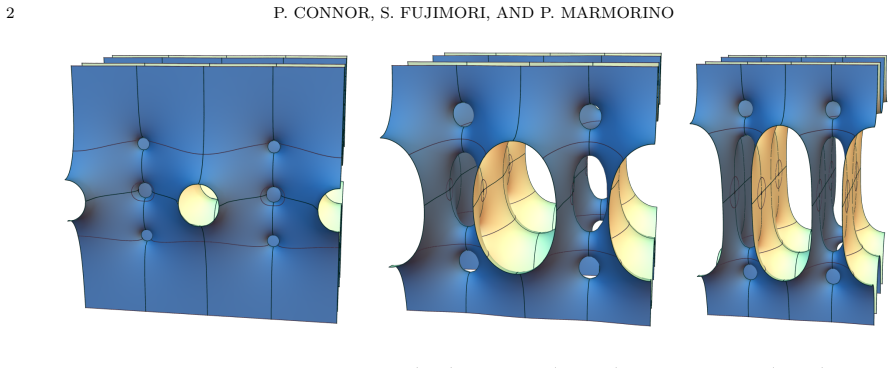


read the original abstract
We construct a one-parameter family of embedded doubly periodic minimal surfaces of genus three with four parallel ends. The Weierstrass data for each surface of the family are given and the two dimensional period problem is solved.
Editorial analysis
A structured set of objections, weighed in public.
Referee Report
Summary. The paper constructs a one-parameter family of embedded doubly periodic minimal surfaces of genus three with four parallel ends. The Weierstrass data for each surface in the family are explicitly given on a suitable Riemann surface, the two-dimensional period problem is reduced to a pair of real equations in one real parameter, a solution is exhibited via a sign-change argument, and the resulting Gauss map is verified to have the correct degree with no extraneous branch points, yielding embedded surfaces by standard criteria for such minimal surfaces.
Significance. If the result holds, the work supplies an explicit new family of examples in the theory of minimal surfaces, which are scarce for genus three with parallel ends. The reduction of the period problem to a one-parameter setting with an intermediate-value argument, together with the verification of embedding criteria, provides a concrete and falsifiable construction that advances the understanding of doubly periodic minimal surfaces.
minor comments (1)
- The abstract and introduction could more explicitly reference the specific Riemann surface on which the Weierstrass data are defined (e.g., by its equation or branch points) to aid readers in reproducing the setup.
Simulated Author's Rebuttal
We thank the referee for their positive summary, significance assessment, and recommendation to accept the manuscript. There are no major comments to address.
Circularity Check
No significant circularity identified
full rationale
The paper constructs explicit Weierstrass data on a Riemann surface for a one-parameter family and reduces the two-dimensional period problem to a pair of real equations in one parameter. It then locates a parameter value at which the period integrals vanish (via sign-change or intermediate-value argument) and verifies the Gauss map degree and absence of extraneous branch points. This is a standard, independent existence argument for minimal surfaces; the period integrals are not defined in terms of the target surface, no parameter is fitted to the output, and no load-bearing step reduces by the paper's own equations to a self-citation or ansatz smuggled from prior work by the same authors. The derivation is therefore self-contained against external benchmarks.
Axiom & Free-Parameter Ledger
free parameters (1)
- one-parameter family parameter
axioms (1)
- standard math Weierstrass representation theorem for minimal surfaces in R^3
Lean theorems connected to this paper
-
IndisputableMonolith/Foundation/AlexanderDuality.leanalexander_duality_circle_linking unclear?
unclearRelation between the paper passage and the cited Recognition theorem.
We construct a one-parameter family Mλ of embedded doubly periodic minimal surfaces with parallel ends such that Mλ/L has genus three and four parallel ends. The Weierstrass data … are given … and the two dimensional period problem is solved.
-
IndisputableMonolith/Foundation/ArithmeticFromLogic.leanreality_from_one_distinction unclear?
unclearRelation between the paper passage and the cited Recognition theorem.
The data of the surface Mλ are given in Section 2, Equations (2.1), (2.7), and (2.8) … Proposition 3.1 … Proposition 4.1.
What do these tags mean?
- matches
- The paper's claim is directly supported by a theorem in the formal canon.
- supports
- The theorem supports part of the paper's argument, but the paper may add assumptions or extra steps.
- extends
- The paper goes beyond the formal theorem; the theorem is a base layer rather than the whole result.
- uses
- The paper appears to rely on the theorem as machinery.
- contradicts
- The paper's claim conflicts with a theorem or certificate in the canon.
- unclear
- Pith found a possible connection, but the passage is too broad, indirect, or ambiguous to say the theorem truly supports the claim.
Reference graph
Works this paper leans on
-
[1]
P. Connor and M. Weber, The construction of doubly periodic minimal surfaces via balance equations, Amer. J. Math., 134 (2012), 1275--1301
work page 2012
-
[2]
Dorff, Minimal graphs in R ^3 over convex domains , Proc
M. Dorff, Minimal graphs in R ^3 over convex domains , Proc. Amer. Math. Soc., 132 (2004), 491--498
work page 2004
-
[3]
H. Jenkins and J. Serrin, Variational problems of minimal surface type, II, Boundary value problems for the minimal surface equation, Arch. Rational Mech. Anal., 21 (1966), 321--342
work page 1966
-
[4]
H. Karcher, Embedded minimal surfaces derived from Scherk's examples, Manuscripta Math., 62 (1988), 83--114
work page 1988
-
[5]
, Construction of Minimal Surfaces, Surveys in Geometry, 1--96, University of Tokyo, 1989
work page 1989
-
[6]
W. H. Meeks III and H. Rosenberg, The Global Theory of Doubly Periodic Minimal Surfaces, Invent. Math., 97 (1989), 351--379
work page 1989
-
[7]
W. Rossman, E. C. Thayer, and M. Wohlgemuth Embedded, doubly periodic minimal surfaces, Experiment. Math., 9 (2000), 197--219
work page 2000
-
[8]
H. F. Scherk, Bemerkungen \" u ber die kleinste F l\" a che I nnerhalb gegebener G renzen , J. Reine Angew. Math., 13 (1835), 185--208
-
[9]
Weber, Minimal Surface Repository, https://minimalsurfaces.blog
M. Weber, Minimal Surface Repository, https://minimalsurfaces.blog
- [10]
-
[11]
Wei, Some existence and uniqueness theorems for doubly periodic minimal surfaces, Invent
F. Wei, Some existence and uniqueness theorems for doubly periodic minimal surfaces, Invent. Math., 109 (1992), 113--136
work page 1992
discussion (0)
Sign in with ORCID, Apple, or X to comment. Anyone can read and Pith papers without signing in.