Dissipation in a Finite Temperature Atomic Josephson Junction
Pith reviewed 2026-05-24 13:03 UTC · model grok-4.3
The pith
Numerical characterization shows dissipation in atomic Josephson junctions depends on initial chemical potential difference and thermal energy versus barrier height, with distinct regimes and a reversal of condensate-thermal cloud roles at high thermal energies.
A machine-rendered reading of the paper's core claim, the machinery that carries it, and where it could break.
Core claim
We numerically demonstrate and characterize the emergence of distinct dynamical regimes of a finite temperature bosonic superfluid in an elongated Josephson junction generated by a thin Gaussian barrier over the entire temperature range where a well-formed condensate can be clearly identified.
Load-bearing premise
The numerical model used to couple the condensate to the dynamical thermal cloud accurately captures the relevant dissipation channels without significant artifacts from the chosen simulation method or approximations.
Figures
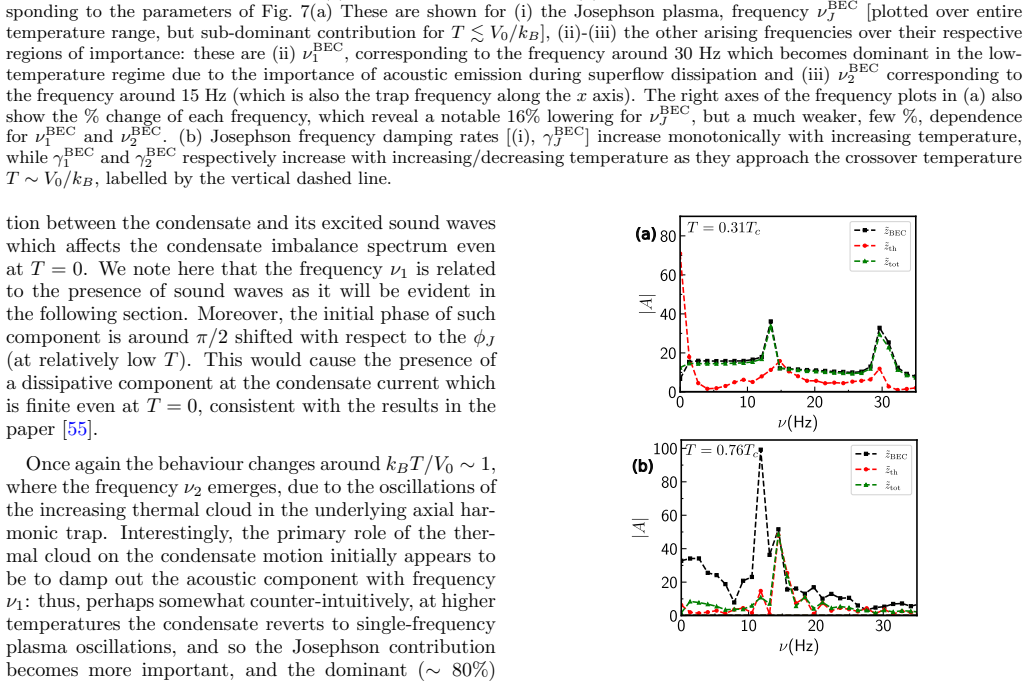
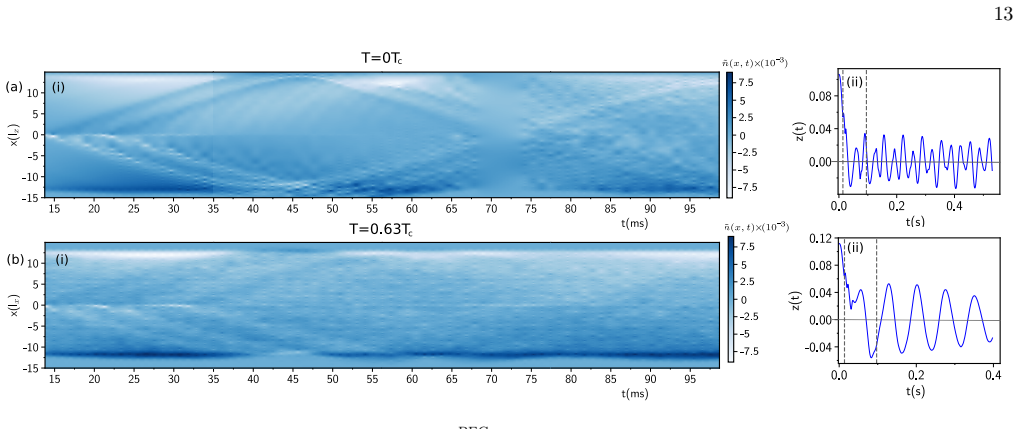
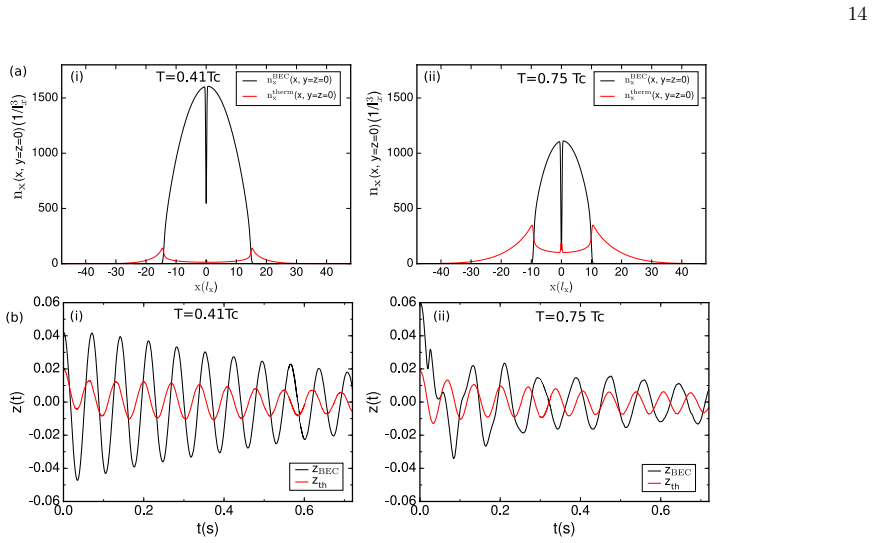
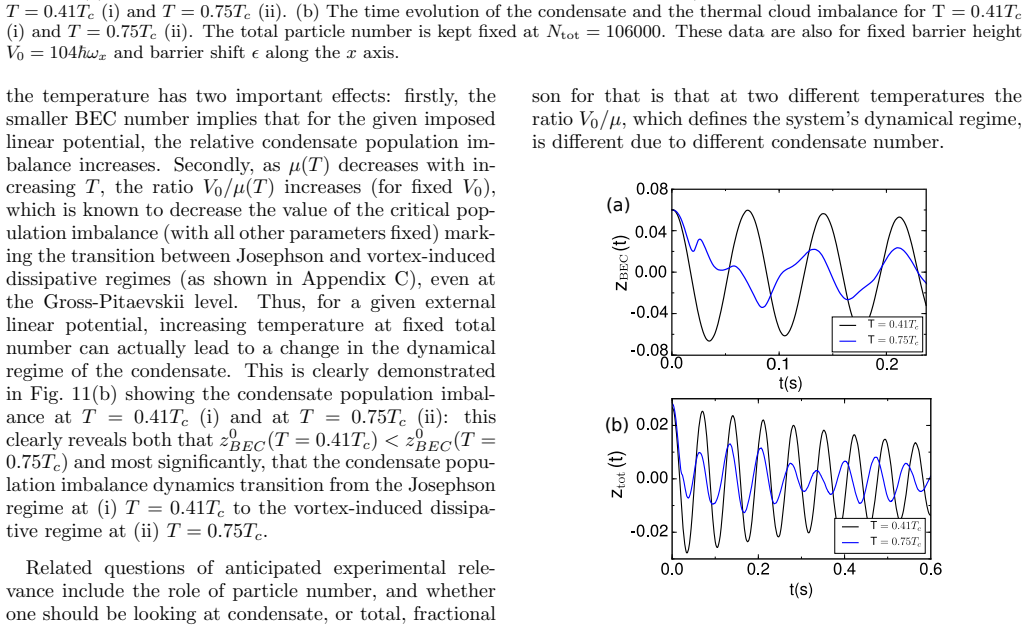
read the original abstract
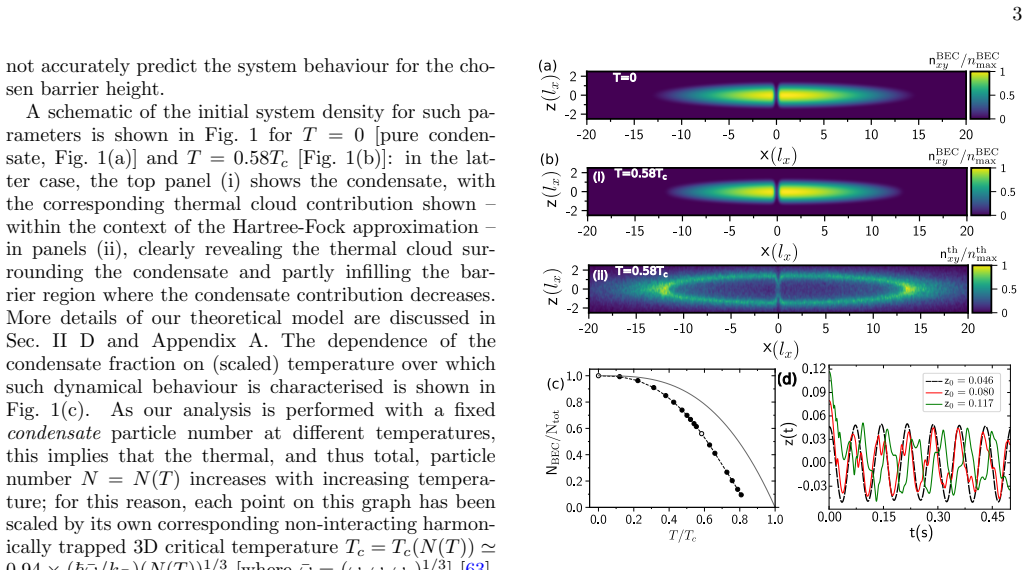
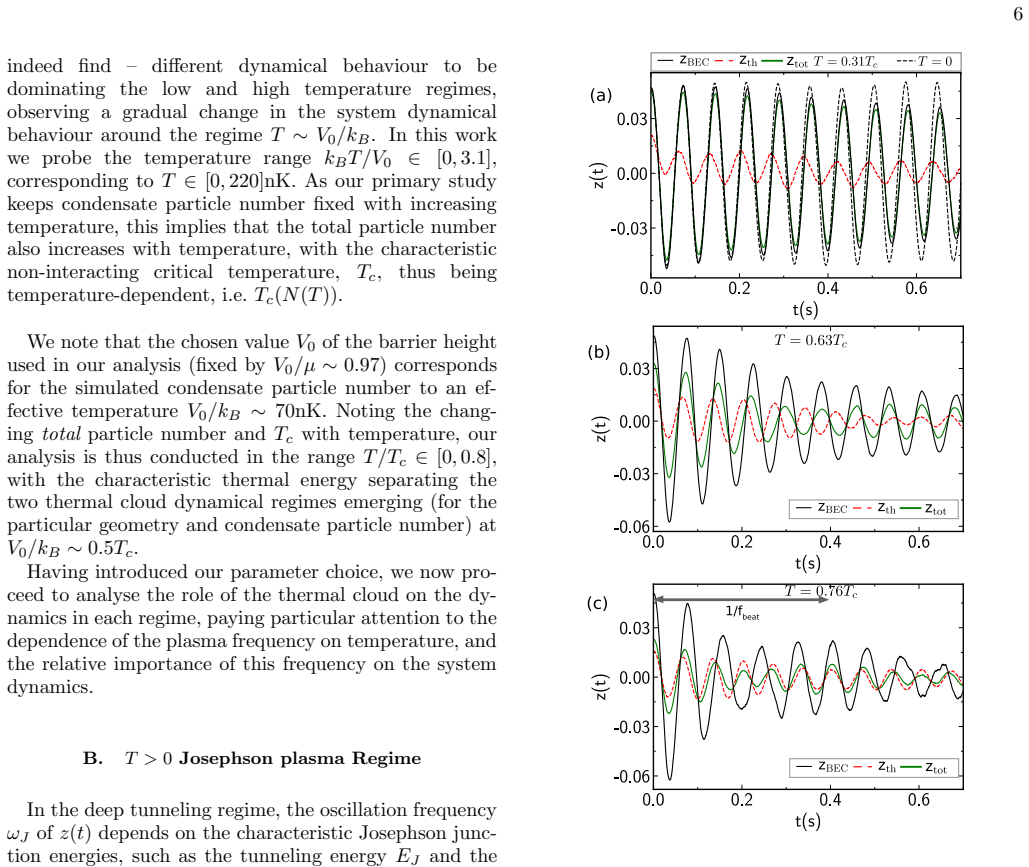
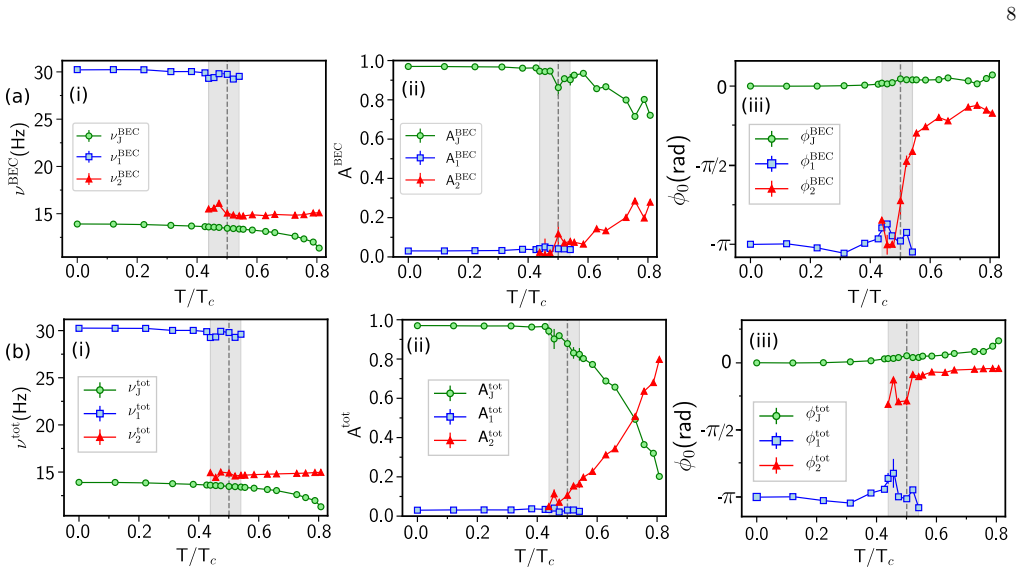
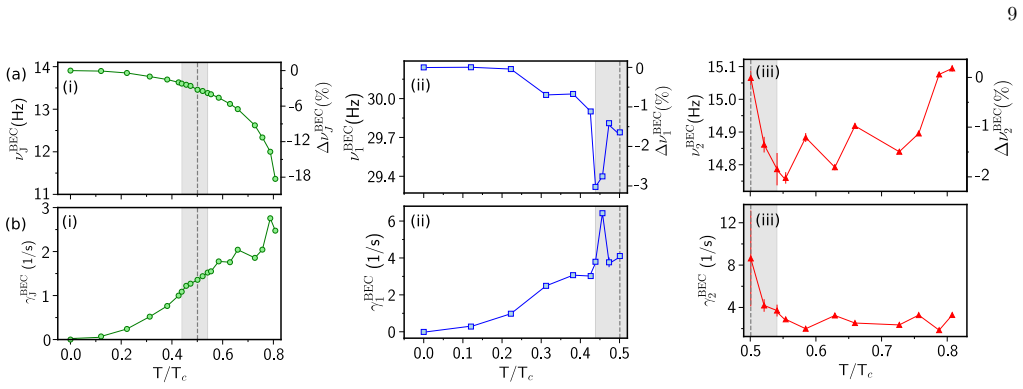
We numerically demonstrate and characterize the emergence of distinct dynamical regimes of a finite temperature bosonic superfluid in an elongated Josephson junction generated by a thin Gaussian barrier over the entire temperature range where a well-formed condensate can be clearly identified. Although the dissipation arising from the coupling of the superfluid to the dynamical thermal cloud increases with increasing temperature as expected, the importance of this mechanism is found to depend on two physical parameters associated (i) with the initial chemical potential difference, compared to some characteristic value, and (ii) the ratio of the thermal energy to the barrier amplitude. The former determines whether the superfluid Josephson dynamics are dominated by gradually damped plasma-like oscillations (for relatively small initial population imbalances), or whether dissipation at early times is instead dominated by vortex- and sound-induced dissipation (for larger initial imbalances). The latter defines the effect of the thermal cloud on the condensate dynamics, with a reversal of roles, i.e. the condensate being driven by the oscillating thermal cloud, being observed when the thermal particles acquire enough energy to overcome the barrier. Our findings are within current experimental reach in ultracold superfluid junctions.
Editorial analysis
A structured set of objections, weighed in public.
Referee Report
Summary. The paper numerically demonstrates and characterizes distinct dynamical regimes of a finite-temperature bosonic superfluid in an elongated Josephson junction created by a thin Gaussian barrier, across the full temperature range where a condensate is identifiable. Dissipation from condensate-thermal cloud coupling increases with temperature but depends on two parameters: the initial chemical potential difference (determining plasma oscillations for small imbalances vs. vortex/sound dissipation for large ones) and the ratio of thermal energy to barrier amplitude (with role reversal when thermal particles overcome the barrier). The results are stated to be experimentally accessible.
Significance. If validated, the work identifies parameter regimes governing dissipation mechanisms in finite-T Josephson junctions, extending zero-temperature treatments and providing guidance for ultracold-atom experiments on superfluid dynamics.
major comments (2)
- [Numerical Methods] The manuscript provides insufficient information on the finite-T coupling scheme (e.g., the specific hybrid model, collision integral approximation, or truncation), convergence tests, and validation against known limits such as the T=0 Josephson regime. This is load-bearing because the claimed regimes (plasma vs. vortex/sound) and role reversal rest on the fidelity of the condensate-thermal cloud interaction without dominant numerical artifacts.
- [Results and Discussion] No explicit benchmarks are shown against analytical expectations or prior zero-T simulations for the early-time dissipation at large imbalances or the crossover when kT exceeds barrier height; without these, it is unclear whether the reported behaviors arise from the physical coupling or from discretization/approximation choices.
minor comments (2)
- The phrase 'some characteristic value' for the chemical potential difference in the abstract should be replaced by a quantitative definition (e.g., in terms of the barrier height or plasma frequency) when introduced in the main text.
- Figure captions would benefit from listing the specific values of imbalance, temperature, and barrier parameters used in each panel to improve reproducibility.
Simulated Author's Rebuttal
We thank the referee for their careful reading of our manuscript and for highlighting the need for greater detail on numerical methods and validation. We address each major comment below and will revise the manuscript accordingly to strengthen the presentation.
read point-by-point responses
-
Referee: [Numerical Methods] The manuscript provides insufficient information on the finite-T coupling scheme (e.g., the specific hybrid model, collision integral approximation, or truncation), convergence tests, and validation against known limits such as the T=0 Josephson regime. This is load-bearing because the claimed regimes (plasma vs. vortex/sound) and role reversal rest on the fidelity of the condensate-thermal cloud interaction without dominant numerical artifacts.
Authors: We agree that additional methodological details are required for full reproducibility and to rule out artifacts. In the revised manuscript we will expand the description of the finite-temperature coupling scheme to specify the hybrid model, the form of the collision integral and any truncation, include convergence tests with respect to discretization parameters, and add explicit validation by recovering the T=0 Josephson regime (plasma oscillations for small imbalances and vortex/sound dynamics for large imbalances) when the thermal cloud is suppressed. revision: yes
-
Referee: [Results and Discussion] No explicit benchmarks are shown against analytical expectations or prior zero-T simulations for the early-time dissipation at large imbalances or the crossover when kT exceeds barrier height; without these, it is unclear whether the reported behaviors arise from the physical coupling or from discretization/approximation choices.
Authors: We accept this criticism and will incorporate the requested benchmarks. The revised manuscript will include direct comparisons of early-time dissipation at large imbalances against zero-temperature simulations and analytical expectations for vortex and sound-wave contributions, together with additional data illustrating the crossover when kT exceeds the barrier height to confirm the physical origin of the observed role reversal. revision: yes
Circularity Check
No circularity: numerical demonstration of regimes from hybrid model simulations
full rationale
The paper reports numerical simulations of an elongated Josephson junction at finite temperature using a condensate-thermal cloud coupling model (likely ZNG-type). Claims concern emergence of distinct dynamical regimes (damped plasma oscillations vs. vortex/sound dissipation) as functions of initial imbalance and thermal energy vs. barrier height, observed across the condensate temperature range. No analytical derivation chain, fitted parameters renamed as predictions, self-definitional quantities, or load-bearing self-citations appear in the abstract or described structure. Results are direct outputs of the chosen numerical scheme rather than reductions to inputs by construction. The work is self-contained as a computational study of model behavior.
Axiom & Free-Parameter Ledger
Reference graph
Works this paper leans on
-
[1]
B. D. Josephson, Phys. Lett. 1, 251 (1962)
work page 1962
-
[2]
P. W. Anderson and J. M. Rowell, Phys. Rev. Lett. 10, 230 (1963)
work page 1963
-
[3]
A. Barone and G. Paterno, Physics and Applications of the Josephson Effect (John Wiley, New York, 1982)
work page 1982
- [4]
-
[5]
J. C. Davis and R. E. Packard, Rev. Mod. Phys. 74, 741 (2002)
work page 2002
-
[6]
Y. Sato, E. Hoskinson, and R. Packard, in Fundamentals and Frontiers of the Josephson Effect, Vol. 286, edited by F. Tafuri (Springer, Cham, 2019)
work page 2019
-
[7]
E. Hoskinson, Y. Sato, I. Hahn, and R. E. Packard, Nat. Phys. 2, 23 (2006)
work page 2006
-
[8]
B. P. Anderson and M. Kasevich, Science 282, 1686 (1998)
work page 1998
-
[9]
F. S. Cataliotti, S. Burger, C. Fort, P. Maddaloni, F. Mi- nardi, A. Trombettoni, A. Smerzi, and M. Inguscio, Sci- ence 293, 843 (2001)
work page 2001
- [10]
- [11]
- [12]
-
[13]
Y. Shin, M. Saba, T. A. Pasquini, W. Ketterle, D. E. Pritchard, and A. E. Leanhardt, Phys. Rev. Lett. 92, 050405 (2004)
work page 2004
-
[14]
S. Levy, E. Lahoud, I. Shomroni, and J. Steinhauer, Nature 449, 579 (2007)
work page 2007
-
[15]
G. Spagnolli, G. Semeghini, L. Masi, G. Ferioli, A. Trenkwalder, S. Coop, M. Landini, L. Pezz` e, G. Mod- ugno, M. Inguscio, A. Smerzi, and M. Fattori, Phys. Rev. Lett. 118, 230403 (2017)
work page 2017
-
[16]
L. J. LeBlanc, A. B. Bardon, J. McKeever, M. H. T. Extavour, D. Jervis, J. H. Thywissen, F. Piazza, and A. Smerzi, Phys. Rev. Lett. 106, 025302 (2011)
work page 2011
-
[17]
G. Valtolina, A. Burchianti, A. Amico, E. Neri, K. Xhani, J. A. Seman, A. Trombettoni, A. Smerzi, M. Zaccanti, M. Inguscio, and G. Roati, Science 350, 1505 (2015)
work page 2015
-
[18]
A. Burchianti, F. Scazza, A. Amico, G. Valtolina, J. A. Seman, C. Fort, M. Zaccanti, M. Inguscio, and G. Roati, Phys. Rev. Lett. 120, 025302 (2018)
work page 2018
-
[19]
W. J. Kwon, G. Del Pace, R. Panza, M. Inguscio, W. Zw- erger, M. Zaccanti, F. Scazza, and G. Roati, Science369, 84 (2020)
work page 2020
- [20]
-
[21]
G. Del Pace, W. J. Kwon, M. Zaccanti, G. Roati, and F. Scazza, Phys. Rev. Lett. 126, 055301 (2021)
work page 2021
-
[22]
K. G. Lagoudakis, B. Pietka, M. Wouters, R. Andr´ e, and B. Deveaud-Pl´ edran, Phys. Rev. Lett.105, 120403 (2010)
work page 2010
-
[23]
A. F. Adiyatullin, M. D. Anderson, H. Flayac, M. T. Portella-Oberli, F. Jabeen, C. Ouellet-Plamondon, G. C. Sallen, and B. Deveaud, Nature Communications 8, 1329 (2017)
work page 2017
- [24]
-
[25]
C. Ryu, P. W. Blackburn, A. A. Blinova, and M. G. Boshier, Phys. Rev. Lett. 111, 205301 (2013)
work page 2013
-
[26]
C. Ryu, E. C. Samson, and M. G. Boshier, Nat. Comms. 11, 3338 (2020)
work page 2020
-
[27]
L. Amico, M. Boshier, G. Birkl, A. Minguzzi, C. Miniatura, L.-C. Kwek, D. Aghamalyan, V. Ahufinger, D. Anderson, N. Andrei, A. S. Arnold, M. Baker, T. A. 20 Bell, T. Bland, J. P. Brantut, D. Cassettari, W. J. Chet- cuti, F. Chevy, R. Citro, S. De Palo, R. Dumke, M. Ed- wards, R. Folman, J. Fortagh, S. A. Gardiner, B. M. Gar- raway, G. Gauthier, A. G¨ unthe...
work page 2021
-
[28]
G. Gauthier, S. S. Szigeti, M. T. Reeves, M. Baker, T. A. Bell, H. Rubinsztein-Dunlop, M. J. Davis, and T. W. Neely, Phys. Rev. Lett. 123, 260402 (2019)
work page 2019
- [29]
-
[30]
S. Raghavan, A. Smerzi, S. Fantoni, and S. R. Shenoy, Phys. Rev. A 59, 620 (1999)
work page 1999
- [31]
-
[32]
E. Sakellari, N. P. Proukakis, M. Leadbeater, and C. S. Adams, New Journal of Physics 6, 42 (2004)
work page 2004
-
[33]
M., and Smerzi, A., EPL 109, 40005 (2015)
Abad, M., Guilleumas, M., Mayol, R., Piazza, F., Jezek, D. M., and Smerzi, A., EPL 109, 40005 (2015)
work page 2015
- [34]
-
[35]
A. Spuntarelli, P. Pieri, and G. C. Strinati, Phys. Rev. Lett. 99, 040401 (2007)
work page 2007
-
[36]
J. Polo, R. Dubessy, P. Pedri, H. Perrin, and A. Min- guzzi, Phys. Rev. Lett. 123, 195301 (2019)
work page 2019
-
[37]
A. K. Saha and R. Dubessy, Phys. Rev. A 104, 023316 (2021)
work page 2021
- [38]
- [39]
-
[40]
F. Jendrzejewski, S. Eckel, N. Murray, C. Lanier, M. Ed- wards, C. J. Lobb, and G. K. Campbell, Phys. Rev. Lett. 113, 045305 (2014)
work page 2014
- [41]
- [42]
- [43]
-
[44]
B. I. Halperin, G. Refael, and E. Demler, Interna- tional Journal of Modern Physics B 24, 4039 (2010), https://doi.org/10.1142/S021797921005644X
-
[45]
Y. Chen, Y.-H. Lin, S. D. Snyder, A. M. Goldman, and A. Kamenev, Nature Physics 10, 567 (2014)
work page 2014
-
[46]
K. C. Wright, R. B. Blakestad, C. J. Lobb, W. D. Phillips, and G. K. Campbell, Phys. Rev. Lett. 110, 025302 (2013)
work page 2013
-
[47]
K. Snizhko, K. Isaieva, Y. Kuriatnikov, Y. Bidasyuk, S. Vilchinskii, and A. Yakimenko, Phys. Rev. A 94, 063642 (2016)
work page 2016
- [48]
- [49]
- [50]
- [51]
-
[52]
E. Sakellari, M. Leadbeater, N. J. Kylstra, and C. S. Adams, Phys. Rev. A 66, 033612 (2002)
work page 2002
- [53]
-
[54]
Y. M. Bidasyuk, M. Weyrauch, M. Momme, and O. O. Prikhodko, J. Phys. B 51, 205301 (2018)
work page 2018
- [55]
-
[56]
V. Piselli, S. Simonucci, and G. C. Strinati, Phys. Rev. B 102, 144517 (2020)
work page 2020
-
[57]
R. Gati, B. Hemmerling, J. F¨ olling, M. Albiez, and M. K. Oberthaler, Phys. Rev. Lett. 96, 130404 (2006)
work page 2006
-
[58]
A. Imamo¯ glu, M. Lewenstein, and L. You, Phys. Rev. Lett. 78, 2511 (1997)
work page 1997
-
[59]
R. FRANZOSI, V. PENNA, and R. ZECCHINA, Inter- national Journal of Modern Physics B 14, 943 (2000)
work page 2000
-
[60]
G. J. Milburn, J. Corney, E. M. Wright, and D. F. Walls, Phys. Rev. A 55, 4318 (1997)
work page 1997
-
[61]
V. P. Singh, N. Luick, L. Sobirey, and L. Mathey, Phys. Rev. Research 2, 033298 (2020)
work page 2020
-
[62]
J. Polo, V. Ahufinger, F. W. J. Hekking, and A. Min- guzzi, Phys. Rev. Lett. 121, 090404 (2018)
work page 2018
-
[63]
F. Dalfovo, S. Giorgini, L. P. Pitaevskii, and S. Stringari, Rev. Mod. Phys. 71, 463 (1999)
work page 1999
- [64]
-
[65]
Y. M. Bidasyuk, O. O. Prikhodko, and M. Weyrauch, Phys. Rev. A 94, 033603 (2016)
work page 2016
-
[66]
S. Mart´ ınez-Garaot, G. Pettini, and M. Modugno, Phys. Rev. A 98, 043624 (2018)
work page 2018
-
[67]
E. Goldobin, D. Koelle, R. Kleiner, and A. Buzdin, Phys. Rev. B 76, 224523 (2007)
work page 2007
- [68]
- [69]
- [70]
-
[71]
N. P. Proukakis and B. Jackson, J. Phys. B: At. Mol. Opt. Phys. 41, 203002 (2008)
work page 2008
-
[72]
N. Proukakis, S. Gardiner, M. Davis, and M. Szyma´ nska, eds., Quantum Gases: Finite Temperature and Non- Equilibrium Dynamics (Imperial College Press, London, United Kingdom, 2013)
work page 2013
-
[73]
M. J. Bijlsma, E. Zaremba, and H. T. C. Stoof, Phys. Rev. A 62, 063609 (2000)
work page 2000
- [74]
- [75]
-
[76]
B. Jackson, N. P. Proukakis, and C. F. Barenghi, Phys. Rev. A 75, 051601 (2007)
work page 2007
-
[77]
B. Jackson, N. P. Proukakis, C. F. Barenghi, and E. Zaremba, Phys. Rev. A 79, 053615 (2009)
work page 2009
-
[78]
A. J. Allen, E. Zaremba, C. F. Barenghi, and N. P. 21 Proukakis, Phys. Rev. A 87, 013630 (2013)
work page 2013
-
[79]
A. J. Allen, S. Zuccher, M. Caliari, N. P. Proukakis, N. G. Parker, and C. F. Barenghi, Phys. Rev. A 90, 013601 (2014)
work page 2014
-
[80]
For example, for V0/µ = 0.6 the sound mode is damped already at T = 60nK
discussion (0)
Sign in with ORCID, Apple, or X to comment. Anyone can read and Pith papers without signing in.