Symfind: Addressing the Fragility of Subhalo Finders and Revealing the Durability of Subhalos
Pith reviewed 2026-05-24 06:55 UTC · model grok-4.3
The pith
A new particle-tracking subhalo finder tracks objects to orders-of-magnitude lower masses than common tools detect.
A machine-rendered reading of the paper's core claim, the machinery that carries it, and where it could break.
Core claim
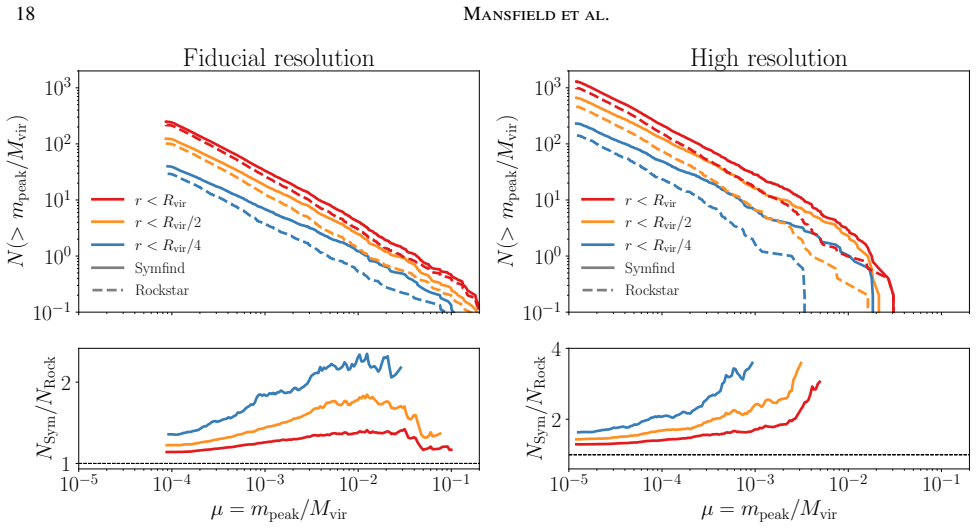
Symfind is a particle-tracking subhalo finder that can track subhalos to orders-of-magnitude lower masses than commonly used halo-finding tools. In the Symphony dark-matter-only simulation suite this produces approximately 15-40 percent more subhalos within R_vir and 35-120 percent more within R_vir/4 at fixed peak subhalo mass. Mass loss itself becomes resolvable at modest particle counts while maximum circular velocity requires much higher resolution. The method traces resolved subhalos until the point of typical galaxy disruption without invoking orphan modeling, and the paper shows that commonly used tools converge to false solutions for the mass function, radial distribution, and subhal
What carries the argument
Symfind, a particle-tracking-based subhalo finder that follows particles to identify bound structures at low particle counts.
If this is right
- At fixed peak mass the number of subhalos rises with simulation resolution.
- Mass loss can be resolved at particle counts around 4000 while v_max requires counts around 30000.
- Subhalos can be followed to the typical galaxy disruption point without separate orphan modeling.
- Commonly used finders produce resolution-dependent errors in the subhalo mass function and radial distribution.
Where Pith is reading between the lines
- Adopting this approach would raise the expected number of satellite galaxies around Milky Way-mass hosts.
- The concrete steps given for testing other finders could become a standard check for reliability at low masses.
- Disruption seen in current simulations may partly reflect finder limits rather than purely physical processes.
Load-bearing premise
The particle-tracking implementation correctly identifies physically bound subhalos at low particle counts without introducing spurious detections or missing real disruption events.
What would settle it
A side-by-side run of Symfind and a standard finder on a simulation at substantially higher resolution that shows whether the extra low-mass subhalos persist or disappear.
Figures




read the original abstract
A major question in $\Lambda$CDM is what this theory actually predicts for the properties of subhalo populations. Subhalos are difficult to simulate and to find within simulations, and this propagates into uncertainty in theoretical predictions for satellite galaxies. We present Symfind, a new particle-tracking-based subhalo finder, and demonstrate that it can track subhalos to orders-of-magnitude lower masses than commonly used halo-finding tools, with a focus on Rockstar and consistent-trees. These longer survival mean that at a fixed peak subhalo mass, we find $\approx 15\%{-}40\%$ more subhalos within the virial radius, $R_\textrm{vir}$, and $\approx 35\%-120\%$ more subhalos within $R_\textrm{vir}/4$ in the Symphony dark-matter-only simulation suite. More subhalos are found as resolution is increased. We perform extensive numerical testing. In agreement with idealized simulations, we show that the $v_{\rm max}$ of subhalos is only resolved at high resolutions ($n_\textrm{peak}\gtrsim3\times 10^4$), but that mass loss itself can be resolved at much more modest particle counts ($n_\textrm{peak}\gtrsim4\times 10^3$). We show that Rockstar converges to false solutions for the mass function, radial distribution, and disruption masses of subhalos. We argue that our new method can trace resolved subhalos until the point of typical galaxy disruption without invoking ``orphan'' modeling. We outline a concrete set of steps for determining whether other subhalo finders meet the same criteria. We publicly release Symfind catalogs and particle data for the Symphony simulation suite at \url{web.stanford.edu/group/gfc/gfcsims/}.
Editorial analysis
A structured set of objections, weighed in public.
Referee Report
Summary. The manuscript introduces Symfind, a new particle-tracking-based subhalo finder, and claims it tracks subhalos to orders-of-magnitude lower masses than Rockstar and consistent-trees. In the Symphony dark-matter-only suite this yields ≈15%–40% more subhalos within R_vir and ≈35%–120% more within R_vir/4 at fixed peak mass. The paper asserts that Rockstar converges to false solutions for the subhalo mass function, radial distribution, and disruption masses, supported by extensive numerical testing and agreement with idealized simulations on v_max and mass-loss resolution thresholds (n_peak ≳ 3×10^4 for v_max, ≳4×10^3 for mass loss). It argues that resolved subhalos can be traced until typical galaxy disruption without orphan modeling, outlines steps to test other finders, and publicly releases Symfind catalogs and particle data.
Significance. If the central claim holds, the result would imply substantially more durable subhalo populations than inferred from standard finders, directly affecting theoretical predictions for satellite galaxies in ΛCDM and reducing reliance on orphan modeling. The public release of catalogs and particle data for the Symphony suite is a clear strength that enables community verification. The reported agreement with idealized simulations on resolution thresholds for v_max versus mass loss is also a constructive element. Significance is contingent on demonstrating that Symfind’s tracking criteria do not introduce artifacts at low particle counts.
major comments (1)
- [Methods] Methods section: The precise binding-energy cut, particle-assignment rule, and tracking continuity criterion used by Symfind are not explicitly stated. This is load-bearing for the central claim because the reported 15–40% (and 35–120%) excess subhalo counts at fixed peak mass, as well as the assertion that Rockstar converges to false solutions, rest on the assumption that Symfind correctly identifies physically bound objects down to n_peak ≳ 4×10^3 without spurious detections or missed disruptions. Without these explicit rules, the numerical testing cannot be independently reproduced or used to falsify the Rockstar results.
Simulated Author's Rebuttal
We thank the referee for their thoughtful review and for identifying a key issue regarding the reproducibility of Symfind. We agree that the precise algorithmic criteria must be stated explicitly in the manuscript and will revise accordingly.
read point-by-point responses
-
Referee: [Methods] Methods section: The precise binding-energy cut, particle-assignment rule, and tracking continuity criterion used by Symfind are not explicitly stated. This is load-bearing for the central claim because the reported 15–40% (and 35–120%) excess subhalo counts at fixed peak mass, as well as the assertion that Rockstar converges to false solutions, rest on the assumption that Symfind correctly identifies physically bound objects down to n_peak ≳ 4×10^3 without spurious detections or missed disruptions. Without these explicit rules, the numerical testing cannot be independently reproduced or used to falsify the Rockstar results.
Authors: We agree that the specific numerical criteria employed by Symfind are essential for reproducibility and for validating the central claims. In the revised manuscript we will add a dedicated subsection to the Methods section that explicitly states (i) the binding-energy cut, including the precise threshold and procedure for removing unbound particles, (ii) the particle-assignment rule, including how particles are initially assigned and reassigned during tracking, and (iii) the tracking continuity criterion, including the conditions used to maintain subhalo identity across snapshots. These parameters are already implemented in the publicly released Symfind code and particle data, but we acknowledge they were not documented with sufficient precision in the original text. The added description will enable independent reproduction of the reported subhalo counts and the numerical tests that compare Symfind to Rockstar. revision: yes
Circularity Check
No significant circularity; Symfind claims rest on independent application to simulation data
full rationale
The paper introduces Symfind as a new particle-tracking algorithm and reports its outputs (higher subhalo counts at fixed peak mass, Rockstar converging to false solutions) by direct comparison against Rockstar/consistent-trees on the Symphony suite. No step reduces a claimed prediction to a fitted parameter from the same data, redefines a quantity in terms of itself, or relies on a load-bearing self-citation whose content is unverified outside the present work. The numerical testing is presented as external validation rather than a definitional loop. The derivation chain is therefore self-contained against external benchmarks.
Axiom & Free-Parameter Ledger
Forward citations
Cited by 1 Pith paper
-
Bulgeless Evolution And the Rise of Discs (BEARD) III. A numerical simulation view of satellites around Milky-Way analogues
Simulation comparison finds bulgeless galaxies host more centrally concentrated, disc-aligned satellites with steeper faint-end luminosity functions than bulge-dominated controls, reflecting co-evolution and quieter m...
Reference graph
Works this paper leans on
-
[1]
We perform post-processingtoremoveerrorsinthetree(Appendix A.1)
We use an existing halo finder and merger tree code to track halos before they become subhalos. We perform post-processingtoremoveerrorsinthetree(Appendix A.1)
-
[2]
Foreachsubhalo,wefindalltheparticlesthataccreted onto the subhalo prior to infall, as well as the most- bound particles at infall (Appendix A.2)
-
[3]
Weuseanexistinghalofindertoidentifydensitypeaks within the set of tracked particles (Appendix A.3)
-
[4]
Weusethemost-boundparticlestoselectwhichdensity peak is the true center of the subhalo. (Appendix A.4)
-
[5]
Wecalculatehalopropertiesbasedonthiscenterusing all the tracked particles. (Appendix A.5) At the highest level of abstraction, this strategy is similar to the codes HBT/HBT+ (Han et al. 2012, 2018) andSparta (Diemeretal.2023),althoughindetailthemethodsarequite different. We discuss this in more detail in Section 7. A.1. Merger Tree Post-Processing Merger ...
work page 2012
-
[6]
If too large a halo boundary is chosen, particles that never orbited the subhalo can be counted in subhalo property calculations
-
[7]
If too large a halo boundary is chosen, some particles whichneverorbitedalargerhalocanbeexcludedfrom accretion onto subhalos prior to infall
-
[8]
If too small a halo boundary is chosen, some particles whicharetrulyorbitingthesubhalowillnotbetracked. Effect 1 is not very important as long as some reasonable definition of halo radius is chosen: this choice of radius cer- tainlychangestheamountofsplashbackmassinisolatedhalos (Diemer2021),butthismassislightlyboundandonly2%of the mass outside the instan...
work page 2017
-
[9]
Theradiusofthehosthaloistakentobetheoverdensity radius corresponding to 200 times the critical density of the universe, replacing𝑅vir with 𝑅200c
-
[10]
A different set of resolution bins are used
-
[11]
No cut is made to remove subhalos with high subhalo- to-host mass ratios at infall
-
[12]
ThesetofresolutiontestsfromHanetal.(2016)thatwe compare against are performed at a fixed mass across resimulations rather than across different mass bins within the same simulation
work page 2016
-
[13]
Profilesaremeasuredforasinglehosthalo,ratherthan averaged across a large population of host halos
-
[14]
Aq-A-1 is higher mass than any of the hosts in Sym- phonyMilkyWay
-
[15]
Thelocationsofthemost-boundparticlesatinfallwere not used to confirm that late-time subhalos were truly the descendants of the initial halos they are connected to. Withthesedifferencesinmind,weshowthedependenceof the radial distribution of satellites on resolution in Fig. 19. Subfind is shown as dashed lines, while the results for particle-tracking are sh...
work page 2016
discussion (0)
Sign in with ORCID, Apple, or X to comment. Anyone can read and Pith papers without signing in.