Constraining the slow-diffusion zone size and electron injection spectral index for the Geminga pulsar halo
Pith reviewed 2026-05-24 06:47 UTC · model grok-4.3
The pith
Geminga's slow-diffusion zone around the pulsar measures 30 to 70 parsecs, with the electron injection index capped at 2.17.
A machine-rendered reading of the paper's core claim, the machinery that carries it, and where it could break.
Core claim
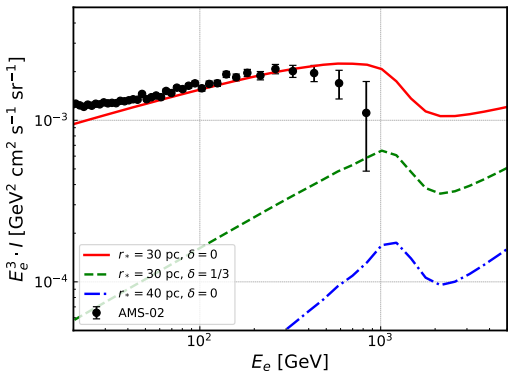
The two-zone diffusion model yields a slow-diffusion zone size r* between 30 and 70 pc for Geminga. The lower bound is fixed by the goodness of fit to the halo's one-dimensional morphology. The upper bound is set by the gamma-ray spectrum together with the condition that the injection spectral index p is at least 1. At r* equal to 30 pc the spectrum allows p up to 2.17 at three sigma significance. This choice of r* and p makes the positron spectrum arriving at Earth agree with AMS-02 data from 50 to 500 GeV.
What carries the argument
Two-zone diffusion model separating a slow-diffusion inner region of size r* from an outer region with faster diffusion.
If this is right
- The lower limit on the slow-diffusion zone size is 30 pc from the morphology fit.
- The upper limit on the zone size is 70 pc from the spectrum and p greater than or equal to 1.
- At the lower zone size the injection index cannot exceed 2.17 at 3 sigma.
- The parameters r* equal to 30 pc and p equal to 2.17 reproduce the observed positron spectrum at Earth.
Where Pith is reading between the lines
- Other pulsars may have comparable slow-diffusion zones that affect their gamma-ray halos.
- Improved spectral measurements could narrow the allowed range for the injection index.
- The match to positron data suggests Geminga contributes substantially to the local positron excess.
Load-bearing premise
The two-zone diffusion model correctly captures electron propagation from Geminga and the HAWC data reflect only Geminga's electrons.
What would settle it
A new observation of the Geminga halo morphology or spectrum that cannot be fit by any r* in 30-70 pc, or that requires p outside the allowed range at r*=30 pc, or that shows a positron spectrum inconsistent with the prediction.
Figures


read the original abstract
Measuring the electron diffusion coefficient is the most straightforward task in the study of gamma-ray pulsar halos. The updated measurements of the spatial morphology and spectrum of the Geminga halo by the High-Altitude Water Cherenkov (HAWC) experiment enable us to constrain parameters beyond the diffusion coefficient, including the size of the slow-diffusion zone and the electron injection spectrum from the pulsar wind nebulae (PWNe). Based on the two-zone diffusion model, we find that the slow-diffusion zone size ($r_*$) around Geminga is within the range of $30-70$~pc. The lower boundary of this range is determined by the goodness of fit of the model to the one-dimensional morphology of the Geminga halo. The upper limit is derived from fitting the gamma-ray spectrum of the Geminga halo, along with the expectations for the power-law index of the injection spectrum based on simulations and PWNe observations, i.e., $p\gtrsim1$. With $r_*$ set at its lower limit of $30$~pc, we obtain the maximum $p$ permitted by the HAWC spectrum measurement, with an upper limit of $2.17$ at a $3\sigma$ significance. Moreover, we find that when $r_*=30$~pc and $p=2.17$, the predicted positron spectrum generated by Geminga at Earth coincides with the AMS-02 measurement in the $50-500$~GeV range.
Editorial analysis
A structured set of objections, weighed in public.
Referee Report
Summary. The manuscript applies a two-zone diffusion model to HAWC gamma-ray morphology and spectrum data for the Geminga pulsar halo. It constrains the slow-diffusion zone size r* to the range 30-70 pc (lower bound from 1D morphology goodness-of-fit, upper bound from spectrum fit requiring p ≳ 1), derives a 3σ upper limit p ≤ 2.17 at r* = 30 pc, and shows that these parameters yield a predicted positron spectrum at Earth that matches AMS-02 data in the 50-500 GeV range.
Significance. If the two-zone model is valid and the HAWC data arise solely from Geminga, the work supplies observationally anchored bounds on the diffusion zone size and injection index that bear on cosmic-ray transport and the positron excess. A clear strength is the separation of morphology (setting r* lower limit) from spectrum (setting p upper limit) followed by an explicit forward prediction to AMS-02 that is not a circular fit to the target observable.
major comments (2)
- [§4] §4 (morphology analysis): the lower bound r* ≥ 30 pc rests on the goodness-of-fit to the one-dimensional HAWC surface-brightness profile; the text does not state whether the fit uses the full covariance matrix of the profile or a diagonal χ², which directly affects the statistical significance of the 30 pc threshold.
- [§5] §5 (spectrum fit and 3σ limit): the quoted 3σ upper limit p = 2.17 at r* = 30 pc is obtained from the HAWC spectrum; it is not shown whether this limit marginalizes over the diffusion-coefficient uncertainty or incorporates HAWC systematic errors, which is load-bearing for the claimed consistency with the AMS-02 positron spectrum.
minor comments (2)
- The definition of the injection index p (power-law slope of the electron spectrum at the source) should be stated explicitly on first use in the main text.
- Figure captions for the morphology and spectrum panels should note the exact energy range and radial binning used in each fit.
Simulated Author's Rebuttal
We thank the referee for the positive assessment of the manuscript's significance and for the constructive major comments. We address each point below and will revise the manuscript to improve clarity on the statistical methods employed.
read point-by-point responses
-
Referee: [§4] §4 (morphology analysis): the lower bound r* ≥ 30 pc rests on the goodness-of-fit to the one-dimensional HAWC surface-brightness profile; the text does not state whether the fit uses the full covariance matrix of the profile or a diagonal χ², which directly affects the statistical significance of the 30 pc threshold.
Authors: The analysis in §4 employed a diagonal χ² for the one-dimensional surface-brightness profile fit, as the HAWC data release for the Geminga halo does not provide the full covariance matrix for the 1D profile. This is a standard approach when covariances are unavailable. The 30 pc lower bound corresponds to the radius at which the fit quality degrades markedly (Δχ² > 9 relative to the best fit). We will revise §4 to explicitly state the use of diagonal χ², report the χ² values for r* = 20, 30, and 40 pc, and note that this yields a conservative lower limit on r*. revision: yes
-
Referee: [§5] §5 (spectrum fit and 3σ limit): the quoted 3σ upper limit p = 2.17 at r* = 30 pc is obtained from the HAWC spectrum; it is not shown whether this limit marginalizes over the diffusion-coefficient uncertainty or incorporates HAWC systematic errors, which is load-bearing for the claimed consistency with the AMS-02 positron spectrum.
Authors: At fixed r* = 30 pc the spectrum fit optimizes over the diffusion coefficient (and normalization) to obtain the minimum χ² for each trial value of p; the 3σ upper limit p ≤ 2.17 is defined by the point where χ² increases by 9. The quoted limit is therefore statistical only and does not include a full marginalization over diffusion-coefficient posterior or HAWC systematic uncertainties (which are not quantified in the public HAWC spectrum). We will revise §5 to state this procedure explicitly, add a sentence noting the limit is statistical, and emphasize that the AMS-02 match is shown for the best-fit parameters at the boundary of the allowed region rather than as a statistically rigorous joint fit. revision: yes
Circularity Check
No significant circularity identified
full rationale
The paper fits the two-zone diffusion model parameters (r* and p) directly to HAWC gamma-ray morphology and spectrum data, deriving the 30-70 pc range for r* and the p<=2.17 limit at r*=30 pc. The AMS-02 positron spectrum match is computed forward from those HAWC-fitted values as an independent consistency check, not a refit or input. No self-citations, self-definitional loops, or renamings of known results appear in the derivation chain; the central bounds rest on external observational data fits with explicit statistical thresholds.
Axiom & Free-Parameter Ledger
free parameters (3)
- r_* =
30-70 pc
- p =
≤2.17
- diffusion_coefficient
axioms (2)
- domain assumption Two-zone diffusion model accurately captures electron transport from Geminga
- domain assumption HAWC gamma-ray data are produced exclusively by Geminga halo electrons
Lean theorems connected to this paper
-
IndisputableMonolith/Foundation/RealityFromDistinction.leanreality_from_one_distinction unclear?
unclearRelation between the paper passage and the cited Recognition theorem.
Based on the two-zone diffusion model, we find that the slow-diffusion zone size (r∗) around Geminga is within the range of 30−70 pc... With r∗ set at its lower limit of 30 pc, we obtain the maximum p permitted by the HAWC spectrum measurement, with an upper limit of 2.17 at a 3σ significance.
-
IndisputableMonolith/Cost/FunctionalEquation.leanwashburn_uniqueness_aczel unclear?
unclearRelation between the paper passage and the cited Recognition theorem.
The diffusion coefficient in the two-zone diffusion model takes the form of D(Ee,r)=... D100(Ee/100 TeV)δ ...
What do these tags mean?
- matches
- The paper's claim is directly supported by a theorem in the formal canon.
- supports
- The theorem supports part of the paper's argument, but the paper may add assumptions or extra steps.
- extends
- The paper goes beyond the formal theorem; the theorem is a base layer rather than the whole result.
- uses
- The paper appears to rely on the theorem as machinery.
- contradicts
- The paper's claim conflicts with a theorem or certificate in the canon.
- unclear
- Pith found a possible connection, but the passage is too broad, indirect, or ambiguous to say the theorem truly supports the claim.
Forward citations
Cited by 3 Pith papers
-
PHECT: A lightweight computation tool for pulsar halo emission
PHECT is a configurable computation tool for pulsar halo gamma-ray emission using multiple transport models and stable finite-volume discretizations.
-
On the contribution of the bow shock pulsar wind nebula PSR J0437-4715 to the observed fluxes of GeV-TeV positrons and antiprotons
The bow shock pulsar wind nebula around PSR J0437-4715 explains the GeV-TeV positron excess and hundreds-of-GeV antiproton flux with an energy-independent ratio by using 25% of the pulsar's wind power.
-
Discrete treatment of inverse Compton scattering: implications on parameter estimation in gamma-ray astronomy
Discrete ICS simulation shows continuous approximations overestimate evolved cutoff energies, leading to lower inferred electron injection cutoffs for Geminga at 95% CL and potential overestimation of acceleration in ...
Reference graph
Works this paper leans on
- [1]
- [2]
-
[3]
K. Fang, Front. Astron. Space Sci. 9, 1022100 (2022), arXiv:2209.13294 [astro-ph.HE]
- [4]
-
[5]
R. L´ opez-Coto, E. de O˜ na Wilhelmi, F. Aharonian, E. Amato, and J. Hinton, Nature Astron. 6, 199 (2022), arXiv:2202.06899 [astro-ph.HE]
-
[6]
C. Evoli, T. Linden, and G. Morlino, Phys. Rev. D 98, 063017 (2018), arXiv:1807.09263 [astro-ph.HE]
work page internal anchor Pith review Pith/arXiv arXiv 2018
-
[7]
K. Fang, X.-J. Bi, and P.-F. Yin, Mon. Not. Roy. Astron. Soc. 488, 4074 (2019), arXiv:1903.06421 [astro-ph.HE]
- [8]
- [9]
-
[10]
K. Fang, S.-Q. Xi, and X.-J. Bi, Phys. Rev. D 104, 103024 (2021), arXiv:2107.02140 [astro- ph.HE]
-
[11]
K. Fang and X.-J. Bi, Phys. Rev. D 105, 103007 (2022), arXiv:2203.01546 [astro-ph.HE]
-
[12]
K. Fang, S.-Q. Xi, L.-Z. Bao, X.-J. Bi, and E.-S. Chen, Phys. Rev. D 106, 123017 (2022), arXiv:2207.13533 [astro-ph.HE]
-
[13]
Extended gamma-ray sources around pulsars constrain the origin of the positron flux at Earth
A. Abeysekara et al. (HAWC), Science 358, 911 (2017), arXiv:1711.06223 [astro-ph.HE]
work page internal anchor Pith review Pith/arXiv arXiv 2017
-
[14]
F. Aharonian et al. (LHAASO), Phys. Rev. Lett. 126, 241103 (2021), arXiv:2106.09396 [astro- ph.HE]
-
[15]
A. Albert et al. (HAWC), Astrophys. J. Lett.944, L29 (2023), arXiv:2301.04646 [astro-ph.HE]
-
[16]
HAWC Observations Strongly Favor Pulsar Interpretations of the Cosmic-Ray Positron Excess
D. Hooper, I. Cholis, T. Linden, and K. Fang, Phys. Rev. D 96, 103013 (2017), arXiv:1702.08436 [astro-ph.HE]
work page internal anchor Pith review Pith/arXiv arXiv 2017
-
[17]
Two-zone diffusion of electrons and positrons from Geminga explains the positron anomaly
K. Fang, X.-J. Bi, P.-F. Yin, and Q. Yuan, Astrophys. J. 863, 30 (2018), arXiv:1803.02640 [astro-ph.HE]
work page internal anchor Pith review Pith/arXiv arXiv 2018
-
[18]
Positron flux and gamma-ray emission from Geminga pulsar and pulsar wind nebula
X. Tang and T. Piran, Mon. Not. Roy. Astron. Soc. 484, 3491 (2019), arXiv:1808.02445 [astro- ph.HE]
work page internal anchor Pith review Pith/arXiv arXiv 2019
-
[19]
S.-Q. Xi, R.-Y. Liu, Z.-Q. Huang, K. Fang, and X.-Y. Wang, Astrophys. J. 878, 104 (2019), arXiv:1810.10928 [astro-ph.HE]
work page internal anchor Pith review Pith/arXiv arXiv 2019
-
[20]
K. Fang, X.-J. Bi, and P.-F. Yin, Astrophys. J. 884, 124 (2019), arXiv:1906.08542 [astro- ph.HE]
-
[21]
S. Manconi, M. Di Mauro, and F. Donato, Phys. Rev. D 102, 023015 (2020), arXiv:2001.09985 [astro-ph.HE]. 16
-
[22]
Wu, JCAP 12, 007 (2022), arXiv:2206.07621 [astro-ph.HE]
D. Wu, JCAP 12, 007 (2022), arXiv:2206.07621 [astro-ph.HE]
-
[23]
B. Schroer, C. Evoli, and P. Blasi, Phys. Rev. D 107, 123020 (2023), arXiv:2305.08019 [astro- ph.HE]
-
[24]
Pulsar TeV Halos Explain the TeV Excess Observed by Milagro
T. Linden and B. J. Buckman, Phys. Rev. Lett. 120, 121101 (2018), arXiv:1707.01905 [astro- ph.HE]
work page internal anchor Pith review Pith/arXiv arXiv 2018
- [25]
- [26]
-
[27]
P. Mukhopadhyay and T. Linden, Phys. Rev. D 105, 123008 (2022), arXiv:2111.01143 [astro- ph.HE]
-
[28]
P. De La Torre Luque, O. Fornieri, and T. Linden, Phys. Rev. D 106, 123033 (2022), arXiv:2205.08544 [astro-ph.HE]
-
[29]
K. Fang, H.-B. Hu, X.-J. Bi, and E.-S. Chen, Phys. Rev. D 108, 023017 (2023), arXiv:2304.04570 [astro-ph.HE]
-
[30]
S. Recchia, M. Di Mauro, F. A. Aharonian, L. Orusa, F. Donato, S. Gabici, and S. Manconi, Phys. Rev. D 104, 123017 (2021), arXiv:2106.02275 [astro-ph.HE]
- [31]
- [32]
-
[33]
B. B. Wang, G. P. Zank, L. L. Zhao, and L. Adhikari, Astrophys. J. 932, 65 (2022)
work page 2022
- [34]
-
[35]
Propagation of cosmic rays in the AMS-02 era
Q. Yuan, S.-J. Lin, K. Fang, and X.-J. Bi, Phys. Rev. D 95, 083007 (2017), arXiv:1701.06149 [astro-ph.HE]
work page internal anchor Pith review Pith/arXiv arXiv 2017
-
[36]
K. Fang, X.-J. Bi, S.-J. Lin, and Q. Yuan, Chin. Phys. Lett. 38, 039801 (2021), arXiv:2007.15601 [astro-ph.HE]
-
[37]
R. N. Manchester, G. B. Hobbs, A. Teoh, and M. Hobbs, Astron. J. 129, 1993 (2005), arXiv:astro-ph/0412641
work page internal anchor Pith review Pith/arXiv arXiv 1993
-
[38]
Radiative losses and cut-offs of energetic particles at relativistic shocks
P. Dempsey and P. Duffy, Mon. Not. Roy. Astron. Soc. 378, 625 (2007), arXiv:0704.0168 [astro-ph]
work page internal anchor Pith review Pith/arXiv arXiv 2007
-
[39]
S. M. Osipov, A. M. Bykov, A. E. Petrov, and V. I. Romansky, J. Phys. Conf. Ser. 1697, 17 012009 (2020)
work page 2020
- [40]
-
[41]
J. Faherty, F. M. Walter, and J. Anderson, Astrophys. Space Sci. 308, 225 (2007)
work page 2007
- [42]
-
[43]
P. Reichherzer, L. Merten, J. D¨ orner, J. Becker Tjus, M. J. Pueschel, and E. G. Zweibel, Appl. Sciences 4, 15 (2022), arXiv:2104.13093 [astro-ph.HE]
-
[44]
Cosmic Ray Propagation: Nonlinear Diffusion Parallel and Perpendicular to Mean Magnetic Field
H. Yan and A. Lazarian, Astrophys. J. 673, 942 (2008), arXiv:0710.2617 [astro-ph]
work page internal anchor Pith review Pith/arXiv arXiv 2008
-
[45]
A. M. Bykov, E. Amato, A. E. Petrov, A. M. Krassilchtchikov, and K. P. Levenfish, Space Sci. Rev. 207, 235 (2017), arXiv:1705.00950 [astro-ph.HE]
work page internal anchor Pith review Pith/arXiv arXiv 2017
-
[46]
Geminga's puzzling pulsar wind nebula
B. Posselt, G. Pavlov, P. Slane, R. Romani, N. Bucciantini, A. Bykov, O. Kargaltsev, M. Weis- skopf, and C. Y. Ng, Astrophys. J. 835, 66 (2017), arXiv:1611.03496 [astro-ph.HE]
work page internal anchor Pith review Pith/arXiv arXiv 2017
-
[47]
A. Khokhriakova, W. Becker, G. Ponti, M. Sasaki, B. Li, and R. Y. Liu, (2023), arXiv:2310.10454 [astro-ph.HE]
-
[48]
Observation of an anomalous positron abundance in the cosmic radiation
O. Adriani et al. (PAMELA), Nature 458, 607 (2009), arXiv:0810.4995 [astro-ph]
work page internal anchor Pith review Pith/arXiv arXiv 2009
-
[49]
Measurement of separate cosmic-ray electron and positron spectra with the Fermi Large Area Telescope
M. Ackermann et al. (Fermi-LAT), Phys. Rev. Lett. 108, 011103 (2012), arXiv:1109.0521 [astro-ph.HE]
work page internal anchor Pith review Pith/arXiv arXiv 2012
- [50]
-
[51]
Pulsars as the Sources of High Energy Cosmic Ray Positrons
D. Hooper, P. Blasi, and P. D. Serpico, JCAP 01, 025 (2009), arXiv:0810.1527 [astro-ph]
work page internal anchor Pith review Pith/arXiv arXiv 2009
-
[52]
TeV Gamma Rays from Geminga and the Origin of the GeV Positron Excess
H. Yuksel, M. D. Kistler, and T. Stanev, Phys. Rev. Lett. 103, 051101 (2009), arXiv:0810.2784 [astro-ph]
work page internal anchor Pith review Pith/arXiv arXiv 2009
-
[53]
Pulsar interpretation for the AMS-02 result
P.-F. Yin, Z.-H. Yu, Q. Yuan, and X.-J. Bi, Phys. Rev. D 88, 023001 (2013), arXiv:1304.4128 [astro-ph.HE]
work page internal anchor Pith review Pith/arXiv arXiv 2013
- [54]
- [55]
-
[56]
A. M. Bykov, A. E. Petrov, A. M. Krassilchtchikov, K. P. Levenfish, S. M. Osipov, and G. G. Pavlov, Astrophys. J. Lett. 876, L8 (2019), arXiv:1904.09430 [astro-ph.HE]
work page internal anchor Pith review Pith/arXiv arXiv 2019
- [57]
-
[58]
M. Di Mauro, S. Manconi, and F. Donato, Phys. Rev. D 100, 123015 (2019), [Erratum: Phys.Rev.D 104, 089903 (2021)], arXiv:1903.05647 [astro-ph.HE]
-
[59]
G.-Y. Zhou, Z.-H. Yu, Q. Yuan, and H.-H. Zhang, Commun. Theor. Phys. 74, 105403 (2022), 18 arXiv:2205.07038 [astro-ph.HE]
-
[60]
F. Aharonian et al. (H.E.S.S.), Astron. Astrophys. 673, A148 (2023), arXiv:2304.02631 [astro- ph.HE]. 19
discussion (0)
Sign in with ORCID, Apple, or X to comment. Anyone can read and Pith papers without signing in.