Combinatorics of nondeterministic walks
Pith reviewed 2026-05-24 05:53 UTC · model grok-4.3
The pith
Nondeterministic walks on the line are algebraic for bridges and meanders once the endpoint is replaced by the full set of reachable points.
A machine-rendered reading of the paper's core claim, the machinery that carries it, and where it could break.
Core claim
Nondeterministic bridges and several subclasses of nondeterministic meanders are always algebraic. The same is conjectured for nondeterministic excursions. These statements hold first for Dyck and Motzkin step sets and then for arbitrary step sets; the proofs rely on generating functions, analytic combinatorics, and additive combinatorics once the single ending height is replaced by the set of all reachable heights.
What carries the argument
The reachable-points set: the collection of all heights that can be reached after a given sequence of nondeterministic steps, which replaces the classical single endpoint in the generating-function equations.
If this is right
- Nondeterministic bridges admit algebraic generating functions for every finite step set.
- Several natural subclasses of nondeterministic meanders are algebraic.
- The same algebraicity is expected for nondeterministic excursions, backed by computational evidence.
- The reachable-points construction extends directly from Dyck and Motzkin steps to arbitrary steps while preserving algebraicity for bridges.
Where Pith is reading between the lines
- The same reachable-set technique may produce algebraic counts for other nondeterministic objects such as walks on graphs or higher-dimensional lattices.
- If the conjecture holds, the software packages can be used to extract limit laws and asymptotic densities for the conjectured algebraic cases.
- Protocol-network models that motivated the work could be re-expressed directly as nondeterministic excursions or meanders.
Load-bearing premise
Switching from a single ending height to the full set of reachable heights keeps the generating functions algebraic for the listed walk classes.
What would settle it
An explicit step set for which the ordinary generating function of nondeterministic bridges is proved non-algebraic.
Figures


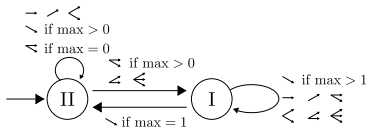


read the original abstract
This paper introduces nondeterministic walks, a new variant of one-dimensional discrete walks. The main difference to classical walks is that its nondeterministic steps consist of sets of steps from a predefined set such that all possible extensions are explored in parallel. We discuss in detail the most natural nondeterministic step sets (Dyck and Motzkin step sets), and show that several nondeterministic classes of lattice paths, such as nondeterministic bridges, excursions, and meanders are algebraic. The key concept is the generalization of the ending point of a walk to its reachable points, i.e., a set of ending points. We extend our results to general step sets: We show that nondeterministic bridges and several subclasses of nondeterministic meanders are always algebraic. We conjecture the same is true for nondeterministic excursions, and we present python and Maple packages to support our conjecture. This research is motivated by the study of networks involving encapsulation and decapsulation of protocols. Our results are obtained using generating functions, analytic combinatorics, and additive combinatorics. Keywords. Random walks, analytic combinatorics, generating functions, limit laws, networking, encapsulation.
Editorial analysis
A structured set of objections, weighed in public.
Referee Report
Summary. This paper introduces nondeterministic walks, a variant of one-dimensional lattice paths in which each step is a set of steps from a fixed step set, with all extensions explored in parallel. The central technical device is replacing the single ending position by the set of reachable positions. For Dyck and Motzkin step sets the authors establish algebraicity of the generating functions for bridges, excursions and meanders. They extend the algebraicity claim to arbitrary step sets for bridges and several subclasses of meanders, conjecture the same for excursions, and supply Python and Maple packages that computationally support the conjecture. The work is motivated by protocol encapsulation networks and employs generating functions together with additive combinatorics.
Significance. If the algebraicity statements hold, the manuscript supplies a new family of algebraic generating functions inside analytic combinatorics and demonstrates that the reachable-set construction preserves algebraicity for the listed classes. The explicit release of verification packages is a concrete strength that permits independent checking of the computational evidence for the excursion conjecture.
major comments (2)
- [section extending results to general step sets] The claim that nondeterministic bridges remain algebraic for arbitrary step sets (abstract and the section extending results to general step sets) rests on the reachable-points construction producing a finite collection of states whose transition rules yield an algebraic system. No explicit argument is given that the attainable subsets of integers remain finite when the underlying step set is arbitrary; for Dyck/Motzkin steps the reachable sets are intervals and finiteness is immediate, but the general case is not addressed. This finiteness is load-bearing for the “always algebraic” assertion.
- [conjecture statement and computational support] The conjecture that nondeterministic excursions are algebraic for general step sets is supported only computationally. The manuscript supplies no partial analytic result, kernel-equation analysis, or state-space bound that would indicate why the reachable-set system stays algebraic in the excursion case, leaving the central conjecture without a clear path to proof.
minor comments (2)
- The abstract states that “several subclasses of nondeterministic meanders” are algebraic but does not name the subclasses; an explicit list or reference to the relevant theorem should appear in the introduction.
- A compact table summarizing which classes are proved algebraic, which are conjectured, and for which step sets would improve readability.
Simulated Author's Rebuttal
We thank the referee for the careful reading and for highlighting points that require clarification or strengthening. We respond to each major comment below.
read point-by-point responses
-
Referee: [section extending results to general step sets] The claim that nondeterministic bridges remain algebraic for arbitrary step sets (abstract and the section extending results to general step sets) rests on the reachable-points construction producing a finite collection of states whose transition rules yield an algebraic system. No explicit argument is given that the attainable subsets of integers remain finite when the underlying step set is arbitrary; for Dyck/Motzkin steps the reachable sets are intervals and finiteness is immediate, but the general case is not addressed. This finiteness is load-bearing for the “always algebraic” assertion.
Authors: We agree that the manuscript does not supply an explicit argument establishing finiteness of reachable subsets for arbitrary finite step sets. In the revised version we will add a short subsection in the general-step-sets section that proves the reachable point sets remain finite for bridges: any reachable set is contained in an interval whose length is bounded by the diameter of the step set and the number of steps needed to return to the origin in the additive sense, using standard facts from additive combinatorics on finite generating sets. revision: yes
-
Referee: [conjecture statement and computational support] The conjecture that nondeterministic excursions are algebraic for general step sets is supported only computationally. The manuscript supplies no partial analytic result, kernel-equation analysis, or state-space bound that would indicate why the reachable-set system stays algebraic in the excursion case, leaving the central conjecture without a clear path to proof.
Authors: The manuscript presents the algebraicity of excursions for general step sets explicitly as a conjecture, supported by the computational evidence in the released Python and Maple packages. We do not possess a partial analytic result, kernel analysis, or state-space bound at this time; the conjecture is offered precisely because such a proof is currently unavailable. The computational verification remains a concrete contribution as stated. revision: no
Circularity Check
No circularity: algebraicity claims rest on independent generating-function analysis of reachable-point models.
full rationale
The paper introduces nondeterministic walks via the reachable-points generalization and applies standard generating-function and analytic-combinatorics techniques to establish algebraicity for bridges and selected meander subclasses. No equations, definitions, or claims reduce the target result to a fitted parameter, self-citation, or ansatz imported from the authors' prior work; the derivation is presented as self-contained and externally motivated by protocol networks. The skeptic concern addresses potential correctness of the finite-state argument for general steps but does not exhibit a definitional or constructional reduction.
Axiom & Free-Parameter Ledger
axioms (1)
- domain assumption Standard techniques of generating functions and analytic combinatorics extend directly to the reachable-points formulation of nondeterministic walks.
invented entities (1)
-
nondeterministic walk
no independent evidence
Reference graph
Works this paper leans on
-
[1]
Andrei Asinowski, Axel Bacher, Cyril Banderier, and Bernhard Gittenberger. Analytic combi- natorics of lattice paths with forbidden patterns, the vectorial kernel method, and generating functions for pushdown automata.Algorithmica, 82(3):386–428, 2020. 40
work page 2020
-
[2]
Basic analytic combinatorics of directed lattice paths
Cyril Banderier and Philippe Flajolet. Basic analytic combinatorics of directed lattice paths. Theoretical Computer Science, 281(1–2):37 – 80, 2002
work page 2002
-
[3]
Cyril Banderier, Christian Krattenthaler, Alan Krinik, Dmitry Kruchinin, Vladimir Kruchinin, David Nguyen, and Michael Wallner.Explicit Formulas for Enumeration of Lattice Paths: Basketball and the Kernel Method, volume 58 ofDevelopments in Mathematics, pages 78–118. Springer, Cham, 2019. [doi]
work page 2019
-
[4]
Latticepathology and Symmetric Functions (Extended Abstract)
Cyril Banderier, Marie-Louise Lackner, and Michael Wallner. Latticepathology and Symmetric Functions (Extended Abstract). InAofA 2020, volume 159 ofLIPIcs, pages 2:1–2:16. Schloss Dagstuhl–Leibniz-Zentrum für Informatik, 2020. [doi]
work page 2020
-
[5]
Some reflections on directed lattice paths
Cyril Banderier and Michael Wallner. Some reflections on directed lattice paths. InProceedings of the 25th International Conference on Probabilistic, Combinatorial and Asymptotic Methods for the Analysis of Algorithms, pages 25–36, 2014
work page 2014
-
[6]
Lattice paths with catastrophes.Discrete Mathematics & Theoretical Computer Science, Vol 19 no
Cyril Banderier and Michael Wallner. Lattice paths with catastrophes.Discrete Mathematics & Theoretical Computer Science, Vol 19 no. 1, September 2017
work page 2017
-
[7]
Cyril Banderier and Michael Wallner.The kernel method for lattice paths below a line of rational slope, volume 58 ofDevelopments in Mathematics, pages 119–154. Springer, Cham,
-
[8]
Nicholas R Beaton, Aleksander L Owczarek, and Andrew Rechnitzer. Exact solution of some quarter plane walks with interacting boundaries.arXiv preprint arXiv:1807.08853, 2018
-
[9]
Nicholas R. Beaton, Aleksander L. Owczarek, and Ruijie Xu. Quarter-plane lattice paths with interacting boundaries: Kreweras and friends.Sém. Lothar. Combin., 82B:Art. 26, 12, 2020
work page 2020
-
[10]
Polynomial equations with one catalytic variable, algebraic series and map enumeration.J
Mireille Bousquet-Mélou and Arnaud Jehanne. Polynomial equations with one catalytic variable, algebraic series and map enumeration.J. Combin. Theory Ser. B, 96(5):623–672,
-
[11]
Walks with small steps in the quarter plane
Mireille Bousquet-Mélou and Marni Mishna. Walks with small steps in the quarter plane. In Algorithmic probability and combinatorics, volume 520 ofContemp. Math., pages 1–39. Amer. Math. Soc., Providence, RI, 2010. [doi]
work page 2010
-
[12]
Culminating paths.Discrete Math
Mireille Bousquet-Mélou and Yann Ponty. Culminating paths.Discrete Math. Theor. Comput. Sci., 10(2):125–152, 2008
work page 2008
-
[13]
Inhomogeneous Restricted Lattice Walks
Manfred Buchacher and Manuel Kauers. Inhomogeneous restricted lattice walks. arXiv preprint arXiv:1811.06725, 2018
work page internal anchor Pith review Pith/arXiv arXiv 2018
-
[14]
J. Courtiel, S. Melczer, M. Mishna, and K. Raschel. Weighted lattice walks and universality classes. J. Combin. Theory Ser. A, 152:255–302, 2017. [doi]
work page 2017
-
[15]
Combinatorics of nondeter- ministic walks of the Dyck and Motzkin type
Élie de Panafieu, Mohamed Lamine Lamali, and Michael Wallner. Combinatorics of nondeter- ministic walks of the Dyck and Motzkin type. InANALCO 2019, pages 1–12, 2019
work page 2019
-
[16]
Walks in the quarter plane, genus zero case.arXiv preprint arXiv:1710.02848, 2017
Thomas Dreyfus, Charlotte Hardouin, Julien Roques, and Michael F Singer. Walks in the quarter plane, genus zero case.arXiv preprint arXiv:1710.02848, 2017. 41
-
[17]
Images and preimages in random mappings.SIAM Journal on Discrete Mathematics, 10(2):246–269, 1997
Michael Drmota and Michèle Soria. Images and preimages in random mappings.SIAM Journal on Discrete Mathematics, 10(2):246–269, 1997
work page 1997
-
[18]
On the enumeration and generation of generalized Dyck words.Discrete Math., 225(1-3):121–135, 2000
Philippe Duchon. On the enumeration and generation of generalized Dyck words.Discrete Math., 225(1-3):121–135, 2000
work page 2000
-
[19]
Cambridge University Press, 2009
Philippe Flajolet and Robert Sedgewick.Analytic Combinatorics. Cambridge University Press, 2009
work page 2009
-
[20]
Ira M. Gessel. A factorization for formal Laurent series and lattice path enumeration.J. Combin. Theory Ser. A, 28(3):321–337, 1980. [doi]
work page 1980
-
[21]
Higher-order Airy scaling in deformed Dyck paths
Nils Haug, Adri Olde Daalhuis, and Thomas Prellberg. Higher-order Airy scaling in deformed Dyck paths. Journal of Statistical Physics, pages 1–16, 2017. [doi]
work page 2017
-
[22]
On convergence rates in the central limit theorems for combinatorial structures
Hsien-Kuei Hwang. On convergence rates in the central limit theorems for combinatorial structures. European J. Combin., 19(3):329–343, 1998. [doi]
work page 1998
-
[23]
Janse van Rensburg, Thomas Prellberg, and Andrew Rechnitzer
Esaias J. Janse van Rensburg, Thomas Prellberg, and Andrew Rechnitzer. Partially directed paths in a wedge.J. Combin. Theory Ser. A, 115(4):623–650, 2008
work page 2008
-
[24]
Donald E. Knuth. The Art of Computer Programming. Vol. 1: Fundamental Algorithms. Addison-Wesley, 1968
work page 1968
-
[25]
Path computation in multi-layer networks: Complexity and algorithms
Mohamed Lamine Lamali, Nasreddine Fergani, Johanne Cohen, and Hélia Pouyllau. Path computation in multi-layer networks: Complexity and algorithms. InIEEE INFOCOM 2016, San Francisco, CA, USA, April 10-14, 2016, pages 1–9, 2016
work page 2016
- [26]
-
[27]
Donatella Merlini, D. G. Rogers, Renzo Sprugnoli, and M. Cecilia Verri. Underdiagonal lattice paths with unrestricted steps.Discrete Appl. Math., 91(1-3):197–213, 1999. [doi]
work page 1999
-
[28]
Two non-holonomic lattice walks in the quarter plane
Marni Mishna and Andrew Rechnitzer. Two non-holonomic lattice walks in the quarter plane. Theoret. Comput. Sci., 410(38-40):3616–3630, 2009. [doi]
work page 2009
-
[29]
RFC7582 - multicast virtual private network (mvpn): Using bidirectional p-tunnels, 2015
E Rosen, IJ Wijnands, Y Cai, and A Boers. RFC7582 - multicast virtual private network (mvpn): Using bidirectional p-tunnels, 2015
work page 2015
-
[30]
RFC4301 - security architecture for the internet protocol, 2005
Karen Seo and Stephen Kent. RFC4301 - security architecture for the internet protocol, 2005
work page 2005
-
[31]
R. Tabbara, A. L. Owczarek, and A. Rechnitzer. An exact solution of two friendly interacting directed walks near a sticky wall.J. Phys. A, 47(1):015202, 34, 2014. [doi]
work page 2014
-
[32]
Cambridge University Press, Cambridge, 2006
Terence Tao and Van Vu.Additive combinatorics, volume 105 ofCambridge Studies in Advanced Mathematics. Cambridge University Press, Cambridge, 2006. [doi]
work page 2006
-
[33]
Peng Wu, Yong Cui, Jianping Wu, Jiangchuan Liu, and Chris Metz. Transition from IPv4 to IPv6: A state-of-the-art survey.IEEE Communications Surveys & Tutorials, 15(3):1407–1424, 2013. 42 A Subclasses of Motzkin N-walks in the OEIS In Theorem 3.7 we have characterized the generating function of Motzkin N-meandersM +(x,y ;t) and proved that it is always alg...
work page 2013
discussion (0)
Sign in with ORCID, Apple, or X to comment. Anyone can read and Pith papers without signing in.