Geometric Guidance for Globally Synchronized Deployment of Elastic Geodesic Grids
Pith reviewed 2026-05-24 05:05 UTC · model grok-4.3
The pith
Inverse tracing and global optimization yield synchronized displacement sequences for elastic geodesic grid deployment.
A machine-rendered reading of the paper's core claim, the machinery that carries it, and where it could break.
Core claim
The central claim is that inverse tracing with a lightweight rod model produces feasible node paths that can be approximated by synchronized polylines; solving the resulting constrained optimization problem via global optimization delivers compact, globally synchronized displacement sequences for all paths simultaneously, enabling robust simulation of the deployment process.
What carries the argument
The polyline approximation problem that selects globally synchronized time steps while minimizing a robust tail-aggregated deviation measure under monotonicity constraints, solved by global optimization.
If this is right
- Compact synchronized displacement sequences are obtained simultaneously for all paths.
- Geometry-centric metrics quantify deviation versus step count and scaling behavior with trajectory count.
- Finite-element deployment simulations driven by the sequences avoid intermediate buckling.
- The same sequences capture deployment-induced prestress in the simulations.
Where Pith is reading between the lines
- The same inverse-tracing-plus-global-optimization pipeline could be applied to other classes of elastic deployable surfaces whose motion is likewise difficult to simulate directly.
- The resulting compact sequences might reduce the number of simulation steps needed for long deployment histories without loss of essential mechanics.
- Because the method is geometry-centric, it could be inserted as a preprocessing stage before any physics-based solver that requires collision-free or buckling-free intermediate states.
Load-bearing premise
The node paths recorded during inverse tracing with the lightweight rod model remain feasible and stay valid once approximated by synchronized polylines that obey the monotonicity constraints.
What would settle it
Apply the computed synchronized sequences to finite-element deployment simulations of the grids and check whether intermediate buckling still appears or whether the sequences fail to reproduce observed prestress.
Figures




read the original abstract
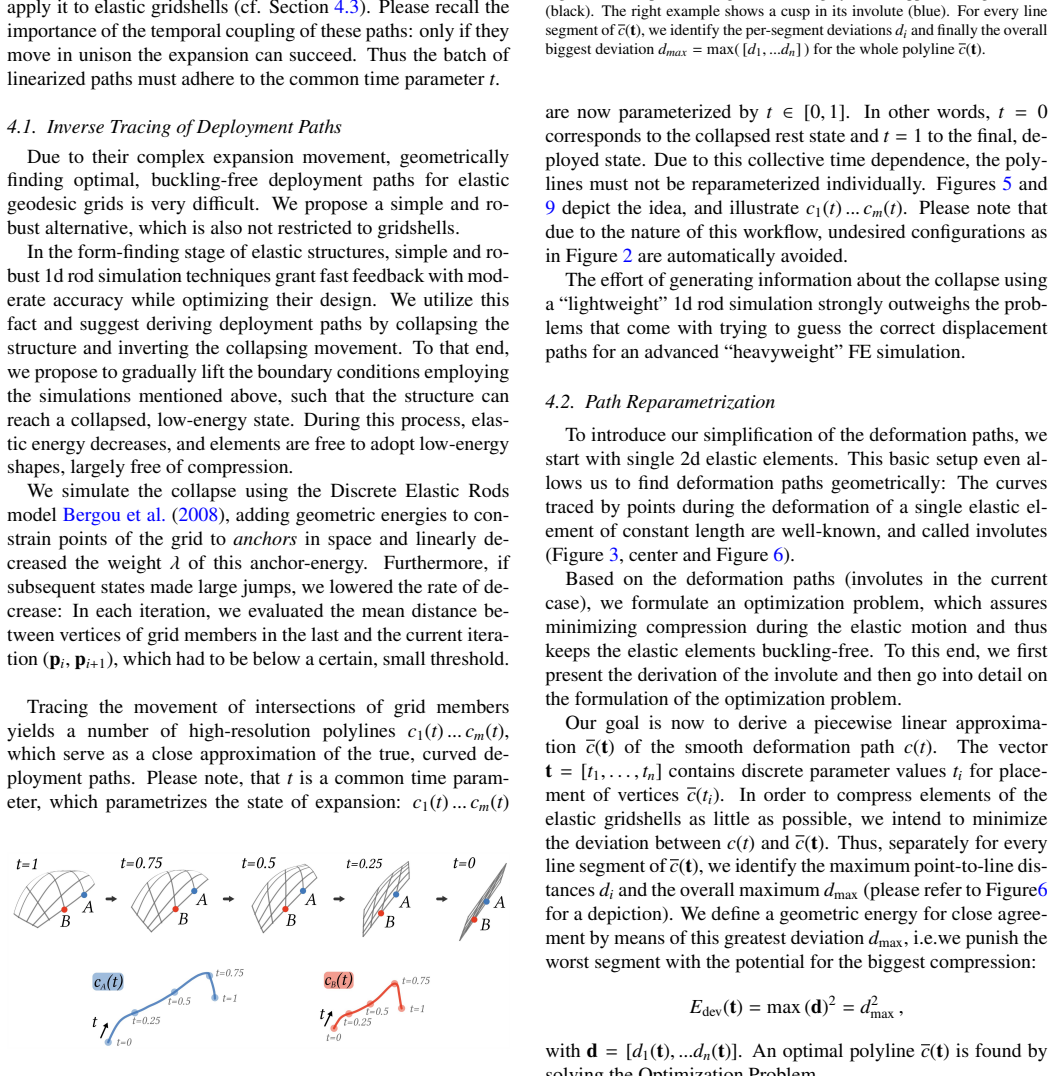
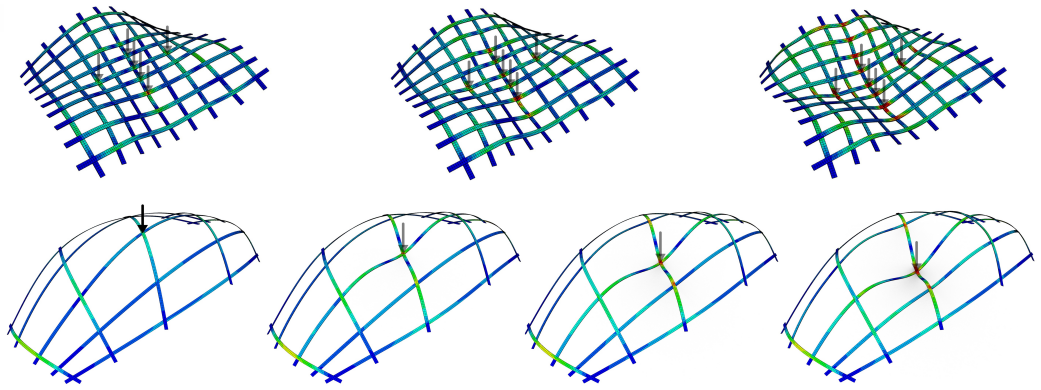
Elastic geodesic grids deploy from flat to spatial configurations via complex nonlinear motion that is difficult to represent robustly for simulation. We present a geometric guidance framework that discretizes deployment as synchronized, time-coupled deformation trajectories. Starting from inverse tracing -- collapsing the deployed structure with a lightweight rod model while recording node paths under a shared parameter -- we obtain feasible node paths and formulate a polyline approximation problem that selects {globally synchronized} time steps and minimizes a robust tail-aggregated deviation measure under monotonicity constraints. {We solve the resulting non-smooth optimization problem via global optimization to obtain compact, synchronized displacement sequences for all paths simultaneously}. We evaluate the method using geometry-centric metrics (deviation versus step count, scaling with trajectory count) and demonstrate its utility by driving finite element deployment simulations that avoid intermediate buckling and capture deployment-induced prestress.
Editorial analysis
A structured set of objections, weighed in public.
Referee Report
Summary. The paper presents a geometric guidance framework for deploying elastic geodesic grids from flat to spatial configurations. It discretizes the deployment via inverse tracing with a lightweight rod model to record node paths under a shared parameter, then formulates a polyline approximation problem that selects globally synchronized time steps while minimizing a tail-aggregated deviation measure subject to monotonicity constraints. The resulting non-smooth optimization is solved via global optimization to produce compact synchronized displacement sequences, which are evaluated using geometry-centric metrics (deviation vs. step count, scaling with trajectory count) and demonstrated by driving finite-element simulations that avoid intermediate buckling and capture deployment-induced prestress.
Significance. If the central claim holds, the framework offers a geometry-driven approach to robustly represent and synchronize complex nonlinear deployment motions that are otherwise difficult to simulate. The combination of inverse tracing, monotonicity-constrained global optimization, and downstream FE validation could provide a practical tool for computational design and analysis of elastic structures in architecture and fabrication, particularly if the method scales with trajectory count and produces sequences that reliably transfer to full elastic models.
major comments (2)
- [Inverse tracing and optimization formulation (as described in the abstract and method overview)] The central claim that the globally synchronized polyline sequences obtained from the rod-model paths remain valid (i.e., avoid buckling and correctly capture prestress) when replayed in the target FE simulator rests on the unverified assumption that the lightweight rod model trajectories are sufficiently close to the true nonlinear elastic-grid kinematics in curvature and relative timing. No quantitative error metric, deviation bound, or direct comparison between rod-model paths and full elastic trajectories is reported before or after the polyline approximation step; this is load-bearing for the claim that the optimization produces usable deployment sequences.
- [Optimization and evaluation sections] The non-smooth optimization problem is stated to be solved via global optimization to obtain compact sequences, yet the manuscript provides no details on the specific solver, convergence criteria, or scaling behavior with increasing numbers of paths. Without these, it is unclear whether the reported geometry metrics (deviation versus step count) reflect reliable global optima or merely feasible local solutions.
minor comments (2)
- [Abstract and method] The abstract refers to 'robust tail-aggregated deviation measure' without defining the aggregation function or tail threshold; this notation should be clarified with an equation in the method section.
- [Evaluation figures] Figure captions and axis labels for the geometry-centric metrics (deviation vs. step count, scaling plots) should include explicit units and the number of trajectories tested to allow direct interpretation of the scaling claim.
Simulated Author's Rebuttal
We thank the referee for the constructive feedback on our geometric guidance framework. We address each major comment below, indicating where revisions to the manuscript will be incorporated to strengthen the presentation.
read point-by-point responses
-
Referee: [Inverse tracing and optimization formulation (as described in the abstract and method overview)] The central claim that the globally synchronized polyline sequences obtained from the rod-model paths remain valid (i.e., avoid buckling and correctly capture prestress) when replayed in the target FE simulator rests on the unverified assumption that the lightweight rod model trajectories are sufficiently close to the true nonlinear elastic-grid kinematics in curvature and relative timing. No quantitative error metric, deviation bound, or direct comparison between rod-model paths and full elastic trajectories is reported before or after the polyline approximation step; this is load-bearing for the claim that the optimization produces usable deployment sequences.
Authors: We agree that the manuscript would benefit from explicit quantification of the approximation quality between the lightweight rod model and the target nonlinear elastic model. The rod model serves as a geometric proxy to extract synchronized node paths under a shared deployment parameter, and the FE results demonstrate that the resulting sequences produce stable deployments without intermediate buckling. However, no direct path-wise error metrics (such as Hausdorff distance or curvature deviation) between rod-model trajectories and full FE trajectories are currently reported. We will revise the evaluation section to include a new quantitative comparison on representative examples, reporting average and maximum path deviations before and after polyline approximation, along with any observed differences in relative timing. revision: yes
-
Referee: [Optimization and evaluation sections] The non-smooth optimization problem is stated to be solved via global optimization to obtain compact sequences, yet the manuscript provides no details on the specific solver, convergence criteria, or scaling behavior with increasing numbers of paths. Without these, it is unclear whether the reported geometry metrics (deviation versus step count) reflect reliable global optima or merely feasible local solutions.
Authors: The manuscript states that the non-smooth problem is solved via global optimization but does not specify the solver implementation, convergence tolerances, or empirical scaling. We will revise the optimization section to document the exact solver (including any library or algorithm variant used), the convergence criteria applied, and additional scaling experiments that report runtime, objective values, and deviation metrics as the number of trajectories increases. These additions will clarify that the reported geometry-centric metrics correspond to the solutions obtained under the stated global optimization procedure. revision: yes
Circularity Check
No circularity: derivation uses independent rod-model tracing then separate global optimization
full rationale
The paper's chain starts from inverse tracing via a lightweight rod model to record node paths, then formulates and solves a distinct non-smooth polyline approximation problem under monotonicity using global optimization. No equation reduces to a fitted parameter renamed as prediction, no self-citation supplies a load-bearing uniqueness theorem, and no ansatz is smuggled. The optimization objective and constraints are defined on the traced paths without re-using the same quantities by construction. This matches the default case of a self-contained geometric method whose central result does not collapse to its inputs.
Axiom & Free-Parameter Ledger
axioms (1)
- domain assumption Inverse tracing with a lightweight rod model yields feasible node paths suitable for polyline approximation under monotonicity constraints.
Reference graph
Works this paper leans on
-
[1]
author Adriaenssens, S. , author Block, P. , author Veenendaal, D. , author Williams, C. , year 2014 . title Shell Structures for Architecture: Form Finding and Optimization . publisher Routledge
work page 2014
-
[2]
author Autengruber, M. , author Lukacevic, M. , author F/üssl, J. , year 2020 . title Finite-element-based moisture transport model for wood including free water above the fiber saturation point . journal International Journal of Heat and Mass Transfer volume 161 , pages 120228 . https://www.sciencedirect.com/science/article/pii/S0017931020331641, :https:...
-
[3]
author Autengruber, M. , author Lukacevic, M. , author Wenighofer, G. , author Mauritz, R. , author F/üssl, J. , year 2021 . title Finite-element-based concept to predict stiffness, strength, and failure of wood composite i-joist beams under various loads and climatic conditions . journal Engineering Structures volume 245 , pages 112908 . https://www.scie...
-
[4]
author Baek, C. , author Reis, P.M. , year 2019 . title Rigidity of hemispherical elastic gridshells under point load indentation . journal Journal of the Mechanics and Physics of Solids volume 124 , pages 411--426 . https://www.sciencedirect.com/science/article/pii/S0022509618306203?via \ :10.1016/J.JMPS.2018.11.002
-
[5]
author Bergou, M. , author Audoly, B. , author Vouga, E. , author Wardetzky, M. , author Grinspun, E. , year 2010 . title Discrete viscous threads . journal ACM Transactions on Graphics volume 29 , pages 1 . http://portal.acm.org/citation.cfm?doid=1399504.1360662 http://portal.acm.org/citation.cfm?doid=1778765.1778853, :10.1145/1778765.1778853
-
[6]
author Bergou, M. , author Wardetzky, M. , author Robinson, S. , author Audoly, B. , author Grinspun, E. , year 2008 . title Discrete elastic rods . journal ACM Transactions on Graphics volume 27 , pages 1 . http://portal.acm.org/citation.cfm?doid=1833349.1778853 http://portal.acm.org/citation.cfm?doid=1360612.1360662, :10.1145/1360612.1360662
-
[7]
author Binninger, A. , author Verhoeven, F. , author Herholz, P. , author Sorkine-Hornung, O. , year 2021 . title Developable approximation via gauss image thinning . journal Computer Graphics Forum (proceedings of SGP 2021) volume 40 , pages 289--300 . :10.1111/cgf.14374
-
[8]
author Chen, T. , author Panetta, J. , author Schnaubelt, M. , author Pauly, M. , year 2021 . title Bistable auxetic surface structures . journal ACM Trans. Graph. volume 40 . https://doi.org/10.1145/3450626.3459940, :10.1145/3450626.3459940
-
[9]
author D'Amico, B. , author Kermani, A. , author Zhang, H. , author Pugnale, A. , author Colabella, S. , author Pone, S. , year 2015 . title Timber gridshells: Numerical simulation, design and construction of a full scale structure , in: booktitle Structures , organization Elsevier . pp. pages 227--235
work page 2015
-
[10]
author Du Peloux, L. , author Tayeb, F. , author Baverel, O. , author Caron, J.F. , year 2016 . title Construction of a large composite gridshell structure: a lightweight structure made with pultruded glass fibre reinforced polymer tubes . journal Structural Engineering International volume 26 , pages 160--167
work page 2016
-
[11]
author Goldberg, D.E. , year 1989 . title Genetic Algorithms in Search, Optimization and Machine Learning . edition 1st ed., publisher Addison-Wesley Longman Publishing Co., Inc. , address USA
work page 1989
-
[12]
o nquist, P. , author Panchadcharam, P. , author Wood, D. , author Menges, A. , author R \
author Gr \"o nquist, P. , author Panchadcharam, P. , author Wood, D. , author Menges, A. , author R \"u ggeberg, M. , author Wittel, F.K. , year 2020 . title Computational analysis of hygromorphic self-shaping wood gridshell structures . journal Royal Society open science volume 7 , pages 192210
work page 2020
-
[13]
author Guseinov, R. , author McMahan, C. , author P \'e rez, J. , author Daraio, C. , author Bickel, B. , year 2020 . title Programming temporal morphing of self-actuated shells . journal Nature communications volume 11 , pages 1--7
work page 2020
-
[14]
author Guseinov, R. , author Miguel, E. , author Bickel, B. , year 2017 . title CurveUps . journal ACM Transactions on Graphics volume 36 , pages 1--12 . http://dl.acm.org/citation.cfm?doid=3072959.3073709, :10.1145/3072959.3073709
-
[15]
author Happold, E. , author Liddell, I. , year 1975 . title Timber Lattice Roof for the Mannheim Bundesgartenschau . journal The Structural Engineer volume 53
work page 1975
-
[16]
author Harris, R. , author Kelly, O. , year 2002 . title The structural engineering of the downland gridshell . journal Space Structures volume 5 , pages 161--172
work page 2002
-
[17]
author Haskell, C. , author Montagne, N. , author Douthe, C. , author Baverel, O. , author Fivet, C. , year 2021 . title Generation of elastic geodesic gridshells with anisotropic cross sections . journal International Journal of Space Structures volume 36 , pages 294--306 . https://doi.org/10.1177/09560599211064099, :10.1177/09560599211064099, http://arx...
-
[18]
author Hern \'a ndez, E.L. , author Baverel, O. , author Gengnagel, C. , year 2013 . title On the design and construction of elastic gridshells with irregular meshes . journal International Journal of Space Structures volume 28 , pages 161--174
work page 2013
-
[19]
author Isvoranu, F. , author Panetta, J. , author Chen, T. , author Bouleau, E. , author Pauly, M. , year 2019 . title X-shell pavilion: A deployable elastic rod structure , in: booktitle Proceedings of IASS Annual Symposia , organization International Association for Shell and Spatial Structures (IASS) . pp. pages 1--8
work page 2019
-
[20]
author Jiang, C. , author Wang, C. , author Rist, F. , author Wallner, J. , author Pottmann, H. , year 2020 . title Quad-mesh based isometric mappings and developable surfaces . journal ACM Trans. Graph. volume 39 . https://doi.org/10.1145/3386569.3392430, :10.1145/3386569.3392430
-
[21]
author Kilian, M. , author Fl \" o ry, S. , author Chen, Z. , author Mitra, N.J. , author Sheffer, A. , author Pottmann, H. , year 2008 . title Curved folding . journal ACM Transactions on Graphics volume 27 , pages 1 . http://portal.acm.org/citation.cfm?doid=1399504.1360674 http://portal.acm.org/citation.cfm?doid=1360612.1360674, :10.1145/1360612.1360674
-
[22]
author Kilian, M. , author Monszpart, A. , author Mitra, N.J. , year 2017 . title String Actuated Curved Folded Surfaces . journal ACM Transactions on Graphics volume 36 , pages 1--13 . http://dl.acm.org/citation.cfm?doid=3087678.3015460, :10.1145/3015460
-
[23]
author Konakovi \' c , M. , author Crane, K. , author Deng, B. , author Bouaziz, S. , author Piker, D. , author Pauly, M. , year 2016 . title Beyond developable . journal ACM Transactions on Graphics volume 35 , pages 1--11 . https://dl.acm.org/citation.cfm?doid=2897824.2925944 http://dl.acm.org/citation.cfm?doid=2897824.2925944, :10.1145/2897824.2925944
-
[24]
author Konakovi \' c -Lukovi \' c , M. , author Panetta, J. , author Crane, K. , author Pauly, M. , year 2018 . title Rapid deployment of curved surfaces via programmable auxetics . journal ACM Transactions on Graphics volume 37 , pages 1--13 . http://dl.acm.org/citation.cfm?doid=3197517.3201373, :10.1145/3197517.3201373
-
[25]
author Laccone, F. , author Malomo, L. , author P \'E rez, J. , author Pietroni, N. , author Ponchio, F. , author Bickel, B. , author Cignoni, P. , year 2019 . title Flexmaps pavilion: a twisted arc made of mesostructured flat flexible panels , in: booktitle Proceedings of IASS Annual Symposia , organization International Association for Shell and Spatial...
work page 2019
-
[26]
author Laccone, F. , author Malomo, L. , author Pietroni, N. , author Cignoni, P. , author Schork, T. , year 2021 . title Integrated computational framework for the design and fabrication of bending-active structures made from flat sheet material . journal Structures volume 34 , pages 979--994 . :10.1016/J.ISTRUC.2021.08.004
-
[27]
author Lara-Bocanegra, A.J. , author Majano-Majano, A. , author Arriaga, F. , author Guaita, M. , year 2018 . title Long-term bending stress relaxation in timber laths for the structural design of lattice shells . journal Construction and Building Materials volume 193 , pages 565--575
work page 2018
-
[28]
author Lefevre, B. , author Tayeb, F. , author Du Peloux, L. , author Caron, J.F. , year 2017 . title A 4-degree-of-freedom kirchhoff beam model for the modeling of bending--torsion couplings in active-bending structures . journal International Journal of Space Structures volume 32 , pages 69--83
work page 2017
-
[29]
author Lienhard, J. , year 2014 . title Bending-Active Structures: Form-finding strategies using elastic deformation in static and kinetic systems and the structural potentials therein . Ph.D. thesis. Universität Stuttgart. :http://dx.doi.org/10.18419/opus-107
-
[30]
author Malomo, L. , author P \' e rez, J. , author Iarussi, E. , author Pietroni, N. , author Miguel, E. , author Cignoni, P. , author Bickel, B. , year 2018 . title FlexMaps . journal ACM Transactions on Graphics volume 37 , pages 1--14 . http://dl.acm.org/citation.cfm?doid=3272127.3275076, :10.1145/3272127.3275076
-
[31]
author Naicu, D. , author Harris, R. , author Williams, C. , year 2014 . title Timber gridshells: Design methods and their application to a temporary pavilion , in: booktitle World Conference on Timber Engineering , pp. pages 10--14
work page 2014
-
[32]
author Panetta, J. , author Isvoranu, F. , author Chen, T. , author Si\' e fert, E. , author Roman, B. , author Pauly, M. , year 2021 . title Computational inverse design of surface-based inflatables . journal ACM Trans. Graph. volume 40 . https://doi.org/10.1145/3450626.3459789, :10.1145/3450626.3459789
-
[33]
, author Konakovi \' c -Lukovi \' c , M
author Panetta, J. , author Konakovi \' c -Lukovi \' c , M. , author Isvoranu, F. , author Bouleau, E. , author Pauly, M. , year 2019 . title X-Shells: a new class of deployable beam structures . journal ACM Transactions on Graphics volume 38 , pages 1--15 . http://dl.acm.org/citation.cfm?doid=3306346.3323040 https://dl.acm.org/doi/10.1145/3306346.3323040...
-
[34]
author Pillwein, S. , author K\" u bert, J. , author Rist, F. , author Musialski, P. , year 2020 a. title Design and fabrication of elastic geodesic grid structures , in: booktitle Symposium on Computational Fabrication , publisher Association for Computing Machinery , address New York, NY, USA . https://doi.org/10.1145/3424630.3425412, :10.1145/3424630.3425412
-
[35]
author Pillwein, S. , author K \"u bert, J. , author Rist, F. , author Musialski, P. , year 2021 . title Design and fabrication of multi-patch elastic geodesic grid structures . journal Computers & Graphics
work page 2021
-
[36]
author Pillwein, S. , author Leimer, K. , author Birsak, M. , author Musialski, P. , year 2020 b. title On Elastic Geodesic Grids and Their Planar to Spatial Deployment . journal ACM Transactions on Graphics volume 39 , pages 125:1--125:12 . :10.1145/3386569.3392490
-
[37]
author Pillwein, S. , author Musialski, P. , year 2021 . title Generalized Deployable Elastic Geodesic Grids . journal ACM Transactions on Graphics (Proc. SIGGRAPH Asia 2021) volume 40 . https://doi.org/10.1145/3478513.3480516, :10.1145/3478513.3480516, http://arxiv.org/abs/2111.08883 arXiv:2111.08883
-
[38]
author Rabinovich, M. , author Hoffmann, T. , author Sorkine-Hornung, O. , year 2019 . title Modeling curved folding with freeform deformations . journal ACM Trans. Graph. volume 38 . https://doi.org/10.1145/3355089.3356531, :10.1145/3355089.3356531
-
[39]
author Ren, Y. , author Panetta, J. , author Chen, T. , author Isvoranu, F. , author Poincloux, S. , author Brandt, C. , author Martin, A. , author Pauly, M. , year 2021 . title 3d weaving with curved ribbons . journal ACM Trans. Graph. volume 40 . https://doi.org/10.1145/3450626.3459788, :10.1145/3450626.3459788
-
[40]
author Sakai, Y. , author Ohsaki, M. , author Adriaenssens, S. , year 2020 . title A 3-dimensional elastic beam model for form-finding of bending-active gridshells . journal International Journal of Solids and Structures volume 193 , pages 328--337
work page 2020
-
[41]
author Shukhov, V. , year 1896 . title Rotunda of the Panrussian Exposition (Nizhny Novgorod, 1896) | Structurae . https://structurae.net/en/structures/rotunda-of-the-panrussian-exposition
-
[42]
author Soriano, E. , author Sastre, R. , author Boixader, D. , year 2019 . title G-shells: Flat collapsible geodesic mechanisms for gridshells , in: booktitle IASS Annual Symposium 2019 – Structural Membranes , address Barcelona
work page 2019
-
[43]
author Stein, O. , author Grinspun, E. , author Crane, K. , year 2018 . title Developability of triangle meshes . journal ACM Trans. Graph. volume 37 . https://doi.org/10.1145/3197517.3201303, :10.1145/3197517.3201303
-
[44]
author Tang, C. , author Bo, P. , author Wallner, J. , author Pottmann, H. , year 2016 . title Interactive design of developable surfaces . journal ACM Trans. Graph. volume 35 . https://doi.org/10.1145/2832906, :10.1145/2832906
-
[45]
, author Konakovi \' c -Lukovi \' c , M
author Vekhter, J. , author Zhuo, J. , author Fandino, L.F.G. , author Huang, Q. , author Vouga, E. , year 2019 . title Weaving geodesic foliations . journal ACM Transactions on Graphics volume 38 , pages 1--22 . http://dl.acm.org/citation.cfm?doid=3306346.3323043, :10.1145/3306346.3323043
discussion (0)
Sign in with ORCID, Apple, or X to comment. Anyone can read and Pith papers without signing in.