The Globalization of Science: The Increasing Power of Individual Scientists
Pith reviewed 2026-05-24 04:51 UTC · model grok-4.3
The pith
The research power of nations now depends on individual scientists' capacity for international collaboration rather than domestic or state-driven efforts.
A machine-rendered reading of the paper's core claim, the machinery that carries it, and where it could break.
Core claim
National science systems have become embedded in global science, so the research power of nations relies on the research power of individual scientists and their capacity to collaborate internationally and tap into the global networked science.
What carries the argument
The split between internationally co-authored publications (driving nearly all Western growth) and the combination of international plus domestic publications (driving developing-world growth) as the measurable indicators of globalization.
If this is right
- Scientists embedded in national systems gain greater agency and self-regulation through global ties.
- Nation-states must add the global level as a distinct layer in science policy alongside national structures.
- New countries, institutions, and teams can enter the system through international networks rather than building domestic capacity first.
- Global science operates as a bottom-up, curiosity-driven process that resists state direction.
Where Pith is reading between the lines
- Policies that increase scientist mobility and cross-border funding access would likely raise national output more than equivalent domestic-only investments.
- Smaller or emerging research nations could accelerate their standing by targeting specific global sub-networks instead of broad national expansion.
- The observed pattern suggests that attempts to insulate national science from global flows would slow growth in both developed and developing contexts.
Load-bearing premise
The chosen publication, collaboration, and citation records from 2000-2020 capture the real drivers of globalization without large biases from database coverage changes or selection effects.
What would settle it
New data showing that domestic-only publications account for most growth in Western countries after 2000, or that international co-authorship shares have not risen in the developing world.
Figures



read the original abstract
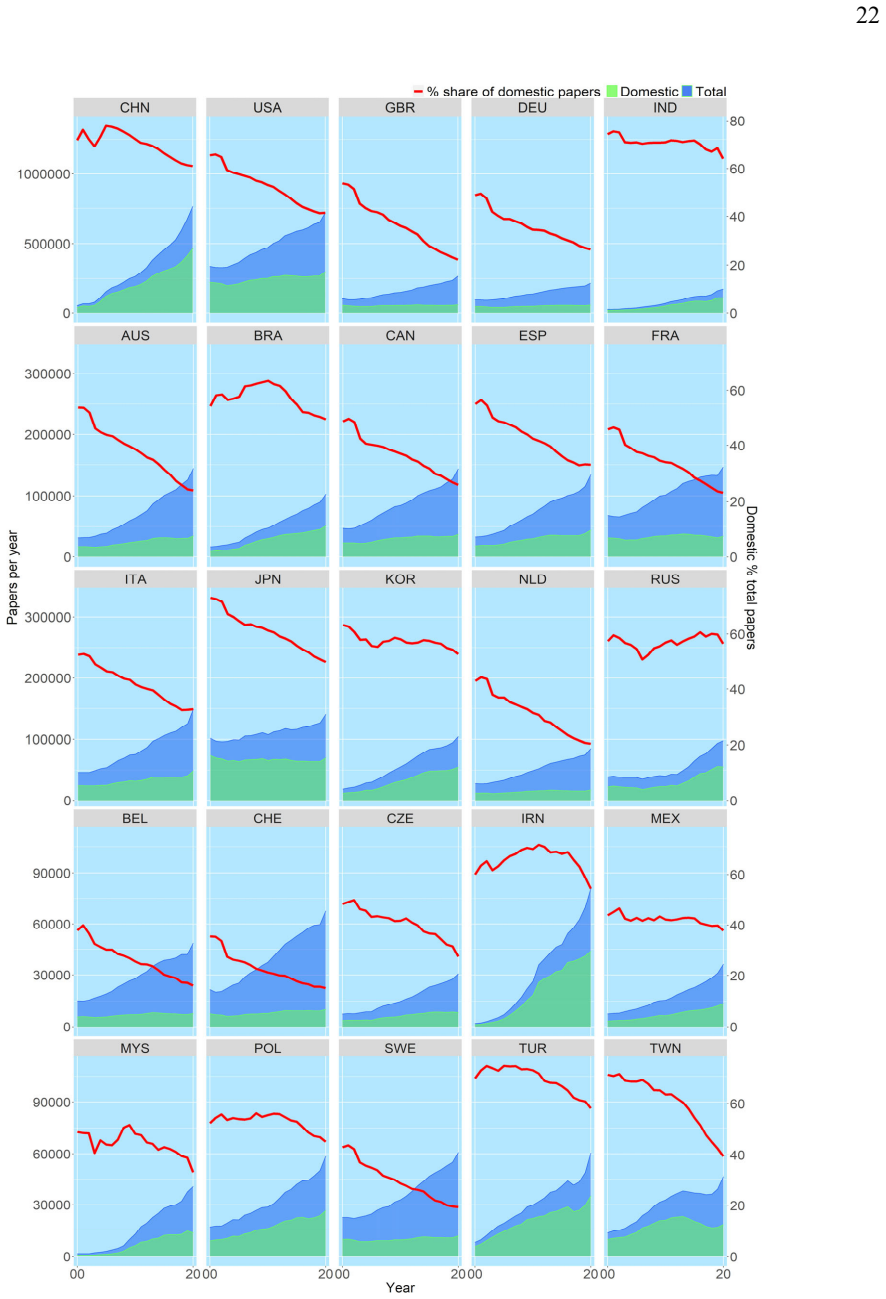
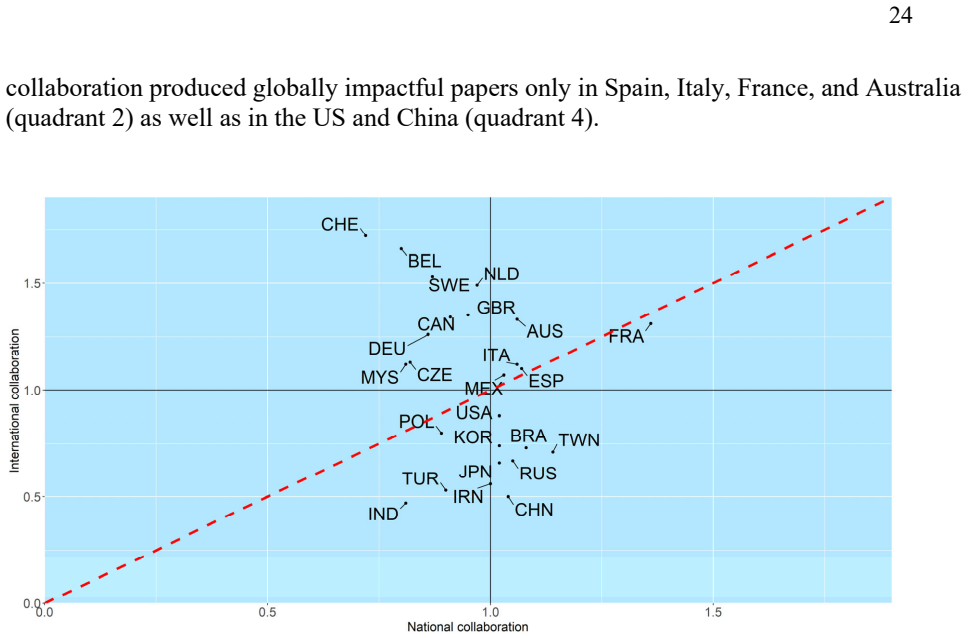
National science systems have become embedded in global science and countries do everything they can to harness global knowledge to national economic needs. However, accessing and using the riches of global knowledge can occur only through scientists. Consequently, the research power of nations relies on the research power of individual scientists. Their capacity to collaborate internationally and to tap into the global networked science is key. The constantly evolving, bottom-up, autonomous, self-regulating, and self-focused nature of global science requires deeper understanding; and the best way to understand its dynamics is to understand what drives academic scientists in their work. The idea that science remains a state-driven rather than curiosity-driven is difficult to sustain. In empirical terms, we describe the globalization of science using selected publication, collaboration, and citation data from 2000-2020. The globalization of science implies two different processes in two different system types: the growth of science in the Western world is almost entirely attributable to internationally co-authored publications; its growth in the developing world, in contrast, is driven by both internationally co-authored and domestic publications. Global network science opens incredible opportunities to new arrivals - countries as well as institutions and research teams. The global system is embedded in the rules created by scientists themselves and maintained as a self-organizing system and nation-states have another major level to consider in their science policies: the global level. Globalization of science provides more agency, autonomy, collegiality, and self-regulation to scientists embedded in national science structures and involved in global networks.
Editorial analysis
A structured set of objections, weighed in public.
Referee Report
Summary. The manuscript claims that national science systems are embedded in global science, with nations harnessing global knowledge through individual scientists whose international collaborations are key. Using selected publication, collaboration, and citation data from 2000-2020, it describes two processes: Western science growth is almost entirely attributable to internationally co-authored publications, while developing-world growth is driven by both international and domestic publications. It concludes that global networked science opens opportunities, operates as a self-organizing system with scientist-driven rules, and grants more agency to scientists within national structures.
Significance. If the reported decomposition of growth drivers proves robust after methodological documentation and coverage controls, the work would add to scientometric understanding of globalization by documenting differential roles of international collaboration across country types and underscoring policy implications for engaging global networks. The emphasis on bottom-up, self-regulating aspects of science provides a counterpoint to state-centric views.
major comments (2)
- [Abstract] Abstract (empirical description paragraph): the central claim decomposing national output growth into domestic vs. internationally co-authored components and attributing nearly all Western growth to the latter supplies no methods, database details (Scopus/WoS), classification rules for co-authorship, sample sizes, error estimates, or validation steps, rendering the Western/developing contrast impossible to assess.
- [Abstract] Abstract (empirical description paragraph): the reported split between international and domestic drivers assumes stable database coverage over 2000-2020, yet no fixed-journal series, coverage-adjusted analysis, or discussion of secular changes in indexed journals (especially those favoring cross-border teams) is described; this assumption is load-bearing for the attribution of growth and could be confounded by coverage expansion.
minor comments (2)
- [Abstract] The abstract contains several run-on sentences and shifts between normative statements (e.g., 'the idea that science remains a state-driven rather than curiosity-driven is difficult to sustain') and empirical claims without clear separation.
- [Abstract] Notation for 'internationally co-authored publications' and 'domestic publications' is used without an explicit definition or example of how fractional counting or full counting is applied.
Simulated Author's Rebuttal
We thank the referee for the constructive comments on the presentation of our empirical claims. We address each major comment below and will revise the manuscript to improve clarity and robustness where needed.
read point-by-point responses
-
Referee: [Abstract] Abstract (empirical description paragraph): the central claim decomposing national output growth into domestic vs. internationally co-authored components and attributing nearly all Western growth to the latter supplies no methods, database details (Scopus/WoS), classification rules for co-authorship, sample sizes, error estimates, or validation steps, rendering the Western/developing contrast impossible to assess.
Authors: We agree that the abstract's brevity omits key methodological details needed for immediate assessment. The full manuscript includes a dedicated Methods section specifying the primary data source (Scopus), the operational definition of international co-authorship (publications with authors affiliated to institutions in more than one country), overall sample sizes (covering millions of records from 2000-2020), and validation procedures such as cross-checks with WoS subsets. To address the concern, we will revise the abstract to include a concise statement on the data source and co-authorship classification, while explicitly referencing the Methods section for full details, sample sizes, and validation steps. revision: yes
-
Referee: [Abstract] Abstract (empirical description paragraph): the reported split between international and domestic drivers assumes stable database coverage over 2000-2020, yet no fixed-journal series, coverage-adjusted analysis, or discussion of secular changes in indexed journals (especially those favoring cross-border teams) is described; this assumption is load-bearing for the attribution of growth and could be confounded by coverage expansion.
Authors: This point correctly identifies a potential confounding factor from database coverage changes. The manuscript relies on a major bibliographic database without an explicit fixed-journal panel or dedicated coverage-sensitivity analysis in the current text. In revision, we will add a brief discussion in the Methods section addressing secular changes in journal indexing, the implications for international vs. domestic attribution, and any robustness checks (such as restricting to persistently indexed journals where feasible). This will strengthen the load-bearing assumption. revision: yes
Circularity Check
No circularity: purely descriptive bibliometric analysis with no derivations or fitted predictions
full rationale
The paper contains no equations, derivations, predictions, or parameter-fitting steps. Its central claims are empirical observations drawn directly from Scopus/WoS publication, collaboration, and citation counts for 2000-2020. No self-citation is invoked to establish uniqueness theorems, ansatzes, or load-bearing premises. The analysis is self-contained against the external database benchmarks it cites; any coverage-bias concerns are data-validity issues, not circularity. No step reduces by construction to its inputs.
Axiom & Free-Parameter Ledger
axioms (1)
- domain assumption International co-authorship indicates tapping into global knowledge networks
Reference graph
Works this paper leans on
-
[1]
Adams, J. (2013). The fourth age of research. Nature, no. 497: 557–560. Buyalskaya, A., Gallo, M. and Camerer, C.F
work page 2013
-
[2]
Barnard, H., Cowan, R., Fernandez de Arroyabe Arranz, M., & Muller, M
The golden age of social science, PNAS February 2, 2021 118 (5) e2002923118. Barnard, H., Cowan, R., Fernandez de Arroyabe Arranz, M., & Muller, M. (2015). The role of global connectedness in the development of indigenous science in middle income countries. In The Handbook of Global Science, Technology, and Innovation (pp. 386-410), ed. Daniele Archibugi,...
work page 2021
-
[3]
A Century of Science: Globalization of Scientific Collaborations, Citations, and Innovations
“A Century of Science: Globalization of Scientific Collaborations, Citations, and Innovations.” KDD 2017 Applied Data Science, 1437-1446. Edelmann, A., Wolff, T., Montagne, D., Bail, C.A. (2020). “Computational Social Science and Sociology.” Annual Review of Sociology, no. 46(1): 61-81. 32 Engels, A., & Ruschenburg, T
work page 2017
-
[4]
doi:10.3152/030234208x317160 Finkelstein, M. & Sethi, W
-
[5]
“Globalization of Scientific and Engineering Talent: International Mobility of Students, Workers, and Ideas and the World Economy.” Economics of Innovation and New Technology, 19(5): 393–406. doi:10.1080/10438590903432871 Glänzel, W
-
[6]
Globalization of Science and International Scientific Collaboration: A Network Perspective
“Globalization of Science and International Scientific Collaboration: A Network Perspective.” Geoforum, no. 105: 1–12. doi:10.1016/j.geoforum.2019.06.017 Hagstrom, W. O
-
[7]
“National Ties of International Scientific Collaboration and Researcher Mobility Found in Nature and Science.” Scientometrics, no. 110(2): 673–694. doi:10.1007/s11192- 016-2183-z King, R
-
[8]
“Gender Disparities in International Research Collaboration: A Large-Scale Bibliometric Study of 25,000 University Professors.” Journal of Economic Surveys. First published: 13 November 2020, https://doi.org/10.1111/joes.12395. Leydesdorff, l., Wagner, CS
-
[9]
The Research University in Transition: The Emerging Global Model
“The Research University in Transition: The Emerging Global Model.” Higher Education Policy, no. 21(1): 5–27. doi:10.1057/palgrave.hep.8300175 Nielsen, M. W., & Andersen, J. P
-
[10]
“What do Citation Counts Measure? An Updated Review of Studies on Citations in Scientific Documents Published between 2006 and 2018.” Scientometrics, no. 121: 1635–1684 Ulnicane, I
work page 2006
-
[11]
Towards a Multipolar Science World: Trends and Impact
“Towards a Multipolar Science World: Trends and Impact.” Scientometrics, no. 82: 439–456. https://doi.org/10.1007/s11192-009-0045-7 Wagner, C. S
-
[12]
Globalisation of Science in Kilometres
“Globalisation of Science in Kilometres.” Journal of Informetrics, no. 5(4): 574–582. doi:10.1016/j.joi.2011.05.003 Wang, D., Barabási, A.-L
-
[13]
The Science of Science: From the Perspective of Complex Systems
“The Science of Science: From the Perspective of Complex Systems.” Physics Reports, nos.714–715: 1-73. Short bio: Marek Kwiek is Professor and Chairholder, UNESCO Chair in Institutional Research and Higher Education Policy, and Director of the Institute for Advanced Studies in Social Sciences and Humanities (IAS), University of Poznan, Poland. His researc...
work page 2019
discussion (0)
Sign in with ORCID, Apple, or X to comment. Anyone can read and Pith papers without signing in.