A Kuratowski-Type Classification of Critical Complexes for the 3-Sphere
Pith reviewed 2026-05-24 03:51 UTC · model grok-4.3
The pith
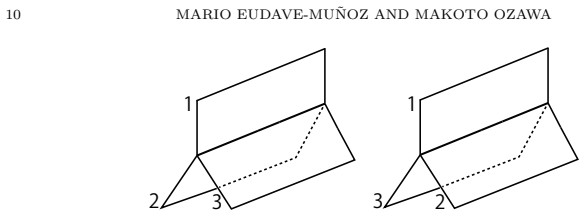
Exactly seven critical complexes of the form (G×S¹)∪H are minimal obstructions to embedding in the 3-sphere up to homeomorphism.
A machine-rendered reading of the paper's core claim, the machinery that carries it, and where it could break.
Core claim
The main theorem states there are exactly seven such critical complexes up to homeomorphism: two K₄-type complexes, four Θ₄-type complexes, and one K_{2,3}-type complex. The proof shows that criticality forces H to be a forest, G to be planar, and the collapsed reduction graph to be inclusion-minimal non-planar, so Kuratowski's theorem reduces the work to the K₅ and K_{3,3} cases; a finite enumeration of forest attachments via the face-incidence criterion then isolates precisely these seven models. The paper also shows every non-embeddable regular multibranched surface in S³ contains a critical subcomplex of the form M∪H.
What carries the argument
The reduction graph obtained by collapsing the S¹-factor of G×S¹, which must be inclusion-minimal non-planar and thereby reduces the classification exactly to the Kuratowski graphs K₅ and K_{3,3} with exhaustive forest attachments checked by the face-incidence criterion.
If this is right
- Every critical complex of this form belongs to one of the seven enumerated homeomorphism types.
- Non-embeddable regular multibranched surfaces in S³ must contain at least one of these seven critical subcomplexes.
- Embeddability after star deletion is completely decided by the face-incidence criterion on the reduced graph.
- The classification is finite because the Kuratowski cases are finite and the forest attachments admit only finitely many incidence patterns.
Where Pith is reading between the lines
- The same reduction technique might classify critical complexes outside the (G×S¹)∪H form by first extracting a maximal multibranched surface subcomplex.
- These seven models could serve as the forbidden minors in a recognition algorithm for embeddability of regular multibranched surfaces in S³.
- The K₄-, Θ₄-, and K_{2,3}-type complexes may correspond to distinct ways the S¹-factor interacts with the attaching forest to create non-embeddability.
Load-bearing premise
Criticality of the complex forces H to be a forest, G to be planar, and the collapsed reduction graph to be inclusion-minimal non-planar.
What would settle it
Discovery of an eighth homeomorphism type of a complex (G×S¹)∪H that is critical for S³ yet lies outside the seven listed models.
Figures




read the original abstract
We give a Kuratowski-type classification of a graph-defined class of minimal piecewise-linear obstructions to embeddability in the 3-sphere. A finite simplicial complex \(X\) is called critical for \(S^3\) if \(|X|\) does not embed in \(S^3\), whereas deleting the open star of any simplex in the second barycentric subdivision of \(X\) yields a polyhedron embeddable in \(S^3\). The main theorem completely classifies critical complexes of the form \((G\times S^1)\cup H\), where \(G\) and \(H\) are graphs and \(H\) is attached along vertices of the branch set of \(G\times S^1\). We prove that there are exactly seven such complexes up to homeomorphism: two \(K_4\)-type complexes, four \(\Theta_4\)-type complexes, and one \(K_{2,3}\)-type complex. The proof is combinatorial in nature. By collapsing the \(S^1\)-factor of \(G\times S^1\), we associate to \(X\) a reduction graph \(\widehat X=G\cup H\). Criticality implies that \(H\) is a forest, \(G\) is planar, and \(\widehat X\) is inclusion-minimal non-planar. Kuratowski's theorem therefore reduces the classification to the cases \(K_5\) and \(K_{3,3}\). A finite analysis of forest attachments, together with a face-incidence criterion for embeddability, leaves precisely the seven models listed above. We also prove that every non-embeddable regular multibranched surface in \(S^3\) contains a critical subcomplex of the form \(M\cup H\), where \(M\) is a regular multibranched surface and \(H\) is a graph.
Editorial analysis
A structured set of objections, weighed in public.
Referee Report
Summary. The manuscript claims a Kuratowski-type classification of critical simplicial complexes for the 3-sphere of the specific form (G × S¹) ∪ H, where G and H are graphs and H attaches along vertices of the branch set of G × S¹. It asserts that there are exactly seven such complexes up to homeomorphism (two K₄-type, four Θ₄-type, one K_{2,3}-type). The proof reduces the problem by collapsing the S¹-factor to obtain a reduction graph X̂ = G ∪ H; criticality forces H to be a forest, G planar, and X̂ inclusion-minimal non-planar, so Kuratowski's theorem reduces the cases to K₅ and K_{3,3}; a finite enumeration of forest attachments via a face-incidence criterion for embeddability then yields the seven models. A secondary result states that every non-embeddable regular multibranched surface in S³ contains a critical subcomplex of the form M ∪ H.
Significance. If the classification holds, the result supplies an explicit, finite list of minimal PL obstructions in this graph-defined class, obtained by a clean combinatorial reduction to the classical Kuratowski graphs followed by exhaustive case analysis. The approach is parameter-free and relies only on standard theorems plus a stated incidence criterion, which is a methodological strength. The additional containment statement for multibranched surfaces broadens the potential utility for embeddability questions in 3-manifolds.
minor comments (3)
- [abstract / §3] The face-incidence criterion used in the enumeration (mentioned in the abstract and presumably stated in §3 or §4) should be given an explicit numbered statement or lemma, together with a short verification that it correctly detects non-embeddability of the resulting complexes after attachment.
- [main theorem statement] The seven models are described only by type names (K₄-type, Θ₄-type, K_{2,3}-type); a table or figure listing the precise edge sets or attaching maps for each would make the classification immediately usable and would facilitate checking the enumeration.
- [final paragraph of abstract] The secondary result on multibranched surfaces is stated without a section reference or proof sketch; a brief outline of how the critical subcomplex is extracted would strengthen the claim.
Simulated Author's Rebuttal
We thank the referee for the positive evaluation, the recognition of the methodological strengths of the combinatorial reduction, and the recommendation of minor revision. No specific major comments or requested changes were listed in the report.
Circularity Check
No significant circularity; classification reduces via external Kuratowski theorem
full rationale
The derivation applies Kuratowski's theorem (external, standard graph-theory result) to reduce criticality of X to the cases of minimal non-planar graphs K5 and K3,3, then enumerates forest attachments H under a stated face-incidence criterion. No equations or claims reduce by construction to fitted inputs, self-definitions, or author-specific prior results. The face-incidence criterion is presented as part of the combinatorial analysis rather than presupposed. The paper is self-contained against external benchmarks, yielding a normal non-circular finding.
Axiom & Free-Parameter Ledger
axioms (2)
- standard math Kuratowski's theorem characterizing minimal non-planar graphs as K₅ and K_{3,3}
- domain assumption Face-incidence criterion for embeddability after forest attachments
Reference graph
Works this paper leans on
-
[1]
Burde, G., Zieschang, H, Knots, de Gruyter Studies in Mathematics 5, Walter de Gruyter & Co., Berlin, 1985
work page 1985
-
[2]
Carmesin, Embedding simply connected 2-complexes in 3-space – I
J. Carmesin, Embedding simply connected 2-complexes in 3-space – I. A Kuratowski-type characterisation, arXiv:1709.04642
-
[3]
K. Eto, S. Matsuzaki, M. Ozawa, An obstruction to embedding 2-dimensional complexes into the 3-sphere, Topol. Appl. 198 (2016), 117–125
work page 2016
-
[4]
M. Eudave-Mu˜ noz,Non-hyperbolic manifolds obtained by Dehn surgery on hyperbolic knots , Geometric topology (Athens, GA, 1993), AMS/IP Stud. Adv. Math., vol. 2, Amer. Math. Soc., Providence, RI, 1997, pp. 35–61
work page 1993
-
[5]
M. Eudave-Mu˜ noz, M. Ozawa,Characterization of 3-punctured spheres in non-hyperbolic link exteriors, Topol. Appl. 264 (2019), 300–312
work page 2019
-
[6]
M. G. Fischer, L. de Campo, J. J. K. Kirkensgaard, S. T. Hyde, and G. E. Schr¨ oder-Turk,The Tricontinuous 3ths(5) Phase: A New Morphology in Copolymer 2 Melts , Macromolecules 47 (2014), 7424–7430
work page 2014
-
[7]
Fr´ echet,Les dimensions d’un ensemble abstrait , Math
M. Fr´ echet,Les dimensions d’un ensemble abstrait , Math. Ann. 68 (1910), 145–168
work page 1910
-
[8]
D. Gay, R. Kirby, Trisecting 4-manifolds, Geom. Topol. 20 (2016), 3097–3132
work page 2016
-
[9]
A Mathematical Trib- ute to Jos´ e Mar´ ıa Montesinos Amilibia
J. C. G´ omez-Larra˜ naga, F. Gonz´ alez-Acu˜ na, W. Heil,2-stratifolds, in “A Mathematical Trib- ute to Jos´ e Mar´ ıa Montesinos Amilibia”, Universidad Complutense de Madrid, 395–405 (2016)
work page 2016
-
[10]
J. C. G´ omez-Larra˜ naga, F. Gonz´ alez-Acu˜ na, W. Heil,2-Stratifold groups have solvable word problem, Revista de la Real Academia de Ciencias Exactas, F´ ısicas y Naturales. Serie A. Matem´ aticas112 (2018), 803–810
work page 2018
-
[11]
J. C. G´ omez-Larra˜ naga, F. Gonz´ alez-Acu˜ na, W. Heil,2-stratifold spines of closed 3-manifolds, Osaka J. Math. 57 (2020), 267–277
work page 2020
-
[12]
J. F. Geelen, R. B. Richter, G. Salazar, Embedding grids in surfaces , European Journal of Combinatorics 25 (2004), 785–792
work page 2004
-
[13]
C. McA. Gordon, J. Luecke, Non-integral toroidal Dehn surgeries , Comm. Anal. Geom. 12 (2004), 417–485
work page 2004
-
[14]
S. T. Hyde, L. de Campo, C. Oguey, Tricontinuous mesophases of balanced three-arm ‘star polyphiles’, Soft Matter 5 (2009), 2782–2794. FORBIDDEN COMPLEXES FOR THE 3-SPHERE 21
work page 2009
-
[15]
S. T. Hyde, G. E. Schr¨ oder-Turk, Geometry of interfaces: topological complexity in biology and materials, Interface Focus 2 (2012), 529–538
work page 2012
-
[16]
Y. Koda, M. Ozawa, Essential surfaces of non-negative Euler characteristic in genus two handlebody exteriors, Trans. Amer. Math. Soc. 367 (2015), 2875–2904
work page 2015
-
[17]
Koenig, Trisections in three and four dimensions , Ph.D
D. Koenig, Trisections in three and four dimensions , Ph.D. thesis, University of California, Davis, 2017
work page 2017
-
[18]
Kuratowski, Sur le probl` eme des courbes gauches en topologie , Fund
K. Kuratowski, Sur le probl` eme des courbes gauches en topologie , Fund. Math. 15 (1930), 271–283
work page 1930
-
[19]
S. Matsuzaki, M. Ozawa, Genera and minors of multibranched surfaces , Topol. Appl. 230 (2017), 621–638
work page 2017
-
[20]
S. Marde˘ si´ c, J. Segal,A note on polyhedra embeddable in the plane , Duke Math. J. 33 (1966), 633–638
work page 1966
-
[21]
B. Mohar and C. Thomassen, Graphs on Surfaces, The Johns Hopskins University Press,2001
work page 2001
-
[22]
Ozawa, Multibranched Surfaces in 3-Manifolds, Zapiski Nauchnykh Seminarov POMI, 498 (2020) 135–156
M. Ozawa, Multibranched Surfaces in 3-Manifolds, Zapiski Nauchnykh Seminarov POMI, 498 (2020) 135–156
work page 2020
-
[23]
Ozawa, Multibranched Surfaces in 3-Manifolds , J
M. Ozawa, Multibranched Surfaces in 3-Manifolds , J. Math. Sci. 255 (2021), 193–208
work page 2021
-
[24]
J. H. Rubinstein, S. Tillmann, Generalized trisections in all dimensions , PNAS 115 (2018), 10908–10913
work page 2018
-
[25]
J. Segal, Quasi dimension type. I. Types in the real line , Pacific J. Math. 20 (1967), 501–534
work page 1967
-
[26]
L. G. Valdez-S´ anchez, Incompressible planar surfaces in hyperbolic link exteriors in the 3- sphere, preprint
-
[27]
Wagner, ¨Uber eine Eigenschaft der ebenen Komplexe , Math
K. Wagner, ¨Uber eine Eigenschaft der ebenen Komplexe , Math. Ann. 114 (1937), 570–590. Instituto de Matem´aticas, Universidad Nacional Aut´onoma de M´exico, Circuito Ex- terior, Ciudad Universitaria, 04510 M ´exico D.F., MEXICO Email address: mario@matem.unam.mx Department of Natural Sciences, Faculty of Arts and Sciences, Komazawa Univer- sity, 1-23-1 K...
work page 1937
discussion (0)
Sign in with ORCID, Apple, or X to comment. Anyone can read and Pith papers without signing in.