Penney's game for permutations
Pith reviewed 2026-05-24 01:51 UTC · model grok-4.3
The pith
Penney's game on permutations of length 3 is non-transitive, with explicit winning probabilities for every pair.
A machine-rendered reading of the paper's core claim, the machinery that carries it, and where it could break.
Core claim
For any two distinct permutations sigma and tau of length k, the probability that a random sequence realizes sigma before tau equals the number of sequences in which sigma occurs first, counted via bijections that map blocks containing one pattern to blocks containing the other while preserving the waiting-time structure; when these probabilities are evaluated for k=3 they yield a non-transitive tournament on the six permutations.
What carries the argument
Bijections between consecutive-pattern occurrences that equate the number of sequences in which one chosen permutation appears before the other.
If this is right
- For every pair of length-3 permutations the probability that the first appears before the second is a rational number not equal to 1/2 except in symmetric cases.
- The resulting dominance graph on the six length-3 permutations contains cycles.
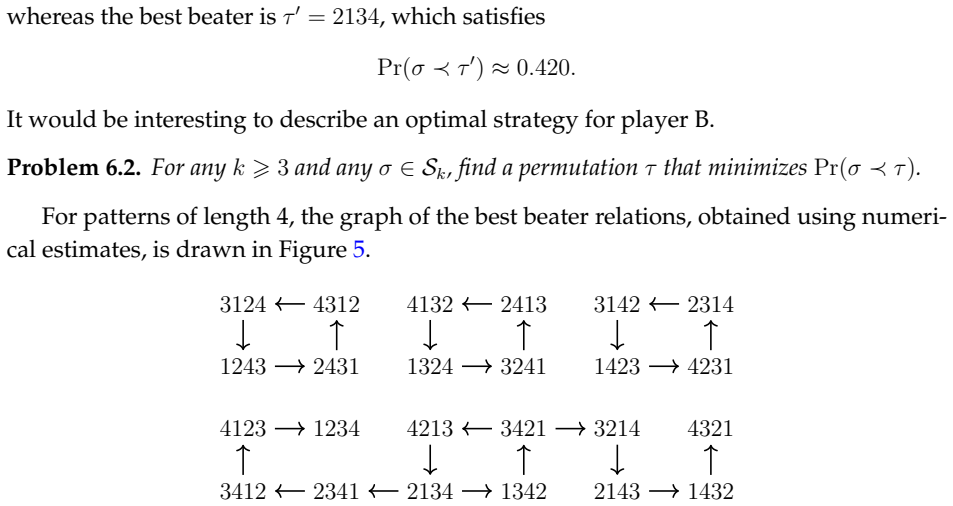
- The same non-transitivity appears for at least some pairs of length-4 permutations.
- Recursive formulas exist that compute the winning probability for arbitrary pairs when k grows.
Where Pith is reading between the lines
- The bijections may transfer to counting problems for other consecutive-pattern statistics such as the number of alternating permutations or vincular patterns.
- The non-transitivity suggests that similar waiting-time games could be defined on other pattern-avoidance posets.
- The second-player strategy conjecture could be tested by computing the full set of length-4 probabilities and checking whether a response permutation always exists that beats any given choice.
Load-bearing premise
The input sequence consists of independent random values from a continuous distribution, so every block of k consecutive values realizes each of the k! relative orders with equal probability.
What would settle it
Direct enumeration or simulation of the waiting times for any specific pair of length-3 permutations whose reported winning probability differs from the value obtained by exhaustive counting of all possible relative-order sequences.
Figures


read the original abstract
We consider the permutation analogue of Penney's game for words. Two players, in order, each choose a permutation of length $k\ge3$; then a sequence of independent random values from a continuous distribution is generated, until the relative order of the last $k$ numbers coincides with one of the chosen permutations, making that player the winner. We compute the winning probabilities for all pairs of permutations of length 3 and some pairs of length 4, showing that, as in the original version for words, the game is non-transitive. Our proofs introduce new bijections for consecutive patterns in permutations. We also give some formulas to compute the winning probabilities more generally, and conjecture a winning strategy for the second player when $k$ is arbitrary.
Editorial analysis
A structured set of objections, weighed in public.
Referee Report
Summary. The paper defines a permutation analogue of Penney's game: two players each select a permutation of length k ≥ 3; a sequence of i.i.d. continuous random variables is generated until the relative ordering of some consecutive k-tuple matches one of the chosen permutations, at which point that player wins. The authors compute exact winning probabilities for every pair of length-3 permutations and selected length-4 pairs, establish non-transitivity via explicit bijections on consecutive patterns, supply general formulas for the probabilities, and conjecture a strategy guaranteeing a win for the second player when k is arbitrary.
Significance. If the bijections and resulting probabilities are correct, the work furnishes the first systematic treatment of Penney's game in the permutation setting, demonstrating that non-transitivity persists and supplying concrete numerical values together with a general conjecture. The new bijections for overlapping consecutive patterns constitute a technical contribution that may be reusable in other problems involving consecutive pattern statistics or Markov-chain analyses of permutation prefixes.
major comments (2)
- [§3] §3 (length-3 probability calculations): the central claim that the reported winning probabilities are exact rests on the correctness of the newly introduced consecutive-pattern bijections. The manuscript provides no independent verification—such as an exhaustive enumeration of all 3! = 6 patterns for small n or a machine-checked summation of all cylinder probabilities equaling 1—leaving open the possibility that an overlap case or measure mis-count has been missed.
- [Table in §3] Table of length-3 probabilities (presumably in §3): without an accompanying check that each pair of probabilities sums to 1 and that the non-transitivity cycles are consistent with these values, the non-transitivity conclusion cannot be confirmed from the numerical output alone.
minor comments (2)
- [§2] Notation for the state space of the Markov chain on prefixes is introduced without an explicit diagram or table listing all reachable prefixes for k=3; adding one would improve readability.
- [Conclusion] The conjecture for the second-player strategy is stated only in the abstract and conclusion; a precise formulation (e.g., which permutation the second player should choose against a given first-player choice) should appear in the main text.
Simulated Author's Rebuttal
We thank the referee for the careful reading and for highlighting the need for additional verification of the length-3 calculations. We address both major comments below and will incorporate the suggested checks into a revised manuscript.
read point-by-point responses
-
Referee: [§3] §3 (length-3 probability calculations): the central claim that the reported winning probabilities are exact rests on the correctness of the newly introduced consecutive-pattern bijections. The manuscript provides no independent verification—such as an exhaustive enumeration of all 3! = 6 patterns for small n or a machine-checked summation of all cylinder probabilities equaling 1—leaving open the possibility that an overlap case or measure mis-count has been missed.
Authors: The bijections are constructed explicitly in §3 with case-by-case analysis of all possible overlaps, and the probabilities are obtained by solving the resulting linear systems. Nevertheless, we agree that an independent numerical check would increase confidence. In the revision we will add a short subsection that (i) enumerates all 6 patterns for sequences of length up to 20 and compares the empirical frequencies against the closed-form probabilities, and (ii) confirms by direct summation that the cylinder probabilities over all 6 patterns sum to 1 for each pair. revision: yes
-
Referee: [Table in §3] Table of length-3 probabilities (presumably in §3): without an accompanying check that each pair of probabilities sums to 1 and that the non-transitivity cycles are consistent with these values, the non-transitivity conclusion cannot be confirmed from the numerical output alone.
Authors: We will augment the table (or add a companion table) that explicitly lists, for every ordered pair (σ,τ), the two probabilities and verifies that they sum to 1. The same table will also mark the three non-transitive cycles (123 ≻ 132 ≻ 213 ≻ 123, etc.) and confirm that the numerical values are consistent with the cycle inequalities. These additions will appear in the revised §3. revision: yes
Circularity Check
No circularity: probabilities derived via new bijections from uniform permutation measure
full rationale
The derivation begins from the standard assumption of i.i.d. continuous random variables inducing uniform random relative orders (permutations) and proceeds by constructing explicit bijections between sets of consecutive patterns. These bijections map the overlapping pattern problem to a solvable counting or Markov-chain system whose transition probabilities are determined directly by the uniform measure, without any parameter fitting, self-definition of the target probabilities, or load-bearing self-citations. The reported length-3 winning probabilities are therefore obtained by direct enumeration under the bijections rather than by construction from the same quantities they purport to predict. No step reduces an output to an input by renaming or tautological redefinition.
Axiom & Free-Parameter Ledger
axioms (1)
- standard math Independent continuous random variables induce a uniform random permutation on any finite initial segment.
Reference graph
Works this paper leans on
-
[1]
Generalized permutation patterns and a clas- sification of the Mahonian statistics
Eric Babson and Einar Steingrímsson. Generalized permutation patterns and a clas- sification of the Mahonian statistics. Sém. Lothar. Combin., 44:Art. B44b, 18, 2000
work page 2000
-
[2]
Anders Claesson. Generalized pattern avoidance. European J. Combin., 22(7):961–971, 2001
work page 2001
-
[3]
Coin sequence probabilities and paradoxes
Stanley Collings. Coin sequence probabilities and paradoxes. Bulletin, 18(11-12):227– 232, 1982
work page 1982
-
[4]
F. N. David and D. E. Barton. Combinatorial chance. Hafner Publishing Co., New York, 1962
work page 1962
-
[5]
Wilf equivalence relations for consecutive patterns
Tim Dwyer and Sergi Elizalde. Wilf equivalence relations for consecutive patterns. Advances in Applied Mathematics, 99:134–157, 2018. 27
work page 2018
-
[6]
A survey of consecutive patterns in permutations
Sergi Elizalde. A survey of consecutive patterns in permutations. In Recent trends in combinatorics, volume 159 of IMA Vol. Math. Appl., pages 601–618. Springer, [Cham], 2016
work page 2016
-
[7]
Consecutive patterns in permutations
Sergi Elizalde and Marc Noy. Consecutive patterns in permutations. Adv. in Appl. Math., 30:110–123, 2003
work page 2003
-
[8]
Clusters, generating functions and asymptotics for consecutive patterns in permutations
Sergi Elizalde and Marc Noy. Clusters, generating functions and asymptotics for consecutive patterns in permutations. Adv. in Appl. Math, 49:351–374, 2012
work page 2012
-
[9]
Optimal penney ante strategy via correlation polynomial identities
Daniel Felix. Optimal penney ante strategy via correlation polynomial identities. The Electronic Journal of Combinatorics, 13(R35), 2016
work page 2016
-
[10]
On the paradoxical situations that arise from nontransitive situation
Martin Gardner. On the paradoxical situations that arise from nontransitive situation. Scientific American, pages 120–125, October 1974
work page 1974
-
[11]
String overlaps, pattern match- ing, and nontransitive games
Leonidas John Guibas and Andrew Michael Odlyzko. String overlaps, pattern match- ing, and nontransitive games. Journal of Combinatorial Theory, A(30):183–208, 1981
work page 1981
-
[12]
On multi-avoidance of generalized patterns
Sergey Kitaev and Toufik Mansour. On multi-avoidance of generalized patterns. Ars Comb., 76, 2005
work page 2005
-
[13]
On the expected duration of a search for a fixed pattern in random data
Peter Tolstrup Nielsen. On the expected duration of a search for a fixed pattern in random data. IEEE Transactions on Information Theory, 19(5):702–704, 1973
work page 1973
-
[14]
The On-Line Encyclopedia of Integer Sequences
OEIS Foundation Inc. The On-Line Encyclopedia of Integer Sequences. Published electronically at http://oeis.org
-
[15]
Walter Penney. Problem 95: Penney-ante. Journal of Recreational Mathematics, 2(4):241, October 1969
work page 1969
-
[16]
Rodica Simion and Frank W. Schmidt. Restricted permutations. European J. Combin., 6(4):383–406, 1985
work page 1985
-
[17]
Stanley.Enumerative Combinatorics, volume 1
Richard P . Stanley.Enumerative Combinatorics, volume 1. Cambridge University Press, second edition edition, 2000. 28
work page 2000
discussion (0)
Sign in with ORCID, Apple, or X to comment. Anyone can read and Pith papers without signing in.