Characterization of Gradient Condition for Asymmetric Partial Exclusion Processes and Their Scaling Limits
Pith reviewed 2026-05-24 01:36 UTC · model grok-4.3
The pith
Gradient condition equals existence of product measures for asymmetric partial exclusion processes
A machine-rendered reading of the paper's core claim, the machinery that carries it, and where it could break.
Core claim
For asymmetric PEPs with product-form jump rates the gradient condition (symmetric part of the instantaneous current written as a discrete gradient) and the existence of product invariant measures are mutually equivalent. When the lattice spacing tends to zero and the process is accelerated diffusively with a square-root asymmetry between right and left jumps, the family of fluctuation fields starting from an invariant measure converges to the stationary energy solution of the stochastic Burgers equation.
What carries the argument
The gradient condition on the symmetric part of the current, which is shown to be equivalent to product measures when rates factor by origin and target site.
If this is right
- The stochastic Burgers equation governs fluctuations for every asymmetric PEP whose rates satisfy the product form.
- Product measures can be used as initial data for the hydrodynamic and fluctuation analysis of these models.
- The same scaling limit holds whenever the asymmetry is tuned to order square-root of the mesh size.
- The result extends the known SBE universality from exclusion and zero-range dynamics to the full partial-exclusion family.
Where Pith is reading between the lines
- The equivalence might extend to rates that depend on a finite number of neighboring sites rather than only origin and target.
- Numerical simulation of a concrete PEP with product rates could check whether the observed fluctuation spectrum matches the energy solution of SBE.
- The same characterization could be attempted for two-dimensional or higher-dimensional lattices where the current decomposition is more involved.
Load-bearing premise
The jump rate factors into a product of one function of the origin occupation and one function of the target occupation.
What would settle it
An explicit asymmetric product-rate PEP on the line for which either a product measure exists but the current is not a gradient, or the current is a gradient but no product measure exists.
Figures
read the original abstract
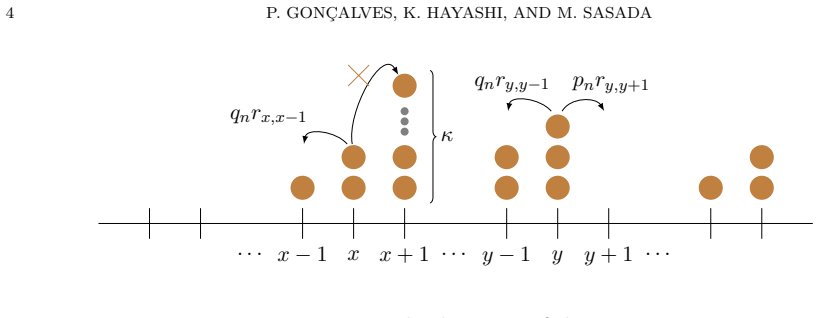
We consider partial exclusion processes~(PEPs) on the one-dimensional square lattice, that is, a system of interacting particles where each particle random walks according to a jump rate satisfying an exclusion rule that allows up to a certain number of particles can exist on each site. Particularly, we assume that the jump rate is given as a product of two functions depending on occupation variables on the original and target sites. Our interest is to study the limiting behavior, especially to derive some macroscopic PDEs by means of (fluctuating) hydrodynamics, of fluctuation fields associated with PEPs, starting from an invariant measure. The so-called gradient condition, meaning that the symmetric part of the instantaneous current is written in a gradient form, and that the invariant measures are given as a product measure is technically crucial. Our first main result is to clarify the relationship between these two conditions, and we show that the gradient condition and the existence of product invariant measures are mutually equivalent, provided the jump rate is given in the above simple form, as it is imposed in most of the literature, and the dynamics is asymmetric. Moreover, when the width of the lattice tends to zero and the process is accelerated in diffusive time-scaling, we show that the family of fluctuation fields converges to the stationary energy solution of the stochastic Burgers equation (SBE), under the setting that the jump rate to the right neighboring site is a bit larger than the one to the left side, of which discrepancy is given as square root of the width of the underlying lattice. This fills the gap at the level of universality of SBE since it has been proved for the exclusion process (a special case of PEP) and for the zero-range process.
Editorial analysis
A structured set of objections, weighed in public.
Referee Report
Summary. The paper considers asymmetric partial exclusion processes (PEPs) on the one-dimensional lattice whose jump rates factor as a product of functions of the occupation numbers at the departure and target sites. It proves that the gradient condition (symmetric part of the instantaneous current in gradient form) is equivalent to the existence of product invariant measures. Under diffusive scaling with an asymmetry of order sqrt(epsilon), the fluctuation fields starting from the invariant measure are shown to converge to the stationary energy solution of the stochastic Burgers equation, extending the SBE universality class beyond the exclusion process and zero-range process.
Significance. If the claims hold, the equivalence result supplies a clean characterization of when product measures exist for this broad family of PEPs, removing a technical obstacle that has appeared repeatedly in the literature on fluctuating hydrodynamics. The scaling-limit theorem closes a gap in the universality picture for the stochastic Burgers equation by covering all models whose rates satisfy the product structure already known to admit product measures when the gradient condition holds.
minor comments (2)
- [Introduction / abstract] The statement that the jump rate 'is given as a product of two functions' should be accompanied by an explicit functional equation or notation (e.g., c(x,y) = f(eta(x))g(eta(y))) already in the introduction so that the hypotheses of the equivalence theorem are immediately visible.
- [Section on scaling limits] In the scaling-limit section the precise definition of the 'stationary energy solution' of the SBE should be recalled (or referenced) so that the reader can verify that the limit object satisfies the required energy estimate without consulting external literature.
Simulated Author's Rebuttal
We thank the referee for their positive summary of the manuscript, recognition of its significance for the SBE universality class, and recommendation of minor revision. No major comments appear in the report.
Circularity Check
No significant circularity; derivation is self-contained
full rationale
The paper's core claims are a mathematical equivalence between the gradient condition and product invariant measures for a specific class of asymmetric PEPs (with product-form rates), plus a hydrodynamic limit result to the SBE under diffusive scaling. These are established via standard stochastic process techniques (e.g., characterization of invariant measures and fluctuation field convergence) without any reduction of predictions to fitted parameters, self-definitional loops, or load-bearing self-citations. The abstract and stated results reference prior work only for special cases (exclusion and zero-range processes) as external benchmarks, not as the justification for the new equivalence or limit. No equations or steps in the provided material exhibit the enumerated circularity patterns; the derivation remains independent of its own inputs.
Axiom & Free-Parameter Ledger
axioms (1)
- standard math Standard assumptions of probability theory and Markov processes on lattices.
Forward citations
Cited by 1 Pith paper
-
Nonlinear fluctuations for a chain of weakly anharmonic oscillators with stochastic perturbation
Phonon fluctuations in a weakly anharmonic oscillator chain with stochastic momentum exchanges converge to uncoupled stochastic Burgers equations under diffusive scaling with weakened anharmonicity.
Reference graph
Works this paper leans on
- [1]
-
[2]
L. Bertini and G. Giacomin. Stochastic burgers and KPZ eq uations from particle systems. Communications in mathematical physics , 183(3):571–607, 1997
work page 1997
-
[3]
P. Billingsley. Convergence of probability measures . John Wiley & Sons, 1968
work page 1968
-
[4]
G. Cannizzaro, P. Gon¸ calves, R. Misturini, and A. Occel li. From ABC to KPZ. arXiv preprint arXiv:2304.02344, 2023
-
[5]
P. Caputo. Spectral gap inequalities in product spaces w ith conservation laws. In Stochastic analysis on large scale interacting systems , volume 39, pages 53–89. Mathematical Society of Japan, 200 4
- [6]
-
[7]
C. Cocozza-Thivent. Processus des misanthropes. Zeitschrift f¨ ur Wahrscheinlichkeitstheorie und verwandt e Gebiete, 70:509–523, 1985
work page 1985
- [8]
-
[9]
P. Gon¸ calves and K. Hayashi. Derivation of anomalous be havior from interacting oscillators in the high- temperature regime. Communications in Mathematical Physics , 403:1193–1243, 2023
work page 2023
-
[10]
P. Gon¸ calves and M. Jara. Crossover to the KPZ equation . Annales Henri Poincar´ e, 13(4):813–826, 2012
work page 2012
-
[11]
P. Gon¸ calves and M. Jara. Scaling limits of additive fu nctionals of interacting particle systems. Communica- tions on Pure and Applied Mathematics , 66(5):649–677, 2013
work page 2013
-
[12]
P. Gon¸ calves and M. Jara. Nonlinear fluctuations of wea kly asymmetric interacting particle systems. Archive for Rational Mechanics and Analysis , 212(2):597–644, 2014
work page 2014
-
[13]
P. Gon¸ calves and M. Jara. The einstein relation for the kpz equation. Journal of Statistical Physics , 158:1262– 1270, 2015
work page 2015
-
[14]
P. Gon¸ calves, M. Jara, and S. Sethuraman. A stochastic Burgers equation from a class of microscopic inter- actions. The Annals of Probability , 43(1):286–338, 2015
work page 2015
-
[15]
M. Gubinelli, P. Imkeller, and N. Perkowski. Paracontr olled distributions and singular PDEs. In Forum of Mathematics, Pi , volume 3. Cambridge University Press, 2015
work page 2015
-
[16]
M. Gubinelli and N. Perkowski. KPZ reloaded. Communications in Mathematical Physics , 349(1):165–269, 2017
work page 2017
-
[17]
M. Gubinelli and N. Perkowski. Energy solutions of KPZ a re unique. Journal of the American Mathematical Society, 31(2):427–471, 2018
work page 2018
-
[18]
M. Hairer. Solving the KPZ equation. Annals of mathematics , pages 559–664, 2013
work page 2013
-
[19]
M. Hairer. A theory of regularity structures. Inventiones mathematicae , 198(2):269–504, 2014
work page 2014
- [20]
-
[21]
K. Hayashi. Derivation of the stochastic Burgers equat ion from totally asymmetric interacting particle sys- tems. Stochastic Processes and their Applications , 155:180–201, 2023
work page 2023
-
[22]
J. Jacod and A. Shiryaev. Limit theorems for stochastic processes , volume 288. Springer Science & Business Media, 2013
work page 2013
-
[23]
M. Jara and G. R. M. Flores. Scaling of the Sasamoto-Spoh n model in equilibrium. Electronic Communica- tions in Probability , 24:1–12, 2019
work page 2019
-
[24]
M. Jara and G. R. M. Flores. Stationary directed polymer s and energy solutions of the Burgers equation. Stochastic Processes and their Applications , 130(10):5973–5998, 2020
work page 2020
-
[25]
C. Kipnis and C. Landim. Scaling limits of interacting particle systems , volume 320. Springer Science & Business Media, 1999
work page 1999
- [26]
-
[27]
T. Komorowski, C. Landim, and S. Olla. Fluctuations in Markov processes: time symmetry and martin gale approximation, volume 345. Springer Science & Business Media, 2012
work page 2012
-
[28]
T. M. Liggett and T. M. Liggett. Interacting particle systems , volume 2. Springer, 1985
work page 1985
-
[29]
I. Mitoma. Tightness of probabilities on C([0, 1]; Y ′) and D([0, 1]; Y ′). The Annals of Probability , 11(4):989– 999, 1983
work page 1983
- [30]
-
[31]
D. Revuz and M. Yor. Continuous martingales and Brownian motion . Springer Science & Business Media, 2013. GRADIENT CONDITION FOR ASYMMETRIC PEP AND THEIR SCALING LIM ITS 25
work page 2013
-
[32]
M. Sasada. On the Green–Kubo formula and the gradient co ndition on currents. The Annals of Applied Probability, 28(5):2727–2739, 2018
work page 2018
-
[33]
G. Sch¨ utz and S. Sandow. Non-Abelian symmetries of stochastic processes: Derivation of correlation functions for random-vertex models and disordered-interacting-par ticle systems. Physical Review E , 49(4):2726, 1994
work page 1994
-
[34]
S. Sellami. Equilibrium density fluctuations of a one-d imensional non-gradient reversible model: the gener- alized exclusion process. Markov Process. Related Fields , 5(1):21–51, 1999
work page 1999
-
[35]
T. Sepp¨ al¨ ainen. Existence of hydrodynamics for the t otally asymmetric simple k-exclusion process. The Annals of Probability , 27(1):361–415, 1999
work page 1999
-
[36]
S. Sethuraman and D. Shahar. Hydrodynamic limits for lo ng-range asymmetric interacting particle systems. Electronic Journal of Probability , 23:1–54, 2018. Departamento de Matem´atica, Instituto Superior T ´ecnico, Universidade de Lisboa, A v. Rovisco P ais, no. 1, 1049-001 Lisboa, Portugal. Email address : pgoncalves@tecnico.ulisboa.pt RIKEN Interdiscip...
work page 2018
discussion (0)
Sign in with ORCID, Apple, or X to comment. Anyone can read and Pith papers without signing in.