Studying knots in self-covers of the modular flow
Pith reviewed 2026-05-23 23:21 UTC · model grok-4.3
The pith
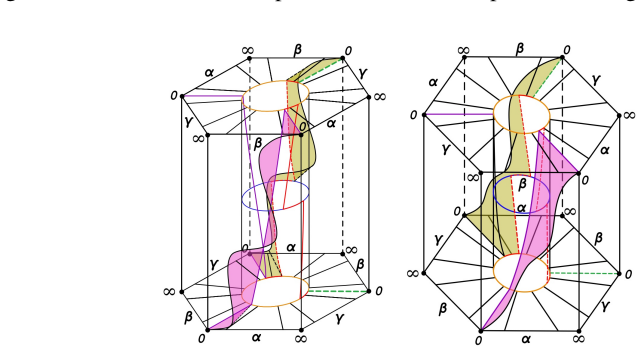
Lifting Ghys' modular template via self-coverings of the trefoil complement gives combinatorial access to knot types of closed geodesics in the resulting Anosov flows.
A machine-rendered reading of the paper's core claim, the machinery that carries it, and where it could break.
Core claim
By lifting Ghys' modular template along self-coverings of the trefoil complement of order 6k+1, the authors obtain templates for the corresponding Anosov flows that preserve both the Anosov property and the combinatorial structure required for knot analysis, thereby permitting direct study of the knot types realized by closed geodesics and the explicit construction of an infinite commensurable family of two-component links with the trefoil as one component.
What carries the argument
The lifted versions of Ghys' modular template obtained from self-coverings of the trefoil complement of order 6k+1, which carry the preserved combinatorial data for tracking knot types in the Anosov flows.
Load-bearing premise
Self-coverings of the trefoil complement of order 6k+1 exist and admit lifts of Ghys' modular template that keep both the Anosov property and the combinatorial structure intact.
What would settle it
For any specific k, failure to produce a lift of the template that remains Anosov while preserving the combinatorial data needed to read off knot types from the template would refute the general construction.
Figures




read the original abstract
In this paper we provide a combinatorial tool to help study some topological properties of modular knots. We construct templates for the infinitely many Anosov flows on the trefoil complement, which are lifts of the geodesic flow on the modular surface, by lifting Ghys' modular template using self-covering of the trefoil complement of order $6k+1$, for $k\in \mathbb{N}_{>0}$. This allows to study the knot properties of closed geodesics in these flows, and an explicit construction of an infinite family of links of two components with one of them being the trefoil, all commensurable to one another.
Editorial analysis
A structured set of objections, weighed in public.
Referee Report
Summary. The paper constructs templates for infinitely many Anosov flows on the trefoil complement as lifts of Ghys' modular template via self-coverings of order 6k+1 (k>0). These templates are used to analyze knot properties of closed geodesics in the flows and to give an explicit infinite family of two-component links, all commensurable to one another, with one component the trefoil.
Significance. If the lifts are shown to preserve the Anosov property and the required combinatorial data, the work supplies a combinatorial tool for studying modular knots in self-covers and an explicit construction of an infinite commensurable family of links containing the trefoil.
major comments (1)
- [Construction via self-covers (following the abstract)] The central construction asserts that self-covers of the trefoil complement of order 6k+1 admit lifts of Ghys' modular template that remain Anosov and retain the branch structure needed for knot analysis. No explicit verification of preserved expansion/contraction rates, no reference to a general theorem guaranteeing hyperbolicity under these covers, and no check that the combinatorial data is unaltered for arbitrary k appear in the manuscript; this is load-bearing for all subsequent claims about closed geodesics and the infinite link family.
Simulated Author's Rebuttal
We thank the referee for their careful reading of the manuscript and for highlighting the need for explicit verification of the central construction. We address the major comment below.
read point-by-point responses
-
Referee: The central construction asserts that self-covers of the trefoil complement of order 6k+1 admit lifts of Ghys' modular template that remain Anosov and retain the branch structure needed for knot analysis. No explicit verification of preserved expansion/contraction rates, no reference to a general theorem guaranteeing hyperbolicity under these covers, and no check that the combinatorial data is unaltered for arbitrary k appear in the manuscript; this is load-bearing for all subsequent claims about closed geodesics and the infinite link family.
Authors: We agree that the manuscript lacks an explicit verification of these properties in the submitted version. The construction relies on the fact that covers of order 6k+1 are compatible with the modular flow's periodic data, but we did not supply a direct check of the expansion/contraction rates or a citation to a general result on preservation of the Anosov property under such lifts. In the revised manuscript we will insert a new subsection (or appendix) that (i) computes the effect of the lift on the hyperbolic metric and verifies that the expansion and contraction rates remain strictly greater than 1 in absolute value, (ii) references standard results on the stability of Anosov flows under finite covers when the cover degree preserves the relevant homology classes, and (iii) confirms by direct inspection of the template's branch lines that the combinatorial data (branching pattern and periodic orbit correspondence) is unchanged for every k>0. These additions will make the load-bearing claims fully rigorous. revision: yes
Circularity Check
No circularity; construction extends external Ghys template via standard self-coverings
full rationale
The derivation constructs templates for Anosov flows on the trefoil complement by lifting Ghys' modular template through self-coverings of order 6k+1. This relies on an external reference (Ghys) and a standard covering-space operation rather than any self-definitional loop, fitted parameter renamed as prediction, or load-bearing self-citation. No equation or claim reduces the target knot properties or link family to quantities defined in terms of themselves; the Anosov preservation and combinatorial structure are stated as assumptions to be checked against the external template, leaving the chain self-contained against independent benchmarks.
Axiom & Free-Parameter Ledger
axioms (2)
- domain assumption Ghys' modular template encodes the geodesic flow on the modular surface and lifts appropriately under self-covers of the trefoil complement.
- domain assumption Self-coverings of the trefoil complement of degree 6k+1 exist for every positive integer k and preserve the Anosov character of the lifted flow.
Lean theorems connected to this paper
-
IndisputableMonolith/Foundation/AlexanderDuality.leanalexander_duality_circle_linking unclear?
unclearRelation between the paper passage and the cited Recognition theorem.
We construct templates for the infinitely many Anosov flows on the trefoil complement... by lifting Ghys’ modular template using self-covering of the trefoil complement of order 6k+1
What do these tags mean?
- matches
- The paper's claim is directly supported by a theorem in the formal canon.
- supports
- The theorem supports part of the paper's argument, but the paper may add assumptions or extra steps.
- extends
- The paper goes beyond the formal theorem; the theorem is a base layer rather than the whole result.
- uses
- The paper appears to rely on the theorem as machinery.
- contradicts
- The paper's claim conflicts with a theorem or certificate in the canon.
- unclear
- Pith found a possible connection, but the passage is too broad, indirect, or ambiguous to say the theorem truly supports the claim.
Reference graph
Works this paper leans on
-
[1]
´Etienne Ghys. “Knots and dynamics”. In: International congress of mathematicians. Vol. 1. Europian Mathematical Society Z¨urich. 2007, pp. 247–277
work page 2007
-
[2]
Graph manifolds that admit arbitrarily many Anosov flows
Adam Clay and Tali Pinsky. “Graph manifolds that admit arbitrarily many Anosov flows”. In:arXiv preprint arXiv:2006.09101(2020)
-
[3]
Introduction to algebraic K-theory
John Willard Milnor. Introduction to algebraic K-theory. 72. Princeton University Press, 1971
work page 1971
-
[4]
The distribution of closed geodesics on the modular surface, and Duke’s theorem
Manfred Einsiedler, Elon Lindenstrauss, Philippe Michel, and Akshay Venkatesh. “The distribution of closed geodesics on the modular surface, and Duke’s theorem”. In: L’Enseignement Math´ematique 58.3 (2012), pp. 249–313
work page 2012
-
[5]
The variance of arithmetic measures associated to closed geodesics on the modular surface
Wenzhi Luo, Ze ´ev Rudnick, and Peter Sarnak. “The variance of arithmetic measures as- sociated to closed geodesics on the modular surface”. In:arXiv preprint arXiv:0810.3331 (2008)
work page internal anchor Pith review Pith/arXiv arXiv 2008
-
[6]
Knotted periodic orbits in dynamical systems I: Lorenz’s equations
Joan S Birman and RF Williams. “Knotted periodic orbits in dynamical systems I: Lorenz’s equations”. In:Topology 22.1 (1983), pp. 47–82
work page 1983
-
[7]
Knotted periodic orbits in dynamical system II: Knot holders for fibered knots
Joan S Birman and Robert F Williams. “Knotted periodic orbits in dynamical system II: Knot holders for fibered knots”. In:Contemporary Mathematics 20 (1983), pp. 1– 60
work page 1983
-
[8]
Dale Rolfsen. Knots and Links. New York: AMS Chelsea Publishing, 2003
work page 2003
-
[9]
Commensurability of Knots and L2–Invariants
Stefan Friedl. “Commensurability of Knots and L2–Invariants”. In:Geometry and topol- ogy down under (2012), pp. 263–279
work page 2012
-
[10]
Knot commen- surability and the Berge conjecture
Michel Boileau, Steven Boyer, Radu Cebanu, and Genevieve S Walsh. “Knot commen- surability and the Berge conjecture”. In:Geometry & Topology 16.2 (2012), pp. 625– 664. 22
work page 2012
-
[11]
Lorenz and Modular Flows: A Visual Introduction
Etienne Ghys and Jos Leys. “Lorenz and Modular Flows: A Visual Introduction”. In: The American mathematical society, Feature Column(2006)
work page 2006
-
[12]
The modular surface and continued fractions
Caroline Series. “The modular surface and continued fractions”. In:Journal of the Lon- don Mathematical Society 2.1 (1985), pp. 69–80
work page 1985
-
[13]
Linking number of modular knots
James Rickards. “Linking number of modular knots”. In:arXiv preprint arXiv:2301.01334 (2023)
-
[14]
Volumes of Hyperbolic Three-Manifolds Associated with Modular Links
Alex Brandts, Tali Pinsky, and Lior Silberman. “Volumes of Hyperbolic Three-Manifolds Associated with Modular Links”. In:Symmetry 11.10 (2019), p. 1206
work page 2019
-
[15]
Arithmeticity, super- rigidity, and totally geodesic submanifolds
Nicholas Miller Uri bader David Fisher and Matthew Stover. “Arithmeticity, super- rigidity, and totally geodesic submanifolds”. In:Annals of mathematics 193.3 (2021), pp. 837–861. 23
work page 2021
discussion (0)
Sign in with ORCID, Apple, or X to comment. Anyone can read and Pith papers without signing in.