Learning-based Linear Inversion for Quantitative Pulse-Echo Speed-of-Sound Imaging
Pith reviewed 2026-05-23 21:34 UTC · model grok-4.3
The pith
Training a linear operator on random tissue models reduces biases in speed-of-sound maps from ultrasound echoes.
A machine-rendered reading of the paper's core claim, the machinery that carries it, and where it could break.
Core claim
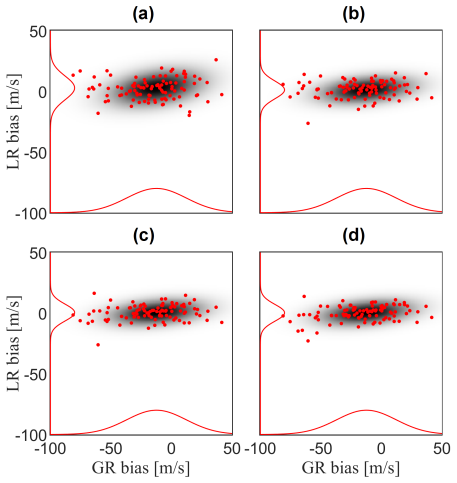
By training a linear operator to minimize SoS errors on average over a large number of random tissue models that sample the distribution of geometries and SoS values expected in vivo, biases in the resulting speed-of-sound maps are strongly reduced. The operator can be applied either directly to echo-shift data or to maps estimated with gradient regularization. Residual biases that remain are the result of a partial non-linearity in the actual physical problem. The approach transfers from simulation to real ultrasound data, as confirmed by experimental phantom results.
What carries the argument
The trained linear operator that maps echo-shift data to SoS maps by minimizing average reconstruction errors over simulated tissue models.
If this is right
- Biases are strongly reduced in an extensive simulation study on liver imaging.
- Direct application to echo-shift data slightly outperforms post-processing of gradient-regularized maps.
- The method remains effective when transferred to real ultrasound data in phantom experiments.
- Residual biases are attributable to partial non-linearity in the physical forward model.
Where Pith is reading between the lines
- If real anatomy deviates systematically from the random models used in training, the operator may introduce new biases on clinical scans.
- The same training strategy could be tested on other linearized inverse problems in pulse-echo imaging where geometry-dependent regularization errors appear.
- Incorporating a small number of nonlinear forward simulations into the training loss might further shrink the residual bias floor.
Load-bearing premise
The distribution of random tissue models used for training accurately samples the geometries and speed-of-sound values expected in living tissue.
What would settle it
Applying the trained operator to echo-shift data from tissue geometries or speed-of-sound values outside the training distribution and observing that bias reduction disappears would show the sampling assumption does not hold.
Figures




read the original abstract
Computed ultrasound tomography in echo mode generates maps of tissue speed of sound (SoS) from the shift of echoes when detected under varying steering angles. It solves a linearized inverse problem that requires regularization to complement the echo shift data with a priori constraints. Spatial gradient regularization has been used to enforce smooth solutions, but SoS estimates were found to be biased depending on tissue layer geometry. Here, we propose to train a linear operator to minimize SoS errors on average over a large number of random tissue models that sample the distribution of geometries and SoS values expected in vivo. In an extensive simulation study on liver imaging, we demonstrate that biases are strongly reduced, with residual biases being the result of a partial non-linearity in the actual physical problem. This approach can either be applied directly to echo-shift data or to the SoS maps estimated with gradient regularization, where the former shows slightly better performance, but the latter is computationally more efficient. Experimental phantom results confirm the transferability of our results to real ultrasound data.
Editorial analysis
A structured set of objections, weighed in public.
Referee Report
Summary. The manuscript proposes training a linear operator on a large ensemble of random tissue models to minimize average speed-of-sound (SoS) estimation errors for pulse-echo ultrasound tomography. This data-driven regularization is shown in liver-imaging simulations to strongly reduce geometry-dependent biases compared with spatial-gradient regularization; residual errors are attributed to partial nonlinearity of the forward problem. The learned operator can be applied either directly to echo-shift measurements or as a post-correction to gradient-regularized maps, with the former yielding slightly better accuracy. Phantom experiments are presented to demonstrate transferability from simulation to real data.
Significance. If the training distribution accurately represents in-vivo liver anatomy and SoS statistics, the approach offers a computationally attractive route to bias-reduced quantitative SoS maps without requiring nonlinear solvers or additional hardware. The simulation study and phantom validation constitute concrete evidence of bias reduction; the explicit attribution of residuals to nonlinearity is a useful diagnostic insight.
major comments (2)
- [Abstract] Abstract: the assertion that the random tissue models 'sample the distribution of geometries and SoS values expected in vivo' is load-bearing for the generalization claim, yet no quantitative validation (e.g., comparison of first- and second-order moments, layer-thickness histograms, or spatial correlation lengths) against real liver data is supplied.
- [Simulation study (inferred from abstract)] The central claim that residual biases arise solely from partial nonlinearity would be strengthened by an explicit quantification (e.g., a table or figure showing the magnitude of the nonlinearity residual versus the learned-operator residual) rather than a qualitative statement.
minor comments (2)
- The abstract would benefit from stating the number of training models, the SoS range, and the precise error metric (bias, RMSE, etc.) used to train and evaluate the operator.
- Clarify whether the learned operator is a single matrix or a set of angle-dependent matrices, and how its application scales with the number of steering angles.
Simulated Author's Rebuttal
We thank the referee for their constructive comments. We respond to each major comment below, indicating planned revisions where appropriate.
read point-by-point responses
-
Referee: [Abstract] Abstract: the assertion that the random tissue models 'sample the distribution of geometries and SoS values expected in vivo' is load-bearing for the generalization claim, yet no quantitative validation (e.g., comparison of first- and second-order moments, layer-thickness histograms, or spatial correlation lengths) against real liver data is supplied.
Authors: We agree the abstract phrasing is strong. The random models were constructed from literature-reported ranges for liver SoS (typically 1480-1620 m/s) and abdominal layer thicknesses, but the manuscript contains no explicit statistical comparison (moments, histograms, or correlation lengths) to in-vivo datasets. In revision we will change the abstract wording to 'random tissue models based on literature-reported distributions of geometries and SoS values' and add a short methods paragraph describing the chosen parameter ranges and their sources. revision: yes
-
Referee: [Simulation study (inferred from abstract)] The central claim that residual biases arise solely from partial nonlinearity would be strengthened by an explicit quantification (e.g., a table or figure showing the magnitude of the nonlinearity residual versus the learned-operator residual) rather than a qualitative statement.
Authors: The manuscript states that residuals remain because the learned operator is linear while the underlying echo-shift physics is partially nonlinear. We will strengthen this by adding a quantitative comparison: on the held-out simulation test set we will report the L2 norm of the difference between the linear forward operator and a nonlinear reference simulation, and directly compare its magnitude to the residual SoS error after the learned operator is applied. This will appear as a new panel in an existing figure or a short supplementary table. revision: yes
Circularity Check
No significant circularity: operator trained on independent random simulations
full rationale
The derivation trains a linear operator by minimizing average SoS error over an ensemble of independently generated random tissue models whose distribution is chosen to approximate in vivo statistics. This training set is external to any particular target measurement, so the learned operator is not equivalent to a fit or redefinition of the input echo-shift data. No equations reduce a claimed prediction to the input by construction, no uniqueness theorems are imported from prior self-work, and no ansatz is smuggled via citation. Phantom experiments supply an external check on transferability. The central claim therefore remains self-contained against the provided benchmarks.
Axiom & Free-Parameter Ledger
free parameters (1)
- Tissue model distribution parameters
axioms (1)
- domain assumption The echo-shift inverse problem admits a useful linear approximation
Forward citations
Cited by 1 Pith paper
-
Wave-Equation Migration Velocity Analysis for Multistatic Synthetic Aperture Ultrasound
Wave-equation migration velocity analysis applied to medical ultrasound corrects sound speed aberrations, improving point target resolution from 1.22 mm to 0.32 mm and lesion contrast from 3.05 dB to 4.39 dB in phanto...
Reference graph
Works this paper leans on
-
[1]
In vivo breast sound-speed imaging with ultrasound tomography
Cuiping Li, Nebojsa Duric, Peter Littrup, and Lianjie Huang. In vivo breast sound-speed imaging with ultrasound tomography. Ultrasound in medicine & biology , 35(10):1615–1628, 2009
work page 2009
-
[2]
Non-linear inverse scattering: High resolution quantitative breast tissue tomography
James Wiskin, David T Borup, SA Johnson, and M Berggren. Non-linear inverse scattering: High resolution quantitative breast tissue tomography. The Journal of the Acoustical Society of America , 131(5):3802–3813, 2012
work page 2012
-
[3]
Frequency domain ultrasound waveform tomography: breast imaging using a ring transducer
GY Sandhu, Cuiping Li, Olivier Roy, S Schmidt, and Neb Duric. Frequency domain ultrasound waveform tomography: breast imaging using a ring transducer. Physics in Medicine & Biology , 60(14):5381–5398, 2015
work page 2015
-
[4]
L. Ruby, S. J. Sanabria, K. Martini, K. J. Dedes, D. V orburger, E. Oezkan, T. Frauenfelder, O. Goksel, and M. B. Rominger. Breast Cancer Assessment With Pulse-Echo Speed of Sound Ultrasound From Intrinsic Tissue Reflections: Proof-of-Concept. Investigative Radiology, 54:419–427, 2019
work page 2019
-
[5]
Nebojsa Duric, Peter Littrup, Lou Poulo, Alex Babkin, Roman Pevzner, Earle Holsapple, Olsi Rama, and Carri Glide. Detection of breast cancer with ultrasound tomography: First results with the Computed Ultrasound Risk Evaluation (CURE) prototype. Medical Physics, 34(2):773–785, 2007
work page 2007
-
[6]
Bita Boozari, Andrej Potthoff, Ingmar Mederacke, Andreas Hahn, Ansgar Reising, Kinan Rifai, Heiner Wedemeyer, Matthias Bahr, Stefan Kubicka, Michael Manns, et al. Evaluation of sound speed for detection of liver fibrosis: prospective comparison with transient dynamic elastography and histology. Journal of Ultrasound in Medicine , 29(11):1581–1588, 2010
work page 2010
-
[7]
Robust sound speed estimation for ultrasound-based hepatic steatosis assessment
Marion Imbault, Alex Faccinetto, Bruno-Félix Osmanski, Antoine Tissier, Thomas Deffieux, Jean-Luc Gennisson, Valérie Vilgrain, and Mickaël Tanter. Robust sound speed estimation for ultrasound-based hepatic steatosis assessment. Physics in Medicine & Biology , 62(9):3582–3598, 2017
work page 2017
-
[8]
Marco Dioguardi Burgio, Marion Imbault, Maxime Ronot, Alex Faccinetto, Bernard E Van Beers, Pierre- Emmanuel Rautou, Laurent Castera, Jean-Luc Gennisson, Mickael Tanter, and Valérie Vilgrain. Ultrasonic adaptive sound speed estimation for the diagnosis and quantification of hepatic steatosis: a pilot study. Ultraschall in der Medizin-European Journal of U...
work page 2019
-
[9]
Arsenii V Telichko, Rehman Ali, Thurston Brevett, Huaijun Wang, Jose G Vilches-Moure, Sukumar U Kumar, Ramasamy Paulmurugan, and Jeremy J Dahl. Noninvasive estimation of local speed of sound by pulse-echo ultrasound in a rat model of nonalcoholic fatty liver. Physics in Medicine & Biology , 67(1):015007, 2022
work page 2022
- [10]
-
[11]
Measurement of velocity of propagation from ultrasonic pulse-echo data
DE Robinson, F Chen, and LS Wilson. Measurement of velocity of propagation from ultrasonic pulse-echo data. Ultrasound in medicine & biology , 8(4):413–420, 1982
work page 1982
-
[12]
An evaluation of an in vivo local sound speed estimation technique by the crossed beam method
Masafumi Kondo, Kinya Takamizawa, Makoto Hirama, Kiyoshi Okazaki, Kazuhiro Iinuma, and Yasuaki Takehara. An evaluation of an in vivo local sound speed estimation technique by the crossed beam method. Ultrasound in medicine & biology, 16(1):65–72, 1990
work page 1990
-
[13]
Markus C Hesse, Leili Salehi, and Georg Schmitz. Nonlinear simultaneous reconstruction of inhomogeneous compressibility and mass density distributions in unidirectional pulse-echo ultrasound imaging. Physics in Medicine & Biology, 58(17):6163, 2013
work page 2013
-
[14]
Local speed of sound estimation in tissue using pulse-echo ultrasound: Model-based approach
Marko Jakovljevic, Scott Hsieh, Rehman Ali, Gustavo Chau Loo Kung, Dongwoon Hyun, and Jeremy J Dahl. Local speed of sound estimation in tissue using pulse-echo ultrasound: Model-based approach. The Journal of the Acoustical Society of America , 144(1):254–266, 2018
work page 2018
-
[15]
Sergio J Sanabria, Ece Ozkan, Marga Rominger, and Orcun Goksel. Spatial domain reconstruction for imaging speed-of-sound with pulse-echo ultrasound: simulation and in vivo study. Physics in Medicine & Biology , 63(21):215015, 2018
work page 2018
-
[16]
Anthony S Podkowa and Michael L Oelze. The convolutional interpretation of registration-based plane wave steered pulse-echo local sound speed estimators. Physics in Medicine & Biology , 65(2):025003, 2020
work page 2020
-
[17]
Micha Feigin, Daniel Freedman, and Brian W. Anthony. A deep learning framework for single-sided sound speed inversion in medical ultrasound. IEEE Transactions on Biomedical Engineering , 67(4):1142–1151, 2020. 15
work page 2020
-
[18]
Refraction-based speed of sound estimation in layered media: an angular approach
Baptiste Hériard-Dubreuil, Adrien Besson, Frédéric Wintzenrieth, Claude Cohen-Bacrie, and Jean-Philippe Thiran. Refraction-based speed of sound estimation in layered media: an angular approach. IEEE Transactions on Ultrasonics, Ferroelectrics, and Frequency Control, 70(6):486–497, 2023
work page 2023
-
[19]
Simson, Magdalini Paschali, Vasiliki Sideri-Lampretsa, Nassir Navab, and Jeremy J
Walter A. Simson, Magdalini Paschali, Vasiliki Sideri-Lampretsa, Nassir Navab, and Jeremy J. Dahl. Investigating pulse-echo sound speed estimation in breast ultrasound with deep learning. Ultrasonics, 137:107179, 2024
work page 2024
-
[20]
Samuel Beuret, Baptiste Hériard-Dubreuil, Naiara Korta Martiartu, Michael Jaeger, and Jean-Philippe Thiran. Windowed Radon Transform for Robust Speed-of-Sound Imaging With Pulse-Echo Ultrasound.IEEE Transactions on Medical Imaging, 43(4):1579–1593, 2024
work page 2024
-
[21]
Michael Jaeger, Gerrit Held, Sara Peeters, Stefan Preisser, Michael Grünig, and Martin Frenz. Computed Ultrasound Tomography in Echo Mode for Imaging Speed of Sound Using Pulse-Echo Sonography: Proof of Principle. Ultrasound in Medicine & Biology , 41(1):235–250, 2015
work page 2015
-
[22]
Improved forward model for quantitative pulse-echo speed-of-sound imaging
Patrick Stähli, Maju Kuriakose, Martin Frenz, and Michel Jaeger. Improved forward model for quantitative pulse-echo speed-of-sound imaging. Ultrasonics, 108:106168, 2020
work page 2020
-
[23]
Pulse-echo speed-of-sound imaging using convex probes
Michael Jaeger, Patrick Stähli, Naiara Korta Martiartu, Parisa Salemi Yolgunlu, Thomas Frappart, Christophe Fraschini, and Martin Frenz. Pulse-echo speed-of-sound imaging using convex probes. Physics in Medicine & Biology, 67(21):215016, 2022
work page 2022
-
[24]
Bayesian Approach for a Robust Speed-of-Sound Reconstruction Using Pulse-Echo Ultrasound
Patrick Stähli, Martin Frenz, and Michael Jaeger. Bayesian Approach for a Robust Speed-of-Sound Reconstruction Using Pulse-Echo Ultrasound. IEEE Transactions on Medical Imaging, 40(2):457–467, 2021
work page 2021
-
[25]
Excluding Echo Shift Noise in Real-Time Pulse-Echo Speed-of-Sound Imaging
Parisa Salemi Yolgunlu, Naiara Korta Martiartu, Urs Richard Gerber, Martin Frenz, and Michael Jaeger. Excluding Echo Shift Noise in Real-Time Pulse-Echo Speed-of-Sound Imaging. Sensors, 23(12), 2023
work page 2023
-
[26]
Learnt correction for regularization-related biases in pulse-echo speed-of-sound imaging
Michael Jaeger, Urs Richard Gerber, Parisa Salemi Yolgunlu, Naiara Korta Martiartu, and Martin Frenz. Learnt correction for regularization-related biases in pulse-echo speed-of-sound imaging. In 2023 IEEE International Ultrasonics Symposium (IUS), pages 1–4, 2023
work page 2023
-
[27]
Urvi Vyas and Douglas Christensen. Ultrasound beam simulations in inhomogeneous tissue geometries using the hybrid angular spectrum method. IEEE Transactions on Ultrasonics, Ferroelectrics, and Frequency Control, 59(6):1093–1100, 2012
work page 2012
- [28]
discussion (0)
Sign in with ORCID, Apple, or X to comment. Anyone can read and Pith papers without signing in.