Endomorphisms of Artin groups of type B_n
Pith reviewed 2026-05-23 20:36 UTC · model grok-4.3
The pith
Endomorphisms of Artin groups of spherical type B_n for n≥5 are classified, along with those of their quotients by the center.
A machine-rendered reading of the paper's core claim, the machinery that carries it, and where it could break.
Core claim
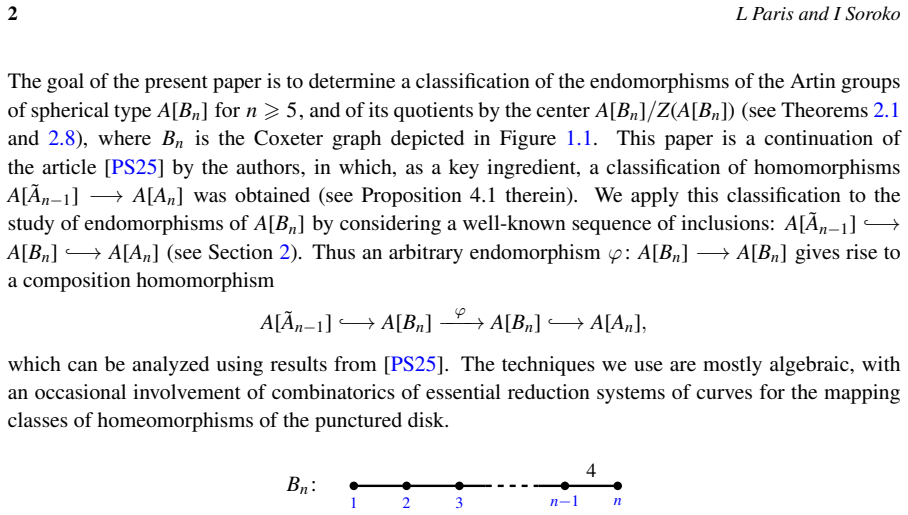
We determine a classification of the endomorphisms of the Artin groups of spherical type B_n for n≥5, and of their quotients by the center.
What carries the argument
The standard Coxeter presentation of the Artin group of type B_n, which encodes the generators and braid relations from the B_n diagram.
If this is right
- Every homomorphism from the group to itself is accounted for by the listed forms.
- The same list applies directly to the quotient groups obtained by killing the center.
- Automorphisms appear as the invertible cases inside this larger list of endomorphisms.
- The classification separates the behavior for n≥5 from possible exceptional cases in lower dimensions.
Where Pith is reading between the lines
- The result supplies a concrete description that could be used to compute the automorphism group explicitly as a corollary.
- Similar classification techniques might apply to other spherical Artin groups once their structural properties are known.
- The center quotient version isolates the projective behavior of the group, which could connect to outer automorphism questions.
Load-bearing premise
These groups obey the usual Coxeter relations of type B_n and possess the expected center and other algebraic properties when n is at least 5.
What would settle it
An explicit endomorphism of the B_5 Artin group (or of its center quotient) that falls outside the listed families would show the classification is incomplete.
Figures


read the original abstract
We determine a classification of the endomorphisms of the Artin groups of spherical type $B_n$ for $n\ge 5$, and of their quotients by the center.
Editorial analysis
A structured set of objections, weighed in public.
Referee Report
Summary. The manuscript determines a classification of the endomorphisms of the Artin groups of spherical type B_n for n≥5, and of their quotients by the center, relying on the standard Coxeter presentation and known structural properties of these groups.
Significance. If the classification is complete and correct, the result would provide a useful addition to the literature on endomorphism monoids of Artin groups of spherical type, extending existing work on type A_n and potentially informing questions about Out(G) and related quotients.
minor comments (1)
- The abstract states the result for n≥5 but does not indicate how the low-dimensional cases (n=2,3,4) are separated or why the classification fails to hold there; a brief remark in the introduction would clarify the scope.
Simulated Author's Rebuttal
We thank the referee for their report and for accurately summarizing the main results of our manuscript. The referee notes that a complete and correct classification would be a useful addition to the literature on endomorphisms of spherical Artin groups. We believe the classification we provide is both complete and correct, as it relies on the standard Coxeter presentation together with established structural properties of these groups (including known results on their centers and parabolic subgroups). No specific concerns or major comments were raised in the report, so we see no need for revisions at this stage. We remain available to supply additional details or clarifications should the referee or editor request them.
Circularity Check
No significant circularity
full rationale
The paper classifies endomorphisms of spherical type B_n Artin groups (n≥5) and their central quotients using the standard Coxeter presentation together with known structural properties of these groups. No derivation step reduces by construction to a fitted input, self-definition, or load-bearing self-citation chain; the argument rests on externally established facts about Artin groups rather than renaming or smuggling its own outputs as premises. This is the normal case of a self-contained classification result in combinatorial group theory.
Axiom & Free-Parameter Ledger
axioms (2)
- domain assumption Standard Coxeter presentation and relations for spherical type B_n Artin groups
- domain assumption Existence and properties of the center for these groups
Reference graph
Works this paper leans on
-
[1]
[AC23] B H An, Y Cho, The automorphism groups of Artin groups of edge-separated CLTTF graphs, J. Korean Math. Soc. 60 (6) (2023), 1171–1213. [BM07] R W Bell, D Margalit, Injections of Artin groups, Comment. Math. Helv. 82 (2007), no. 4, 725–
work page 2023
-
[2]
[BLM83] J S Birman, A Lubotzky, J McCarthy, Abelian and solvable subgroups of the mapping class groups, Duke Math. J. 50 (1983), no. 4, 1107–1120. [Bou68] N Bourbaki, ´El´ements de math ´ematique. Fasc. XXXIV . Groupes et alg`ebres de Lie. Chapitre IV: Groupes de Coxeter et syst`emes de Tits. Chapitre V: Groupes engendr´es par des r´eflexions. Chapitre VI...
work page 1983
-
[3]
[Bri73] E Brieskorn, Sur les groupes de tresses [d’apr`es V . I. Arnol’d],S´eminaire Bourbaki, 24`eme ann´ee (1971/1972), Exp. No. 401, pp. 21–44. Lecture Notes in Mathematics, V ol
work page 1971
-
[4]
[BS72] E Brieskorn, K Saito, Artin-Gruppen und Coxeter-Gruppen, Invent. Math. 17 (1972), 245–271. [Cas09] F Castel, Repr´esentations g ´eom´etriques des groupes de tresses, Ph. D. Thesis, Universit ´e de Bourgogne,
work page 1972
-
[5]
[CP23] F Castel, L Paris, Endomorphisms of Artin groups of type D, Algebr. Geom. Topol., to appear. arXiv:2307.02880. [CC05] R Charney, J Crisp,Automorphism groups of some affine and finite type Artin groups,Math. Res. Lett. 12 (2005), no. 2–3, 321–333. 26 L Paris and I Soroko [CP03] R Charney, D Peifer,The K (π, 1)-conjecture for the affine braid groups,...
-
[6]
arXiv:1910.00712. [Cri99] J Crisp, Injective maps between Artin groups, Geometric group theory down under (Canberra, 1996), 119–137. Walter de Gruyter & Co., Berlin,
-
[7]
[Cri05] J Crisp, Automorphisms and abstract commensurators of 2-dimensional Artin groups, Geom. Topol. 9 (2005), 1381–1441. [CP02] J Crisp, L Paris, Artin groups of type B and D, preprint,
work page 2005
-
[8]
arXiv:math/0210438. [DG81] J L Dyer, E K Grossman, The automorphism groups of the braid groups, Amer. J. Math. 103 (1981), no. 6, 1151–1169. [FM12] B Farb, D Margalit, A primer on mapping class groups, Princeton Mathematical Series,
work page internal anchor Pith review Pith/arXiv arXiv 1981
-
[9]
[GHMR00] N D Gilbert, J Howie, V Metaftsis, E Raptis, Tree actions of automorphism groups, J. Group Theory 3 (2000), no. 2, 213–223. [GW04] J Gonz ´alez-Meneses, B Wiest, On the structure of the centralizer of a braid, Ann. Scient. ´Ec. Norm. Sup., 4e s´erie, t. 37 (2004), 729–757. [KT08] C Kassel, V Turaev, Braid groups. With the graphical assistance of ...
work page 2000
-
[10]
xii+340 pp. [KP02] R P Kent IV , D Peifer,A geometric and algebraic description of annular braid groups, Internat. J. Algebra Comput. 12 (2002), no. 1–2, 85–97. [LP01] C Labru `ere, L Paris, Presentations for the punctured mapping class groups in terms of Artin groups, Algebr. Geom. Topol. 1 (2001), 73–114. [Lam94] S F Lambropoulou,Solid torus links and H...
work page 2002
-
[11]
[LL10] E-K Lee, S-J Lee,Uniqueness of roots up to conjugacy for some affine and finite type Artin groups, Math. Z. 256 (2010), 571–587. [Lek83] H van der Lek,The homotopy type of complex hyperplane complements,Ph. D. Thesis, Nijmegen,
work page 2010
-
[12]
[Man97] S Manfredini, Some subgroups of Artin’s braid group, Topology Appl. 78 (1997), no. 1–2, 123–142. [Mat00] M Matsumoto, A presentation of mapping class groups in terms of Artin groups and geometric monodromy of singularities, Math. Ann. 316 (2000), 401–418. [Mor12] J Mortada, Artin relations in the mapping class group, Geom. Dedicata 158 (2012), 283...
discussion (0)
Sign in with ORCID, Apple, or X to comment. Anyone can read and Pith papers without signing in.