Non-Markovianity of 2K-B and a degeneration
Pith reviewed 2026-05-23 20:24 UTC · model grok-4.3
The pith
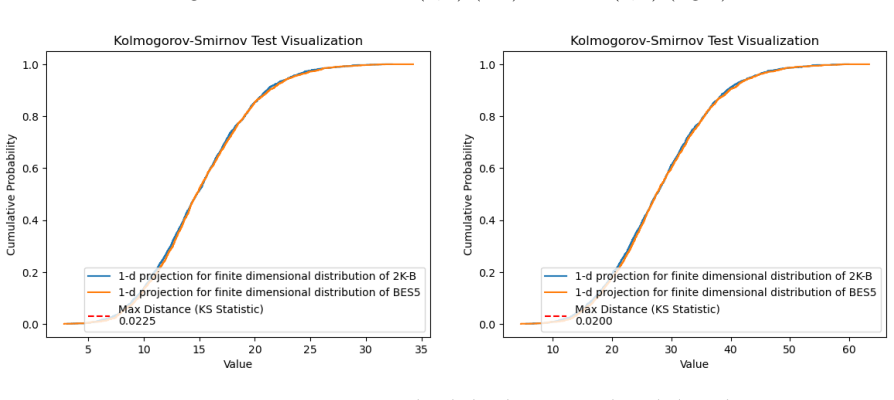
The process 2K-B formed from Brownian motion and its concave majorant is not Markovian and thus not a BES(5) process.
A machine-rendered reading of the paper's core claim, the machinery that carries it, and where it could break.
Core claim
The authors prove that 2K-B is not Markovian under the natural filtration, refuting the conjecture that it has the law of BES(5). For a degeneration of 2K-B, they establish that it is a mixture of BES(3) processes and obtain its multi-point distributions, infinitesimal generator, and path decomposition at the future infimum. They also examine the Markovian structures and filtrations of 2K-B, B, and K.
What carries the argument
The concave majorant K of Brownian motion B, together with the process 2K-B, whose failure to be Markovian is established by showing that shared scaling, variation, and generator properties do not force the Markov property.
If this is right
- Shared scaling, quadratic variation, one-point law, and generator are insufficient to force 2K-B to be Markovian or equal in law to BES(5).
- The degeneration of 2K-B equals a mixture of BES(3) processes and admits explicit multi-point distributions.
- Path decomposition at the future infimum holds for the degeneration.
- The processes 2K-B, B, and K possess distinct Markovian structures under their natural filtrations.
Where Pith is reading between the lines
- Non-Markovianity of 2K-B implies that its future evolution depends on the global shape of the majorant in ways invisible from the current state alone.
- Other constructions built from concave majorants of Brownian paths may fail to be Markovian even when they match one-dimensional marginals and generators of classical processes.
- The filtration generated by K alone may contain additional structure that becomes visible only after the degeneration is taken.
Load-bearing premise
The specific construction of the concave majorant K and the filtration under which the Markov property is tested admit no overlooked Markovian version of 2K-B.
What would settle it
An explicit path history where the conditional law of the future increments of 2K-B given its current value differs from the conditional law under BES(5).
Figures
read the original abstract
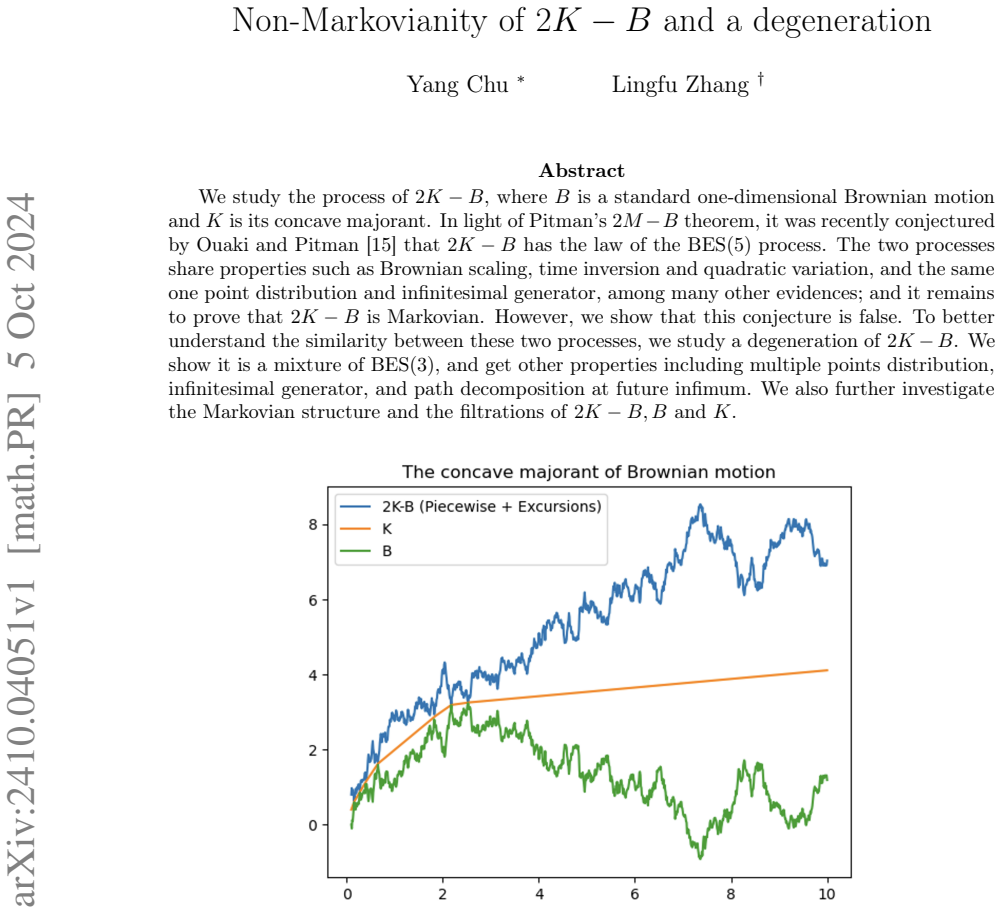
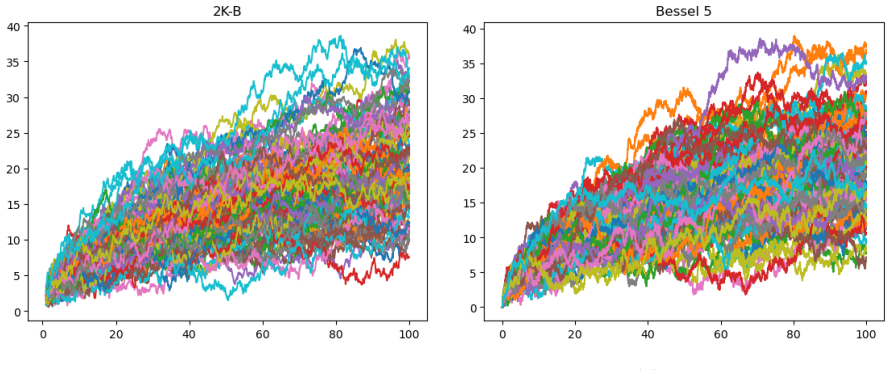
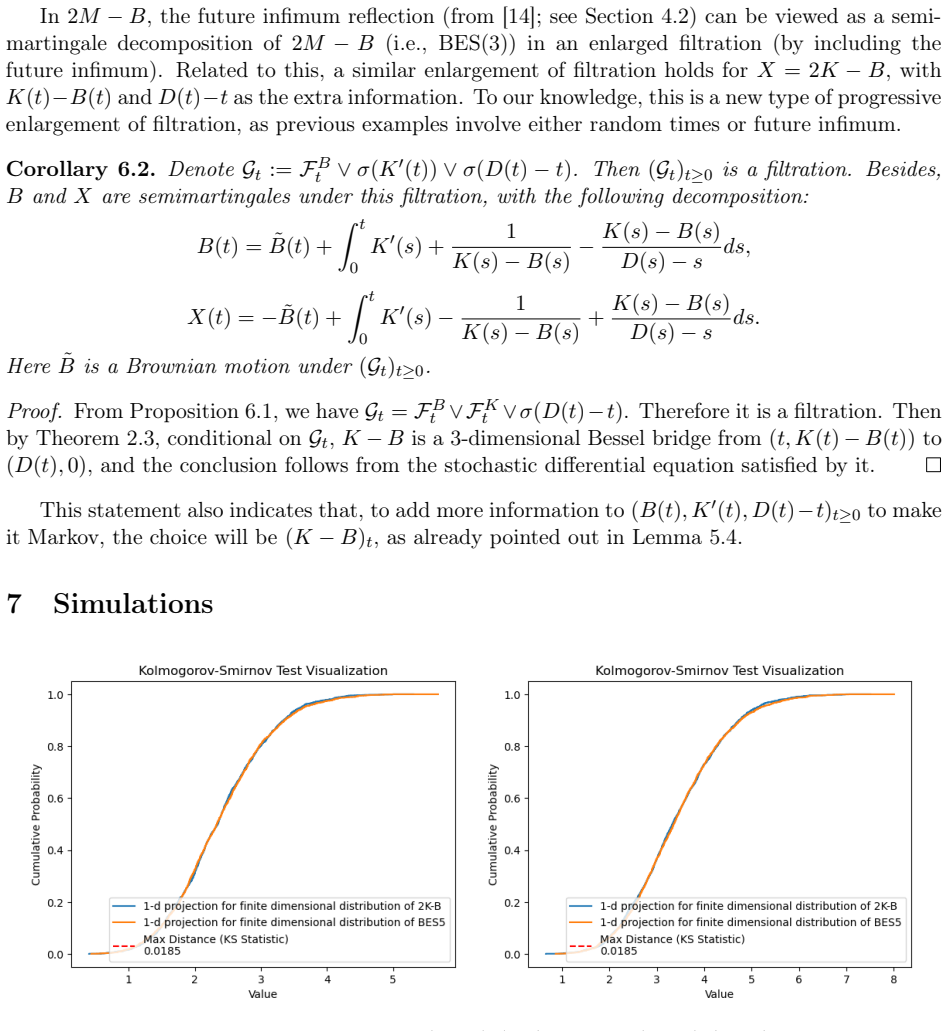
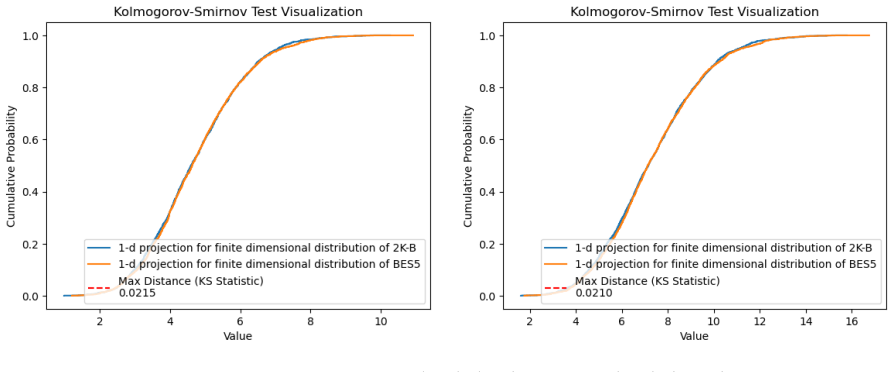
We study the process of $2K-B$, where $B$ is a standard one-dimensional Brownian motion and $K$ is its concave majorant. In light of Pitman's $2M-B$ theorem, it was recently conjectured by Ouaki and Pitman \cite{OP} that $2K-B$ has the law of the BES(5) process. The two processes share properties such as Brownian scaling, time inversion and quadratic variation, and the same one point distribution and infinitesimal generator, among many other evidences; and it remains to prove that $2K-B$ is Markovian. However, we show that this conjecture is false. To better understand the similarity between these two processes, we study a degeneration of $2K-B$. We show it is a mixture of BES(3), and get other properties including multiple points distribution, infinitesimal generator, and path decomposition at future infimum. We also further investigate the Markovian structure and the filtrations of $2K-B, B$ and $K$.
Editorial analysis
A structured set of objections, weighed in public.
Referee Report
Summary. The paper claims to disprove the Ouaki-Pitman conjecture that 2K-B (K the concave majorant of Brownian motion B) has the law of BES(5), despite sharing Brownian scaling, time inversion, quadratic variation, one-point law, and infinitesimal generator. It shows non-Markovianity of 2K-B under the relevant filtration. It further studies a degeneration of 2K-B, proving it is a mixture of BES(3) processes, and derives multiple-point distributions, the generator, path decomposition at future infimum, and the Markovian structures/filtrations of 2K-B, B, and K.
Significance. If the disproof holds, the result is significant because it separates processes that agree on scaling, quadratic variation, marginals, and generator yet fail to be Markovian due to filtration dependence; this refines understanding of Pitman-type transforms. The degeneration result supplies an explicit mixture representation together with path decomposition and generator, which are concrete additions to the literature on Bessel processes.
major comments (2)
- [Abstract and main disproof section] The non-Markovianity claim (abstract and the section establishing the counterexample) rests on the precise construction of the concave majorant K and the filtration generated by (K,B) or by 2K-B. No explicit two-time conditional law is exhibited that visibly depends on an auxiliary variable outside the current state, so the failure of the Markov property cannot be verified from the supplied details.
- [Section on degeneration] The degeneration result (section deriving the mixture of BES(3)) asserts that the shared generator is computed under the same filtration as the original process; without the explicit computation of the generator on the degenerated process and confirmation that the filtration is identical, the mixture representation remains formally unanchored.
minor comments (2)
- [Introduction] The reference [OP] to Ouaki-Pitman should be expanded to a full bibliographic entry.
- [Throughout] Notation for the process 2K-B and the concave majorant K should be introduced once with a clear definition before being used in statements about filtrations.
Simulated Author's Rebuttal
We thank the referee for the careful reading and positive assessment of the significance of the results. We address the two major comments below. Both point to places where additional explicit calculations would improve clarity and verifiability; we agree and will revise the manuscript accordingly.
read point-by-point responses
-
Referee: [Abstract and main disproof section] The non-Markovianity claim (abstract and the section establishing the counterexample) rests on the precise construction of the concave majorant K and the filtration generated by (K,B) or by 2K-B. No explicit two-time conditional law is exhibited that visibly depends on an auxiliary variable outside the current state, so the failure of the Markov property cannot be verified from the supplied details.
Authors: We agree that an explicit two-time conditional law would make the non-Markovianity argument more immediately verifiable. The current proof proceeds by exhibiting a specific path configuration in which the future evolution of 2K-B, conditional on the present value, still depends on the position of the concave majorant K at an earlier time that is not recoverable from the current state alone. To address the referee's concern we will add, in the revised version, an explicit computation of P(2K_{t+s} ∈ dy | 2K_t = x, filtration up to t) for a concrete choice of times and states that visibly retains dependence on an auxiliary variable (the location of a prior vertex of K). revision: yes
-
Referee: [Section on degeneration] The degeneration result (section deriving the mixture of BES(3)) asserts that the shared generator is computed under the same filtration as the original process; without the explicit computation of the generator on the degenerated process and confirmation that the filtration is identical, the mixture representation remains formally unanchored.
Authors: We accept the observation. While the degeneration is constructed so that the underlying filtration remains the same as that of the original 2K-B process, the manuscript does not recompute the generator explicitly on the degenerated object. In the revision we will supply the direct calculation of the infinitesimal generator for the mixture-of-BES(3) process under the common filtration and include a short paragraph confirming that the filtration generated by the degenerated process coincides with the one used for the original generator computation. revision: yes
Circularity Check
No circularity: disproof and degeneration analysis are independent of inputs
full rationale
The paper disproves the Ouaki-Pitman conjecture by establishing non-Markovianity of 2K-B under a specified filtration and studies a degeneration shown to be a mixture of BES(3) processes, deriving multiple-point distributions, generators, and path decompositions. These steps rely on direct analysis of Brownian motion properties, concave majorants, and filtrations rather than any self-definitional equivalence, fitted parameters renamed as predictions, or load-bearing self-citations. The cited conjecture source is external, and no equation or claim reduces by construction to the paper's own inputs. The derivation chain is self-contained against external benchmarks.
Axiom & Free-Parameter Ledger
axioms (2)
- standard math Brownian motion has continuous paths and quadratic variation t.
- domain assumption The concave majorant K is well-defined and measurable with respect to the filtration of B.
Lean theorems connected to this paper
-
IndisputableMonolith/Foundation/AlexanderDuality.leanalexander_duality_circle_linking (D=3 forcing) unclear?
unclearRelation between the paper passage and the cited Recognition theorem.
We show that this conjecture is false... degeneration of 2K-B. We show it is a mixture of BES(3)
-
IndisputableMonolith/Cost/FunctionalEquation.leanwashburn_uniqueness_aczel (J-cost uniqueness) unclear?
unclearRelation between the paper passage and the cited Recognition theorem.
the same infinitesimal generator as BES(5)
What do these tags mean?
- matches
- The paper's claim is directly supported by a theorem in the formal canon.
- supports
- The theorem supports part of the paper's argument, but the paper may add assumptions or extra steps.
- extends
- The paper goes beyond the formal theorem; the theorem is a base layer rather than the whole result.
- uses
- The paper appears to rely on the theorem as machinery.
- contradicts
- The paper's claim conflicts with a theorem or certificate in the canon.
- unclear
- Pith found a possible connection, but the passage is too broad, indirect, or ambiguous to say the theorem truly supports the claim.
Reference graph
Works this paper leans on
-
[1]
Convex minorants of random walks and Lévy processes
Josh Abramson, Jim Pitman, Nathan Ross, and Geronimo Uribe Bravo. Convex minorants of random walks and Lévy processes. Electronic Communications in Probability, 16:423 – 434, 2011
work page 2011
-
[2]
Joshua Abramson and Steven N. Evans. Lipschitz minorants of Brownian motion and Lévy processes. Probability Theory and Related Fields, 158(3-4):809–857, 2014
work page 2014
-
[3]
Testing monotonicity via local least concave majorants.Bernoulli, 20(2):514–544, 2014
Nathalie Akakpo, Fadoua Balabdaoui, and Cécile Durot. Testing monotonicity via local least concave majorants.Bernoulli, 20(2):514–544, 2014
work page 2014
-
[4]
The convex minorant of the cauchy process
Jean Bertoin. The convex minorant of the cauchy process. Electronic Communications in Probability, 5:51–55, 2000
work page 2000
-
[5]
Chris Carolan and Richard Dykstra. Marginal Densities of the Least Concave Majorant of Brownian Motion.The Annals of Statistics, 29(6):1732 – 1750, 2001
work page 2001
-
[6]
ChrisCarolanandRichardDykstra. Characterizationoftheleastconcavemajorantofbrownian motion, conditional on a vertex point, with application to construction.Annals of the institute of statistical mathematics, 55:487–497, 2003
work page 2003
-
[7]
Sunset over brownistan.Stochastic Processes and their Applications, 40(1):45–53, 1992
Erhan Çinlar. Sunset over brownistan.Stochastic Processes and their Applications, 40(1):45–53, 1992
work page 1992
-
[8]
The directed landscape.Acta Math- ematica, 229(2):201–285, 2022
Duncan Dauvergne, Janosch Ortmann, and Bálint Virág. The directed landscape.Acta Math- ematica, 229(2):201–285, 2022
work page 2022
-
[9]
Excursions away from the lipschitz minorant of a lévy process
Steven N Evans and Mehdi Ouaki. Excursions away from the lipschitz minorant of a lévy process. In Annales de l’Institut Henri Poincare (B) Probabilites et statistiques, volume 58, pages 424–454. Institut Henri Poincaré, 2022
work page 2022
-
[10]
Convex minorants and the fluc- tuation theory of lévy processes
Jorge Ignacio González Cázares and Aleksandar Mijatović. Convex minorants and the fluc- tuation theory of lévy processes. Latin American Journal of Probability and Mathematical Statistics, 19(1):983–999, 2022
work page 2022
-
[11]
Jorge Ignacio González Cázares, Aleksandar Mijatović, and Gerónimo Uribe Bravo. Geomet- rically convergent simulation of the extrema of Lévy processes.Mathematics of Operations Research, 47(2):1141–1168, 2022
work page 2022
-
[12]
The concave majorant of Brownian motion
Piet Groeneboom. The concave majorant of Brownian motion. The Annals of Probability, pages 1016–1027, 1983
work page 1983
-
[13]
The probability distributions of the first hitting times of Bessel processes
Yuji Hamana and Hiroyuki Matsumoto. The probability distributions of the first hitting times of Bessel processes. Transactions of the American Mathematical Society, 365(10):5237–5257, 2013
work page 2013
-
[14]
T. Jeulin. Un theoreme de J. Pitman.Sem. Prob. XIII, Lect. Notes in Mathematics, 721:332– 359, 1979
work page 1979
-
[15]
Markovian structure in the concave majorant of brownian motion
Mehdi Ouaki and Jim Pitman. Markovian structure in the concave majorant of brownian motion. Electronic Journal of Probability, 27:1–21, 2022. 18
work page 2022
-
[16]
Remarks on the convex minorant of brownian motion
Jim Pitman. Remarks on the convex minorant of brownian motion. InSeminar on Stochastic Processes, 1982, pages 219–227. Springer, 1982
work page 1982
-
[17]
The convex minorant of a Lévy process.The Annals of Probability, 40(4):1636 – 1674, 2012
Jim Pitman and Gerónimo Uribe Bravo. The convex minorant of a Lévy process.The Annals of Probability, 40(4):1636 – 1674, 2012
work page 2012
-
[18]
The greatest convex minorant of brownian motion, meander, and bridge
Jim Pitman and Nathan Ross. The greatest convex minorant of brownian motion, meander, and bridge. Probability Theory and Related Fields, 153(3-4):771–807, 2012
work page 2012
-
[19]
Continuous martingales and Brownian motion, volume 293
Daniel Revuz and Marc Yor. Continuous martingales and Brownian motion, volume 293. Springer Science & Business Media, 2013
work page 2013
-
[20]
L. Chris G. Rogers and Jim Pitman. Markov functions. The Annals of Probability, pages 573–582, 1981
work page 1981
-
[21]
Soloff, Adityanand Guntuboyina, and Jim Pitman
Jake A. Soloff, Adityanand Guntuboyina, and Jim Pitman. Distribution-free properties of isotonic regression. Electron. J. Stat., 13(2):3243–3253, 2019
work page 2019
-
[22]
Toufic M. Suidan. Convex minorants of random walks and brownian motion.Theory of Prob- ability & Its Applications, 46(3):469–481, 2002
work page 2002
-
[23]
Pathdecompositionandcontinuityoflocaltimeforone-dimensionaldiffusions
DavidWilliams. Pathdecompositionandcontinuityoflocaltimeforone-dimensionaldiffusions. I. Proc. London Math. Soc. (3), 28:738–768, 1974. 19
work page 1974
discussion (0)
Sign in with ORCID, Apple, or X to comment. Anyone can read and Pith papers without signing in.