ZONIA: a Zero-Trust Oracle System for Blockchain IoT Applications
Pith reviewed 2026-05-23 19:19 UTC · model grok-4.3
The pith
ZONIA uses a decentralized zero-trust oracle with reputation scoring to keep IoT data reliable on blockchain even when 40 percent of nodes are malicious.
A machine-rendered reading of the paper's core claim, the machinery that carries it, and where it could break.
Core claim
ZONIA's zero-trust model combined with its reputation mechanism enables a scalable oracle network for IoT that maintains high data accuracy despite up to 40 percent of participating nodes behaving maliciously, without reliance on trusted execution environments or single data sources.
What carries the argument
The reputation mechanism that scores nodes according to agreement with verifiable ground truth and filters their contributions in the decentralized oracle network.
If this is right
- The oracle network can accommodate larger numbers of IoT nodes while preserving performance under different workloads.
- Data accuracy stays high even when a substantial fraction of nodes attempt falsification or collusion.
- The architecture supports semantic and geospatial query types without central coordination.
- Anonymous participation becomes feasible while still enforcing reliability through reputation.
Where Pith is reading between the lines
- Such an oracle could allow IoT applications to draw data across competing device providers without a single trusted intermediary.
- The design may lower barriers to building cross-vendor IoT services that require tamper-resistant sensor readings.
- Extending the query support to additional data modalities could broaden the set of blockchain applications that can safely consume live IoT feeds.
Load-bearing premise
The evaluation assumes independent data sources exist that supply verifiable ground truth and that the reputation mechanism can correctly identify malicious behavior without further unstated conditions on attack patterns or data distributions.
What would settle it
A test in which the reputation scores fail to keep aggregate accuracy above a high threshold once 40 percent of nodes collude on falsified data, or a workload run showing throughput or latency degrading sharply beyond a measured node count.
Figures





read the original abstract
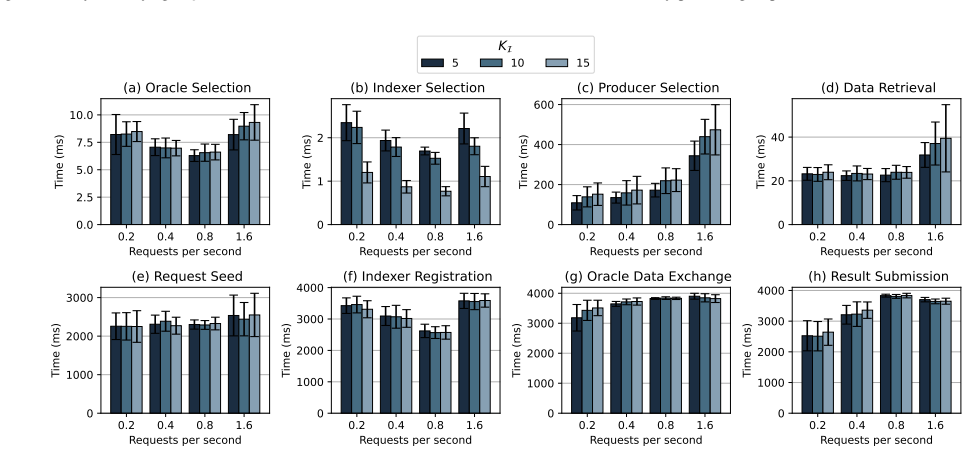
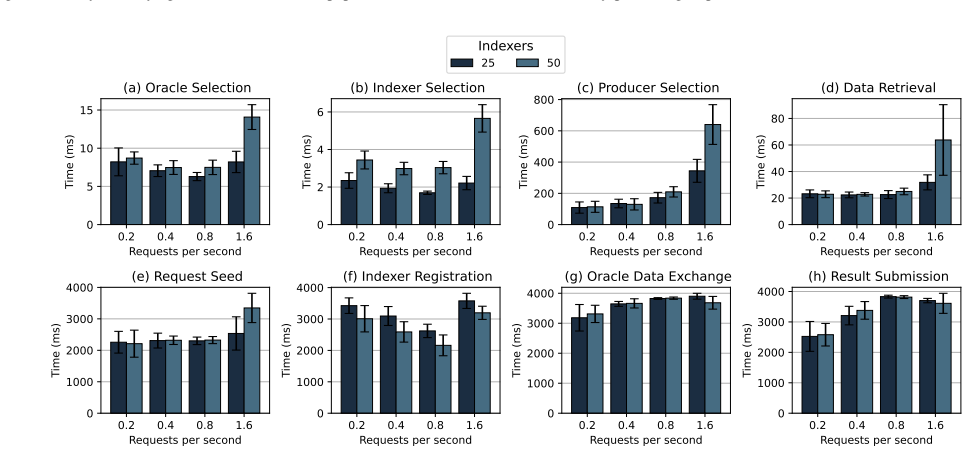
The rapid expansion of the Internet of Things (IoT) has led to significant data reliability and system transparency challenges, aggravated by the centralized nature of existing IoT architectures. This centralization often results in siloed data ecosystems, where interoperability issues and opaque data handling practices compromise both the utility and trustworthiness of IoT applications. To address these issues, we introduce ZONIA (Zero-trust Oracle Network for IoT Applications), a novel blockchain oracle system designed to enhance data integrity and decentralization in IoT environments. Unlike traditional approaches that rely on Trusted Execution Environments and centralized data sources, ZONIA utilizes a decentralized, zero-trust model that allows for anonymous participation and integrates multiple data sources to ensure fairness and reliability. This paper outlines ZONIA's architecture, which supports semantic and geospatial queries, details its data reliability mechanisms, and presents a comprehensive evaluation demonstrating its scalability and resilience against data falsification and collusion attacks. Both analytical and experimental results demonstrate ZONIA's scalability, showcasing its feasibility to handle an increasing number of nodes in the system under different system conditions and workloads. Furthermore, the implemented reputation mechanism significantly enhances data accuracy, maintaining high reliability even when 40\% of nodes exhibit malicious behavior.
Editorial analysis
A structured set of objections, weighed in public.
Referee Report
Summary. The paper introduces ZONIA, a decentralized zero-trust oracle network for blockchain-based IoT applications. It replaces TEEs and centralized sources with anonymous node participation and integration of multiple data sources, supports semantic and geospatial queries, incorporates a reputation mechanism for data reliability, and reports both analytical and experimental results claiming scalability to increasing node counts under varied workloads plus resilience that maintains high data accuracy even when 40% of nodes behave maliciously.
Significance. If the reported scalability and reputation results can be reproduced with full experimental details, the work would offer a concrete architecture for trustworthy oracles in IoT settings that avoids trusted hardware and single points of failure. The explicit integration of multiple sources and the 40% malicious-node threshold are potentially useful benchmarks for the field, though the absence of methodological specifics currently limits assessment of whether these constitute a substantive advance over existing reputation or consensus schemes.
major comments (2)
- [Abstract] Abstract (and any evaluation section): the headline claim that the reputation mechanism 'maintains high reliability even when 40% of nodes exhibit malicious behavior' is load-bearing for the paper's central contribution, yet the manuscript supplies no description of how ground truth is obtained when sources may be adversarial, the precise definition of malicious behavior (constant falsification, selective omission, collusion threshold, etc.), the data-distribution assumptions used to generate the 40% case, or the attack models tested. Without these, the reported accuracy figure cannot be reproduced or falsified.
- [Abstract] Abstract: the statement that 'both analytical and experimental results demonstrate ZONIA's scalability' is presented without any indication of the analytical model (queueing, simulation equations, or closed-form bounds), the experimental setup (node counts, workload parameters, hardware or simulation platform), baselines, error bars, or data-exclusion rules. These omissions directly undermine the verifiability of the scalability claim.
Simulated Author's Rebuttal
We thank the referee for the constructive comments on our manuscript. We address each major comment point by point below and will make the necessary revisions to improve methodological transparency and verifiability.
read point-by-point responses
-
Referee: [Abstract] Abstract (and any evaluation section): the headline claim that the reputation mechanism 'maintains high reliability even when 40% of nodes exhibit malicious behavior' is load-bearing for the paper's central contribution, yet the manuscript supplies no description of how ground truth is obtained when sources may be adversarial, the precise definition of malicious behavior (constant falsification, selective omission, collusion threshold, etc.), the data-distribution assumptions used to generate the 40% case, or the attack models tested. Without these, the reported accuracy figure cannot be reproduced or falsified.
Authors: We agree that the abstract and evaluation section require these details for reproducibility. The current manuscript presents experimental accuracy results under malicious conditions but does not explicitly define ground-truth acquisition, the precise malicious behaviors modeled, data-distribution assumptions, or the full set of attack models. We will revise both the abstract and the evaluation section to include these descriptions. revision: yes
-
Referee: [Abstract] Abstract: the statement that 'both analytical and experimental results demonstrate ZONIA's scalability' is presented without any indication of the analytical model (queueing, simulation equations, or closed-form bounds), the experimental setup (node counts, workload parameters, hardware or simulation platform), baselines, error bars, or data-exclusion rules. These omissions directly undermine the verifiability of the scalability claim.
Authors: The referee correctly notes that the abstract lacks these specifics. While the manuscript contains analytical and experimental scalability results, the abstract does not summarize the underlying models, node counts, workload parameters, baselines, or statistical reporting conventions. We will revise the abstract to include concise indications of the analytical approach and experimental setup. revision: yes
Circularity Check
No circularity in derivation chain; claims rest on architecture description and evaluation outcomes
full rationale
The provided abstract and context describe ZONIA's architecture, zero-trust model, reputation mechanism, and both analytical and experimental results on scalability and resilience to 40% malicious nodes. No equations, derivations, or first-principles results are presented that reduce any claimed performance metric to a quantity defined by its own inputs, fitted parameters, or self-citation chains. The evaluation outcomes are reported as independent measurements against the described system, with no evidence of self-definitional steps, fitted inputs renamed as predictions, or load-bearing self-citations. This is the common case of a self-contained systems paper whose central claims do not reduce by construction.
Axiom & Free-Parameter Ledger
axioms (2)
- domain assumption Multiple independent data sources can be integrated to provide verifiable ground truth for IoT queries.
- domain assumption Anonymous nodes can participate without trusted execution environments while maintaining system integrity.
Reference graph
Works this paper leans on
-
[1]
Next generation edge-cloud continuum architecture for structural health monitoring,
L. Gigli, I. Zyrianoff, F. Zonzini, D. Bogomolov, N. Testoni, M. D. Felice, L. De Marchi, G. Augugliaro, C. Mennuti, and A. Marzani, “Next generation edge-cloud continuum architecture for structural health monitoring,” IEEE Transactions on Industrial Informatics , vol. 20, no. 4, pp. 5874–5887, 2024
work page 2024
-
[2]
Private-blockchain-based industrial iot for material and product tracking in smart manufacturing,
M. I. S. Assaqty, Y . Gao, X. Hu, Z. Ning, V . C. M. Leung, Q. Wen, and Y . Chen, “Private-blockchain-based industrial iot for material and product tracking in smart manufacturing,” IEEE Network, vol. 34, no. 5, pp. 91–97, 2020
work page 2020
-
[3]
Blockchain for the iot and industrial iot: A review,
Q. Wang, X. Zhu, Y . Ni, L. Gu, and H. Zhu, “Blockchain for the iot and industrial iot: A review,” Internet of Things , vol. 10, p. 100081, 2020. Special Issue of the Elsevier IoT Journal on Blockchain Applications in IoT Environments
work page 2020
-
[4]
Security and trust in blockchains: Architecture, key technologies, and open issues,
P. Zhang and M. Zhou, “Security and trust in blockchains: Architecture, key technologies, and open issues,” IEEE Transactions on Computa- tional Social Systems , vol. 7, no. 3, pp. 790–801, 2020
work page 2020
-
[5]
Understanding the blockchain oracle problem: A call for action,
G. Caldarelli, “Understanding the blockchain oracle problem: A call for action,” Information, vol. 11, no. 11, p. 509, 2020
work page 2020
-
[6]
Connect api with blockchain: A survey on blockchain oracle implementation,
A. Pasdar, Y . C. Lee, and Z. Dong, “Connect api with blockchain: A survey on blockchain oracle implementation,” ACM Comput. Surv. , vol. 55, feb 2023
work page 2023
-
[7]
Auditing the blockchain oracle problem,
M. D. Sheldon, “Auditing the blockchain oracle problem,” J. Inf. Syst. , vol. 35, pp. 121–133, 2020
work page 2020
-
[8]
A. Al Sadawi, M. S. Hassan, and M. Ndiaye, “On the integration of blockchain with iot and the role of oracle in the combined system: The full picture,” IEEE Access , vol. 10, pp. 92532–92558, 2022
work page 2022
-
[9]
Provable (oraclize) - blockchain oracle for modern dapps,
Chainlink, “Provable (oraclize) - blockchain oracle for modern dapps,” 04 2024
work page 2024
-
[10]
Town crier: An authenticated data feed for smart contracts,
F. Zhang, E. Cecchetti, K. Croman, A. Juels, and E. Shi, “Town crier: An authenticated data feed for smart contracts,” in Proceedings of the 2016 aCM sIGSAC conference on computer and communications security , pp. 270–282, 2016
work page 2016
-
[11]
Tora: A trusted blockchain oracle based on a decentralized tee network,
L. Chen, R. Yuan, and Y . Xia, “Tora: A trusted blockchain oracle based on a decentralized tee network,” in 2021 IEEE International Conference on Joint Cloud Computing (JCC) , pp. 28–33, IEEE, 2021
work page 2021
-
[12]
A distributed oracle using intel sgx for blockchain-based iot applications,
S. Woo, J. Song, and S. Park, “A distributed oracle using intel sgx for blockchain-based iot applications,” Sensors, vol. 20, no. 9, p. 2725, 2020
work page 2020
-
[13]
A distributed efficient blockchain oracle scheme for internet of things,
Y . Xian, L. Zhou, J. Jiang, B. Wang, H. Huo, and P. Liu, “A distributed efficient blockchain oracle scheme for internet of things,” IEICE Trans- actions on Communications , 2024
work page 2024
-
[14]
D. C. G. Valadares, N. C. Will, J. Caminha, M. B. Perkusich, A. Perku- sich, and K. C. Gorg ˆonio, “Systematic literature review on the use of trusted execution environments to protect cloud/fog-based internet of things applications,” IEEE Access , vol. 9, pp. 80953–80969, 2021
work page 2021
-
[15]
A decentralized oracle architecture for a blockchain-based iot global market,
L. Gigli, I. Zyrianoff, F. Montori, C. Aguzzi, L. Roffia, and M. Di Felice, “A decentralized oracle architecture for a blockchain-based iot global market,” IEEE Communications Magazine , vol. 61, no. 8, pp. 86–92, 2023
work page 2023
-
[16]
Web of things (wot) architecture 1.1,
K. Toumura, M. Lagally, R. Matsukura, and M. McCool, “Web of things (wot) architecture 1.1,” W3C proposed reccommendation, W3C, July
-
[17]
https://www.w3.org/TR/2023/PR-wot-architecture11-20230711/
work page 2023
-
[18]
Web of things (wot) thing description 1.1,
E. Korkan, M. McCool, and S. K ¨abisch, “Web of things (wot) thing description 1.1,” W3C proposed reccommendation, W3C, July 2023. https://www.w3.org/TR/2023/PR-wot-thing-description11-20230711/
work page 2023
-
[19]
Web of things (wot) discovery,
A. Cimmino, F. Tavakolizadeh, K. Toumura, and M. McCool, “Web of things (wot) discovery,” W3C proposed reccommendation, W3C, July
-
[20]
https://www.w3.org/TR/2023/PR-wot-discovery-20230711/
work page 2023
-
[21]
Decentralized identifiers (DIDs) v1.0,
D. Reed, M. Sporny, A. Guy, M. Sabadello, D. Longley, O. Steele, and C. Allen, “Decentralized identifiers (DIDs) v1.0,” W3C recommen- dation, W3C, July 2022. https://www.w3.org/TR/2022/REC-did-core- 20220719/
work page 2022
-
[22]
S. Micali, M. Rabin, and S. Vadhan, “Verifiable random functions,” in 40th Annual Symposium on F oundations of Computer Science (Cat. No.99CB37039), pp. 120–130, 1999
work page 1999
-
[23]
Eip-225: Clique proof-of-authority consensus pro- tocol,
P. Szil ´agyi, “Eip-225: Clique proof-of-authority consensus pro- tocol,” ethereum improvement proposal, Ethereum, Mar. 2017. https://eips.ethereum.org/EIPS/eip-225. 18
work page 2017
-
[24]
Zion: A scalable w3c web of things directory,
C. Aguzzi, L. Gigli, I. Zyrianoff, and L. Roffia, “Zion: A scalable w3c web of things directory,” in 2024 IEEE 21st Consumer Communications & Networking Conference (CCNC) , pp. 1–6, 2024
work page 2024
-
[25]
Performance analysis of ethereum transac- tions in private blockchain,
S. Rouhani and R. Deters, “Performance analysis of ethereum transac- tions in private blockchain,” in 2017 8th IEEE International Conference on Software Engineering and Service Science (ICSESS) , pp. 70–74, 2017
work page 2017
-
[26]
A survey of layer-two blockchain protocols,
A. Gangwal, H. R. Gangavalli, and A. Thirupathi, “A survey of layer-two blockchain protocols,” Journal of Network and Computer Applications , vol. 209, p. 103539, 2023
work page 2023
-
[27]
Exploring the attack surface of blockchain: A comprehensive survey,
M. Saad, J. Spaulding, L. Njilla, C. Kamhoua, S. Shetty, D. Nyang, and D. Mohaisen, “Exploring the attack surface of blockchain: A comprehensive survey,” IEEE Communications Surveys & Tutorials , vol. 22, no. 3, pp. 1977–2008, 2020
work page 1977
-
[28]
Towards a scalable and trustworthy blockchain: Iot use case,
H. Moudoud, S. Cherkaoui, and L. Khoukhi, “Towards a scalable and trustworthy blockchain: Iot use case,” in ICC 2021-IEEE International Conference on Communications , pp. 1–6, IEEE, 2021
work page 2021
-
[29]
Astraea: A decentralized blockchain oracle,
J. Adler, R. Berryhill, A. Veneris, Z. Poulos, N. Veira, and A. Kas- tania, “Astraea: A decentralized blockchain oracle,” in 2018 IEEE international conference on internet of things (IThings) and IEEE green computing and communications (GreenCom) and IEEE cyber , physical and social computing (CPSCom) and IEEE smart data (SmartData) , pp. 1145–1152, IEEE, 2018
work page 2018
-
[30]
H. Moudoud, S. Cherkaoui, and L. Khoukhi, “An iot blockchain ar- chitecture using oracles and smart contracts: the use-case of a food supply chain,” in 2019 IEEE 30th Annual International Symposium on Personal, Indoor and Mobile Radio Communications (PIMRC) , pp. 1–6, IEEE, 2019
work page 2019
-
[31]
A novel oracle- aided industrial iot blockchain: Architecture, challenges, and potential solutions,
Y . Du, J. Li, L. Shi, Z. Wang, T. Wang, and Z. Han, “A novel oracle- aided industrial iot blockchain: Architecture, challenges, and potential solutions,” IEEE Network , 2022
work page 2022
-
[32]
Augur: a decentralized oracle and prediction market platform,
J. Peterson, J. Krug, M. Zoltu, A. K. Williams, and S. Alexander, “Augur: a decentralized oracle and prediction market platform,” arXiv preprint arXiv:1501.01042, 2015
-
[33]
On public crowdsource-based mechanisms for a decentralized blockchain oracle,
K. Nelaturu, J. Adler, M. Merlini, R. Berryhill, N. Veira, Z. Poulos, and A. Veneris, “On public crowdsource-based mechanisms for a decentralized blockchain oracle,” IEEE Transactions on Engineering Management, vol. 67, no. 4, pp. 1444–1458, 2020
work page 2020
-
[34]
A decentralized truth dis- covery approach to the blockchain oracle problem,
Y . Xiao, N. Zhang, W. Lou, and Y . T. Hou, “A decentralized truth dis- covery approach to the blockchain oracle problem,” in IEEE INFOCOM 2023-IEEE Conference on Computer Communications , pp. 1–10, IEEE, 2023
work page 2023
-
[35]
Smart contract data feed frame- work for privacy-preserving oracle system on blockchain,
J. Park, H. Kim, G. Kim, and J. Ryou, “Smart contract data feed frame- work for privacy-preserving oracle system on blockchain,” Computers, vol. 10, no. 1, p. 7, 2020. Lorenzo Gigli received his Master’s Degree with distinction (summa cum laude) in Computer Science in 2019 from the University of Bologna, Italy. Sub- sequently, he served as a Research Fell...
work page 2020
-
[36]
He was a Visiting Researcher at the Huawei European Research Center of Munich, Germany
He is also a former Expert at the European Commission, where he explored the challenges re- lated to ethics and privacy for the use of Personal Digital Twin (PDT). He was a Visiting Researcher at the Huawei European Research Center of Munich, Germany. He is a part of the IoT Prism Laboratory directed by Prof. Marco Di Felice and Prof. Luciano Bononi. His ...
work page 2017
discussion (0)
Sign in with ORCID, Apple, or X to comment. Anyone can read and Pith papers without signing in.