Ellipsoidal Density-Equalizing Map for Genus-0 Closed Surfaces
Pith reviewed 2026-05-23 19:16 UTC · model grok-4.3
The pith
Density-equalizing maps for genus-0 closed surfaces can now target ellipsoidal domains to cut parameterization distortion.
A machine-rendered reading of the paper's core claim, the machinery that carries it, and where it could break.
Core claim
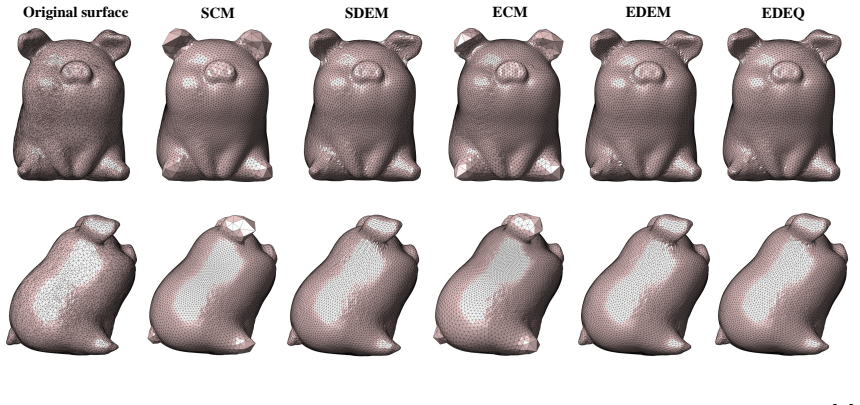
We develop a novel method for computing density-equalizing maps of genus-0 closed surfaces onto an ellipsoidal domain. This allows us to achieve ellipsoidal area-preserving parameterizations and ellipsoidal parameterizations with controlled area change. We further propose an energy minimization approach that combines density-equalizing maps and quasi-conformal maps, which allows us to produce ellipsoidal density-equalizing quasi-conformal maps for achieving a balance between density-equalization and quasi-conformality. Using our proposed methods, we can significantly improve the performance of surface remeshing for genus-0 closed surfaces.
What carries the argument
The ellipsoidal density-equalizing map, a deformation based on density diffusion principles that equalizes local densities while filling an ellipsoidal domain.
If this is right
- Ellipsoidal area-preserving parameterizations become available for genus-0 closed surfaces.
- Ellipsoidal parameterizations with controlled area change are achievable.
- Energy minimization yields ellipsoidal density-equalizing quasi-conformal maps.
- Surface remeshing performance improves for genus-0 closed surfaces.
Where Pith is reading between the lines
- Choosing the ellipsoid axes to align with the surface's principal directions could further minimize distortion.
- The same diffusion-plus-energy approach might adapt to other convex target domains.
- Lower-distortion maps could reduce numerical errors in downstream tasks such as simulation or texture mapping.
- Systematic tests across surfaces with different aspect ratios would reveal how to select the best ellipsoid per shape.
Load-bearing premise
Switching the target domain from a sphere to an ellipsoid reduces geometric distortion for extreme genus-0 surfaces without introducing instabilities in the density diffusion or energy minimization.
What would settle it
Running the ellipsoidal method and the prior spherical method on the same set of extreme genus-0 surfaces and measuring distortion metrics plus remeshing quality; equal or worse results with the ellipsoid would falsify the advantage.
Figures




read the original abstract
Surface parameterization is a fundamental task in geometry processing and plays an important role in many science and engineering applications. In recent years, the density-equalizing map, a shape deformation technique based on the physical principle of density diffusion, has been utilized for the parameterization of simply connected and multiply connected open surfaces. More recently, a spherical density-equalizing mapping method has been developed for the parameterization of genus-0 closed surfaces. However, for genus-0 closed surfaces with extreme geometry, using a spherical domain for the parameterization may induce large geometric distortion. In this work, we develop a novel method for computing density-equalizing maps of genus-0 closed surfaces onto an ellipsoidal domain. This allows us to achieve ellipsoidal area-preserving parameterizations and ellipsoidal parameterizations with controlled area change. We further propose an energy minimization approach that combines density-equalizing maps and quasi-conformal maps, which allows us to produce ellipsoidal density-equalizing quasi-conformal maps for achieving a balance between density-equalization and quasi-conformality. Using our proposed methods, we can significantly improve the performance of surface remeshing for genus-0 closed surfaces. Experimental results on a large variety of genus-0 closed surfaces are presented to demonstrate the effectiveness of our proposed methods.
Editorial analysis
A structured set of objections, weighed in public.
Referee Report
Summary. The paper develops a density-equalizing mapping method for genus-0 closed surfaces that targets an ellipsoidal domain rather than a sphere. This produces ellipsoidal area-preserving parameterizations or parameterizations with controlled area distortion, and an energy-minimization formulation that blends density equalization with quasi-conformality. The authors claim the ellipsoidal target reduces geometric distortion for surfaces with extreme aspect ratios and improves downstream remeshing performance, supported by experiments on a variety of genus-0 models.
Significance. If the discretization and solver remain stable for high-eccentricity ellipsoids, the approach would supply a practical extension of existing spherical density-equalizing maps, offering lower distortion for elongated or flattened genus-0 surfaces without requiring manual sphere-to-ellipsoid post-processing. The quasi-conformal augmentation adds a tunable trade-off that may be useful in applications where pure area equalization is too rigid.
major comments (3)
- [Abstract and §3] Abstract and §3 (method overview): the central claim that the ellipsoidal target 'significantly improve[s] the performance of surface remeshing' rests on the unshown assertion that the density-diffusion PDE and its quasi-conformal augmentation remain contractive and free of new instabilities when the target eccentricity exceeds modest values; no convergence analysis, condition-number bounds, or failure cases for high-eccentricity ellipsoids are referenced.
- [§4] §4 (discretization): the Laplace-Beltrami operator and density-equalizing flow must be discretized on the ellipsoidal metric, yet the manuscript supplies no explicit statement of how the axes of the target ellipsoid are chosen from the input surface (e.g., PCA of bounding box versus optimization) or whether the resulting linear systems are solved with the same preconditioners used in the spherical case; without this, the improvement over the spherical baseline cannot be verified.
- [§5] §5 (experiments): quantitative distortion tables or plots comparing ellipsoidal versus spherical results on the most extreme test models (aspect ratio > 5:1) are required to substantiate the 'large geometric distortion' reduction claim; if only qualitative figures are shown, the load-bearing performance assertion remains unsupported.
minor comments (2)
- [§3] Notation for the ellipsoidal metric and the combined energy functional should be introduced with explicit definitions before the minimization statement to avoid ambiguity between the density-equalizing term and the quasi-conformal term.
- [Abstract] The abstract states that the method works for 'a large variety of genus-0 closed surfaces' but does not list the specific models or their bounding-box aspect ratios; adding a table of test surfaces with quantitative metrics would improve reproducibility.
Simulated Author's Rebuttal
We thank the referee for the constructive comments, which help clarify key aspects of the method and its validation. We address each major comment below and indicate planned revisions to strengthen the manuscript.
read point-by-point responses
-
Referee: [Abstract and §3] the central claim that the ellipsoidal target 'significantly improve[s] the performance of surface remeshing' rests on the unshown assertion that the density-diffusion PDE and its quasi-conformal augmentation remain contractive and free of new instabilities when the target eccentricity exceeds modest values; no convergence analysis, condition-number bounds, or failure cases for high-eccentricity ellipsoids are referenced.
Authors: The manuscript's stability claim for high-eccentricity cases is supported by the numerical experiments across a variety of genus-0 models (including those with aspect ratios exceeding 5:1), which converged reliably without reported instabilities. The energy formulation extends the spherical density-equalizing flow by replacing the spherical metric with the ellipsoidal one, preserving the contractive properties of the diffusion process. We will add a brief discussion in §3 on the well-posedness under the ellipsoidal metric and include supplementary condition-number plots versus eccentricity to address this explicitly. revision: partial
-
Referee: [§4] the Laplace-Beltrami operator and density-equalizing flow must be discretized on the ellipsoidal metric, yet the manuscript supplies no explicit statement of how the axes of the target ellipsoid are chosen from the input surface (e.g., PCA of bounding box versus optimization) or whether the resulting linear systems are solved with the same preconditioners used in the spherical case.
Authors: The target ellipsoid axes are obtained via PCA on the input surface vertices, with semi-axis lengths scaled to the principal component variances; this choice is detailed in the implementation section. The discretization employs the same finite-element scheme for the Laplace-Beltrami operator as the spherical case, with the metric tensor adjusted to the ellipsoid, and identical preconditioned CG solvers are used. We will insert an explicit paragraph in §4 describing these choices and confirming solver consistency to allow direct verification of the baseline comparison. revision: yes
-
Referee: [§5] quantitative distortion tables or plots comparing ellipsoidal versus spherical results on the most extreme test models (aspect ratio > 5:1) are required to substantiate the 'large geometric distortion' reduction claim; if only qualitative figures are shown, the load-bearing performance assertion remains unsupported.
Authors: We agree that quantitative evidence is necessary for the distortion reduction claim on extreme models. The current experiments include both qualitative visualizations and aggregate statistics, but we will expand §5 with dedicated tables and plots reporting area distortion, angle distortion, and remeshing quality metrics specifically for all models with aspect ratio >5:1, directly comparing ellipsoidal and spherical results. revision: yes
Circularity Check
No circularity; derivation chain absent from provided text
full rationale
The abstract and reader's summary describe a novel extension from spherical to ellipsoidal density-equalizing maps but contain no equations, fitted parameters, self-referential definitions, or load-bearing self-citations that reduce the central claim to its own inputs. No derivation steps are exhibited that could be inspected for the enumerated circularity patterns. The work is therefore self-contained against external benchmarks at the level of information supplied.
Axiom & Free-Parameter Ledger
Reference graph
Works this paper leans on
-
[1]
Surface parameterization: a tutorial and survey,
M. S. Floater and K. Hormann, “Surface parameterization: a tutorial and survey,” in Advances in Multiresolution for Geometric Modelling , pp. 157–186, Springer, 2005
work page 2005
-
[2]
Mesh parameterization methods and their applications,
A. Sheffer, E. Praun, and K. Rose, “Mesh parameterization methods and their applications,” Found. Trends Comput. Graph. Vis. , vol. 2, no. 2, pp. 105–171, 2007. 31
work page 2007
-
[3]
Mesh parameterization: theory and practice,
K. Hormann, K. Polthier, and A. Sheffer, “Mesh parameterization: theory and practice,” in ACM SIGGRAPH ASIA 2008 courses , pp. 1–87, Association for Computing Machinery, 2008
work page 2008
-
[4]
Recent developments of surface parameterization methods using quasi-conformal geometry,
G. P. T. Choi and L. M. Lui, “Recent developments of surface parameterization methods using quasi-conformal geometry,” Handbook of Mathematical Models and Algorithms in Computer Vision and Imaging: Mathematical Imaging and Vision , pp. 1483–1523, 2023
work page 2023
-
[5]
Conformal surface parameterization for texture mapping,
S. Haker, S. Angenent, A. Tannenbaum, R. Kikinis, G. Sapiro, and M. Halle, “Conformal surface parameterization for texture mapping,” IEEE Trans. Vis. Comput. Graph. , vol. 6, no. 2, pp. 181–189, 2000
work page 2000
-
[6]
Genus zero surface conformal mapping and its application to brain surface mapping,
X. Gu, Y. Wang, T. F. Chan, P. M. Thompson, and S.-T. Yau, “Genus zero surface conformal mapping and its application to brain surface mapping,” IEEE Trans. Med. Imaging, vol. 23, no. 8, pp. 949–958, 2004
work page 2004
-
[7]
Ricci flow-based spherical parameteri- zation and surface registration,
X. Chen, H. He, G. Zou, X. Zhang, X. Gu, and J. Hua, “Ricci flow-based spherical parameteri- zation and surface registration,” Comput. Vis. Image Underst. , vol. 117, no. 9, pp. 1107–1118, 2013
work page 2013
-
[8]
Robust fairing via conformal curvature flow,
K. Crane, U. Pinkall, and P. Schr¨ oder, “Robust fairing via conformal curvature flow,”ACM Trans. Graph., vol. 32, no. 4, pp. 1–10, 2013
work page 2013
-
[9]
FLASH: Fast landmark aligned spherical harmonic parameterization for genus-0 closed brain surfaces,
P. T. Choi, K. C. Lam, and L. M. Lui, “FLASH: Fast landmark aligned spherical harmonic parameterization for genus-0 closed brain surfaces,” SIAM J. Imaging Sci. , vol. 8, no. 1, pp. 67–94, 2015
work page 2015
-
[10]
Parallelizable global conformal param- eterization of simply-connected surfaces via partial welding,
G. P. T. Choi, Y. Leung-Liu, X. Gu, and L. M. Lui, “Parallelizable global conformal param- eterization of simply-connected surfaces via partial welding,” SIAM J. Imaging Sci. , vol. 13, no. 3, pp. 1049–1083, 2020
work page 2020
-
[11]
Convergence analysis of Dirichlet energy minimization for spherical conformal parameterizations,
W.-H. Liao, T.-M. Huang, W.-W. Lin, and M.-H. Yueh, “Convergence analysis of Dirichlet energy minimization for spherical conformal parameterizations,” J. Sci. Comput., vol. 98, no. 29, pp. 1–28, 2024
work page 2024
-
[12]
Area preserving brain mapping,
Z. Su, W. Zeng, R. Shi, Y. Wang, J. Sun, and X. Gu, “Area preserving brain mapping,” in Proceedings of the IEEE Conference on Computer Vision and Pattern Recognition , pp. 2235– 2242, 2013
work page 2013
-
[13]
X. Gu, F. Luo, J. Sun, and S. T. Yau, “Variational principles for minkowski type problems, discrete optimal transport, and discrete monge-ampere equations,” Asian J. Math. , vol. 20, no. 2, pp. 383–398, 2016
work page 2016
-
[14]
Spherical optimal transportation,
L. Cui, X. Qi, C. Wen, N. Lei, X. Li, M. Zhang, and X. Gu, “Spherical optimal transportation,” Comput. Aided Des., vol. 115, pp. 181–193, 2019
work page 2019
-
[15]
3DPeople: Modeling the geometry of dressed humans,
A. Pumarola, J. Sanchez-Riera, G. P. T. Choi, A. Sanfeliu, and F. Moreno-Noguer, “3DPeople: Modeling the geometry of dressed humans,” in Proceedings of the IEEE International Conference on Computer Vision , pp. 2242–2251, 2019
work page 2019
-
[16]
Open and closed anatomical surface description via hemispherical area-preserving map,
A. Giri, G. P. T. Choi, and L. Kumar, “Open and closed anatomical surface description via hemispherical area-preserving map,” Signal Process., vol. 180, p. 107867, 2021. 32
work page 2021
-
[17]
Adaptive area-preserving parameterization of open and closed anatomical surfaces,
G. P. T. Choi, A. Giri, and L. Kumar, “Adaptive area-preserving parameterization of open and closed anatomical surfaces,” Comput. Biol. Med. , vol. 148, p. 105715, 2022
work page 2022
-
[18]
Fundamentals of spherical parameterization for 3D meshes,
C. Gotsman, X. Gu, and A. Sheffer, “Fundamentals of spherical parameterization for 3D meshes,” ACM Trans. Graph., vol. 22, no. 3, pp. 358–363, 2003
work page 2003
-
[19]
L. M. Lui, Y. Wang, T. F. Chan, and P. Thompson, “Landmark constrained genus zero surface conformal mapping and its application to brain mapping research,” Appl. Numer. Math., vol. 57, no. 5-7, pp. 847–858, 2007
work page 2007
-
[20]
Spherical parameterization for genus zero surfaces using laplace- beltrami eigenfunctions,
J. Lef` evre and G. Auzias, “Spherical parameterization for genus zero surfaces using laplace- beltrami eigenfunctions,” in International Conference on Geometric Science of Information , pp. 121–129, Springer, 2015
work page 2015
-
[21]
Spherical parameterization balancing angle and area distortions,
S. Nadeem, Z. Su, W. Zeng, A. Kaufman, and X. Gu, “Spherical parameterization balancing angle and area distortions,” IEEE Trans. Vis. Comput. Graph. , vol. 23, no. 6, pp. 1663–1676, 2016
work page 2016
-
[22]
Bijective spherical parametrization with low distortion,
C. Wang, X. Hu, X. Fu, and L. Liu, “Bijective spherical parametrization with low distortion,” Comput. Graph., vol. 58, pp. 161–171, 2016
work page 2016
-
[23]
G. P.-T. Choi, M. H.-Y. Man, and L. M. Lui, “Fast spherical quasiconformal parameterization of genus-0 closed surfaces with application to adaptive remeshing,” Geom. Imaging Comput. , vol. 3, no. 1–2, pp. 1–29, 2016
work page 2016
-
[24]
Advanced hierarchical spherical parameterizations,
X. Hu, X.-M. Fu, and L. Liu, “Advanced hierarchical spherical parameterizations,” IEEE Trans. Vis. Comput. Graph. , vol. 24, no. 6, pp. 1930–1941, 2017
work page 1930
-
[25]
A novel local/global approach to spherical parameterization,
Z. Wang, Z. Luo, J. Zhang, and E. Saucan, “A novel local/global approach to spherical parameterization,” J. Comput. Appl. Math. , vol. 329, pp. 294–306, 2018
work page 2018
-
[26]
M.-H. Yueh, T.-M. Huang, T. Li, W.-W. Lin, and S.-T. Yau, “Projected gradient method combined with homotopy techniques for volume-measure-preserving optimal mass transportation problems,” J. Sci. Comput. , vol. 88, pp. 1–24, 2021
work page 2021
-
[27]
Z. Lyu, Q. Chen, and L. M. Lui, “A two-stage algorithm for combined quasiconformal and optimal mass transportation spherical parameterization,” Math. Comput. Geom. Data , vol. 3, no. 1, pp. 29–57, 2023
work page 2023
-
[28]
T.-M. Huang, W.-H. Liao, and W.-W. Lin, “Fundamental theory and R-linear convergence of stretch energy minimization for spherical equiareal parameterization,” J. Numer. Math. , vol. 32, no. 1, pp. 1–25, 2024
work page 2024
-
[29]
J.-W. Lin, T. Li, W.-W. Lin, and T.-M. Huang, “Ellipsoidal conformal and area-/volume- preserving parameterizations and associated optimal mass transportations,” Adv. Comput. Math., vol. 49, no. 4, p. 50, 2023
work page 2023
-
[30]
Fast ellipsoidal conformal and quasi-conformal parameterization of genus-0 closed surfaces,
G. P. T. Choi, “Fast ellipsoidal conformal and quasi-conformal parameterization of genus-0 closed surfaces,” J. Comput. Appl. Math. , p. 115888, 2024
work page 2024
-
[31]
Spheroidal harmonics for generalizing the morphological decomposition of closed parametric surfaces,
M. Shaqfa and W. M. van Rees, “Spheroidal harmonics for generalizing the morphological decomposition of closed parametric surfaces,” arXiv preprint arXiv:2407.03350 , 2024. 33
-
[32]
Diffusion-based method for producing density-equalizing maps,
M. T. Gastner and M. E. J. Newman, “Diffusion-based method for producing density-equalizing maps,” Proc. Natl. Acad. Sci., vol. 101, no. 20, pp. 7499–7504, 2004
work page 2004
-
[33]
D. Dorling, M. Newman, and A. Barford, The atlas of the real world . Thames & Hudson., 2008
work page 2008
-
[34]
M. T. Gastner, Spatial distributions: Density-equalizing map projections, facility location, and two-dimensional networks. Ph.D. Thesis, University of Michigan, 2005
work page 2005
-
[35]
Fast flow-based algorithm for creating density-equalizing map projections,
M. T. Gastner, V. Seguy, and P. More, “Fast flow-based algorithm for creating density-equalizing map projections,” Proc. Natl. Acad. Sci., vol. 115, no. 10, pp. E2156–E2164, 2018
work page 2018
-
[36]
Diffusion-based cartogram on spheres,
Z. Li and S. Aryana, “Diffusion-based cartogram on spheres,” Cartogr. Geogr. Inf. Sci. , vol. 45, no. 5, pp. 464–475, 2018
work page 2018
-
[37]
Density-equalizing maps for simply connected open surfaces,
G. P. T. Choi and C. H. Rycroft, “Density-equalizing maps for simply connected open surfaces,” SIAM J. Imaging Sci. , vol. 11, no. 2, pp. 1134–1178, 2018
work page 2018
-
[38]
Area-preserving mapping of 3D carotid ultrasound images using density-equalizing reference map,
G. P. T. Choi, B. Chiu, and C. H. Rycroft, “Area-preserving mapping of 3D carotid ultrasound images using density-equalizing reference map,” IEEE Trans. Biomed. Eng. , vol. 67, no. 9, pp. 1507–1517, 2020
work page 2020
-
[39]
M. Shaqfa, G. P. T. Choi, G. Anciaux, and K. Beyer, “Disk harmonics for analysing curved and flat self-affine rough surfaces and the topological reconstruction of open surfaces,” arXiv preprint arXiv:2403.07001, 2024
-
[40]
Hemispheroidal parameterization and harmonic decomposition of simply connected open surfaces,
G. P. T. Choi and M. Shaqfa, “Hemispheroidal parameterization and harmonic decomposition of simply connected open surfaces,” arXiv preprint arXiv:2407.15417 , 2024
-
[41]
Volumetric density-equalizing reference maps with applica- tions,
G. P. T. Choi and C. H. Rycroft, “Volumetric density-equalizing reference maps with applica- tions,” J. Sci. Comput. , vol. 86, no. 3, p. 41, 2021
work page 2021
-
[42]
Bijective density-equalizing quasiconformal map for multiply connected open surfaces,
Z. Lyu, G. P. T. Choi, and L. M. Lui, “Bijective density-equalizing quasiconformal map for multiply connected open surfaces,” SIAM J. Imaging Sci. , vol. 17, no. 1, pp. 706––755, 2024
work page 2024
-
[43]
Spherical density-equalizing map for genus-0 closed surfaces,
Z. Lyu, L. M. Lui, and G. P. T. Choi, “Spherical density-equalizing map for genus-0 closed surfaces,” SIAM J. Imaging Sci. , to appear
- [44]
-
[45]
O. Lehto and K. I. Virtanen, Quasiconformal mappings in the plane , vol. 126. Springer Berlin, Heidelberg, 1973
work page 1973
-
[46]
L. V. Ahlfors, Lectures on quasiconformal mappings, vol. 38. American Mathematical Society, Providence, RI, 2006
work page 2006
-
[47]
Texture map and video compression using Beltrami representation,
L. M. Lui, K. C. Lam, T. W. Wong, and X. Gu, “Texture map and video compression using Beltrami representation,” SIAM J. Imaging Sci. , vol. 6, no. 4, pp. 1880–1902, 2013
work page 1902
-
[48]
Computing discrete minimal surfaces and their conjugates,
U. Pinkall and K. Polthier, “Computing discrete minimal surfaces and their conjugates,” Exp. Math., vol. 2, no. 1, pp. 15–36, 1993
work page 1993
-
[49]
A. Jacobson, “Common 3D test models.” https://github.com/alecjacobson/ common-3d-test-models , 2023. Accessed: 2023-10-03. 34
work page 2023
-
[50]
Recent advances in remeshing of surfaces,
P. Alliez, G. Ucelli, C. Gotsman, and M. Attene, “Recent advances in remeshing of surfaces,” in Shape Analysis and Structuring , pp. 53–82, Springer, 2008
work page 2008
-
[51]
Parameterization of faceted surfaces for meshing using angle-based flattening,
A. Sheffer and E. de Sturler, “Parameterization of faceted surfaces for meshing using angle-based flattening,” Eng. Comput., vol. 17, pp. 326–337, 2001
work page 2001
-
[52]
Spherical parametrization and remeshing,
E. Praun and H. Hoppe, “Spherical parametrization and remeshing,” ACM Trans. Graph., vol. 22, no. 3, pp. 340–349, 2003
work page 2003
-
[53]
Meshing point clouds using spherical parameterization,
M. Zwicker and C. Gotsman, “Meshing point clouds using spherical parameterization,” in Proceedings of the First Eurographics conference on Point-Based Graphics , pp. 173–180, 2004
work page 2004
-
[54]
Spherical conformal parameterization of genus-0 point clouds for meshing,
G. P.-T. Choi, K. T. Ho, and L. M. Lui, “Spherical conformal parameterization of genus-0 point clouds for meshing,” SIAM J. Imaging Sci. , vol. 9, no. 4, pp. 1582–1618, 2016
work page 2016
-
[55]
A simple mesh generator in MATLAB,
P.-O. Persson and G. Strang, “A simple mesh generator in MATLAB,” SIAM Review, vol. 46, no. 2, pp. 329–345, 2004. 35
work page 2004
discussion (0)
Sign in with ORCID, Apple, or X to comment. Anyone can read and Pith papers without signing in.