REVIEW 4 major objections 6 minor 1 cited by
Revisiting rotationally excited CH at radio wavelengths: A case study towards W51
T0 review · 4 major / 6 minor · reviewed 2026-08-12 · deepseek-v4-flash
Pith's one-line read First interferometric detection of the 700 MHz CH lines shows they trace dense gas.
desk verdict First interferometric shot at the 700 MHz CH lines with new electron-CH rates, but the dense-gas claim sits on sub-3.2-sigma features and one questionable fit. read the letter →
The pith
A machine-rendered reading of the paper's core claim, the machinery that carries it, and where it could break.
The reading
What carries the argument
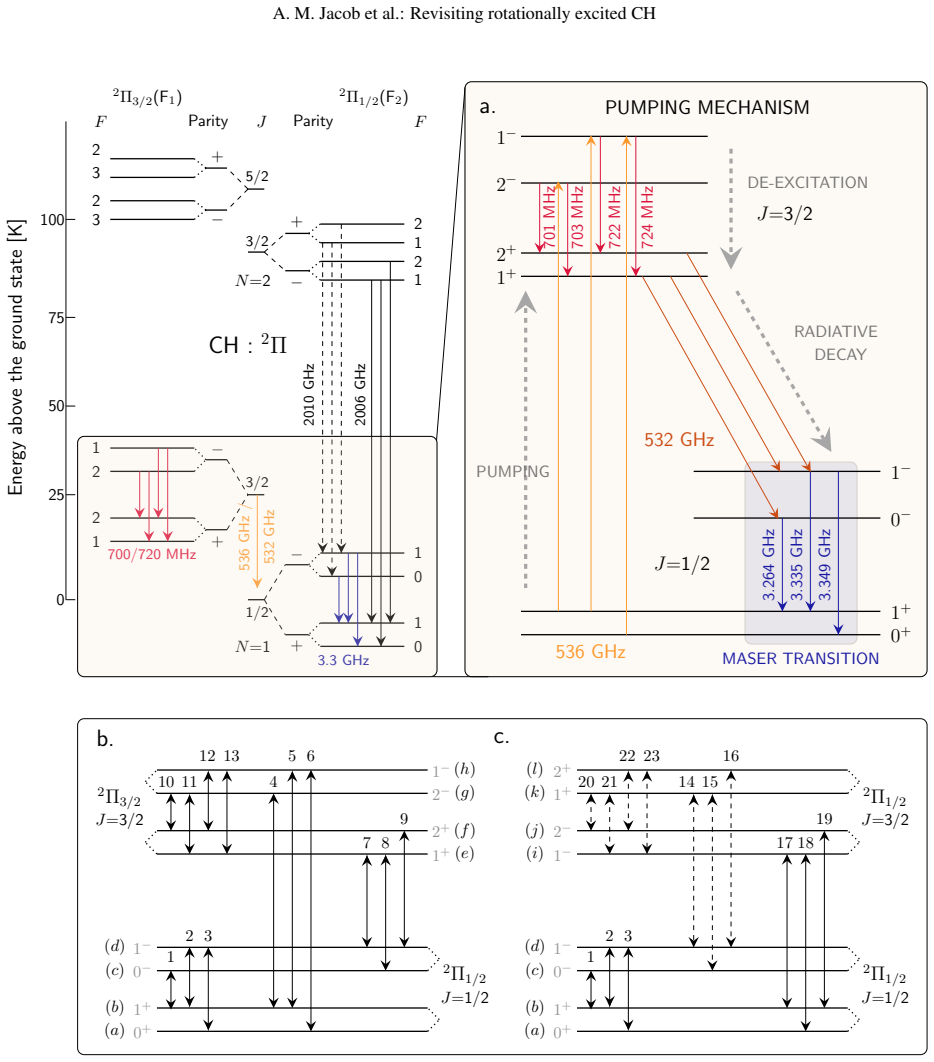
The central machinery is a non-LTE radiative transfer code based on the coupled escape probability formalism, which solves the multi-level statistical equilibrium and includes effects of line overlap and an external radiation field. The models use hyperfine-resolved collisional rate coefficients for CH with atomic and molecular hydrogen, plus electron-CH rate coefficients derived in the Born approximation and presented in the paper, with line widths tied to the observed Gaussian components. The analysis hinges on line ratios R1 = T3.264 GHz / T3.349 GHz, R2 = T3.335 GHz / T3.349 GHz, and R3 = T701 MHz / T724 MHz, which are fitted across a density-temperature grid to determine the physical conditions and the population of the first excited state.
What would settle it
Integrate the 701 and 724 MHz spectra toward W51 E to a noise level well below the current rms and check whether the absorption features persist and match the fitted Gaussian components; if they vanish or shift to different velocities, the derived dense-gas excitation conditions are unsupported.
Extended reading notes
Core claim
The paper's central discovery is that the hyperfine-structure lines within the first rotationally excited state of CH (the 2Π3/2, N = 1, J = 3/2 state) near 700 MHz are excited only in high-density gas, with nH around a few times $10^{5}$ $cm^{-3}$, where collisional processes dominate the excitation and drive the lines into absorption. Toward W51 E the main lines at 701 and 724 MHz are detected in absorption at 3.1σ and 2.6σ, respectively, at velocities near 55 km/s, coincident with the dense star-forming clump, while the ground-state 3.3 GHz lines show anomalous (maser) emission at 65–67 km/s in lower-density gas with nH at or below 1800 $cm^{-3}$. The authors model both sets of lines simultaneously with a non-LTE radiative transfer code that includes line overlap, far-infrared pumping, and newly computed electron-CH collisional rate coefficients, and find that electron collisions do not significantly change the excitation scheme. This provides a consistent picture of CH excitation in which the 532/536 GHz lines connecting the first excited state to the ground state can also be modeled and used for column density determinations.
Load-bearing premise
The paper's conclusions rest on the weak 2.6–3.1 sigma absorption signals at 701 and 724 MHz being real CH absorption at the fitted velocities; if those signals are noise or belong to other gas, the dense-gas excitation scheme derived from them collapses.
Editorial extensions
If this is right
- The 700 MHz CH lines can serve as a density-selective probe of molecular gas, distinguishing dense clumps from diffuse foreground gas along a single sightline.
- The ground-state CH maser at 3.3 GHz is quenched in dense gas, so its presence indicates low-density, FIR-pumped environments.
- The new electron-CH collisional rate coefficients, although not decisive for this sightline, are now available for modeling other regions with high electron fractions.
- Modeling the 700 MHz lines constrains the 532/536 GHz line emission and enables separation of emission and absorption in those spectra, improving CH column density measurements.
- Higher rotationally excited CH lines (in the 4.8–7.3 GHz range) are predicted to remain undetectable, explaining past non-detections.
Reading between the lines
- A testable extension would be to search for 700 MHz CH absorption toward other bright, compact continuum sources with known dense foreground gas, predicting that detections cluster at densities near 10^5 cm^-3.
- The density dichotomy may be used to map the interface between diffuse and dense gas in star-forming complexes, since CH ground-state emission and 700 MHz absorption trace complementary phases.
- The paper's conclusion that electron collisions do not thermalize the CH lines suggests that for similar hydride radicals with strong dipole moments, electron impact may be less important than assumed in photodissociation-region models, at least below electron fractions of about 10^-4.
- If the Zeeman splitting of the 700 MHz lines could be measured toward W51 E with future instruments, it would probe magnetic fields specifically in the dense clump, a regime complementary to existing Zeeman probes.
Signed reviews
Editorial analysis
A structured set of objections, weighed in public.
Referee Report
Summary. The paper reports the first interferometric search and detection of the 700 MHz hyperfine-structure transitions within the first rotationally excited state of CH (2Π3/2, N=1, J=3/2) toward W51 E, using uGMRT. The two main lines at 701 and 724 MHz are seen in absorption at 3.1σ and 2.6σ, respectively, and the satellite lines are not detected. The authors jointly model the ground-state 3.3 GHz lines and the 700 MHz excited-state lines with the non-LTE radiative transfer code MOLPOP-CEP, including line overlap and newly computed electron-CH collision rate coefficients in the Born approximation. From the line ratios R1, R2, and R3 (where R3 = T701/T724), they derive gas densities of a few × 10^5 cm^-3 for the 51, 57, and 61 km/s velocity components toward W51 E, and kinetic temperatures of 27–72 K. They further show that the ground-state inversion is quenched in these dense components except in the 3.264 GHz line, use the model to separate emission and absorption in the 532/536 GHz CH lines, and predict that higher rotational CH transitions are unlikely to be detectable. Non-detections toward five other targets are attributed to sensitivity and/or high densities.
Significance. If the detection and dense-gas interpretation hold, this is the first interferometric detection of the 700 MHz CH lines and provides an observational probe of density and excitation in the dense star-forming gas where the ground-state CH maser is quenched. The paper also contributes new electron-CH collision rate coefficients that will be useful for future modeling of CH excitation. The modeling strategy is sensible: it uses a well-benchmarked radiative transfer code, exploits line ratios to remove beam-filling dependence, and includes line-overlap effects that are essential for CH. However, the central observational claim rests on marginal detections (2.6–3.1σ), and there is an internal inconsistency in Table 3 that undermines one of the three components used for the density analysis. The dense-gas conclusion is therefore not yet sufficiently supported by the data as presented.
major comments (4)
- [Table 3, 724 MHz row] For the 51.7 km/s component at 724 MHz, the fitted peak brightness temperature is negative (Peak TB = -28.5 ± 4.0 K) but the integrated intensity is positive (∫TB dV = +162.5 ± 32.2 K km/s). A negative-amplitude Gaussian must have a negative area, so this sign inconsistency implies either a typographical error or that the fitted component is not a simple absorption feature. Since the 51 km/s component enters the R3 ratio used to derive the density and temperature in Table 4 (Sect. 5.1, Fig. 8), the derived physical conditions for this component are not trustworthy until this discrepancy is resolved.
- [Sect. 4.1, Fig. 4, Table 4] The 700 MHz main lines are detected at 3.1σ and 2.6σ (Sect. 4.1), and the three Gaussian components at 51, 57, and 61 km/s in the 700 MHz spectra have positions and widths tied to the much stronger 3.3 GHz lines; the 700 MHz spectra do not independently resolve three components. Consequently, the R3 = T701/T724 ratios for each component used in the MOLPOP-CEP analysis (Sect. 5.1, Table 4, Fig. 8) inherit the assumed 3.3 GHz decomposition instead of being demonstrated in the 700 MHz band. If the 701/724 MHz features are noise or baseline artifacts, R3 is undefined and the derived nH ~ 10^5 cm^-3 collapses. The authors should provide a detection significance estimate that does not presuppose the 3.3 GHz decomposition (e.g., matched filtering or moment analysis at the known line positions) and show that the inferred densities are robust to alternative decompositions, such as a single broad component near 55 km/s.
- [Sect. 5.1, Table 4, Fig. 8] For the 61 km/s component, the reduced chi-squared of the model fit is less than 1, and the authors themselves describe the derived column density of the first excited state (N(CH) ~ 4.2 × 10^14 cm^-2) as 'questionable' because of underestimated uncertainties. This component is nevertheless included in the summary statement that the 700 MHz lines trace gas at nH ~ a few × 10^5 cm^-3 (Sect. 6). The dense-gas conclusion should be based on the robust 51 and 57 km/s components alone, or the 61 km/s component should be re-fit with a more careful treatment of systematic uncertainties before it is used to support the central claim.
- [Sect. 4.3 and Appendix C] The new electron-CH collision rate coefficients are computed in the Born approximation using the Einstein A coefficients, and the paper states that this is accurate for 'pure rotationally excited levels.' However, the 700 MHz HFS transitions within the Λ-doublet of the first excited state have Einstein A coefficients as small as ~2 × 10^-12 s^-1; the validity of applying the dipole Born formula to such weak, non-rotational transitions is not demonstrated. Since the electron contribution can be comparable to H2 collisions at the assumed electron fractions (xe = 1.5 × 10^-4 down to 3 × 10^-5, as described in Sect. 4.2), an error in these rates could propagate into the R3 predictions and the derived densities. The authors should justify the Born treatment for these transitions or provide an uncertainty estimate for the resulting rate coefficients.
minor comments (6)
- [Sect. 4.3] The phrase 'in the following section and Appendix 4.3' should be 'in the following section and Appendix C'; the appendix is not numbered 4.3.
- [Sect. 2] There is a duplicated definite article in 'the the 560µm pump'; please correct.
- [Sect. 3 and Fig. 3 caption] The name 'Hershel' is misspelled in two places; it should be 'Herschel'.
- [Sect. 8 and Appendix A] The data availability statement reads 'Appendices A and B are available at' with no URL or pointer, and Appendix A contains an unresolved citation placeholder '( ?)' in the text about corner plots; both should be completed.
- [Table 4] The table header lists absolute values of the line ratios (|Ri|), but Sect. 5.1 defines R3 = T701/T724 without explicitly stating that absolute values are used; please clarify the sign convention in the text.
- [Fig. 9 caption] The caption describes 'model constrained brightness temperature (in red)' but the figure shows red, pink, and blue shaded regions representing emission, absorption, and the composite fit; please make the association between colors and components explicit.
Circularity Check
No significant circularity: the line-ratio modeling is a standard radiative-transfer fit, the electron-CH rates are derived from an independent Born-approximation formula, and the Paper I self-citations are backed by external benchmarks.
full rationale
The paper's central derivation is a non-LTE radiative-transfer fit of observed line ratios (R1, R2, R3) to a density-temperature grid using MOLPOP-CEP. This is standard model fitting, not circular: the ratios are independent observed quantities, and model outputs such as excitation temperatures and column densities are used as consistency checks rather than as fit inputs that define the observables. The electron-CH collisional rate coefficients are derived from an independent analytic Born-approximation formalism (Appendix C, Eqs. C.1-C.4) using Einstein A coefficients and molecular constants; they are not constructed from the target line ratios. The paper relies on Paper I (Jacob et al. 2021b) for the choice of collisional rate combination and for benchmarking, but Paper I is an independent prior study benchmarked against TMC-1 and built on external collisional rates (Dagdigian 2018; Marinakis et al. 2019). The statement 'only this specific combination of collisional rate coefficients is capable of producing level inversion' is a modeling result from that prior work, not a uniqueness theorem imported to force the present conclusions. The low significance of the 700 MHz detections (3.1 sigma and 2.6 sigma) and the apparent sign inconsistency in the Table 3 integrated intensity for the 724 MHz 51.7 km/s component are data-quality and statistical-robustness concerns, not evidence of circular reasoning. The paper also explicitly acknowledges limitations, including uncertainty about the role of electron collisions and questionable high excited-state column densities for the 61 km/s component. No step in the derivation chain reduces by construction to its own inputs.
Assumptions & free parameters
free parameters (4)
- Gas density nH for each fitted velocity component =
log nH/cm^-3 = 5.32 (51), 5.02 (57), 5.3 (61), 3.25 (65), 2.49 (67)
- Kinetic temperature Tkin for each fitted velocity component =
63 K (51), 72 K (57), 27 K (61), >=178 K (65), >=172 K (67)
- Column density of CH in the first excited state N(CH, 2Π3/2, J=3/2) =
~2e14 cm^-2 (range 0.35e14 - 5.57e14 in Fig. 8)
- Electron fraction xe =
1.5e-4 to 3.0e-5
assumptions (5)
- domain assumption Born approximation for electron-CH inelastic collisions is valid for the transitions considered
- domain assumption Single-zone plane-parallel slab with uniform density and temperature
- domain assumption The specific combination of collisional rate coefficients (Dagdigian 2018 for H and ortho-H2, He-based scaled rates for para-H2) is the only one that produces ground-state inversion
- domain assumption The CH column density is constrained by the 2006 GHz ground-state FIR lines, and the CH-H2 relationship of Sheffer et al. (2008) is used to estimate H2 column densities
- domain assumption Electron density upper limit of 3000 cm^-3 from W49 CRRL PDR models applies to the W51 E sightline
Cite this review
Pith. "Pith review of Revisiting rotationally excited CH at radio wavelengths: A case study towards W51." pith.science (2026). https://pith.science/paper/OTZUE2CX
@misc{pith2026241108193,
  author       = {Pith},
  title        = {Pith review of: Revisiting rotationally excited CH at radio wavelengths: A case study towards W51},
  year         = {2026},
  howpublished = {\url{https://pith.science/paper/OTZUE2CX}},
  note         = {Machine review of arXiv:2411.08193}
}
read the original abstract
Ever since they were first detected in the interstellar medium, the radio wavelength (3.3 GHz) hyperfine-structure splitting transitions in the rotational ground state of CH have been observed to show anomalous excitation. Astonishingly, this behaviour has been uniformly observed towards a variety of different sources probing a wide range of physical conditions. While the observed level inversion can be explained globally by a pumping scheme involving collisions, a description of the extent of 'over-excitation' observed in individual sources requires the inclusion of radiative processes, involving transitions at higher rotational levels. Therefore, a complete description of the excitation mechanism in the CH ground state, observed towards individual sources entails observational constraints from the rotationally excited levels of CH and in particular that of its first rotationally excited state. Given the limited detections of these lines, the objective of this work is to characterise the physical and excitation properties of the rotationally excited lines of CH near 700 MHz, and investigate their influence on the pumping mechanisms of the ground-state lines of CH. This work presents the first interferometric search for the rotationally excited lines of CH near 700 MHz carried out using the uGMRT array and jointly models the physical and excitation conditions traced by lines from both the ground and first rotationally excited states of CH.
Figures


Figures from the paper (10 more)


Forward citations
Cited by 1 Pith paper
-
The Lunar Farside Transients and Technology Telescope (LFT3) Mission
Proposes a $150M-class lunar farside radio telescope (LFT3) to survey 0.1–2700 MHz in the RFI-pristine shielded zone before lunar-orbital interference closes the window.
Reference graph
Works this paper leans on
-
[1]
Adams , W. S. 1941, , 93, 11
1941
-
[2]
& Elitzur , M
Asensio Ramos , A. & Elitzur , M. 2018, , 616, A131
2018
-
[3]
M., Sip o cz , B
Astropy Collaboration , Price-Whelan , A. M., Sip o cz , B. M., et al. 2018, , 156, 123
2018
-
[4]
P., Tollerud , E
Astropy Collaboration , Robitaille , T. P., Tollerud , E. J., et al. 2013, , 558, A33
2013
-
[5]
C., & Townes , C
Bertojo , M., Cheung , A. C., & Townes , C. H. 1976, , 208, 914
1976
-
[6]
1984, , 130, 380
Bouloy , D., Nguyen-Q-Rieu , & Field , D. 1984, , 130, 380
1984
-
[7]
1984, , 285, 312
Bujarrabal , V., Salinas , F., & Gonzalo , I. 1984, , 285, 312
1984
-
[8]
Burton , W. B. 1970, , 2, 291
1970
Show all 88 references
-
[9]
2022, , 134, 114501
CASA Team , Bean , B., Bhatnagar , S., et al. 2022, , 134, 114501
2022
-
[10]
& Walmsley , C
Cesaroni , R. & Walmsley , C. M. 1991, , 241, 537
1991
-
[11]
Crutcher , R. M. 2012, , 50, 29
2012
-
[12]
Dagdigian , P. J. 2018, , 475, 5480
2018
-
[13]
Dagdigian , P. J. 2023, , 518, 5976
2023
-
[14]
2019, , 623, A25
Damiani , F., Prisinzano , L., Micela , G., & Sciortino , S. 2019, , 623, A25
2019
-
[15]
A., Evenson , K
Davidson , S. A., Evenson , K. M., & Brown , J. M. 2001, , 546, 330
2001
-
[16]
1937, , 49, 26
Dunham , T., J. 1937, , 49, 26
1937
-
[17]
A., Gusten , R., Risacher , C., et al
Duran , C. A., Gusten , R., Risacher , C., et al. 2021, IEEE Transactions on Terahertz Science and Technology, 11, 194
2021
-
[18]
1977, , 218, 677
Elitzur , M. 1977, , 218, 677
1977
-
[19]
& Asensio Ramos , A
Elitzur , M. & Asensio Ramos , A. 2006, , 365, 779
2006
-
[20]
& de Jong , T
Elitzur , M. & de Jong , T. 1978, , 67, 323
1978
-
[21]
Federman , S. R. & Willson , R. F. 1982, , 260, 124
1982
-
[22]
W., Lang , D., & Goodman , J
Foreman-Mackey , D., Hogg , D. W., Lang , D., & Goodman , J. 2013, , 125, 306
2013
-
[23]
2021, , 73, S172
Fujita , S., Torii , K., Kuno , N., et al. 2021, , 73, S172
2021
-
[24]
Gaia Collaboration , Brown , A. G. A., Vallenari , A., et al. 2018, , 616, A1
2018
-
[25]
L., & Bieging , J
Genzel , R., Downes , D., Pauls , T., Wilson , T. L., & Bieging , J. 1979, , 73, 253
1979
-
[26]
R., et al
Gerin , M., de Luca , M., Goicoechea , J. R., et al. 2010, , 521, L16
2010
-
[27]
R., et al
Gerin , M., Ruaud , M., Goicoechea , J. R., et al. 2015, , 573, A30
2015
-
[28]
2017, arXiv e-prints, arXiv:1702.06627
Ginsburg , A. 2017, arXiv e-prints, arXiv:1702.06627
2017 arXiv
-
[29]
2015, , 573, A106
Ginsburg , A., Bally , J., Battersby , C., et al. 2015, , 573, A106
2015
-
[30]
Ginsburg , A., Goddi , C., Kruijssen , J. M. D., et al. 2017, , 842, 92
2017
-
[31]
& Pauls , T
Greve , A. & Pauls , T. 1980, , 82, 388
1980
-
[32]
S., et al
Gupta , Y., Ajithkumar , B., Kale , H. S., et al. 2017, Current Science, 113, 707
2017
-
[33]
2019, in Bulletin of the American Astronomical Society, Vol
Hallinan , G., Ravi , V., Weinreb , S., et al. 2019, in Bulletin of the American Astronomical Society, Vol. 51, 255
2019
-
[34]
M., Menten , K
Jacob , A. M., Menten , K. M., Gong , Y., et al. 2021 a , , 647, A42
2021
-
[35]
M., Menten , K
Jacob , A. M., Menten , K. M., Wiesemeyer , H., et al. 2019, , 632, A60
2019
-
[36]
M., Menten , K
Jacob , A. M., Menten , K. M., Wiesemeyer , H., & Ortiz-Le \'o n , G. N. 2021 b , , 650, A133
2021
-
[37]
V., Kaiser , R
Kalenskii , S. V., Kaiser , R. I., Bergman , P., et al. 2022, , 932, 5
2022
-
[38]
J., Alexander , M
K os , J., Dagdigian , P. J., Alexander , M. H., Faure , A., & Lique , F. 2020, , 493, 3491
2020
-
[39]
M., et al
Koley , A., Roy , N., Menten , K. M., et al. 2021, , 501, 4825
2021
-
[40]
S., Csengeri , T., et al
K \"o nig , C., Urquhart , J. S., Csengeri , T., et al. 2017, , 599, A139
2017
-
[41]
Litvak , M. M. 1969, Science, 165, 855
1969
-
[42]
2022, , 516, 5964
Loreau , J., Faure , A., & Lique , F. 2022, , 516, 5964
2022
-
[43]
2019, , 629, A130
Marinakis , S., Kalugina , Y., K os , J., & Lique , F. 2019, , 629, A130
2019
-
[44]
E., Bell , M
Matthews , H. E., Bell , M. B., Sears , T. J., Turner , B. E., & Rickard , L. J. 1986, , 161, 329
1986
-
[45]
1940, , 52, 187
McKellar , A. 1940, , 52, 187
1940
-
[46]
u ller , H. S. P., Schl \
M \"u ller , H. S. P., Schl \"o der , F., Stutzki , J., & Winnewisser , G. 2005, Journal of Molecular Structure, 742, 215
2005
-
[47]
J., Menten , K
Reid , M. J., Menten , K. M., Brunthaler , A., et al. 2019, , 885, 131
2019
-
[48]
C., Snyder , L
Remijan , A., Sutton , E. C., Snyder , L. E., et al. 2004, , 606, 917
2004
-
[49]
2016, , 595, A34
Risacher , C., G \"u sten , R., Stutzki , J., et al. 2016, , 595, A34
2016
-
[50]
2015, in Advancing Astrophysics with the Square Kilometre Array (AASKA14), 110
Robishaw , T., Green , J., Surcis , G., et al. 2015, in Advancing Astrophysics with the Square Kilometre Array (AASKA14), 110
2015
-
[51]
& Bressert , E
Robitaille , T. & Bressert , E. 2012, APLpy: Astronomical Plotting Library in Python
2012
-
[52]
A., De Pree , C
Roshi , D. A., De Pree , C. G., Goss , W. M., & Anantharamaiah , K. R. 2006, , 644, 279
2006
-
[53]
Rydbeck , O. E. H., Elld \'e r , J., & Irvine , W. M. 1973, , 246, 466
1973
-
[54]
Rydbeck , O. E. H., Kollberg , E., Hjalmarson , A., et al. 1976, , 31, 333
1976
-
[55]
Rygl , K. L. J., Brunthaler , A., Sanna , A., et al. 2012, , 539, A79
2012
-
[56]
J., Brunthaler , A., & Menten , K
Sato , M., Reid , M. J., Brunthaler , A., & Menten , K. M. 2010, , 720, 1055
2010
-
[57]
M., Contreras , Y., et al
Schuller , F., Menten , K. M., Contreras , Y., et al. 2009, , 504, 415
2009
-
[58]
R., et al
Sheffer , Y., Rogers , M., Federman , S. R., et al. 2008, , 687, 1075
2008
-
[59]
J., Lauroesch , J
Sofia , U. J., Lauroesch , J. T., Meyer , D. M., & Cartledge , S. I. B. 2004, , 605, 272
2004
-
[60]
J., Lugten , J
Stacey , G. J., Lugten , J. B., & Genzel , R. 1987, , 313, 859
1987
-
[61]
& Neufeld , D
Sternberg , A. & Neufeld , D. A. 1999, , 516, 371
1999
-
[62]
Sume , A., Rydbeck , O. E. H., Kollberg , E., & Irvine , W. M. 1976, , 51, 155
1976
-
[63]
& Rosenfeld , L
Swings , P. & Rosenfeld , L. 1937, , 86, 483
1937
-
[64]
1966, Journal of the Physical Society of Japan, 21, 507
Takayanagi , K. 1966, Journal of the Physical Society of Japan, 21, 507
1966
-
[65]
S., Araya , E
Tan , W. S., Araya , E. D., Lee , L. E., et al. 2020, , 497, 1348
2020
-
[66]
D., Green , J
Tremblay , C. D., Green , J. A., Mader , S. L., Phillips , C. J., & Whiting , M. 2020, , 37, e055
2020
-
[67]
Troland , T. H. & Heiles , C. 1977, , 214, 703
1977
-
[68]
J., Hinds , E
Truppe , S., Hendricks , R. J., Hinds , E. A., & Tarbutt , M. R. 2014, , 780, 71
2014
-
[69]
J., Tokunaga , S
Truppe , S., Hendricks , R. J., Tokunaga , S. K., et al. 2013, Nature Communications, 4, 2600
2013
-
[70]
Turner , B. E. 1988, , 329, 425
1988
-
[71]
Turner , B. E. & Zuckerman , B. 1974, , 187, L59
1974
-
[72]
2019, in Canadian Long Range Plan for Astronomy and Astrophysics White Papers, Vol
Vanderlinde , K., Liu , A., Gaensler , B., et al. 2019, in Canadian Long Range Plan for Astronomy and Astrophysics White Papers, Vol. 2020, 28
2019
-
[73]
E., et al
Virtanen, P., Gommers, R., Oliphant, T. E., et al. 2020, Nature Methods, 17, 261
2020
-
[74]
Watson , J. K. G. 2001, , 555, 472
2001
-
[75]
Wells , D. C. 1985, in Data Analysis in Astronomy, ed. V. di Gesu , L. Scarsi , P. Crane , J. H. Friedman , & S. Levialdi , 195
1985
-
[76]
A., Beletsky , Y., & Kre owski , J
Weselak , T., Galazutdinov , G. A., Beletsky , Y., & Kre owski , J. 2010, , 402, 1991
2010
-
[77]
M., et al
Wiesemeyer , H., G \"u sten , R., Menten , K. M., et al. 2018, , 612, A37
2018
-
[78]
M., et al
Winkel , B., Wiesemeyer , H., Menten , K. M., et al. 2017, , 600, A2
2017
-
[79]
M., & Churchwell , E
Winnberg , A., Walmsley , C. M., & Churchwell , E. 1978, , 66, 431
1978
-
[80]
T., Becklin , E
Young , E. T., Becklin , E. E., Marcum , P. M., et al. 2012, , 749, L17
2012
-
[81]
M., Henkel , C., & Saykally , R
Ziurys , L. M., Henkel , C., & Saykally , R. J. 1983, , 275, 175
1983
-
[82]
Ziurys , L. M. & Turner , B. E. 1985, , 292, L25
1985
-
[83]
& Turner , B
Zuckerman , B. & Turner , B. E. 1975, , 197, 123
1975
-
[84]
, " * write output.state after.block = add.period write newline
ENTRY address archiveprefix author booktitle chapter edition editor howpublished institution eprint journal key month note number organization pages publisher school series title type volume year label extra.label sort.label short.list INTEGERS output.state before.all mid.sent...
-
[85]
write newline
" write newline "" before.all 'output.state := FUNCTION n.dashify 't := "" t empty not t #1 #1 substring "-" = t #1 #2 substring "--" = not "--" * t #2 global.max substring 't := t #1 #1 substring "-" = "-" * t #2 global.max substring 't := while if t #1 #1 substring * t #2 gl...
-
[86]
@esa (Ref
\@ifclassloaded aguplus natbib The aguplus class already includes natbib coding, so you should not add it explicitly Type <Return> for now, but then later remove the command natbib from the document \@ifclassloaded nlinproc natbib The nlinproc class already includes natbib cod...
-
[87]
@stdbsttrue NAT@ctr \@lbibitem[ NAT@ctr ] \@lbibitem[#1]#2 \@extra@b@citeb \@ifundefined br@#2\@extra@b@citeb \@namedef br@#2 \@nameuse br@#2\@extra@b@citeb \@ifundefined b@#2\@extra@b@citeb @num @parse #2 [ @natanchorstart #2\@extra@b@citeb \@biblabel @num @natanchorend] @ifc...
-
[88]
@open @close @open @close and [1] URL: #1 \@ifundefined chapter * \@mkboth \@ifundefined NAT@sectionbib * \@mkboth * \@mkboth\@gobbletwo \@ifclassloaded amsart * \@ifclassloaded amsbook * \@ifundefined bib@heading @heading NAT@ctr thebibliography [1] 1 @ @ \@biblabel NAT@ctr \...
Reviewed August 12, 2026 · model on record in the stance chip above.
Discussion (0). Continue with ORCID to comment.