REVIEW 3 major objections 5 minor 43 references
The host galaxies of radio-loud quasars at z>5 with ALMA
T0 review · 3 major / 5 minor · reviewed 2026-08-12 · deepseek-v4-flash
Pith's one-line read New ALMA observations of six radio-loud quasars at z>5 show that in at least four of them the 1 mm continuum is a mix of dust and jet synchrotron, with the jet supplying up to 100% of the flux.
desk verdict Useful new ALMA data on a rare sample, but the 'at least four' synchrotron-contamination claim is weaker than advertised once you account for spectral breaks. read the letter →
The pith
A machine-rendered reading of the paper's core claim, the machinery that carries it, and where it could break.
The reading
What carries the argument
The radio-to-submillimetre spectral energy distribution (SED) is the central object: each quasar's ALMA 300 GHz continuum measurement is joined to radio fluxes from 0.15 to 10 GHz, and the non-thermal jet component is modelled as a power law $S_\nu \propto \nu^{\alpha}$, with a broken power law for PSO352-15. The dust component is a modified blackbody at $T=47$ K with emissivity index $\beta=1.6$. Extrapolating the synchrotron power law to 300 GHz and comparing it with the observed ALMA flux gives the contamination fraction that anchors the paper's argument.
What would settle it
Observe the six quasars with ALMA at frequencies between 100 and 230 GHz and compare the 100-300 GHz slope with the extrapolation from lower-frequency radio data. A break or excess in that range would separate dust from jet emission; a single power law all the way to 300 GHz would overturn the contamination claim.
Extended reading notes
Core claim
The central discovery is that the 1 mm continuum of high-redshift radio-loud quasars can be substantially contaminated by the same synchrotron emission that powers the radio jet. Extrapolating the radio power laws of J0131-0321, J1034+2033, PSO352-15, PSO055-00 and PSO135+16 to the ALMA Band 7 frequency, the paper estimates synchrotron fractions of roughly 100%, 40%, 9%, 9% and 2% respectively, and concludes that at least four of the six sources show a synchrotron-plus-dust mixture rather than dust alone. The authors therefore report dust-based quantities twice: taking all 1 mm flux as dust gives upper limits, while subtracting the extrapolated synchrotron gives lower limits. For the blazar J0131-0321, they treat the dust-only interpretation as a strict upper limit because the jet may account for essentially all of the 300 GHz flux.
Load-bearing premise
The radio spectra measured below about 10 GHz are assumed to stay the same up to 300 GHz; if they fall off before reaching the ALMA band, the jet's contribution to the 1 mm light is smaller than estimated.
Editorial extensions
If this is right
- Single-band 1 mm continuum of a radio-loud quasar at $z>5$ cannot be converted directly into an infrared luminosity, gas mass or star-formation rate without radio data to remove or bracket the jet component.
- Published host properties of such objects that assume pure dust should be read as upper limits, and for blazar-like sources like J0131-0321 the 1 mm band may trace the jet rather than the host ISM.
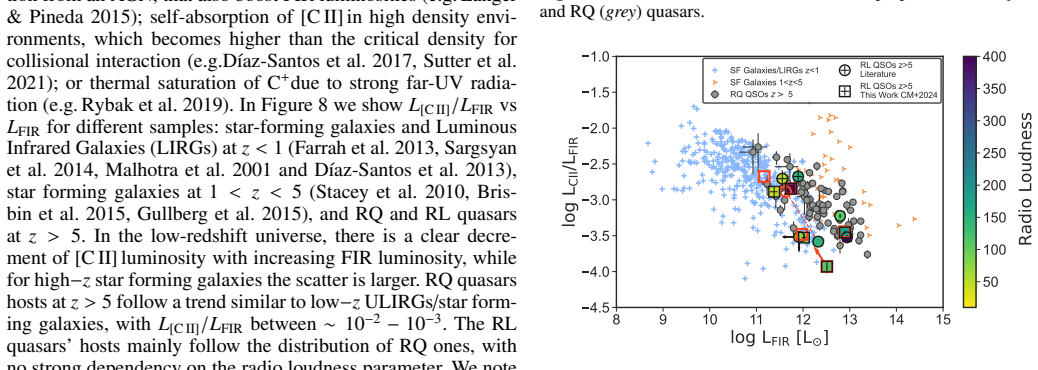
- After subtracting the estimated synchrotron flux, the RL hosts in this sample move into the same $L_{\rm [CII]}/L_{\rm FIR}$ locus as radio-quiet quasar hosts, including the apparent outliers.
- [C II] emission remains a usable ISM tracer for these hosts, giving star-formation rates of $30$-$400\,M_\odot\,{\rm yr}^{-1}$ and gas reservoirs of order $10^{10}\,M_\odot$ even when the continuum is contaminated.
- The absence of [C II]-emitting companion candidates around the five Band 7 fields is consistent with blank-field expectations and with RQ quasar fields at comparable depth, so no overdensity conclusion is drawn.
Reading between the lines
- Inference: because roughly 10-20% of quasars at these redshifts are radio-loud, a small but non-negligible fraction of 1 mm-selected host-galaxy samples will carry this contamination, and population-wide star-formation censuses may be biased high unless radio information is included.
- Inference: the quoted fractions are first estimates from low-frequency power laws, and those power laws are expected to steepen before 300 GHz, so the true synchrotron contributions are probably lower and the true dust properties lie between the paper's upper and lower bounds.
- Inference: a decisive test would be ALMA continuum measurements at roughly 100 and 230 GHz for these six sources, since a changing spectral slope across 100-300 GHz would separate the bending jet component from the dust Rayleigh-Jeans tail.
- Inference: the mild [C II] deficit seen in the RL sample hints that jets may suppress cool gas emission, but with only five detections it could also be selection noise, and repeating the comparison on a larger RL sample would settle it.
Editorial analysis
A structured set of objections, weighed in public.
Referee Report
Summary. The paper presents new ALMA Band 7 observations of five z>5 radio-loud quasars and Band 3 observations of two additional quasars (one reclassified as radio-quiet), detecting [CII] 158 micron line and dust continuum in five sources and placing upper limits on CO(6-5) and continuum for the others. The authors build radio-to-submillimeter SEDs combining their ALMA fluxes with literature radio data, and find that in at least four of the six radio-loud quasars the 1 mm continuum likely contains a non-negligible synchrotron component, estimating contributions of roughly 9%, 9%, 40%, and 100% at about 300 GHz for PSO055-00, PSO352-15, J1034+2033, and J0131-0321. They then derive IR luminosities, star formation rates, dust masses, dynamical masses, and molecular gas masses under two assumptions: all continuum is dust (upper limits) and continuum is synchrotron-corrected (lower limits). They compare the host properties with literature radio-quiet and radio-loud quasar samples, report a marginal decrease in [CII] luminosity for radio-loud sources, and search for, but do not find, [CII]-emitting companion galaxies.
Significance. If the central synchrotron-contamination claim is correct, the paper delivers an important cautionary result for high-redshift quasar host-galaxy studies: single-band 1 mm continuum measurements of radio-loud quasars cannot be taken as pure dust tracers, so SFRs, dust masses, and gas masses derived from those data may be substantially overestimated. The paper is also useful as one of the few ALMA studies of z>5 radio-loud quasar hosts, and the authors are commendably explicit in presenting their derived quantities as upper/lower limits rather than point estimates. The analysis uses only previously published conversion factors and does not tune parameters to produce the central claim, and the companion search is carried out with a standard fidelity-based method. The main caveat, acknowledged partly in the text, is that the synchrotron fractions are extrapolations of low-frequency radio power laws to 300 GHz; the robustness of the 'at least four' claim depends on assumptions about spectral curvature that are not quantitatively tested.
major comments (3)
- [Section 4.3 and Section 6] The headline claim that 'at least four' sources show >~10% synchrotron contamination at 300 GHz is not robust to the spectral-curvature uncertainty that the paper itself raises. For PSO055-00 and PSO135+16, Section 4.3 states that radio data exist only between 0.8 and 1.7 GHz, so no power law can be fit; the adopted slope α=-0.67 is the median slope of z>5 quasars from Bañados et al. (2021). The PSO055-00 synchrotron fraction of about 9% is obtained by extrapolating this assumed slope from 1.4 GHz to 300 GHz, roughly a factor of 200 in frequency. The text also notes (citing Jaffe & Perola 1973) that such power laws are expected to bend downward at higher frequencies. A modest break of Δα=-0.5 at 10 GHz reduces the PSO055-00 extrapolated 300 GHz synchrotron flux from about 0.057 mJy to about 0.01 mJy, dropping its fraction to about 2% and excluding this source from the 'at least four' set. Because PSO352-15 is at about 9% (also near the threshold) and J0131-0321 is a blazar with variability that is not quantified, the secure cases are reduced to J1034+2033 and possibly J0131-0321. The authors should either quantify the effect of plausible spectral breaks on each fraction or soften the abstract and conclusions to state that 'up to four' or 'a few' sources may show substantial contamination, with the two secure cases identified explicitly.
- [Section 4.3, Tables 7 and Figure 6] The synchrotron fractions and the synchrotron-corrected IR luminosities in Table 7 are quoted without propagated uncertainties. Figure 6 shows 1-sigma uncertainty bands on the fitted power-law slopes, and the ALMA continuum fluxes have reported errors, but no error bars are given for the fractional contributions or for the corrected values such as LFIR,syn and SFRIR,syn. For borderline sources like PSO055-00 and PSO352-15, the difference between a 9% and a 3% contribution is comparable to or larger than the statistical uncertainties of the input fluxes, so the absence of error propagation makes it impossible to assess whether the 'at least four' claim is statistically supported. The authors should propagate the slope uncertainties and ALMA flux uncertainties through the extrapolation and report the resulting ranges on the synchrotron fractions.
- [Section 4.3 and Figure 6] The synchrotron contribution is estimated by independently extrapolating radio power laws to the ALMA frequency and comparing with the observed 300 GHz flux; there is no joint SED fit in which a dust modified blackbody plus a synchrotron power law (or broken power law) are simultaneously fitted to the available radio and ALMA points. As a result, the 'synchrotron fraction' is entirely controlled by the assumed power-law normalization and slope, and the dust component is not allowed to contribute to the lower-frequency radio data. This is acceptable for a first-order estimate, but it means the quoted fractions should be described as illustrative extrapolations rather than measured components. A joint fit, even with fixed dust temperature and beta, would provide a more defensible estimate and would allow the reported fractions to be accompanied by meaningful uncertainties.
minor comments (5)
- [Figure 3 caption] The caption refers to 'J2052+0047', but the source in the text and Tables is J2053+0047; the caption should be corrected.
- [Section 3.1 and Table 2] The [CII] line of PSO055-00 is repeatedly flagged as falling at the edge of the bandwidth, but the 2D Gaussian fit flux for this source is still used in Table 4 and in the derived quantities. The cautionary note is appropriate, but it would be helpful to state explicitly which derived quantities (e.g., L[CII], SFR[CII], Mdyn) are most affected and to consider giving these values as limits rather than detections.
- [Section 4.3] The text notes that the radio observations were taken at different epochs and that variability may alter the SED shape, but the J0131-0321 blazar is nevertheless assigned a ~100% synchrotron fraction at 300 GHz. Because J0131-0321 is a known blazar with documented radio variability (Section 2.1), the extrapolated flux should be treated with explicit caveats about epoch mismatch with the ALMA observation; otherwise the '100%' figure may be overinterpreted.
- [Section 4.4, Equation (2)] The modified blackbody equation is missing an explicit factor for the rest-frame frequency dependence of the Planck function in the observed frame; the notation could be confusing to readers who are not specialists. Please check the equation and clarify the frequency conventions (rest-frame vs observed) in the text.
- [Section 4.2] The paper reports a mean/median Ly-alpha/template-to-[CII] velocity shift of -1269/-770 km/s with a large standard deviation (2271 km/s), but the sample size is only five sources. This should be described as a tentative estimate, which is already implied but could be stated explicitly to avoid overinterpretation.
Circularity Check
No significant circularity: the synchrotron fractions are extrapolations from independent radio measurements, not fits to the ALMA points, and the paper transparently labels the estimates as initial.
full rationale
After walking the derivation chain, I find no step in which a predicted quantity reduces by construction to a fitted input or to a self-citation. The ALMA continuum measurements (Table 4) are independent new data. The synchrotron fractions at roughly 300 GHz are obtained by extrapolating radio power laws measured at lower frequencies (Shao et al. 2020, 2022; Rojas-Ruiz et al. 2021; Bañados et al. 2021 for the median slope), not by fitting to the ALMA points, so the central claim is not statistically forced. For PSO055-00 and PSO135+16 the paper explicitly states that no radio power law can be fitted and therefore adopts an indicative median slope alpha = -0.67 from Bañados et al. (2021); this is an externally stated assumption rather than a parameter tuned to the ALMA data. The paper also flags the expected downward bend of radio spectra and labels the estimates as 'initial estimations', presenting IR-derived quantities as upper/lower limits. The cited prior works by the same group, including Rojas-Ruiz et al. (2021), are used as data sources and are themselves based on independent radio and sub-mm measurements; no uniqueness or existence theorem from the authors is invoked to force the adopted decomposition. The comparison samples and conversion factors (T_dust = 47 K, beta = 1.6, kappa, SFR calibrations) all come from the literature. Hence there is no self-definitional, fitted-input-as-prediction, or self-citation load-bearing circularity; the central claim is an extrapolation whose main vulnerability is spectral curvature between the radio and ALMA bands, which is an empirical robustness concern, not circularity.
Assumptions & free parameters
free parameters (8)
- Dust temperature T_dust =
47 K
- Dust emissivity index beta =
1.6
- Dust mass opacity normalization kappa_0 =
0.077 m2/kg at 352 GHz
- Synchrotron spectral index alpha for PSO055-00 and PSO135+16 =
-0.67
- Radio spectral indices for J0131-0321, J1034+2033, PSO352-15, J2228+0110 =
alpha = -0.70/-1.0, -1.0, -0.88/-1.26 (broken), -0.39 (approx.)
- Disk inclination i =
46 deg
- Molecular gas conversion alpha_[CII] =
30 M_sun/L_sun
- SFR-[CII] calibration =
SFR = 3e-9 (L[CII]/Lsun)^1.18
assumptions (6)
- standard math Flat LCDM cosmology with H0=67.8, Omega_M=0.3, Omega_Lambda=0.7
- domain assumption [CII] line luminosity conversion formula of Carilli and Walter (2013)
- domain assumption Modified black body dust emission with T_dust=47 K and beta=1.6
- ad hoc to paper Radio synchrotron power laws measured at GHz frequencies extrapolate to about 300 GHz without additional spectral curvature
- domain assumption The [CII]-SFR and IR-SFR calibrations calibrated at lower redshift apply to z>5 RL quasar hosts
- domain assumption Dynamical masses assume dispersion or rotation-dominated disks with median inclination i=46 deg
Cite this review
Pith. "Pith review of The host galaxies of radio-loud quasars at z>5 with ALMA." pith.science (2026). https://pith.science/paper/RRJZAMBX
@misc{pith2026241111952,
  author       = {Pith},
  title        = {Pith review of: The host galaxies of radio-loud quasars at z>5 with ALMA},
  year         = {2026},
  howpublished = {\url{https://pith.science/paper/RRJZAMBX}},
  note         = {Machine review of arXiv:2411.11952}
}
abstract
The interaction between radio-jets and quasar host galaxies plays a paramount role in quasar/galaxy co-evolution. However, very little has been known so far about this interaction at very high-z. Here, we present new Atacama Large Millimeter/submillimeter Array (ALMA) observations in Band 7 and Band 3 of six radio-loud quasars' host galaxies at $z > 5$. We recover [CII] 158 $\mu$m line and underlying dust continuum emission at $>2\sigma$ for five sources, while we obtain upper limits for the CO(6-5) emission line and continuum for the remaining source. At the spatial resolution of our observations ($\sim$1.0"-1.4"), we do not recover perturbed/extended morphologies or kinematics, signatures of potential mergers. These galaxies already host large quantities of gas, with [CII]-based star formation rates of $30-400 M_{\odot} $yr$^{-1}$. Building their radio/sub-mm spectral energy distributions (SEDs), we find that in at least four cases the 1mm continuum intensity arises from a combination of synchrotron and dust emission, with an initial estimation of synchrotron contribution at 300 GHz of $\gtrsim$10%. We compare the properties of the sources inspected here with a large collection of radio-quiet sources from the literature, as well as a sample of radio-loud quasars from previous studies, at comparable redshift. We recover a potential mild decrease in $L_{\rm [CII]}$ for the radio-loud sources, which might be due to a suppression of the cool gas emission due to the radio-jets. We do not find any [CII]-emitting companion galaxy candidate around the five radio-loud quasars observed in Band 7: given the depth of our dataset, this result is still consistent with that observed around radio-quiet quasars. Further higher-spatial resolution observations, over a larger frequency range, of high-z radio-loud quasars hosts will allow for a better understanding of the physics of such sources.
Figures


Figures from the paper (7 more)




Reference graph
Works this paper leans on
-
[1]
Ajiki, M., Taniguchi, Y ., Murayama, T., et al. 2006, PASJ, 58, 499, doi:
work page 2006
-
[3]
2023, A&A, 671, L12, doi: 10.1051/0004-6361/202345964 Bañados, E., Carilli, C., Walter, F., et al
3847/1538-4357/aaed2a Audibert, A., Ramos Almeida, C., García-Burillo, S., et al. 2023, A&A, 671, L12, doi: 10.1051/0004-6361/202345964 Bañados, E., Carilli, C., Walter, F., et al. 2018a, ApJ, 861, L14, doi: 10.3847/ 2041-8213/aac511 Bañados, E., Decarli, R., Walter, F., et al. 2015a, ApJ, 805, L8, doi: 10.1088/ 2041-8205/805/1/L8 Bañados, E., Venemans, B...
-
[4]
3847/0067-0049/227/1/11 Bañados, E., Venemans, B. P., Mazzucchelli, C., et al. 2018b, Nature, 553, 473, doi: 10.1038/nature25180 Bañados, E., Mazzucchelli, C., Momjian, E., et al. 2021, ApJ, 909, 80, doi:
-
[5]
3847/1538-4357/abe239 Bañados, E., Schindler, J.-T., Venemans, B. P., et al. 2023, ApJS, 265, 29, doi: 10.3847/1538-4365/acb3c7 Banados, E., Momjian, E., Connor, T., et al. 2024a, arXiv e-prints, arXiv:2407.07236, doi: 10.48550/arXiv.2407.07236 Banados, E., Khusanova, Y ., Decarli, R., et al. 2024b, arXiv e-prints, arXiv:2408.12299, doi: 10.48550/arXiv.24...
-
[6]
1086/176166 Beelen, A., Cox, P., Benford, D. J., et al. 2006, ApJ, 642, 694, doi: 10.1086/ 500636 Belladitta, S., Moretti, A., Caccianiga, A., et al. 2023, A&A, 669, A134, doi:10. 1051/0004-6361/202243855 —. 2019, A&A, 629, A68, doi: 10.1051/0004-6361/201935965 —. 2020, A&A, 635, L7, doi: 10.1051/0004-6361/201937395 Bischetti, M., Maiolino, R., Carniani, ...
-
[7]
1051/0004-6361/201833557 Boogaard, L., Meyer, R. A., & Novak, M. 2021, Interferopy: analysing dat- acubes from radio-to-submm observations, v1.0.0-beta, Zenodo, doi:
work page 2021
-
[8]
5281/zenodo.5775603 Bosman, S. E. I., Kakiichi, K., Meyer, R. A., et al. 2020, ApJ, 896, 49, doi:
work page 2020
-
[9]
3847/1538-4357/ab85cd Breiding, P., Chiaberge, M., Lambrides, E., et al. 2024, ApJ, 963, 91, doi:
work page 2024
Show all 43 references
-
[10]
R., Sadler, E
1093/pasj/58.3.499 Allison, J. R., Sadler, E. M., Amaral, A. D., et al. 2022, PASA, 39, e010, doi:10. 1017/pasa.2022.3 Appleton, P. N., Diaz-Santos, T., Fadda, D., et al. 2018, ApJ, 869, 61, doi:
2022
-
[11]
2015, ApJ, 799, 13, doi: 10.1088/ 0004-637X/799/1/13 Carilli, C
3847/1538-4357/ad19db Brisbin, D., Ferkinhoff, C., Nikola, T., et al. 2015, ApJ, 799, 13, doi: 10.1088/ 0004-637X/799/1/13 Carilli, C. L., & Walter, F. 2013, ARA&A, 51, 105, doi: 10.1146/ annurev-astro-082812-140953 Champagne, J. B., Decarli, R., Casey, C. M., et al. 2018, ApJ...
2015
-
[12]
2018, ApJ, 854, 97, doi: 10.3847/1538-4357/aaa5aa Decarli, R., Aravena, M., Boogaard, L., et al
1038/nature22358 —. 2018, ApJ, 854, 97, doi: 10.3847/1538-4357/aaa5aa Decarli, R., Aravena, M., Boogaard, L., et al. 2020, ApJ, 902, 110, doi:
2018 doi
-
[13]
2022, A&A, 662, A60, doi:10
3847/1538-4357/abaa3b Decarli, R., Pensabene, A., Venemans, B., et al. 2022, A&A, 662, A60, doi:10. 1051/0004-6361/202142871 Díaz-Santos, T., Armus, L., Charmandaris, V ., et al. 2013, ApJ, 774, 68, doi:10. 1088/0004-637X/774/1/68 —. 2017, ApJ, 846, 32, doi: 10.3847/1538-4357/...
2022 doi
-
[14]
B., Farina, E
1038/s41586-023-06345-5 Drake, A. B., Farina, E. P., Neeleman, M., et al. 2019, ApJ, 881, 131, doi:
2019
-
[15]
2000, MNRAS, 315, 115, doi:
3847/1538-4357/ab2984 Dunne, L., Eales, S., Edmunds, M., et al. 2000, MNRAS, 315, 115, doi:
2000
-
[16]
F., Decarli, R., et al
1046/j.1365-8711.2000.03386.x Eilers, A.-C., Hennawi, J. F., Decarli, R., et al. 2020, ApJ, 900, 37, doi:
2000
-
[17]
2021, ApJ, 914, 74, doi: 10.3847/1538-4357/ac05c3 Fan, X., Bañados, E., & Simcoe, R
3847/1538-4357/aba52e —. 2021, ApJ, 914, 74, doi: 10.3847/1538-4357/ac05c3 Fan, X., Bañados, E., & Simcoe, R. A. 2023, ARA&A, 61, 373, doi: 10.1146/ annurev-astro-052920-102455 Fan, X., Narayanan, V . K., Lupton, R. H., et al. 2001, AJ, 122, 2833, doi:
2021 doi
-
[18]
A., Becker, R
1086/324111 Fan, X., Strauss, M. A., Becker, R. H., et al. 2006, AJ, 132, 117, doi: 10.1086/ 504836 Farina, E. P., Arrigoni-Battaia, F., Costa, T., et al. 2019, ApJ, 887, 196, doi:10. 3847/1538-4357/ab5847 Farina, E. P., Schindler, J.-T., Walter, F., et al. 2022, ApJ, 941, 106, doi:
2006
- [19]
-
[20]
2015, MNRAS, 450, L34, doi: 10.1093/mnrasl/slv042 Gilli, R., Mignoli, M., Peca, A., et al
1093/mnrasl/slv046 Ghisellini, G., Tagliaferri, G., Sbarrato, T., & Gehrels, N. 2015, MNRAS, 450, L34, doi: 10.1093/mnrasl/slv042 Gilli, R., Mignoli, M., Peca, A., et al. 2019, A&A, 632, A26, doi: 10.1051/ 0004-6361/201936121 Gloudemans, A. J., Duncan, K. J., Saxena, A., et al...
2015 doi
-
[21]
D., Wolfire, M
1086/191285 Herrera-Camus, R., Bolatto, A. D., Wolfire, M. G., et al. 2015, ApJ, 800, 1, doi: 10.1088/0004-637X/800/1/1 Ighina, L., Belladitta, S., Caccianiga, A., et al. 2021, A&A, 647, L11, doi:
2015 doi
-
[22]
2024, A&A, 687, A242, doi:
1051/0004-6361/202140362 Article number, page 16 of 19 Mazzucchelli et al.: The host galaxies of radio–loud quasars at z>5 with ALMA Ighina, L., Caccianiga, A., Moretti, A., et al. 2024, A&A, 687, A242, doi:
2024
-
[23]
T., Jagannathan, P., Mooley, K
1051/0004-6361/202449369 Intema, H. T., Jagannathan, P., Mooley, K. P., & Frail, D. A. 2017, A&A, 598, A78, doi: 10.1051/0004-6361/201628536 Izumi, T., Onoue, M., Shirakata, H., et al. 2018, Publications of the Astronomical Society of Japan, 70, 36, doi: 10.1093/pasj/psy026 Iz...
2017 doi
-
[24]
A., et al
1051/0004-6361/202451025 Lai, S., Bian, F., Onken, C. A., et al. 2022, MNRAS, 513, 1801, doi: 10.1093/ mnras/stac1001 Langer, W. D., & Pineda, J. L. 2015, A&A, 580, A5, doi:10.1051/0004-6361/ 201525950 Li, J., Wang, R., Pensabene, A., et al. 2024, ApJ, 962, 119, doi: 10.3847/ ...
2022 doi
-
[25]
2023, A&A, 676, A71, doi: 10.1051/0004-6361/202346317 McConnell, D., Hale, C
3847/1538-4357/ab2f75 Mazzucchelli, C., Bischetti, M., D’Odorico, V ., et al. 2023, A&A, 676, A71, doi: 10.1051/0004-6361/202346317 McConnell, D., Hale, C. L., Lenc, E., et al. 2020, PASA, 37, e048, doi:
2023 doi
-
[26]
A., Ryan, R
1017/pasa.2020.41 Mechtley, M., Windhorst, R. A., Ryan, R. E., et al. 2012, ApJ, 756, L38, doi:10. 1088/2041-8205/756/2/L38 Meenakshi, M., Mukherjee, D., Wagner, A. Y ., et al. 2022, MNRAS, 516, 766, doi: 10.1093/mnras/stac2251 Meyer, R. A., Bosman, S. E. I., & Ellis, R. S. 20...
2020 doi
-
[27]
2019, ApJ, 881, 63, doi: 10.3847/ 1538-4357/ab2beb Novak, M., Venemans, B
3847/1538-4357/ab8bd3 Novak, M., Bañados, E., Decarli, R., et al. 2019, ApJ, 881, 63, doi: 10.3847/ 1538-4357/ab2beb Novak, M., Venemans, B. P., Walter, F., et al. 2020, ApJ, 904, 131, doi:
2019
-
[28]
2020, ApJ, 898, 105, doi:
3847/1538-4357/abc33f Onoue, M., Bañados, E., Mazzucchelli, C., et al. 2020, ApJ, 898, 105, doi:
2020
-
[29]
D., et al
3847/1538-4357/aba193 Onoue, M., Ding, X., Silverman, J. D., et al. 2024, arXiv e-prints, arXiv:2409.07113, doi: 10.48550/arXiv.2409.07113 Overzier, R. A. 2022, ApJ, 926, 114, doi: 10.3847/1538-4357/ac448c Pacucci, F., & Loeb, A. 2024, ApJ, 964, 154, doi: 10.3847/1538-4357/ ad...
-
[30]
2021, A&A, 652, A66, doi:
1051/0004-6361/201936634 Pensabene, A., Decarli, R., Bañados, E., et al. 2021, A&A, 652, A66, doi:
2021
-
[31]
L., Banerji, M., Becker, G
1051/0004-6361/202039696 Reed, S. L., Banerji, M., Becker, G. D., et al. 2019, MNRAS, 487, 1874, doi:10. 1093/mnras/stz1341 Roche, N., Humphrey, A., & Binette, L. 2014, MNRAS, 443, 3795, doi:
2019
-
[32]
2021, ApJ, 920, 150, doi:
1093/mnras/stu1430 Rojas-Ruiz, S., Bañados, E., Neeleman, M., et al. 2021, ApJ, 920, 150, doi:
2021
-
[33]
A., et al
3847/1538-4357/ac1a13 Rybak, M., Calistro Rivera, G., Hodge, J. A., et al. 2019, ApJ, 876, 112, doi:10. 3847/1538-4357/ab0e0f Salomé, Q., Salomé, P., & Combes, F. 2015, A&A, 574, A34, doi: 10.1051/ 0004-6361/201424932 Sargsyan, L., Samsonyan, A., Lebouteiller, V ., et al. 2014...
2019
-
[34]
P., Richards, G
3847/1538-4357/abc2d7 Schneider, D. P., Richards, G. T., Hall, P. B., et al. 2010, AJ, 139, 2360, doi:10. 1088/0004-6256/139/6/2360 Shao, Y ., Wagg, J., Wang, R., et al. 2020, A&A, 641, A85, doi: 10.1051/ 0004-6361/202038469 —. 2022, A&A, 659, A159, doi: 10.1051/0004-6361/2021...
2010 doi
-
[35]
A., Lyu, J., Rieke, G
3847/1538-4357/acebe0 Stone, M. A., Lyu, J., Rieke, G. H., Alberts, S., & Hainline, K. N. 2024, ApJ, 964, 90, doi: 10.3847/1538-4357/ad2a57 Sutter, J., Dale, D. A., Sandstrom, K., et al. 2021, MNRAS, 503, 911, doi:
2024 doi
-
[36]
2017, ApJ, 836, 8, doi: 10.3847/ 1538-4357/836/1/8 Uzgil, B
1093/mnras/stab490 Trakhtenbrot, B., Lira, P., Netzer, H., et al. 2017, ApJ, 836, 8, doi: 10.3847/ 1538-4357/836/1/8 Uzgil, B. D., Oesch, P. A., Walter, F., et al. 2021, ApJ, 912, 67, doi: 10.3847/ 1538-4357/abe86b Vayner, A., Zakamska, N. L., Ishikawa, Y ., et al. 2023, ApJ, ...
2017
-
[37]
P., Walter, F., Zschaechner, L., et al
3847/1538-4357/ace784 Venemans, B. P., Walter, F., Zschaechner, L., et al. 2016, ApJ, 816, 37, doi:10. 3847/0004-637X/816/1/37 Venemans, B. P., Röttgering, H. J. A., Miley, G. K., et al. 2007, A&A, 461, 823, doi: 10.1051/0004-6361:20053941 Venemans, B. P., Walter, F., Decarli,...
2016 doi
-
[38]
2017b, ApJ, 845, 154, doi: 10.3847/1538-4357/aa81cb Venemans, B
3847/2041-8213/aa943a —. 2017b, ApJ, 845, 154, doi: 10.3847/1538-4357/aa81cb Venemans, B. P., Decarli, R., Walter, F., et al. 2018, ApJ, 866, 159, doi:
2018 doi
-
[39]
P., Walter, F., Neeleman, M., et al
3847/1538-4357/aadf35 Venemans, B. P., Walter, F., Neeleman, M., et al. 2020, ApJ, 904, 130, doi:
2020
-
[40]
2023, A&A, 678, A127, doi:10.1051/ 0004-6361/202347375 Villar Martín, M., Emonts, B., Humphrey, A., Cabrera Lavers, A., & Binette, L
3847/1538-4357/abc563 Venturi, G., Treister, E., Finlez, C., et al. 2023, A&A, 678, A127, doi:10.1051/ 0004-6361/202347375 Villar Martín, M., Emonts, B., Humphrey, A., Cabrera Lavers, A., & Binette, L. 2014, MNRAS, 440, 3202, doi: 10.1093/mnras/stu448 Walter, F., Riechers, D.,...
2023 doi
-
[41]
2018, MNRAS, 480, 345, doi:10.1093/mnras/ sty1763 Yang, J., Wang, F., Fan, X., et al
3847/2041-8213/ac98c3 Xu, F., Bian, F., Shen, Y ., et al. 2018, MNRAS, 480, 345, doi:10.1093/mnras/ sty1763 Yang, J., Wang, F., Fan, X., et al. 2019a, AJ, 157, 236, doi: 10.3847/ 1538-3881/ab1be1 Yang, J., Venemans, B., Wang, F., et al. 2019b, ApJ, 880, 153, doi: 10.3847/ 1538...
2018 doi
-
[42]
R., White, R
1093/mnras/sty2394 Zeimann, G. R., White, R. L., Becker, R. H., et al. 2011, ApJ, 736, 57, doi:
2011
-
[43]
A., Bouwens, R
1088/0004-637X/736/1/57 Zheng, W., Overzier, R. A., Bouwens, R. J., et al. 2006, ApJ, 640, 574, doi:
2006
-
[44]
K., Sugahara, Y ., et al
1086/500167 Zhong, Y ., Inoue, A. K., Sugahara, Y ., et al. 2024, MNRAS, 529, 4531, doi:10. 1093/mnras/stae798 Article number, page 18 of 19 Mazzucchelli et al.: The host galaxies of radio–loud quasars at z>5 with ALMA Appendix A: Velocity maps We report here the continuum-sub...
2024
Reviewed August 12, 2026 · model on record in the stance chip above.
Discussion (0). Continue with ORCID to comment.