REVIEW 3 major objections 6 minor 50 references
Easy-plane ferromagnetic ordering and crystal-field ground state in the Kondo lattice CeCuSi
T0 review · 3 major / 6 minor · reviewed 2026-08-12 · deepseek-v4-flash
Pith's one-line read CeCuSi is a Kondo-lattice ferromagnet whose easy-plane order follows from ferromagnetic exchange along both crystallographic directions.
desk verdict Solid single-crystal study of a triangular-lattice Ce ferromagnet with a plausible CEF scheme, but the 'ferromagnetic along both axes' claim is not as secure as the abstract implies. read the letter →
The pith
A machine-rendered reading of the paper's core claim, the machinery that carries it, and where it could break.
The reading
What carries the argument
The central object is the trigonal CEF Hamiltonian $H_\mathrm{CEF} = B_2^0 O_2^0 + B_4^0 O_4^0 + B_4^3 O_4^3$ written in Stevens operators for a $J=5/2$ Ce$^{3+}$ ion, whose eigenstates are two mixed $|\pm1/2\rangle/|\pm5/2\rangle$ doublets and a pure $|\pm3/2\rangle$ doublet. The magnetic susceptibility is then dressed by a molecular field through $\chi_i^{-1} = (\chi_i^\mathrm{CEF}/(1-\lambda_i\chi_i^\mathrm{CEF}) + \chi_i^0)^{-1}$, with $\lambda_\parallel$, $\lambda_\perp$, and small residual offsets $\chi_i^0$ as parameters. This formula is what allows the authors to separate crystal-field anisotropy from exchange: the CEF parameters set the anisotropy, while the sign of $\lambda$ sets whether the exchange is ferromagnetic along each direction. The simultaneous fit to both susceptibility axes, anchored by a $B_2^0$ estimate from the Curie--Weiss temperatures, is the load-bearing step that produces the easy-plane ground state and the positive $\lambda$ values.
What would settle it
A low-temperature neutron diffraction and inelastic neutron scattering study on CeCuSi single crystals could settle the claim directly: if the ordered moment is found to have a dominant $c$-axis component, or if the measured CEF excitations require a level scheme whose simultaneous susceptibility fit yields a negative $\lambda$ in either direction, the paper's explanation of easy-plane order would fail.
Extended reading notes
Core claim
The authors establish that CeCuSi, with Ce$^{3+}$ on a triangular lattice of $D_{3d}$ point symmetry, has a crystalline-electric-field ground state $\Gamma_4^{(1)} = 0.257|\pm 5/2\rangle - 0.967|\mp 1/2\rangle$, which yields a saturation moment of about $1.20\,\mu_\mathrm{B}$ in the basal plane versus $0.26\,\mu_\mathrm{B}$ along $c$. Simultaneous fits of the inverse magnetic susceptibility along both axes to a trigonal CEF Hamiltonian with molecular-field terms give positive exchange parameters $\lambda_\parallel = 9.0$ and $\lambda_\perp = 5.2$ mol/emu, meaning the exchange interaction is ferromagnetic along both directions. The paper argues that this positive exchange is why CeCuSi orders along the easy plane, in contrast to many Kondo-lattice ferromagnets that order along the CEF hard axis. Supporting evidence includes the Schottky anomaly in specific heat, CEF excitations observed in Raman at energies consistent with the splittings $\Delta_1 = 112$ K and $\Delta_2 = 122$ K, and the magnon-gap behavior seen in heat capacity, resistivity, and Raman.
Load-bearing premise
Everything rests on assuming that the exchange can be represented by temperature-independent molecular-field constants $\lambda_\parallel$ and $\lambda_\perp$ plus small residual susceptibility offsets, and that the fitted negative in-plane offset $\chi_{\perp 0} = -8.21\times10^{-5}$ emu/mol is an unphysical mounting artifact.
Editorial extensions
If this is right
- Below $T_\mathrm{C}=15.5$ K, the ordered moment should point in the basal plane with a magnitude near $1.2\,\mu_\mathrm{B}$ per Ce$^{3+}$, not along $c$.
- The CEF scheme with $\Delta_1=112$ K and $\Delta_2=122$ K predicts specific CEF excitations and a Schottky anomaly, both of which the paper reports observing.
- Because both $\lambda_\parallel$ and $\lambda_\perp$ are positive, no hard-axis ordering is expected, distinguishing CeCuSi from Kondo-lattice ferromagnets that order along the CEF hard axis.
- The exponential low-temperature resistivity and heat capacity are signatures of a gapped ferromagnetic magnon branch with gap $\Delta\approx 24$--25 K, implying strong magnetic anisotropy.
- The previous inelastic neutron scattering CEF parameters from polycrystalline CeCuSi agree with the single-crystal fit, so the CEF scheme is not an artifact of this particular sample batch.
Reading between the lines
- Editorial inference: applying the same simultaneous CEF-plus-molecular-field analysis to known hard-axis Kondo-lattice ferromagnets would directly test whether their in-plane exchange is actually antiferromagnetic; if so, hard-axis ordering becomes a fingerprint of competing exchange rather than of the CEF alone.
- Editorial inference: because the magnon gap exceeds $T_\mathrm{C}$, an in-plane magnetic field applied below $T_\mathrm{C}$ should shift or soften the roughly 25 cm$^{-1}$ Raman magnon mode, and measuring that field dependence would independently check the magnon assignment.
- Editorial inference: the fitted negative residual susceptibility $\chi_{\perp 0} = -8.21\times10^{-5}$ emu/mol enters the fit as an offset, so re-measuring the in-plane susceptibility with a rigid sample holder or with oriented powder would test whether this offset is indeed a mounting artifact.
Signed reviews
Editorial analysis
A structured set of objections, weighed in public.
Referee Report
Summary. The paper reports the first single-crystal growth of CeCuSi and a multi-probe study (structural, magnetic, transport, heat capacity, Raman) of its magnetic properties. CeCuSi orders ferromagnetically at 15.5 K with the easy magnetization direction in the basal plane. The authors perform a crystalline-electric-field (CEF) analysis of the anisotropic susceptibility using a molecular-field correction and residual susceptibility terms, obtaining a CEF ground-state doublet with moment primarily in the basal plane and positive molecular-field parameters along both the c axis and the ab plane. They interpret the positive parameters as ferromagnetic exchange along both directions, explaining the absence of hard-axis ordering. Independent checks from the Schottky anomaly, Raman-active CEF excitations, and saturation moments are presented as support.
Significance. If the central claim holds, the paper provides a concrete counterexample within the CeTX family to the tendency of Kondo-lattice ferromagnets to order along the CEF hard axis, and it demonstrates the importance of simultaneous CEF analysis of anisotropic data. The paper also provides useful single-crystal data for a material previously studied only in polycrystalline form. Its main strengths are the multiple independent probes and the explicit treatment of the CEF contribution to the susceptibility and heat capacity. However, the most novel conclusion — that the exchange is ferromagnetic along both axes — rests on a seven-parameter mean-field fit whose stability is not demonstrated. The overall significance is therefore conditional on a robustness analysis of that fit.
major comments (3)
- [Section III.C and Table III, Eq. (A6)] The signs of λ∥ and λ⊥, which are the basis of the statement that the interactions are ferromagnetic along both directions, come from a fit with seven free parameters (B0_2, B0_4, B3_4, λ∥, λ⊥, χ∥0, χ⊥0) against two susceptibility curves, with no reported uncertainties or parameter-correlation analysis. The fitted χ⊥0 = -8.21×10^-5 emu/mol is attributed to a straw-mounting artifact; if this background is incorrect, or if a different trade-off between χ⊥0, the mixing angle α, and λ⊥ exists, the sign of λ⊥ is not secured. I request a robustness analysis: report error bars and correlations, or repeat the fit with χ⊥0 fixed to zero and with the CEF parameters fixed to the values of Ref. [16], and show whether λ⊥ remains positive.
- [Section III.C, III.E, and Table III] The agreement with previous inelastic neutron scattering and with the Raman data is overstated. The fitted B0_2 = 4.42 K and B3_4 = 2.93 K differ substantially from Ref. [16]'s values of 2.43 K and 5.43 K, and the Raman peaks at 94 K and 129 K are 18 K and 7 K away from Δ1 = 112 K and Δ2 = 122 K, respectively. Because α in Eqs. (A3)–(A4) controls the Van Vleck terms and is set by B3_4, the CEF parameters are not uniquely pinned. The paper should quantify these discrepancies and, ideally, constrain the CEF parameters with a combined fit to susceptibility, heat capacity, and Raman peak positions.
- [Section III.B and Eq. (1)] The calculated c-axis saturation moment (0.26 μB) is 44% larger than the measured value (0.18 μB) shown in the inset of Fig. 2. This is a direct test of the ground-state wavefunction, and the discrepancy weakens the quantitative determination of the mixing angle α on which the Van Vleck terms and hence λ∥ and λ⊥ depend. Please discuss whether this discrepancy is within the expected accuracy of the model and how it affects the inferred signs of the molecular-field parameters.
minor comments (6)
- [Section I] The phrase 'the highest in the CeTX family' should be qualified to make clear it refers to the compounds discussed in this work rather than an exhaustive statement about all CeTX materials.
- [Eq. (A6)] The notation in Eq. (A6) is confusing: the left side is χ_i^{-1} while the right side is ( ... )^{-1}; please clarify that the residual susceptibility is added to the molecular-field-corrected susceptibility before taking the inverse.
- [Fig. 2(b) caption] The caption states that the inverse susceptibility was 'fitted to Curie-Weiss law and the CEF model'; these are two separate fits with different functional forms, so the wording should distinguish them.
- [Table IV] For CePtAl4Ge2 the mixing angle α is listed as N/A even though B3_4 ≈ 0; please explain why α is not defined or not reported for that compound.
- [Section III.E] When claiming that the Raman energies 'agree reasonably well' with the CEF splittings, please include the numeric comparison (94 K vs 112 K and 129 K vs 122 K) so that readers can judge the level of agreement directly.
- [Section III.F] The single-crystal residual resistivity (241 μΩ cm) is much larger than that of the polycrystalline sample (9 μΩ cm); because the transport-derived magnon gap is extracted from this sample, the possible influence of micro-cracks on the fit should be discussed.
Circularity Check
No significant circularity: the CEF parameters are fitted to susceptibility data but are cross-checked against independent heat-capacity, Raman, and magnetization measurements; the exchange-sign conclusion is a fit output, not a circular prediction.
full rationale
The paper fits Eq. (A6) simultaneously to the c-axis and ab-plane inverse susceptibilities, obtaining the CEF parameters and the molecular-field parameters λ∥ and λ⊥ (Table III). The resulting ground-state doublet and splittings Δ1=112 K and Δ2=122 K are then used to compute the Schottky anomaly in heat capacity, the CEF Raman excitation energies, and the saturation moments from Eq. (1). These are independent data sets that were not part of the susceptibility fit, so their agreement provides genuine external cross-validation. The previous inelastic neutron scattering parameters [16] also come from an independent external study, not from the present authors, and are used as a comparison rather than as the basis of the fit. The only candidate for circularity is the statement that the molecular-field contributions are positive along both axes, which directly restates the fitted values λ∥=9.0 and λ⊥=5.2 mol/emu. However, the paper does not present this as an independent prediction; it explicitly reports it as an outcome of the CEF analysis ('Our CEF analysis suggests that the exchange interactions along both axes are ferromagnetic'). Fitted exchange parameters interpreted as physics are not definitionally circular. The concerns about the seven-parameter fit, the negative fitted χ⊥0, and the imperfect agreement with Raman energies are model-robustness and identifiability issues, not circularity of the derivation chain.
Assumptions & free parameters
free parameters (9)
- B0_2 =
4.42 K
- B0_4 =
-0.293 K
- B3_4 =
2.93 K
- λ∥ (molecular field along c) =
9.0 mol/emu
- λ⊥ (molecular field in ab plane) =
5.2 mol/emu
- χ∥0 =
5.63e-5 emu/mol
- χ⊥0 =
-8.21e-5 emu/mol
- Magnon gap Δ (heat capacity) =
25.3 K
- Magnon gap Δ (resistivity) =
23.9 K
assumptions (4)
- standard math The CEF Hamiltonian for Ce3+ in D3d symmetry contains only B0_2 O0_2, B0_4 O0_4, and B3_4 O3_4 (Eq. A1).
- standard math The theoretical susceptibility is given by the Van Vleck formula, Eqs. A2-A4, taken from Ref. [26].
- domain assumption Exchange is captured by a temperature-independent molecular field λ_i and constant residual susceptibility χ_i^0 (Eq. A6).
- domain assumption The heat capacity of LaCuSi is an appropriate phonon reference for CeCuSi, so C4f = C_CeCuSi - C_LaCuSi.
Cite this review
Pith. "Pith review of Easy-plane ferromagnetic ordering and crystal-field ground state in the Kondo lattice CeCuSi." pith.science (2026). https://pith.science/paper/YCNUNR5G
@misc{pith2026241112054,
  author       = {Pith},
  title        = {Pith review of: Easy-plane ferromagnetic ordering and crystal-field ground state in the Kondo lattice CeCuSi},
  year         = {2026},
  howpublished = {\url{https://pith.science/paper/YCNUNR5G}},
  note         = {Machine review of arXiv:2411.12054}
}
abstract
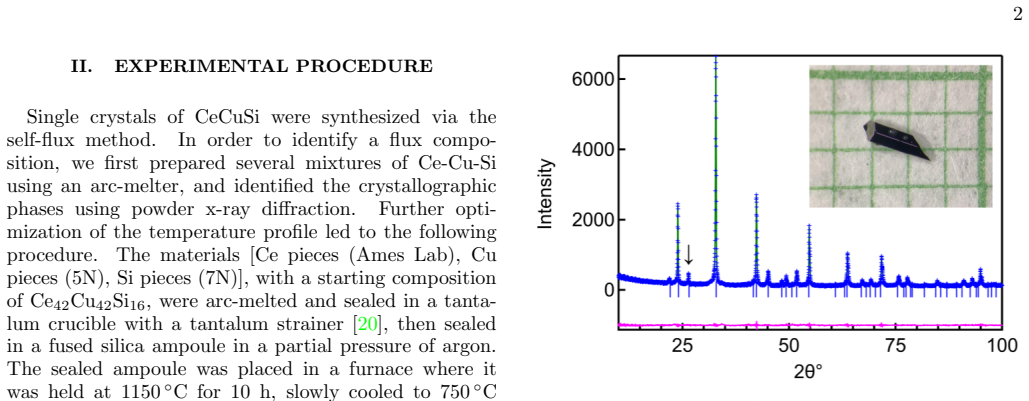
We report the successful growth of CeCuSi single crystals using a metallic flux method and the physical properties using structural, magnetic, electrical transport, optical, and heat capacity measurements. CeCuSi crystallizes in a hexagonal-bar shape, and single crystal x-ray diffraction confirms the ZrBeSi-type structure (space group $P6_{3}/mmc$). CeCuSi orders ferromagnetically below $T_\textrm{C}=15.5$ K with easy magnetization direction within the basal plane. The Ce$^{3+}$ ions are situated within a triangular lattice with a point group of $D_{3d}$. We perform a detailed crystalline electric field (CEF) analysis of the anisotropic magnetic susceptibility, the Schottky anomaly in heat capacity, and the Raman-active excitations. The results indicate a ground state doublet with magnetic moment primarily in the basal plane, and a ferromagnetic interaction along both directions. The exponential behavior in resistivity and in heat capacity below $T_\textrm{C}$ can also be well explained by the ferromagnetic magnon model. We found that CeCuSi does not exhibit the CEF hard axis ordering observed in many ferromagnetic Kondo lattice (FM-KL) compounds. Our CEF analysis suggests that the exchange interactions along both axes are ferromagnetic, potentially explaining the absence of hard-axis ordering.
Figures


Figures from the paper (2 more)


Reference graph
Works this paper leans on
-
[16]
B. Sondezi-Mhlungu, D. Adroja, A. Strydom, S. Paschen, and E. Goremychkin, Crystal electric field excitations in ferromagnetic CeTX compounds, Physica B: Condensed Matter 404, 3032 (2009)
work page 2009
-
[1]
T.-N. Ye, Y. Lu, J. Li, T. Nakao, H. Yang, T. Tada, M. Kitano, and H. Hosono, Copper-based intermetallic electride catalyst for chemoselective hydrogenation reac- tions, Journal of the American Chemical Society 139, 17089 (2017)
work page 2017
-
[2]
S. Gupta and K. Suresh, Review on magnetic and related properties of R TX compounds, Journal of Alloys and Compounds 618, 562 (2015)
work page 2015
-
[3]
R. P¨ ottgen and B. Chevalier, Cerium intermetallics with ZrNiAl-type structure – a review, Zeitschrift f¨ ur Natur- forschung B 70, 289 (2015)
work page 2015
-
[4]
R. P¨ ottgen and B. Chevalier, Equiatomic cerium inter- metallics CeXX ′ with two p elements, Zeitschrift f¨ ur Naturforschung B 70, 695 (2015)
work page 2015
-
[5]
R. P¨ ottgen, O. Janka, and B. Chevalier, Cerium in- termetallics Ce TX – review III, Zeitschrift f¨ ur Natur- forschung B 71, 165 (2016)
work page 2016
- [6]
-
[7]
Balents, Spin liquids in frustrated magnets, Nature 464, 199 (2010)
L. Balents, Spin liquids in frustrated magnets, Nature 464, 199 (2010)
2010
Show all 50 references
-
[8]
Huang, G
Y.-P. Huang, G. Chen, and M. Hermele, Quantum spin ices and topological phases from dipolar-octupolar dou- blets on the pyrochlore lattice, Physical Review Letters 112, 167203 (2014)
2014
-
[9]
Sibille, E
R. Sibille, E. Lhotel, V. Pomjakushin, C. Baines, T. Fen- nell, and M. Kenzelmann, Candidate Quantum Spin Liq- uid in the Ce3+ Pyrochlore Stannate Ce2Sn2O7, Physical Review Letters 115, 097202 (2015)
2015
-
[10]
Kirkpatrick, Frustration and ground-state degeneracy in spin glasses, Physical Review B 16, 4630 (1977)
S. Kirkpatrick, Frustration and ground-state degeneracy in spin glasses, Physical Review B 16, 4630 (1977)
1977
-
[11]
O. P. Uzoh, S. Kim, and E. Mun, Influence of crystalline electric field on the magnetic properties of CeCd 3X3 (X = P, As), Physical Review Materials 7, 013402 (2023)
2023
-
[12]
Ochiai, N
A. Ochiai, N. Kabeya, K. Maniwa, M. Saito, S. Naka- mura, and K. Katoh, Field-induced anomalous mag- netic state beyond the magnetically ordered state in the slightly distorted triangular S=1/2 rare-earth antiferro- magnet CeZn3P3, Physical Review B104, 144420 (2021)
2021
-
[13]
Rieger and E
W. Rieger and E. Parth´ e, Tern¨ are erdalkali-und seltene erd-silicide und-Germanide mit AlB 2-Struktur, Monat- shefte f¨ ur Chemie / Chemical Monthly100, 439 (1969)
1969
-
[14]
Gignoux, D
D. Gignoux, D. Schmitt, and M. Zerguine, Magnetic properties of CeCuSi, Solid State Communications 58, 559 (1986)
1986
-
[15]
Iandelli, A low temperature crystal modification of the rare earth ternary compounds RCuSi, Journal of the Less Common Metals 90, 121 (1983)
A. Iandelli, A low temperature crystal modification of the rare earth ternary compounds RCuSi, Journal of the Less Common Metals 90, 121 (1983)
1983
-
[17]
F. Yang, J. P. Kuang, J. Li, E. Br¨ uck, H. Nakotte, F. R. de Boer, X. Wu, Z. Li, and Y. Wang, Magnetic properties of CeCuX compounds, Journal of Applied Physics 69, 4705 (1991)
1991
-
[18]
G. R. Hearne, G. Diguet, A. M. Strydom, B. Sondezi- Mhlungu, F. B. K. Kamenev, and L. Nataf, Pressure effects on the magnetic behavior of the local moment ferromagnet CeCuSi, in Proceedings of SAIP2014, the 59th Annual Conference of the South African Institute of Physics (2014)
2014
-
[19]
Hafner, B
D. Hafner, B. K. Rai, J. Banda, K. Kliemt, C. Krell- ner, J. Sichelschmidt, E. Morosan, C. Geibel, and M. Brando, Kondo-lattice ferromagnets and their pecu- liar order along the magnetically hard axis determined by the crystalline electric field, Physical Review B 99, 201109 (2019)
2019
-
[20]
Jesche and P
A. Jesche and P. Canfield, Single crystal growth from light, volatile and reactive materials using lithium and calcium flux, Philosophical Magazine 94, 2372 (2014)
2014
-
[21]
B. H. Toby and R. B. Von Dreele, GSAS-II: The gene- sis of a modern open-source all purpose crystallography software package, Journal of Applied Crystallography46, 544 (2013)
2013
-
[22]
(counts s-1 mW-1) 300K, 5mW 2K, 5mW 2K, 1mWE2g phonons Y(XX)Y(a) 0 100 200 3000.00.050.100.150 40 80 120 1600.000.050.100.150.200.25 c
A. Mugnoli, A. Albinati, and A. Hewat, A neutron pow- der diffraction study of the crystal structure of LaCuSi, 10 0.00.10.20.30.4 c" (counts s-1 mW-1) 300K, 5mW 2K, 5mW 2K, 1mWE2g phonons Y(XX)Y(a) 0 100 200 3000.00.050.100.150 40 80 120 1600.000.050.100.150.200.25 c" (counts...
1984
-
[23]
Ullah, Doctoral dissertation, University of California, Davis, 2024
R. Ullah, Doctoral dissertation, University of California, Davis, 2024
2024
-
[24]
M. O. Ajeesh, T. Shang, W. B. Jiang, W. Xie, R. D. dos Reis, M. Smidman, C. Geibel, H. Q. Yuan, and M. Nick- las, Ising-type magnetic anisotropy in CePd 2As2, Scien- tific Reports 7, 7338 (2017)
2017
-
[25]
C. L. Huang, V. Fritsch, B. Pilawa, C. C. Yang, M. Merz, and H. v. L¨ ohneysen, Low-temperature magnetic, ther- modynamic, and transport properties of antiferromag- netic CeAuSn single crystals, Physical Review B 91, 144413 (2015)
2015
-
[26]
Banda, B
J. Banda, B. K. Rai, H. Rosner, E. Morosan, C. Geibel, and M. Brando, Crystalline electric field of Ce in trigonal symmetry: CeIr 3Ge7 as a model case, Physical Review B 98, 195120 (2018)
2018
-
[27]
B. K. Rai, J. Banda, M. Stavinoha, R. Borth, D.-J. Jang, K. A. Benavides, D. A. Sokolov, J. Y. Chan, M. Nick- las, M. Brando, C.-L. Huang, and E. Morosan, CeIr3Ge7: A local moment antiferromagnetic metal with extremely low ordering temperature, Physical Review B 98, 195119 (2018)
2018
-
[28]
S. R. Dunsiger, J. Lee, J. E. Sonier, and E. D. Mun, Long-range magnetic order in the anisotropic triangular lattice system CeCd3As3, Physical Review B102, 064405 (2020)
2020
-
[29]
Higuchi, Y
S. Higuchi, Y. Noshima, N. Shirakawa, M. Tsubota, and J. Kitagawa, Optical, transport and magnetic properties of new compound CeCd 3P3, Materials Research Express 3, 056101 (2016)
2016
-
[30]
S. Shin, V. Pomjakushin, L. Keller, P. F. S. Rosa, U. Stuhr, C. Niedermayer, R. Sibille, S. Toth, J. Kim, H. Jang, S.-K. Son, H.-O. Lee, T. Shang, M. Medarde, E. D. Bauer, M. Kenzelmann, and T. Park, Magnetic structure and crystalline electric field effects in the trian- gular...
2020
-
[31]
B. Gao, T. Chen, D. W. Tam, C.-L. Huang, K. Sas- mal, D. T. Adroja, F. Ye, H. Cao, G. Sala, M. B. Stone, C. Baines, J. A. T. Verezhak, H. Hu, J.-H. Chung, X. Xu, S.-W. Cheong, M. Nallaiyan, S. Spagna, M. B. Maple, A. H. Nevidomskyy, E. Morosan, G. Chen, and P. Dai, Experimenta...
2019
-
[32]
Gaudet, E
J. Gaudet, E. M. Smith, J. Dudemaine, J. Beare, C. R. C. Buhariwalla, N. P. Butch, M. B. Stone, A. I. Kolesnikov, G. Xu, D. R. Yahne, K. A. Ross, C. A. Marjerrison, J. D. Garrett, G. M. Luke, A. D. Bianchi, and B. D. Gaulin, Quantum spin ice dynamics in the dipole-octupole py-...
2019
-
[33]
Por´ ee, E
V. Por´ ee, E. Lhotel, S. Petit, A. Krajewska, P. Puphal, A. H. Clark, V. Pomjakushin, H. C. Walker, N. Gauthier, D. J. Gawryluk, and R. Sibille, Crystal-field states and defect levels in candidate quantum spin ice Ce 2Zr2O7, Physical Review Materials 6, 044406 (2022)
2022
-
[34]
V. A. Sidorov, E. D. Bauer, N. A. Frederick, J. R. Jef- fries, S. Nakatsuji, N. O. Moreno, J. D. Thompson, M. B. Maple, and Z. Fisk, Magnetic phase diagram of the fer- romagnetic Kondo-lattice compound CeAgSb 2 up to 80 kbar, Physical Review B 67, 224419 (2003)
2003
-
[35]
Coqblin, Electronic structure of rare-earth metals and Alloys–the magnetic heavy rare-earths, Academic Press Inc., New York and London
B. Coqblin, Electronic structure of rare-earth metals and Alloys–the magnetic heavy rare-earths, Academic Press Inc., New York and London. 1977 (1977)
1977
-
[36]
Jobiliong, J
E. Jobiliong, J. S. Brooks, E. S. Choi, H. Lee, and Z. Fisk, Magnetization and electrical-transport investigation of the dense Kondo system CeAgSb 2, Physical Review B 72, 104428 (2005)
2005
-
[37]
Souza, R
M. Souza, R. Paupitz, A. Seridonio, and R. E. Lagos, Specific heat anomalies in solids described by a multilevel model, Brazilian Journal of Physics 46, 206 (2016)
2016
-
[38]
P. A. Fleury and R. Loudon, Scattering of Light by One- and Two-Magnon Excitations, Phys. Rev. 166, 514 (1968)
1968
-
[39]
Inoue and T
M. Inoue and T. Moriya, Raman Scattering by Magnons in Rare Earth Metals, Journal of the Physical Society of 11 Japan 29, 117 (1970)
1970
-
[40]
Benfatto, M
L. Benfatto, M. B. Silva Neto, A. Gozar, B. S. Dennis, G. Blumberg, L. L. Miller, S. Komiya, and Y. Ando, Field dependence of the magnetic spectrum in anisotropic and Dzyaloshinskii-Moriya antiferromagnets. II. Raman spectroscopy, Phys. Rev. B 74, 024416 (2006)
2006
-
[41]
N. H. Andersen and H. Smith, Electron-magnon interac- tion and the electrical resistivity of Tb, Physical Review B 19, 384 (1979)
1979
-
[42]
Kadowaki and S
K. Kadowaki and S. Woods, Universal relationship of the resistivity and specific heat in heavy-Fermion com- pounds, Solid State Communications 58, 507 (1986)
1986
-
[43]
A. C. Jacko, J. O. Fjærestad, and B. J. Powell, A uni- fied explanation of the Kadowaki–Woods ratio in strongly correlated metals, Nature Physics 5, 422 (2009)
2009
-
[44]
K. W. H. Stevens, Matrix elements and operator equiv- alents connected with the magnetic properties of rare earth ions, Proceedings of the Physical Society. Section A 65, 209 (1952)
1952
-
[45]
Hutchings, Point-charge calculations of energy levels of magnetic ions in crystalline electric fields, Solid State Physics 16, 227 (1964)
M. Hutchings, Point-charge calculations of energy levels of magnetic ions in crystalline electric fields, Solid State Physics 16, 227 (1964)
1964
-
[46]
G. J. Bowden, D. S. P. Bunbury, and M. A. H. Mc- Causland, Crystal fields and magnetic anisotropy in the molecular field approximation. I. General considerations, Journal of Physics C: Solid State Physics 4, 1840 (1971)
1971
-
[47]
Wang, Crystal-field effects of paramagnetic Curie temperature, Physics Letters A 35, 383 (1971)
Y.-L. Wang, Crystal-field effects of paramagnetic Curie temperature, Physics Letters A 35, 383 (1971)
1971
-
[48]
Kabeya, S
N. Kabeya, S. Takahara, T. Arisumi, S. Kimura, K. Araki, K. Katoh, and A. Ochiai, Eigenstate analysis of the crystal electric field at low-symmetry sites: Ap- plication for an orthogonal site in the tetragonal crystal Ce2Pd2Pb, Physical Review B 105, 014419 (2022)
2022
-
[49]
Thalmeier and P
P. Thalmeier and P. Fulde, Bound State between a Crystal-Field Excitation and a Phonon in CeAl 2, Phys. Rev. Lett. 49, 1588 (1982)
1982
-
[50]
Thalmeier, Theory of the bound state between phonons and a CEF excitation in CeAl 2, Journal of Physics C: Solid State Physics 17, 4153 (1984)
P. Thalmeier, Theory of the bound state between phonons and a CEF excitation in CeAl 2, Journal of Physics C: Solid State Physics 17, 4153 (1984)
1984
Reviewed August 12, 2026 · model on record in the stance chip above.
Discussion (0). Continue with ORCID to comment.