Thermal Entropy, Density Disorder and Antiferromagnetism of Repulsive Fermions in 3D Optical Lattice
Pith reviewed 2026-05-23 17:01 UTC · model grok-4.3
The pith
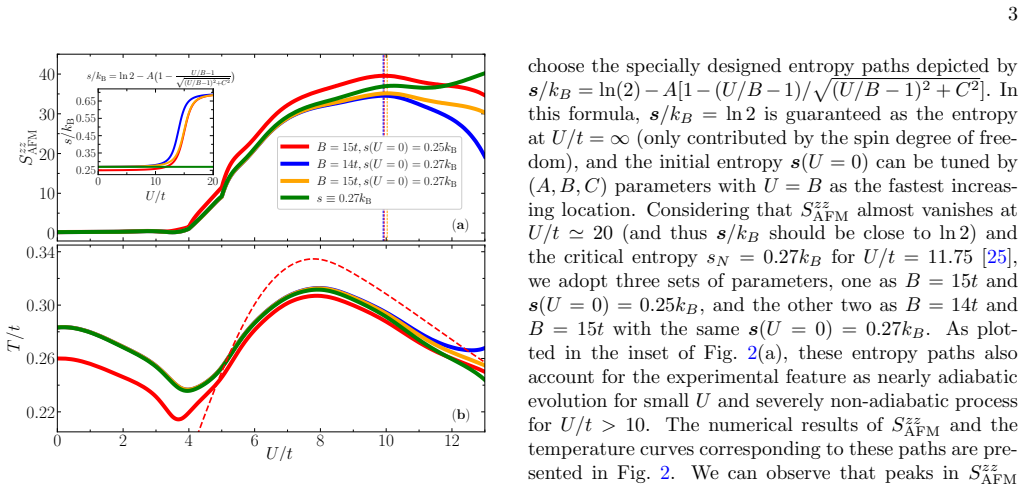
Entropy increase with interaction strength and lattice density disorder quantitatively explain the experimental shift of peak antiferromagnetic order to U/t ≃ 11.75 instead of the theoretical 8.
A machine-rendered reading of the paper's core claim, the machinery that carries it, and where it could break.
Core claim
The discrepancy between the experimental AFM structure factor maximum at U/t ≃ 11.75 and the theoretical prediction at ≃ 8 can be quantitatively explained by the entropy increase as enhancing the interaction in experiment, and together by the lattice density disorder existing in the experimental setup.
What carries the argument
The entropy phase diagram computed via auxiliary-field quantum Monte Carlo simulations, which permits tracking of arbitrary entropy paths on the temperature-interaction plane while incorporating density disorder.
If this is right
- The entropy dependence of double occupancy exhibits universal behaviors that can serve as independent probes in future optical-lattice experiments.
- Including both entropy variation and density disorder brings the calculated antiferromagnetic structure factor into quantitative agreement with the measured data across the interaction range.
- The same numerical framework can be used to predict how the critical entropy for antiferromagnetic order changes when experimental imperfections are reduced.
- Double-occupancy measurements at fixed entropy provide a direct test of the interaction-driven entropy increase assumed in the analysis.
Where Pith is reading between the lines
- Experiments that actively cool the system while ramping interaction strength could move the observed peak closer to the ideal theoretical location.
- Similar entropy-tracking methods could be applied to doped or anisotropic Hubbard models to forecast observable shifts caused by the same experimental imperfections.
- The universal double-occupancy curves may allow entropy calibration without separate thermometry in future setups.
Load-bearing premise
The experimental entropy path on the temperature-interaction plane can be accurately tracked from the measured parameters and that the modeled density disorder faithfully represents the dominant imperfection in the real apparatus.
What would settle it
If the peak position remains at U/t ≃ 11.75 in simulations that hold entropy fixed while ramping U or that set density disorder to zero, the proposed explanation would fail.
Figures


read the original abstract
The celebrated antiferromagnetic phase transition was realized in a most recent optical lattice experiment for 3D fermionic Hubbard model [Shao {\it et al}., Nature {\bf 632}, 267 (2024)]. Despite the great achievement, it was observed that the AFM structure factor (and also the critical entropy) reaches the maximum around the interaction strength $U/t\simeq 11.75$, which is significantly larger than the theoretical prediction as $U/t\simeq 8$. Here we resolve this discrepancy by studying the interplay between the thermal entropy, density disorder and antiferromagnetism of half-filled 3D Hubbard model with numerically exact auxiliary-field quantum Monte Carlo simulations. We have achieved accurate entropy phase diagram, which allows us to simulate arbitrary entropy path on the temperature-interaction plane and to track the experimental parameters. We then find that above discrepancy can be quantitatively explained by the {\it entropy increase} as enhancing the interaction in experiment, and together by the lattice {\it density disorder} existing in the experimental setup. We furthermore investigate the entropy dependence of double occupancy, and predict its universal behaviors which can be used as useful probes in future optical lattice experiments.
Editorial analysis
A structured set of objections, weighed in public.
Referee Report
Summary. The paper uses auxiliary-field quantum Monte Carlo (AFQMC) simulations, which are sign-problem free at half filling, to compute entropy phase diagrams for the 3D repulsive Hubbard model. It claims that following the experimental entropy path on the T-U plane together with a static density-disorder model quantitatively shifts the AFM structure-factor maximum from the clean-theory value U/t ≃ 8 to the experimental value ≃ 11.75, thereby resolving the discrepancy reported in Shao et al. (Nature 632, 267, 2024). The work also examines the entropy dependence of double occupancy and predicts universal behaviors as experimental probes.
Significance. If the numerical results are converged and the disorder model faithfully captures the dominant experimental imperfection, the manuscript supplies a concrete, parameter-free explanation for an important mismatch between theory and the first optical-lattice realization of 3D antiferromagnetism. The ability to simulate arbitrary entropy paths via thermodynamic integration is a technical strength that directly enables the central claim.
major comments (3)
- [results on entropy phase diagram] Entropy phase diagram and experimental-path tracking (results section on entropy surfaces): the abstract asserts that the experimental entropy path can be accurately tracked from measured parameters and that this, combined with disorder, quantitatively accounts for the shift from U/t ≃ 8 to ≃ 11.75. No explicit mapping procedure, sensitivity analysis to small changes in the path, or comparison of simulated versus measured entropy values is described; without these the quantitative attribution remains unverified.
- [density disorder modeling] Density-disorder implementation (section introducing the disorder model): the static density inhomogeneity is introduced to close the remaining gap after the entropy effect. The manuscript must demonstrate that the chosen disorder distribution is derived from the experimental apparatus rather than adjusted post hoc; otherwise the claim that the two effects together provide a quantitative explanation is weakened.
- [AFQMC results] Numerical convergence and error control (throughout the AFQMC results): the central claim is a precise numerical shift of the structure-factor peak. The provided abstract and summary contain no error bars, finite-size extrapolations, or Trotter-step convergence checks on the structure factor or entropy; these are load-bearing for asserting that the modeled effects move the peak exactly to the experimental location.
minor comments (2)
- [abstract] The abstract states 'accurate entropy phase diagram' without quantifying accuracy; a brief statement of the largest system size and statistical error would improve clarity.
- [figures] Figure captions should explicitly state whether the plotted structure factor includes the disorder average or is for the clean system.
Simulated Author's Rebuttal
We thank the referee for the detailed and constructive report. The comments identify areas where additional documentation and verification will strengthen the quantitative claims. We address each major comment below and will incorporate the requested clarifications and data in a revised manuscript.
read point-by-point responses
-
Referee: [results on entropy phase diagram] Entropy phase diagram and experimental-path tracking (results section on entropy surfaces): the abstract asserts that the experimental entropy path can be accurately tracked from measured parameters and that this, combined with disorder, quantitatively accounts for the shift from U/t ≃ 8 to ≃ 11.75. No explicit mapping procedure, sensitivity analysis to small changes in the path, or comparison of simulated versus measured entropy values is described; without these the quantitative attribution remains unverified.
Authors: We agree that the mapping procedure requires explicit documentation to allow independent verification. In the revised manuscript we will add a dedicated subsection detailing the thermodynamic integration used to obtain the entropy surfaces, the precise procedure for mapping the experimental parameters (temperature, interaction, and entropy) onto the T-U plane, a sensitivity analysis under small variations of the path, and direct numerical comparisons between the simulated entropies and the values reported or inferred in Shao et al. These additions will make the quantitative tracking fully transparent. revision: yes
-
Referee: [density disorder modeling] Density-disorder implementation (section introducing the disorder model): the static density inhomogeneity is introduced to close the remaining gap after the entropy effect. The manuscript must demonstrate that the chosen disorder distribution is derived from the experimental apparatus rather than adjusted post hoc; otherwise the claim that the two effects together provide a quantitative explanation is weakened.
Authors: The disorder distribution is constructed from the trap parameters, atom number, and observed density inhomogeneity reported in the experimental work of Shao et al. We will revise the disorder-model section to include the explicit derivation steps, showing how the Gaussian or measured density profile is obtained directly from the experimental apparatus parameters without additional fitting. This will confirm that the model is parameter-free with respect to the experimental setup. revision: yes
-
Referee: [AFQMC results] Numerical convergence and error control (throughout the AFQMC results): the central claim is a precise numerical shift of the structure-factor peak. The provided abstract and summary contain no error bars, finite-size extrapolations, or Trotter-step convergence checks on the structure factor or entropy; these are load-bearing for asserting that the modeled effects move the peak exactly to the experimental location.
Authors: While the full manuscript contains internal convergence tests, we accept that these must be presented explicitly for the structure factor and entropy. The revised version will include statistical error bars on all reported quantities, finite-size extrapolations for the structure-factor peak position, and Trotter-step convergence data. These additions will substantiate that the reported shift to U/t ≃ 11.75 is numerically robust. revision: yes
Circularity Check
No significant circularity
full rationale
The paper's central claim rests on AFQMC simulations (sign-problem free at half filling) that compute the entropy surface via standard thermodynamic integration, followed by a static density-disorder model to shift the AFM structure-factor peak. These steps are independent numerical procedures whose outputs are not defined in terms of the target experimental discrepancy; the entropy path is chosen to follow measured experimental parameters rather than being fitted to reproduce the U/t shift by construction. No self-citation chain, uniqueness theorem, or ansatz smuggling is load-bearing. The derivation is therefore self-contained against external benchmarks.
Axiom & Free-Parameter Ledger
axioms (1)
- domain assumption The half-filled 3D fermionic Hubbard model with on-site repulsion U and hopping t accurately captures the physics of the experimental optical lattice system.
Lean theorems connected to this paper
-
IndisputableMonolith/Cost/FunctionalEquation.leanwashburn_uniqueness_aczel unclear?
unclearRelation between the paper passage and the cited Recognition theorem.
We have achieved accurate entropy phase diagram... along representative entropy paths... lattice density disorder... Gaussian disorder by adding a site-dependent chemical potential
-
IndisputableMonolith/Foundation/RealityFromDistinction.leanreality_from_one_distinction unclear?
unclearRelation between the paper passage and the cited Recognition theorem.
numerically exact auxiliary-field quantum Monte Carlo simulations
What do these tags mean?
- matches
- The paper's claim is directly supported by a theorem in the formal canon.
- supports
- The theorem supports part of the paper's argument, but the paper may add assumptions or extra steps.
- extends
- The paper goes beyond the formal theorem; the theorem is a base layer rather than the whole result.
- uses
- The paper appears to rely on the theorem as machinery.
- contradicts
- The paper's claim conflicts with a theorem or certificate in the canon.
- unclear
- Pith found a possible connection, but the passage is too broad, indirect, or ambiguous to say the theorem truly supports the claim.
Reference graph
Works this paper leans on
-
[1]
M. Lewenstein, A. Sanpera, V. Ahufinger, B. Damski, A. Sen(De), and U. Sen, Ultracold atomic gases in op- tical lattices: mimicking condensed matter physics and beyond, Advances in Physics 56, 243 (2007)
work page 2007
- [2]
-
[3]
J. Hubbard and B. H. Flowers, Electron correlations in narrow energy bands, Proc. R. Soc. Lond. Ser. A 276, 238 (1963)
work page 1963
-
[4]
Kanamori, Electron correlation and ferromagnetism of transition metals, Prog
J. Kanamori, Electron correlation and ferromagnetism of transition metals, Prog. Theor. Phys 30, 275 (1963)
work page 1963
-
[5]
M. C. Gutzwiller, Effect of correlation on the ferromag- netism of transition metals, Phys. Rev. Lett. 10, 159 (1963)
work page 1963
-
[6]
T. Esslinger, Fermi-hubbard physics with atoms in an op- tical lattice, Annual Review of Condensed Matter Physics 1, 129 (2010)
work page 2010
-
[7]
C. Gross and I. Bloch, Quantum simulations with ultra- cold atoms in optical lattices, Science 357, 995 (2017)
work page 2017
-
[8]
F. Sch¨ afer, T. Fukuhara, S. Sugawa, Y. Takasu, and Y. Takahashi, Tools for quantum simulation with ultra- cold atoms in optical lattices, Nature Reviews Physics 2, 411 (2020)
work page 2020
-
[9]
D. P. Arovas, E. Berg, S. A. Kivelson, and S. Raghu, The hubbard model, Annual Review of Condensed Mat- ter Physics 13, 239 (2022)
work page 2022
-
[10]
M. Qin, T. Sch¨ afer, S. Andergassen, P. Corboz, and E. Gull, The hubbard model: A computational perspec- tive, Annual Review of Condensed Matter Physics 13, 275 (2022)
work page 2022
-
[11]
J. P. F. LeBlanc, A. E. Antipov, F. Becca, I. W. Bulik, G. K.-L. Chan, C.-M. Chung, Y. Deng, M. Ferrero, T. M. Henderson, C. A. Jim´ enez-Hoyos, E. Kozik, X.-W. Liu, A. J. Millis, N. V. Prokof’ev, M. Qin, G. E. Scuseria, H. Shi, B. V. Svistunov, L. F. Tocchio, I. S. Tupitsyn, S. R. White, S. Zhang, B.-X. Zheng, Z. Zhu, and E. Gull (Simons Collaboration on...
work page 2015
-
[12]
B.-X. Zheng, C.-M. Chung, P. Corboz, G. Ehlers, M.-P. Qin, R. M. Noack, H. Shi, S. R. White, S. Zhang, and G. K.-L. Chan, Stripe order in the underdoped region of the two-dimensional hubbard model, Science 358, 1155 (2017)
work page 2017
-
[13]
B. Xiao, Y.-Y. He, A. Georges, and S. Zhang, Tem- perature dependence of spin and charge orders in the doped two-dimensional hubbard model, Phys. Rev. X13, 011007 (2023)
work page 2023
- [14]
- [15]
-
[16]
R. A. Fontenele, N. C. Costa, R. R. dos Santos, and T. Paiva, Two-dimensional attractive hubbard model and 6 the bcs-bec crossover, Phys. Rev. B 105, 184502 (2022)
work page 2022
- [17]
- [18]
-
[19]
M. Boll, T. A. Hilker, G. Salomon, A. Omran, J. Nespolo, L. Pollet, I. Bloch, and C. Gross, Spin- and density- resolved microscopy of antiferromagnetic correlations in fermi-hubbard chains, Science 353, 1257 (2016)
work page 2016
-
[20]
L. W. Cheuk, M. A. Nichols, K. R. Lawrence, M. Okan, H. Zhang, E. Khatami, N. Trivedi, T. Paiva, M. Rigol, and M. W. Zwierlein, Observation of spatial charge and spin correlations in the 2d fermi-hubbard model, Science 353, 1260 (2016)
work page 2016
-
[21]
A. Mazurenko, C. S. Chiu, G. Ji, M. F. Parsons, M. Kan´ asz-Nagy, R. Schmidt, F. Grusdt, E. Demler, D. Greif, and M. Greiner, A cold-atom fermi–hubbard antiferromagnet, Nature 545, 462 (2017)
work page 2017
- [22]
-
[23]
M. Xu, L. H. Kendrick, A. Kale, Y. Gang, G. Ji, R. T. Scalettar, M. Lebrat, and M. Greiner, Frustration- and doping-induced magnetism in a fermi–hubbard simulator, Nature 620, 971 (2023)
work page 2023
-
[24]
R. A. Hart, P. M. Duarte, T.-L. Yang, X. Liu, T. Paiva, E. Khatami, R. T. Scalettar, N. Trivedi, D. A. Huse, and R. G. Hulet, Observation of antiferromagnetic correla- tions in the hubbard model with ultracold atoms, Nature 519, 211 (2015)
work page 2015
-
[25]
H.-J. Shao, Y.-X. Wang, D.-Z. Zhu, Y.-S. Zhu, H.-N. Sun, S.-Y. Chen, C. Zhang, Z.-J. Fan, Y. Deng, X.-C. Yao, Y.- A. Chen, and J.-W. Pan, Antiferromagnetic phase tran- sition in a 3d fermionic hubbard model, Nature 632, 267 (2024)
work page 2024
-
[26]
L. Niaz and A. Krasnok, Quantum leap: observing an- tiferromagnetic transition in a 3D fermionic hubbard model with ultracold atoms, Advanced Photonics 6, 060503 (2024)
work page 2024
-
[27]
J. L. Miller, A quintessential quantum simulator takes a 10 000-fold leap, Physics Today 77, 12 (2024)
work page 2024
-
[28]
M. Campostrini, M. Hasenbusch, A. Pelissetto, P. Rossi, and E. Vicari, Critical exponents and equation of state of the three-dimensional heisenberg universality class, Phys. Rev. B 65, 144520 (2002)
work page 2002
- [29]
- [30]
- [31]
-
[32]
E. Ibarra-Garc´ ıa-Padilla, R. Mukherjee, R. G. Hulet, K. R. A. Hazzard, T. Paiva, and R. T. Scalettar, Ther- modynamics and magnetism in the two-dimensional to three-dimensional crossover of the hubbard model, Phys. Rev. A 102, 033340 (2020)
work page 2020
- [33]
- [34]
- [35]
-
[36]
Khatami, Three-dimensional hubbard model in the thermodynamic limit, Phys
E. Khatami, Three-dimensional hubbard model in the thermodynamic limit, Phys. Rev. B 94, 125114 (2016)
work page 2016
- [37]
- [38]
-
[39]
E. V. Gorelik, D. Rost, T. Paiva, R. Scalettar, A. Kl¨ umper, and N. Bl¨ umer, Universal probes for anti- ferromagnetic correlations and entropy in cold fermions on optical lattices, Phys. Rev. A 85, 061602 (2012)
work page 2012
-
[40]
J. Imriˇ ska, M. Iazzi, L. Wang, E. Gull, D. Greif, T. Uehlinger, G. Jotzu, L. Tarruell, T. Esslinger, and M. Troyer, Thermodynamics and magnetic properties of the anisotropic 3d hubbard model, Phys. Rev. Lett. 112, 115301 (2014)
work page 2014
- [41]
- [42]
-
[43]
C. Lenihan, A. J. Kim, F. ˇSimkovic, and E. Kozik, Evaluating second-order phase transitions with diagram- matic monte carlo: N´ eel transition in the doped three- dimensional hubbard model, Phys. Rev. Lett. 129, 107202 (2022)
work page 2022
-
[44]
R. Garioud, F. ˇSimkovic, R. Rossi, G. Spada, T. Sch¨ afer, F. Werner, and M. Ferrero, Symmetry-broken perturba- tion theory to large orders in antiferromagnetic phases, Phys. Rev. Lett. 132, 246505 (2024)
work page 2024
-
[45]
G. Li, A. E. Antipov, A. N. Rubtsov, S. Kirchner, and W. Hanke, Competing phases of the hubbard model on a triangular lattice: Insights from the entropy, Phys. Rev. B 89, 161118 (2014)
work page 2014
-
[46]
Wessel, Critical entropy of quantum heisenberg mag- nets on simple-cubic lattices, Phys
S. Wessel, Critical entropy of quantum heisenberg mag- nets on simple-cubic lattices, Phys. Rev. B 81, 052405 (2010)
work page 2010
-
[47]
See Supplemental Material at http://link.aps.org/supplemental/xxx for supple- mental results of the full maps for AFM structure factor and double occupancy, and the critical scaling of AFM structure factor versus the entropy
-
[48]
Thermal Entropy, Density Disorder and Antiferromagnetism of Repulsive Fermions in 3D Optical Lattice
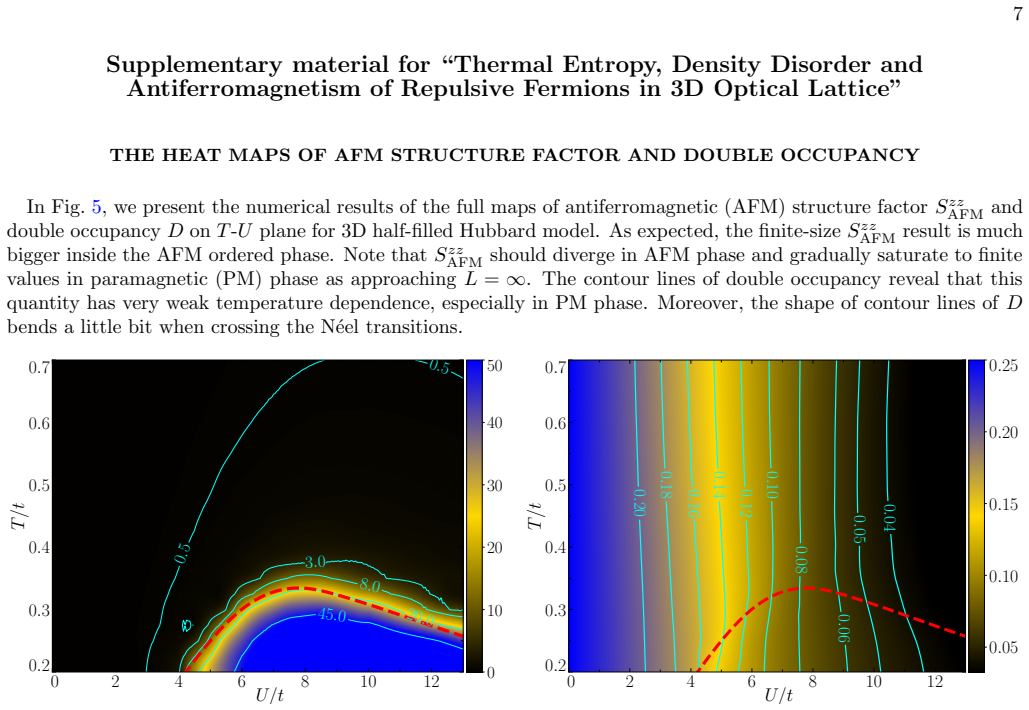
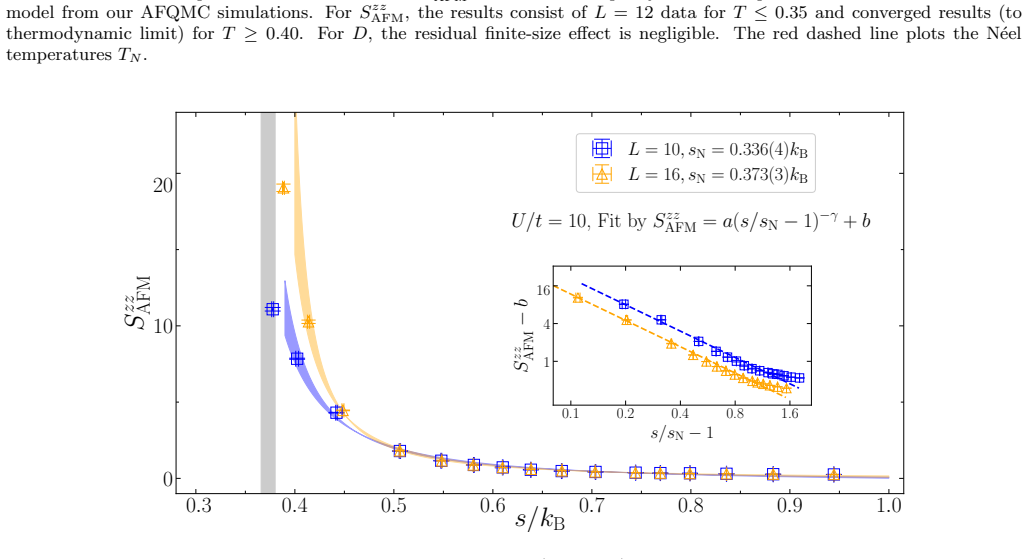
Private communication with Xing-Can Yao. 7 Supplementary material for “Thermal Entropy, Density Disorder and Antiferromagnetism of Repulsive Fermions in 3D Optical Lattice” THE HEA T MAPS OF AFM STRUCTURE F ACTOR AND DOUBLE OCCUP ANCY In Fig. 5, we present the numerical results of the full maps of antiferromagnetic (AFM) structure factor Szz AFM and doubl...
discussion (0)
Sign in with ORCID, Apple, or X to comment. Anyone can read and Pith papers without signing in.