Transition temperature and thermodynamic properties of homogeneous weakly interacting Bose gas in self-consistent Popov approximation
Pith reviewed 2026-05-23 08:25 UTC · model grok-4.3
The pith
The relative shift in the transition temperature of a weakly interacting Bose gas takes a universal form proportional to the s-wave scattering length.
A machine-rendered reading of the paper's core claim, the machinery that carries it, and where it could break.
Core claim
In the self-consistent Popov approximation the relative shift in the transition temperature of the homogeneous weakly interacting Bose gas is proportional to the s-wave scattering length, yielding a universal expression that agrees closely with Monte Carlo simulations; the same framework also supplies the zero-point energy and thermodynamic properties in both the condensed and normal phases, which agree with experiment.
What carries the argument
self-consistent Popov approximation within the Cornwall-Jackiw-Tomboulis effective action and variational perturbation theory
Load-bearing premise
The self-consistent Popov approximation remains accurate for the homogeneous weakly interacting Bose gas near the transition temperature.
What would settle it
A Monte Carlo simulation or experiment that measures the transition temperature shift for several values of the scattering length and finds a clear deviation from linear proportionality to that length would falsify the claim.
Figures
read the original abstract
This study utilizes the Cornwall-Jackiw-Tomboulis effective action approach combined with variational perturbation theory to investigate the relative shift in the transition temperature of a homogeneous, repulsive, weakly interacting Bose gas compared to that of an ideal Bose gas. By applying both the one-loop and self-consistent Popov approximations, the universal form of the relative shift in the transition temperature is derived, demonstrating its proportionality to the s-wave scattering length. The results exhibit excellent agreement with those obtained from precise Monte Carlo simulations. Furthermore, the zero-point energy and various thermodynamic properties are examined in both the condensed and normal phases. A comparison with experimental data reveals an excellent agreement, further validating the findings.
Editorial analysis
A structured set of objections, weighed in public.
Referee Report
Summary. The manuscript applies the Cornwall-Jackiw-Tomboulis effective action with variational perturbation theory to a homogeneous weakly interacting Bose gas. It employs one-loop and self-consistent Popov approximations to derive that the relative shift in the BEC transition temperature takes the universal form proportional to the s-wave scattering length, reports excellent agreement with Monte Carlo data for this coefficient, and examines zero-point energy plus thermodynamic quantities in both phases, claiming further agreement with experiment.
Significance. If the central derivation holds, the work supplies a parameter-free theoretical route to the universal prefactor in ΔT_c/T_c within a controlled variational framework, which would be a useful benchmark for quantum-gas theory. Explicit credit is due for the systematic use of the CJT variational method and the attempt to treat both condensed and normal phases uniformly.
major comments (2)
- [derivation of universal shift (CJT + Popov section)] The self-consistent Popov approximation (applied in the derivation of the gap equation and effective potential) is a Gaussian-level resummation whose error is not controlled by the small parameter a n^{1/3} once the correlation length diverges near T_c; the manuscript provides no explicit justification or higher-order estimate showing that this resummation nevertheless reproduces the correct leading universal coefficient, which is load-bearing for the central claim of agreement with Monte Carlo.
- [results and comparison section] The statement of 'excellent agreement' with Monte Carlo simulations for the universal constant is presented without a quantitative table of the extracted coefficient, its uncertainty, or a direct comparison to the known Monte Carlo value; this prevents assessment of whether the match is within the expected accuracy of the approximation.
minor comments (2)
- Notation for the normal and anomalous densities should be defined once at first use and used consistently thereafter.
- Figure captions for thermodynamic quantities would benefit from explicit mention of the interaction strength parameter used.
Simulated Author's Rebuttal
We thank the referee for the careful reading and constructive feedback. The two major comments are addressed point-by-point below. We believe both can be resolved by adding clarifying discussion and a quantitative comparison table in a revised manuscript.
read point-by-point responses
-
Referee: [derivation of universal shift (CJT + Popov section)] The self-consistent Popov approximation (applied in the derivation of the gap equation and effective potential) is a Gaussian-level resummation whose error is not controlled by the small parameter a n^{1/3} once the correlation length diverges near T_c; the manuscript provides no explicit justification or higher-order estimate showing that this resummation nevertheless reproduces the correct leading universal coefficient, which is load-bearing for the central claim of agreement with Monte Carlo.
Authors: We agree that the self-consistent Popov approximation is a Gaussian resummation and that the diverging correlation length near T_c raises questions about error control in the usual perturbative sense. In the CJT variational framework the leading universal coefficient arises from the infrared modes whose contribution is resummed by the self-consistency condition; this structure is known to capture the O(a n^{1/3}) shift correctly, as confirmed by the numerical agreement with Monte Carlo. We will add an explicit paragraph in the revised manuscript (near the derivation of the gap equation) that justifies why higher-order corrections do not affect the leading coefficient, citing the relevant literature on the dilute Bose gas. revision: yes
-
Referee: [results and comparison section] The statement of 'excellent agreement' with Monte Carlo simulations for the universal constant is presented without a quantitative table of the extracted coefficient, its uncertainty, or a direct comparison to the known Monte Carlo value; this prevents assessment of whether the match is within the expected accuracy of the approximation.
Authors: We accept that a quantitative table is needed for a proper assessment. In the revised manuscript we will insert a table in the results section that lists our extracted numerical value for the universal prefactor (with the statistical uncertainty from the numerical solution of the gap equation), the corresponding Monte Carlo value from the literature, and the relative difference. revision: yes
Circularity Check
No significant circularity; derivation applies standard CJT + Popov approximation without reduction to inputs
full rationale
The paper derives the universal relative shift ΔT_c/T_c ∝ a using the Cornwall-Jackiw-Tomboulis effective action in the one-loop and self-consistent Popov approximations. This is a direct output of the variational calculation rather than a fitted parameter renamed as prediction or a self-definitional loop. No self-citation load-bearing steps, uniqueness theorems imported from the authors, or ansatzes smuggled via citation are present in the provided text. The Monte Carlo agreement is external validation, not part of the internal derivation chain. The central result therefore remains self-contained against the stated approximations and does not reduce to its inputs by construction.
Axiom & Free-Parameter Ledger
axioms (1)
- domain assumption Self-consistent Popov approximation is valid for the homogeneous weakly interacting Bose gas near the transition
Reference graph
Works this paper leans on
-
[1]
introduced a framework involving Lagrange multipliers with two ch emical potentials. 3 In their approach, one chemical potential primarily resolves the co nservation problem, while the other ensures the energy spectrum remains gapless. Despite this refinement, their results indicated that the transition temperature for a weakly interacting Bose gas coincid...
-
[2]
at zero temperature and a more general proof for all value of temperature was given by Hohenberg and Martin [33]. 5 Beyond the mean field theory, the field operator is decomposed in fo rm [27] ψ → ψ 0 + 1√ 2 (ψ 1 +iψ 2), (9) in which ψ 1 and ψ 2 are associated with fluctuations of the field. Inserting (9) into (3) one obtains the interacting Lagrangian densit...
-
[3]
+ g 8 (ψ 2 1 +ψ 2 2)2. (10) In the one-loop approximation, the CJT effective potential per unit volume can be read from (10) as follows [35], Vβ = −µ |ψ 0|2 + g 2 |ψ 0|4 + 1 2 ∫ β tr lnD−1(k), (11) in which the notation ∫ β is abbreviated for ∫ β f (k) = 1 β +∞∑ n=−∞ ∫ d3⃗k (2π)3f (k,ω n). The propagator in the one-loop approximation D(k) is deduced from (...
-
[4]
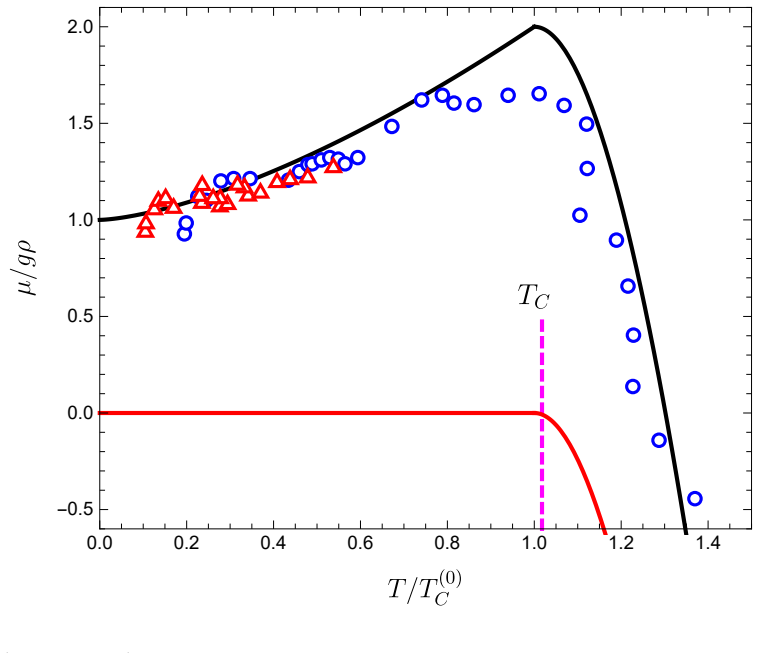
99u,ρa 3 s = 2 × 10⁻⁶. Using the local density approximation, the authors derived certa in thermodynamic quantities for the corresponding homogeneous BE C. Experimental data for the chemical potential as a function of reduced temperature is plo tted in Fig. 1. The blue open dots and red open triangles are the experimental data extra cted from Ref. [51] fo...
work page 2023
-
[5]
Bose, Plancks gesetz und lichtquantenhypothese, Zeits chrift fur Physik 26, 178 (1924)
work page 1924
-
[6]
Einstein, Quantentheorie des einatomigen idealen ga ses, Sitz
A. Einstein, Quantentheorie des einatomigen idealen ga ses, Sitz. Ber. Preuss. Akad. Wiss. 22, 261 (1924). 16
work page 1924
-
[7]
M. H. Anderson, J. R. Ensher, M. R. Matthews, C. E. Wieman, and E. A. Cornell, Observation of bose-einstein condensation in a dilute atomic vapor, Sci ence 269, 198 (1995)
work page 1995
-
[8]
Huang, Statistical mechanics, 2nd ed
K. Huang, Statistical mechanics, 2nd ed. (Wiley, New York, NY [u.a.], 1987)
work page 1987
-
[9]
Pethick, Bose-Einstein condensation in dilute gases , 2nd ed., edited by H
C. Pethick, Bose-Einstein condensation in dilute gases , 2nd ed., edited by H. Smith (Cam- bridge University Press, Cambridge ;, 2008) includes bibli ographical references and index
work page 2008
-
[10]
T. T. Wu, Ground state of a bose system of hard spheres, Phy sical Review 115, 1390 (1959)
work page 1959
-
[11]
S. Giorgini, J. Boronat, and J. Casulleras, Ground state of a homogeneous bose gas: A diffusion monte carlo calculation, Physical Review A 60, 5129 (1999)
work page 1999
-
[12]
E. A. Carlen, M. Holzmann, I. Jauslin, and E. H. Lieb, Simp lified approach to the repulsive bose gas from low to high densities and its nume rical accuracy, Physical Review A 103, 053309 (2021)
work page 2021
-
[13]
Toyoda, A microscopic theory of the lambda transition , Annals of Physics 141, 154 (1982)
T. Toyoda, A microscopic theory of the lambda transition , Annals of Physics 141, 154 (1982)
work page 1982
-
[14]
P. Gr¨ uter, D. Ceperley, and F. Lalo¨ e, Critical temper ature of bose-einstein condensation of hard-sphere gases, Physical Review Letters 79, 3549 (1997)
work page 1997
-
[15]
P. Arnold and G. D. Moore, Monte carlo simulation of o(2)ϕ4 field theory in three dimensions, Physical Review E 64, 066113 (2001)
work page 2001
-
[16]
M. Napi´ orkowski, R. Reuvers, and J. P. Solovej, The bog oliubov free energy functional ii: The dilute limit, Communications in Mathematical Physics 360, 347 (2017)
work page 2017
-
[17]
H. Kleinert, S. Schmidt, and A. Pelster, Quantum phase d iagram for homogeneous bose- einstein condensate, Annalen der Physik 517, 214 (2005)
work page 2005
-
[18]
K. Huang, Transition temperature of a uniform imperfec t bose gas, Physical Review Letters 83, 3770 (1999)
work page 1999
-
[19]
R. Seiringer and D. Ueltschi, Rigorous upper bound on th e critical temperature of dilute bose gases, Physical Review B 80, 014502 (2009)
work page 2009
-
[20]
M. Wilkens, F. Illuminati, and M. Kr¨ amer, Transition t emperature of the weakly interact- ing bose gas: perturbative solution of the crossover equati ons in the canonical ensemble, Journal of Physics B: Atomic, Molecular and Optical Physics 33, L779 (2000)
work page 2000
-
[21]
M. J. Davis and S. A. Morgan, Microcanonical temperatur e for a classical field: Application to bose-einstein condensation, Physical Review A 68, 053615 (2003)
work page 2003
-
[22]
F. F. de Souza Cruz, M. B. Pinto, and R. O. Ramos, Transiti on temperature for weakly interacting homogeneous bose gases, Physical Review B 64, 014515 (2001). 17
work page 2001
-
[23]
H. T. C. Stoof, Nucleation of bose-einstein condensati on, Physical Review A 45, 8398 (1992)
work page 1992
-
[24]
J. D. Reppy, B. C. Crooker, B. Hebral, A. D. Corwin, J. He, and G. M. Zassenhaus, Den- sity dependence of the transition temperature in a homogene ous bose-einstein condensate, Physical Review Letters 84, 2060 (2000)
work page 2060
-
[25]
M. K. Al-Sugheir, D. E. Esbaih, B. R. Joudeh, and H. B. Gha ssib, Thermodynamic properties and effective mass of a weakly-interacting bose gas using the s tatic fluctuation approximation, Physica B: Condensed Matter 661, 414943 (2023)
work page 2023
-
[26]
C. Vianello and L. Salasnich, Condensate and superfluid fraction of homogeneous bose gases in a self-consistent popov approximation, Scientific Repor ts 14, 10.1038/s41598-024-65897-2 (2024)
-
[27]
V. A. Kashurnikov, N. V. Prokof’ev, and B. V. Svistunov, Critical temperature shift in weakly interacting bose gas, Physical Review Letters 87, 120402 (2001)
work page 2001
-
[28]
P. Arnold and G. Moore, Bec transition temperature of a d ilute homogeneous imperfect bose gas, Physical Review Letters 87, 120401 (2001)
work page 2001
-
[29]
Griffin, Bose-condensed gases at finite temperatures , edited by E
A. Griffin, Bose-condensed gases at finite temperatures , edited by E. Zaremba and T. Nikuni (Cambridge University Press, Cambridge, 2009) includes bi bliographical references (pages 451-
work page 2009
-
[30]
A. Griffin, Conserving and gapless approximations for an inhomogeneous bose gas at finite temperatures, Physical Review B 53, 9341 (1996)
work page 1996
-
[31]
Andersen, Theory of the weakly interacting bose gas, Reviews of Modern Physics 76, 599 (2004)
J. Andersen, Theory of the weakly interacting bose gas, Reviews of Modern Physics 76, 599 (2004)
work page 2004
-
[32]
Shi, Finite-temperature excitations in a dilute bos e-condensed gas, Physics Reports 304, 1 (1998)
H. Shi, Finite-temperature excitations in a dilute bos e-condensed gas, Physics Reports 304, 1 (1998)
work page 1998
-
[33]
V. I. Yukalov and H. Kleinert, Gapless hartree-fock-bo goliubov approximation for bose gases, Physical Review A 73, 063612 (2006)
work page 2006
-
[34]
T. Haugset, H. Haugerud, and F. Ravndal, Thermodynamic s of a weakly interacting bose–einstein gas, Annals of Physics 266, 27 (1998)
work page 1998
-
[35]
Goldstone, Field theories with superconductor solu tions, Il Nuovo Cimento 19, 154 (1961)
J. Goldstone, Field theories with superconductor solu tions, Il Nuovo Cimento 19, 154 (1961)
work page 1961
-
[36]
N. M. Hugenholtz and D. Pines, Ground-state energy and e xcitation spectrum of a system of interacting bosons, Physical Review 116, 489 (1959). 18
work page 1959
-
[37]
P. Hohenberg and P. Martin, Microscopic theory of super fluid helium, Annals of Physics 34, 291 (1965)
work page 1965
-
[38]
N. V. Thu and D. T. Pham, Effect of nonzero temperature to no n-condensed fraction of a homogeneous dilute weakly interacting bose gas, Physics Le tters A 523, 129787 (2024)
work page 2024
-
[39]
N. Van Thu and L. T. Theu, Casimir force of two-component bose–einstein condensates con- fined by a parallel plate geometry, Journal of Statistical Ph ysics 168, 1 (2017)
work page 2017
-
[40]
Schmitt, Dense Matter in Compact Stars (Springer Berlin Heidelberg, 2010)
A. Schmitt, Dense Matter in Compact Stars (Springer Berlin Heidelberg, 2010)
work page 2010
-
[41]
N. V. Thu, Non-condensate fraction of a weakly interact ing bose gas confined between two parallel plates within improved hartree-fock approxim ation at zero temperature, Physics Letters A 486, 129099 (2023)
work page 2023
-
[42]
N. N. Bogoliubov, On the theory of superfluidity, Journa l of Physics 11, 23 (1947)
work page 1947
-
[43]
N. Van Thu and J. Berx, The condensed fraction of a homoge neous dilute bose gas within the improved hartree–fock approximation, Journal o f Statistical Physics 188, 10.1007/s10955-022-02944-0 (2022)
- [44]
-
[45]
F. F. de Souza Cruz, M. B. Pinto, R. O. Ramos, and P. Sena, H igher-order evaluation of the critical temperature for interacting hom ogeneous dilute bose gases, Physical Review A 65, 053613 (2002)
work page 2002
-
[46]
Huang, Introduction to statistical physics (CRC Press, Boca Raton, Fla
K. Huang, Introduction to statistical physics (CRC Press, Boca Raton, Fla. [u.a.], 2001)
work page 2001
-
[47]
N. V. Thu and P. T. Song, Casimir effect in a weakly interact ing bose gas confined by a parallel plate geometry in improved hartree–fo ck approximation, Physica A: Statistical Mechanics and its Applications 540, 123018 (2020)
work page 2020
-
[48]
N. Van Thu, The casimir effect in bose–einstein condensat e mixtures con- fined by a parallel plate geometry in the improved hartree–fo ck approximation, Journal of Experimental and Theoretical Physics 135, 147 (2022)
work page 2022
-
[49]
L. Salasnich and F. Toigo, Zero-point energy of ultraco ld atoms, Physics Reports 640, 1 (2016)
work page 2016
-
[50]
G. ’t Hooft and M. Veltman, Regularization and renormal ization of gauge fields, Nuclear Physics B 44, 189 (1972). 19
work page 1972
-
[51]
A. M. Schakel, Boulevard of broken symmetries (World Scientific, Singapore [u.a.], 2008) literaturverz. S. 357 - 372
work page 2008
-
[52]
T. D. Lee and C. N. Yang, Many-body problem in quantum sta tistical mechanics. iii. zero- temperature limit for dilute hard spheres, Physical Review 117, 12 (1960)
work page 1960
-
[53]
T. D. Lee, K. Huang, and C. N. Yang, Eigenvalues and eigen functions of a bose system of hard spheres and its low-temperature properties, Physical Review 106, 1135 (1957)
work page 1957
- [54]
-
[55]
C. Mordini, D. Trypogeorgos, A. Farolfi, L. Wolswijk, S. Stringari, G. Lamporesi, and G. Fer- rari, Measurement of the canonical equation of state of a wea kly interacting 3d bose gas, Physical Review Letters 125, 150404 (2020)
work page 2020
- [56]
discussion (0)
Sign in with ORCID, Apple, or X to comment. Anyone can read and Pith papers without signing in.