REVIEW 3 major objections 6 minor 47 references
On Pooling-Based Track Fusion Strategies : Harmonic Mean Density
T0 review · 3 major / 6 minor · reviewed 2026-08-11 · deepseek-v4-flash
Pith's one-line read Harmonic mean density pooling fuses correlated tracks with lower root-mean-squared error than existing conservative strategies, in closed form for both Gaussian and Gaussian-mixture tracks.
desk verdict A serious but incomplete paper: the harmonic-mean fusion rule is novel and mostly sound, yet the implemented Gaussian approximation's conservativeness is asserted, and the simulations omit the most relevant competitors (ICI/EI). read the letter →
The pith
A machine-rendered reading of the paper's core claim, the machinery that carries it, and where it could break.
The reading
What carries the argument
The central object is the harmonic mean density $M^h_ω = p_1 p_2 / ((1-ω)p_1 + ω p_2)$, a normalized interpolation between two local track densities. Its role is to encode the common information as an arithmetic average of the local densities, turning the exact Bayesian fusion ratio $p_1 p_2 / p_c$ into a form computable from local tracks alone. The carrying mechanism is the implementation: the denominator, a mixture $(1-ω)p_1 + ω p_2$, is approximated by a single Gaussian with matching mean and covariance, and the fusion reduces to a Gaussian product and division whose closed-form fused mean and covariance are given by Eqs. (53a)–(53b). For Gaussian-mixture tracks the same formulas are applied component-wise, producing a closed-form fused mixture with $M×N$ components.
What would settle it
Fuse two local IMM tracks whose modes are separated by less than one standard deviation, so the denominator mixture is strongly multimodal, using Eq. (53); if the fused NEES falls below the 95% confidence bound over Monte Carlo runs, the Gaussian approximation has made the fusion overconfident and the central claim fails for that regime.
Extended reading notes
Core claim
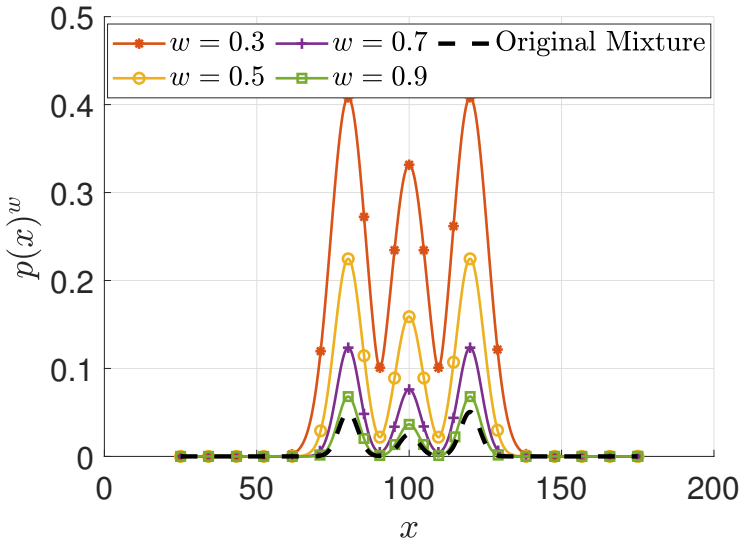
The central discovery is that the harmonic mean density, $M^h_ω = p_1 p_2 / ((1-ω)p_1 + ω p_2)$, normalized to integrate to one, works as a conservative track-fusion rule that can be implemented in closed form for both Gaussian and Gaussian-mixture tracks. The paper shows that this rule corresponds to the exact Bayesian fusion formula $p_1 p_2 / p_c$ with the unknown common-information density $p_c(x)$ replaced by the arithmetic average $(1-ω)p_1 + ω p_2$ of the local densities, and that this replacement removes the double counting of common information. For Gaussian local densities, the denominator mixture is approximated by a single moment-matched Gaussian, and the fused mean and covariance follow from the standard product and division identities for Gaussians: $Γ^f = (Γ_1^{-1} + Γ_2^{-1} - Γ_{eq}^{-1})^{-1}$ and $x̂^f = Γ^f (Γ_1^{-1}x̂_1 + Γ_2^{-1}x̂_2 - Γ_{eq}^{-1}x̂_{eq})$. For Gaussian mixtures, the same component-wise formulas yield a fused mixture with $M×N$ components and a scaling factor $κ_{ij}$. The paper further proves that the normalization constant is convex in $ω$ and that the fused density is bounded below by the infimum of the component densities, and provides simulation evidence that HMD achieves lower RMSE than GMD and AMD with NEES inside the 95% confidence region.
Load-bearing premise
The load-bearing premise is that replacing the denominator mixture $(1-ω)p_1 + ω p_2$ by a single Gaussian with matching mean and covariance preserves the conservativeness and consistency of the exact harmonic mean density, which the paper asserts and verifies only by simulation.
Editorial extensions
If this is right
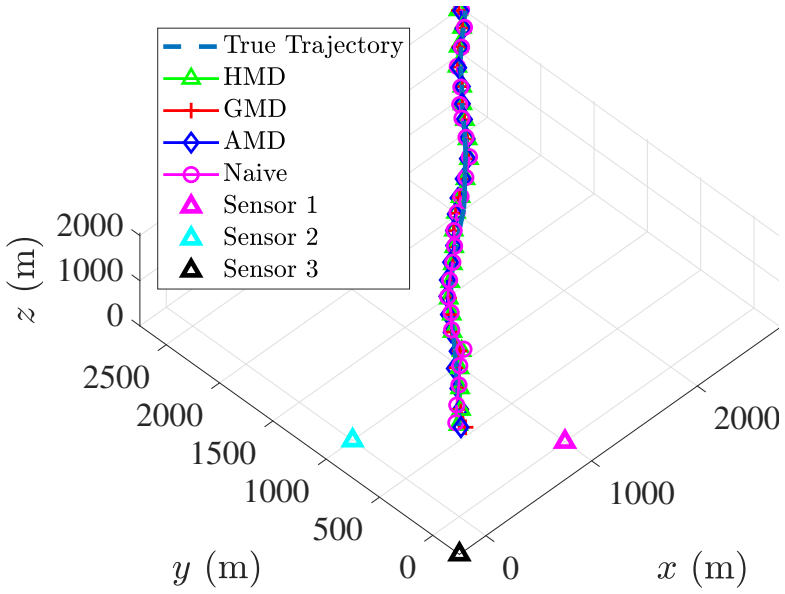
- HMD fusion achieves lower position and velocity RMSE than geometric mean density (covariance intersection) and arithmetic mean density fusion in both the 3D constant-velocity scenario and the 2D maneuvering IMM scenario.
- The fused HMD estimate stays within the 95% NEES confidence region in both simulations, meaning it is neither overconfident like naive fusion nor as over-conservative as arithmetic averaging.
- Because it avoids non-integer powers of mixtures, HMD handles Gaussian-mixture tracks with the same closed-form framework as Gaussian tracks, without the mode-separation assumptions that pseudo-Chernoff fusion relies on.
- The recursive form of harmonic averaging extends the pairwise fusion rule to any number of sensors with minimal added complexity.
- The implementation is computationally comparable to covariance intersection for Gaussian tracks and faster than sigma-point Chernoff fusion for mixtures.
Reading between the lines
- The paper fixes the fusion weight at $ω = 0.5$ in all simulations; an immediate extension is to select $ω$ adaptively per fusion instant, for instance by minimizing the trace of the fused covariance, which could close more of the gap to the centralized lower bound.
- The Gaussian approximation of the denominator is the only non-exact step, so an exact HMD computed by Monte Carlo integration of the normalization constant would reveal how much accuracy is lost on strongly multimodal tracks; one can expect the approximation to degrade when the modes of the denominator mixture are close together.
- Because HMD matches inverse covariance intersection when the local means are equal, the extra spread-of-means term in the denominator's Gaussian equivalent can be read as a correction for estimate disagreement; this suggests HMD may be especially robust when local trackers disagree, such as during maneuvers or with model mismatch.
- The connection between HMD and Bayesian fusion with an arithmetic-mean common information suggests a broader family of pooling rules: any abstract mean of the local densities can serve as the common-information approximation, and the harmonic mean is just the member whose closed form requires only one Gaussian approximation.
Signed reviews
Editorial analysis
A structured set of objections, weighed in public.
Referee Report
Summary. The paper proposes a track-to-track fusion rule based on the harmonic mean density, M_h = p_1 p_2 / ((1-ω)p_1 + ω p_2), normalized as in Eqs. (20)-(22), and studies its theoretical properties. The exact HMD is shown to avoid double counting, to have a convex normalization constant, to be bounded below by a component density, to be monotone, and to satisfy certain Kullback-Leibler inequalities. For implementation, Section 5 approximates the denominator mixture in Eq. (48) by a single moment-matched Gaussian and derives a closed-form Gaussian fusion rule in Eqs. (53a)-(53b), with an analogous component-wise treatment for Gaussian mixtures. The paper reports 2D and 3D simulations claiming lower RMSE than other conservative strategies and acceptable NEES.
Significance. If the implemented approximation were proved conservative and consistent, the paper would make a useful contribution: it offers a closed-form, pooling-based alternative to generalized covariance intersection for Gaussian mixtures, avoiding non-integer powers of mixture densities, and it extends an existing class of mean-density fusers to multimodal tracks. The theoretical properties of the exact HMD are clean and mostly straightforward; in particular, the proofs of Theorems 1-4 and Proposition 1 are correct in outline and give the reader a clear picture of the exact density's behavior. The main value of the paper, however, rests on the approximate implementation in Section 5, and that is exactly where the support is weakest: no proof or targeted numerical study establishes that the moment-matched Gaussian denominator preserves the conservativeness or consistency of the exact HMD.
major comments (3)
- [Section 5, Eq. (48) and Appendix A] The load-bearing implementation step is the replacement of the denominator q(x) = (1-ω)p1(x)+ωp2(x) by a single moment-matched Gaussian N(x_eq, Γ_eq). The proof in Appendix A only establishes Γ_eq ≻ Γ_num, i.e., that the subtracted covariance in Eq. (53a) remains positive definite. Positive definiteness of Γ_f is a validity condition for the Gaussian division, not a conservativeness condition. Conservativeness would require Γ_f to dominate, in the Loewner order, the covariance of the exact HMD or at least the expected error covariance of the approximate estimate; neither is shown. Consequently, the statement in the Abstract that the proposed fusion is 'consistent' is not established for the implemented formula.
- [Section 6] The simulation study does not cover the regime where the Gaussian approximation in Eq. (48) is most likely to fail. All runs use the fixed value ω=0.5, and no scenario is reported with a strongly bimodal denominator mixture or with closely spaced modes, even though Section 3 explicitly identifies closely spaced modes as the regime where the pseudo-Chernoff approximation degrades. Moreover, there is no comparison against the exact HMD, even for unimodal Gaussian densities where numerical integration could provide a reference. The RMSE and NEES plots therefore do not demonstrate that the approximate rule is safe in the very situations where the single-Gaussian denominator can most distort the ratio p1 p2 / q.
- [Section 5, consistency paragraph after Eq. (59)] The argument that HMD is consistent because it satisfies the pointwise lower bound in Eq. (36) and avoids double counting is applied to the approximate implementation, but both properties are proved only for the exact HMD. The definition of inconsistency in Eq. (60), namely p(x_t)=0, only excludes degeneracy at the true state; it does not control the second moment of the approximate fused density, so it cannot support the NEES-based consistency claim. Since the actual algorithm substitutes a moment-matched Gaussian for the denominator mixture, the consistency statement needs a separate proof or a direct numerical check of covariance domination for Eq. (53).
minor comments (6)
- [Theorem 2] The statement that the normalization constant ζ is 'less than 1' should be 'less than or equal to 1', because equality occurs when p1 = p2.
- [Eq. (61)] There is a typo in the displayed fused density: 'p(xk|z1 ∪ z1)' should read 'p(xk|z1 ∪ z2)'.
- [Eq. (62)] The scaling factor κ_ij is presented without a derivation, and the quantities Γ_m and Γ_naive are not defined before their first use; the presence of both a Gaussian evaluation and determinant ratios needs a clear derivation to be checkable.
- [Section 6.1] Claims such as 'improvement of roughly double' and 'roughly 50%' are made without confidence intervals or Monte Carlo standard errors; the plotted RMSE differences against GMD look small, so the statistical significance of the claimed advantage should be quantified.
- [Section 6.2] The NEES for Gaussian mixture fusions is said to be computed using a Gaussian approximation, but no formula is given for this approximation; since consistency is a central claim, the NEES computation should be stated explicitly.
- [References] Reference [44] is the authors' own unpublished manuscript and is cited for 'a major result on divergence minimization of harmonic mean density'; this result should either be proved in the present paper or replaced by an independent, published reference.
Circularity Check
No substantive circularity: HMD is a defined pooling rule, no fitted parameters are renamed as predictions, and the sole minor self-citation [44] is non-load-bearing.
full rationale
The central object is introduced by definition (Eqs. 20-22), not derived from the target claims, and the closed-form implementation (Eqs. 48-53) is an explicit Gaussian-moment approximation of the HMD denominator. Appendix A/Proposition 2 proves only positive definiteness of the Gaussian division, not conservativeness, but this is a validity gap rather than a circular reduction. No simulation parameter is fitted to produce the reported RMSE/NEES results: the fusion weight is fixed at omega=0.5 and the baselines (GMD, AMD, centralized EKF) are external. Theorem 1's no-double-counting argument is an algebraic consequence of the assumed conditional-dependence factorization and not a restatement of the HMD formula. The only self-reference is [44], the authors' own unpublished manuscript, cited for an additional divergence-minimization result that is not used in the derivation chain, implementation, or simulations; it is therefore a minor self-citation, not load-bearing. The paper's genuine weakness is that consistency/conservativeness of the approximate Eq. (53) density is asserted from properties of the exact HMD and verified only by simulation, and the closed form reduces to inverse covariance intersection when local means are equal; these are correctness and benchmarking concerns, not cases where the derivation reduces to its own inputs.
Assumptions & free parameters
free parameters (1)
- fusion weight omega =
0.5
assumptions (5)
- domain assumption Local track densities can be decomposed into exclusive information and common information as p(z_i|x) = p(z_{i/j}|x) p(z_i intersect z_j|x).
- ad hoc to paper The common information in the Bayesian fusion equation can be approximated by the arithmetic average of the local posterior densities (Eq. 23).
- ad hoc to paper The denominator mixture in HMD can be approximated by a single Gaussian via moment matching (Eq. 48).
- domain assumption Fused local estimates pass an association test and each local density is consistent.
- standard math Harmonic means lie between the component densities and the normalization constant is positive, standard real-analysis properties of densities.
Cite this review
Pith. "Pith review of On Pooling-Based Track Fusion Strategies : Harmonic Mean Density." pith.science (2026). https://pith.science/paper/YK7BVTYQ
@misc{pith2026241206716,
  author       = {Pith},
  title        = {Pith review of: On Pooling-Based Track Fusion Strategies : Harmonic Mean Density},
  year         = {2026},
  howpublished = {\url{https://pith.science/paper/YK7BVTYQ}},
  note         = {Machine review of arXiv:2412.06716}
}
read the original abstract
In a distributed sensor fusion architecture, using standard Kalman filter (naive fusion) can lead to degraded results as track correlations are ignored and conservative fusion strategies are employed as a sub-optimal alternative to the problem. Since, Gaussian mixtures provide a flexible means of modeling any density, therefore fusion strategies suitable for use with Gaussian mixtures are needed. While the generalized covariance intersection (CI) provides a means to fuse Gaussian mixtures, the procedure is cumbersome and requires evaluating a non-integer power of the mixture density. In this paper, we develop a pooling-based fusion strategy using the harmonic mean density (HMD) interpolation of local densities and show that the proposed method can handle both Gaussian and mixture densities without much changes to the framework. Mathematical properties of the proposed fusion strategy are studied and simulated on 2D and 3D maneuvering target tracking scenarios. The simulations suggest that the proposed HMD fusion performs better than other conservative strategies in terms of root-mean-squared error while being consistent.
Figures


Figures from the paper (12 more)




Reference graph
Works this paper leans on
- [44]
-
[1]
F. Govaers, W. Koch, An exact solution to track-to-track-fusion at arbi- trary communication rates, IEEE Transactions on Aerospace and Elec- tronic Systems 48 (3) (2012) 2718–2729
work page 2012
-
[2]
K.-C. Chang, C.-Y. Chong, S. Mori, Analytical and computational eval- uation of scalable distributed fusion algorithms, IEEE transactions on Aerospace and Electronic Systems 46 (4) (2010) 2022–2034
work page 2010
-
[3]
F. Govaers, W. Koch, On the globalized likelihood function for exact track-to-track fusion at arbitrary instants of time, in: 14th International Conference on Information Fusion, IEEE, 2011, pp. 1–5. 39 0 50 100 150 200 250 300 Time (s) 0 5 10 15 20NEES 95% Confidence GMD AMD HMD Naive Centralized-CV Centralized-CA Figure 14: Normalized estimation squared...
work page 2011
-
[4]
O. E. Drummond, Tracklets and a hybrid fusion with process noise, in: Signal and Data Processing of Small Targets 1997, Vol. 3163, Interna- tional Society for Optics and Photonics, 1997, pp. 512–524
work page 1997
-
[5]
O. E. Drummond, Track and tracklet fusion filtering, in: Signal and Data Processing of Small Targets 2002, Vol. 4728, International Society for Optics and Photonics, 2002, pp. 176–195
work page 2002
-
[6]
D. Acar, U. Orguner, Decorrelation of previously communicated infor- mation for an interacting multiple model filter, IEEE Transactions on Aerospace and Electronic Systems (2020)
work page 2020
-
[7]
J. Ajgl, M. ˇSimandl, Conservativeness of estimates given by probabil- ity density functions: Formulation and aspects, Information Fusion 20 (2014) 117–128. 40 100 150 200 250 300 350 400 100 150 200 250 300 350 400 True Trajectory True Trajectory Initial Naive Track (a) Naive (˜qN CV= 0.01) 100 150 200 250 300 350 400 100 150 200 250 300 350 400 True Tra...
work page 2014
Show all 47 references
-
[8]
R. P. Mahler, Optimal/robust distributed data fusion: a unified ap- proach, in: Signal Processing, Sensor Fusion, and Target Recognition IX, Vol. 4052, International Society for Optics and Photonics, 2000, pp. 128–138
2000
-
[9]
Reinhardt, B
M. Reinhardt, B. Noack, U. D. Hanebeck, Closed-form optimization of covariance intersection for low-dimensional matrices, in: 2012 15th International Conference on Information Fusion, IEEE, 2012, pp. 1891– 1896
2012
-
[10]
T. Li, X. Wang, Y. Liang, Q. Pan, On arithmetic average fusion and its 41 application for distributed multi-Bernoulli multitarget tracking, IEEE Transactions on Signal Processing 68 (2020) 2883–2896
2020
-
[11]
X. Tian, Y. Bar-Shalom, On algorithms for asynchronous track-to-track fusion, in: 2010 13th International Conference on Information Fusion, IEEE, 2010, pp. 1–8
2010
-
[12]
Sirichai, M
P. Sirichai, M. Yamakita, Using ensemble Kalman filter for distributed sensor fusion, Transactions of the Institute of Systems, Control and Information Engineers 26 (12) (2013) 466–476
2013
-
[13]
Bar-Shalom, On the track-to-track correlation problem, IEEE Trans- actions on Automatic control 26 (2) (1981) 571–572
Y. Bar-Shalom, On the track-to-track correlation problem, IEEE Trans- actions on Automatic control 26 (2) (1981) 571–572
1981
-
[14]
Bar-Shalom, X.-R
Y. Bar-Shalom, X.-R. Li, Multitarget-Multisensor Tracking: Principles and Techniques, Vol. 19, YBs Storrs, CT, 1995
1995
-
[15]
K. C. Chang, C. Y. Chong, S. Mori, On scalable distributed sensor fusion, in: 2008 11th International Conference on Information Fusion, IEEE, 2008, pp. 1–8
2008
-
[16]
K. C. Chang, T. Zhi, R. K. Saha, Performance evaluation of track fusion with information matrix filter, IEEE Transactions on Aerospace and Electronic Systems 38 (2) (2002) 455–466
2002
-
[17]
M. B. Hurley, An information theoretic justification for covariance in- tersection and its generalization, in: Proceedings of the Fifth Interna- tional Conference on Information Fusion. FUSION 2002.(IEEE Cat. No. 02EX5997), Vol. 1, IEEE, 2002, pp. 505–511
2002
-
[18]
Battistelli, L
G. Battistelli, L. Chisci, Kullback–Leibler average, consensus on prob- ability densities, and distributed state estimation with guaranteed sta- bility, Automatica 50 (3) (2014) 707–718
2014
-
[19]
Bailey, S
T. Bailey, S. Julier, G. Agamennoni, On conservative fusion of informa- tion with unknown non-Gaussian dependence, in: 2012 15th Interna- tional Conference on Information Fusion, IEEE, 2012, pp. 1876–1883
2012
-
[20]
A. E. Abbas, A Kullback-Leibler view of linear and log-linear pools, Decision Analysis 6 (1) (2009) 25–37. 42
2009
-
[21]
R. A. Best, J. Norton, A new model and efficient tracker for a target with curvilinear motion, IEEE Transactions on Aerospace and Electronic Sys- tems 33 (3) (1997) 1030–1037
1997
-
[22]
Bar-Shalom, X
Y. Bar-Shalom, X. R. Li, T. Kirubarajan, Estimation with applications to tracking and navigation: theory algorithms and software, John Wiley & Sons, 2004
2004
-
[23]
Alspach, H
D. Alspach, H. Sorenson, Nonlinear bayesian estimation using Gaussian sum approximations, IEEE transactions on automatic control 17 (4) (1972) 439–448
1972
-
[24]
D. E. Clark, K. Panta, B.-N. Vo, The GM-PHD filter multiple target tracker, in: 2006 9th International Conference on Information Fusion, IEEE, 2006, pp. 1–8
2006
-
[25]
N. R. Ahmed, What’s one mixture divided by another?: A unified ap- proach to high-fidelity distributed data fusion with mixture models, in: 2015 IEEE International Conference on Multisensor Fusion and Integra- tion for Intelligent Systems (MFI), IEEE, 2015, pp. 289–296
2015
-
[26]
Gunay, U
M. Gunay, U. Orguner, M. Demirekler, Chernoff fusion of Gaussian mixtures based on sigma-point approximation, IEEE Transactions on Aerospace and Electronic Systems 52 (6) (2016) 2732–2746
2016
-
[27]
Noack, M
B. Noack, M. Reinhardt, U. D. Hanebeck, On nonlinear track-to-track fusion with Gaussian mixtures, in: 17th International Conference on Information Fusion (FUSION), IEEE, 2014, pp. 1–8
2014
-
[28]
Visina, Y
R. Visina, Y. Bar-Shalom, P. Willett, D. Dey, On-demand track-to- track fusion using local imm inside information, in: Signal Processing, Sensor/Information Fusion, and Target Recognition XXVIII, Vol. 11018, International Society for Optics and Photonics, 2019, p. 1101804
2019
-
[29]
Nielsen, R
F. Nielsen, R. Bhatia, Matrix information geometry, Springer, 2013
2013
-
[30]
Upcroft, L
B. Upcroft, L. L. Ong, S. Kumar, M. Ridley, T. Bailey, S. Sukkarieh, H. Durrant-Whyte, Rich probabilistic representations for bearing only decentralised data fusion, in: 2005 7th International Conference on In- formation Fusion, Vol. 2, IEEE, 2005, pp. 8–pp. 43
2005
-
[31]
S. J. Julier, An empirical study into the use of Chernoff information for robust, distributed fusion of Gaussian mixture models, in: 2006 9th International Conference on Information Fusion, IEEE, 2006, pp. 1–8
2006
-
[32]
J. Ajgl, M. ˇSimandl, J. Dun ´ ık, Approximation of powers of Gaussian mixtures, in: 2015 18th International Conference on Information Fusion (Fusion), IEEE, 2015, pp. 878–885
2015
-
[33]
K. Lu, C. Sun, Q. Fu, Q. Zhu, Distributed track-to-track fusion for non-linear systems with Gaussian mixture noise, IET Radar, Sonar & Navigation 13 (5) (2019) 740–749
2019
-
[34]
Nielsen, On the Jensen–Shannon symmetrization of distances relying on abstract means, Entropy 21 (5) (2019) 485
F. Nielsen, On the Jensen–Shannon symmetrization of distances relying on abstract means, Entropy 21 (5) (2019) 485
2019
-
[35]
Niculescu, L.-E
C. Niculescu, L.-E. Persson, Convex functions and their applications, Springer, 2006
2006
-
[36]
Nielsen, V
F. Nielsen, V. Garcia, Statistical exponential families: A digest with flash cards, arXiv preprint arXiv:0911.4863 (2009)
2009 arXiv
-
[37]
G. J. McLachlan, S. X. Lee, S. I. Rathnayake, Finite mixture models, Annual review of statistics and its application 6 (2019) 355–378
2019
-
[38]
M. Uney, D. E. Clark, S. J. Julier, Information measures in distributed multitarget tracking, in: 14th International Conference on Information Fusion, IEEE, 2011, pp. 1–8
2011
-
[39]
Julier, Fusion without independence, IET Conference Proceedings (2008) 1–4(3)
S. Julier, Fusion without independence, IET Conference Proceedings (2008) 1–4(3). URL https://digital-library.theiet.org/content/ conferences/10.1049/ic_20080050
2008 doi
-
[40]
K. Da, T. Li, Y. Zhu, H. Fan, Q. Fu, Kullback-Leibler averaging for multitarget density fusion, in: International Symposium on Distributed Computing and Artificial Intelligence, Springer, 2019, pp. 253–261
2019
-
[41]
Kolmogorov, Selected works of A.N
A. Kolmogorov, Selected works of A.N. kolmogorov. vol. i: Mathematics and mechanics. edited by Tikhomirov V.M. (1991)
1991
-
[42]
de Carvalho, Mean, what do you mean?, The American Statistician 70 (3) (2016) 270–274
M. de Carvalho, Mean, what do you mean?, The American Statistician 70 (3) (2016) 270–274. 44
2016
-
[43]
Bibby, Axiomatisations of the average and a further generalisation of monotonic sequences, Glasgow Mathematical Journal 15 (1) (1974) 63–65
J. Bibby, Axiomatisations of the average and a further generalisation of monotonic sequences, Glasgow Mathematical Journal 15 (1) (1974) 63–65
1974
-
[45]
J. Sijs, M. Lazar, P. Bosch, State fusion with unknown correlation: El- lipsoidal intersection, in: Proceedings of the 2010 American Control Conference, IEEE, 2010, pp. 3992–3997
2010
-
[46]
Noack, J
B. Noack, J. Sijs, M. Reinhardt, U. D. Hanebeck, Decentralized data fusion with inverse covariance intersection, Automatica 79 (2017) 35– 41
2017
-
[47]
L. Kan, Y. Zhang, H. Fan, W. Yang, Z. Chen, Matlab-based simulation of buoyancy-driven underwater glider motion, Journal of Ocean Univer- sity of China 7 (1) (2008) 113–118. 45
2008
Reviewed August 11, 2026 · model on record in the stance chip above.
Discussion (0). Continue with ORCID to comment.