Estimation of time-varying treatment effects using marginal structural models dependent on partial treatment history
Pith reviewed 2026-05-23 07:44 UTC · model grok-4.3
The pith
New inverse probability weights and closed testing let marginal structural models depend on partial treatment history for time-varying effects.
A machine-rendered reading of the paper's core claim, the machinery that carries it, and where it could break.
Core claim
The central claim is that new IP-weights for MSMs dependent on partial treatment history, together with closed testing procedures for selecting the partial history, provide improved estimators for time-varying treatment effects. The methods are shown to outperform existing ones in simulation studies for both estimation performance and history selection, with theoretical properties derived under known weights and extensions discussed for estimated weights, and demonstrated on real hemodialysis patient data.
What carries the argument
New inverse probability weights for marginal structural models that depend on partial treatment history, paired with closed testing procedures to determine the appropriate history length.
If this is right
- The new weights reduce inefficiency from cumulating all time points in the full history.
- The closed testing procedure selects the partial history length to limit misspecification bias.
- Estimators achieve better performance than existing methods in simulations for both effect estimation and history selection.
- The approach applies directly to real longitudinal data such as hemodialysis patient records.
Where Pith is reading between the lines
- The selection procedure could be applied in other longitudinal studies to simplify models without losing causal information.
- If the extra assumptions can be checked from data as noted, practitioners might verify them before using the new weights.
- Extensions to estimated weights could make the methods usable in observational settings where true weights are unknown.
Load-bearing premise
The theoretical consistency and efficiency of the new weights and testing procedure depend on additional assumptions beyond standard identifiability assumptions that may not always hold.
What would settle it
A simulation where the additional assumptions are violated and the proposed estimators show higher bias or lower efficiency than standard full-history methods.
Figures
read the original abstract
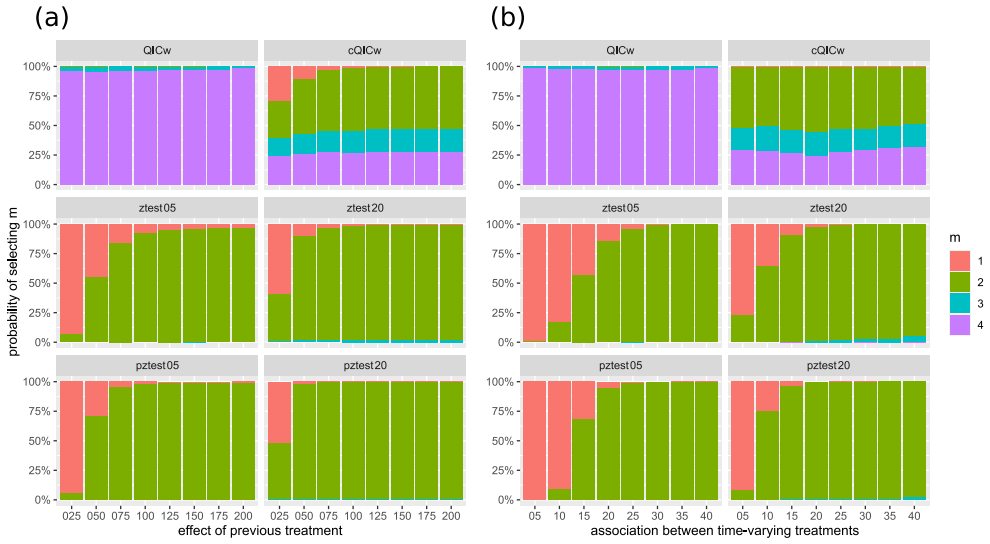
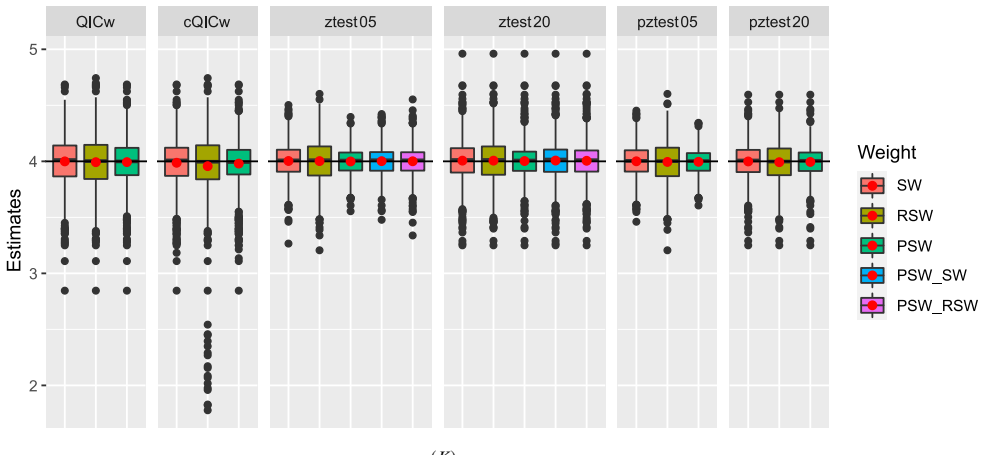
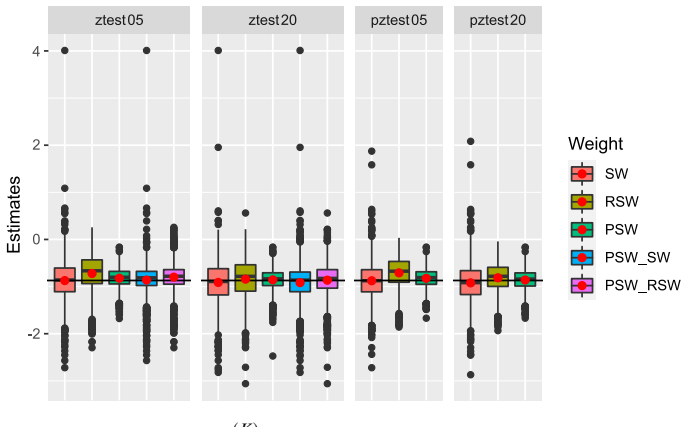
Inverse probability (IP) weighting of marginal structural models (MSMs) can provide consistent estimators of time-varying treatment effects under correct model specifications and identifiability assumptions, even in the presence of time-varying confounding. However, this method has two problems: (i) inefficiency due to IP-weights cumulating all time points and (ii) bias and inefficiency due to the MSM misspecification. To address these problems, we propose (i) new IP-weights for estimating parameters of the MSM that depends on partial treatment history and (ii) closed testing procedures for selecting partial treatment history (how far back in time the MSM depends on past treatments). We derive the theoretical properties of our proposed methods under known IP-weights and discuss their extension to estimated IP-weights. Although some of our theoretical results are derived under additional assumptions beyond standard identifiability assumptions, some of which can be checked empirically from the data. In simulation studies, our proposed methods outperformed existing methods both in terms of performance in estimating time-varying treatment effects and in selecting partial treatment history. Our proposed methods have also been applied to real data of hemodialysis patients with reasonable results.
Editorial analysis
A structured set of objections, weighed in public.
Referee Report
Summary. The paper proposes new inverse probability (IP) weights for marginal structural models (MSMs) that depend only on partial treatment history, along with closed testing procedures to select that history, in order to improve efficiency and reduce bias from full-history weighting and MSM misspecification when estimating time-varying treatment effects under time-varying confounding. Theoretical properties are derived under known weights (with extension to estimated weights) subject to additional assumptions beyond standard identifiability; simulations are reported to show outperformance versus existing methods in both estimation accuracy and history selection, with an application to hemodialysis data.
Significance. If the additional assumptions hold in practice and the reported simulation advantages are robust, the methods could yield more efficient estimators and better-calibrated model selection for longitudinal causal inference, addressing two recognized limitations of standard IP-weighted MSMs.
major comments (2)
- [Simulation studies] Simulation studies section: the data-generating processes are not described as including cases that violate the additional assumptions required for the consistency and efficiency claims of the new weights and closed testing procedure. Because the central claim is outperformance in simulations, absence of such stress tests leaves open whether the reported gains persist or whether type-I error control for the testing procedure degrades when the assumptions fail.
- [Theoretical results] Theoretical results section: the extension of the closed testing procedure to estimated IP-weights is stated to follow from the known-weights case, but no explicit bound or simulation evidence is given on how estimation error in the weights propagates to the family-wise error rate of the closed test under the additional assumptions.
minor comments (2)
- [Abstract and introduction] The abstract states that some additional assumptions 'can be checked empirically from the data'; an explicit list of these assumptions together with the corresponding diagnostic procedures would improve readability.
- [Notation and model] Notation for the partial treatment history (e.g., the truncation lag) is introduced without an early concrete numerical example; adding one would clarify the MSM specification.
Simulated Author's Rebuttal
We thank the referee for their constructive feedback on our manuscript. We respond to each major comment below, indicating the revisions we will make to address the concerns.
read point-by-point responses
-
Referee: [Simulation studies] Simulation studies section: the data-generating processes are not described as including cases that violate the additional assumptions required for the consistency and efficiency claims of the new weights and closed testing procedure. Because the central claim is outperformance in simulations, absence of such stress tests leaves open whether the reported gains persist or whether type-I error control for the testing procedure degrades when the assumptions fail.
Authors: Our simulation studies are performed under the additional assumptions because the theoretical properties of the proposed weights and closed testing procedure are established under these conditions. However, we agree that examining performance when the assumptions are violated would provide valuable insight into the robustness of the methods. In the revised manuscript, we will expand the simulation section to include data-generating processes that violate the additional assumptions and report the resulting estimation accuracy and type-I error rates for the closed testing procedure. revision: yes
-
Referee: [Theoretical results] Theoretical results section: the extension of the closed testing procedure to estimated IP-weights is stated to follow from the known-weights case, but no explicit bound or simulation evidence is given on how estimation error in the weights propagates to the family-wise error rate of the closed test under the additional assumptions.
Authors: The manuscript notes that the results for estimated weights follow from the known-weights case under the additional assumptions, but we did not include explicit bounds or simulation studies specifically addressing the propagation of weight estimation error to the family-wise error rate. We will revise the theoretical results section to incorporate simulation evidence showing the effect of estimated weights on the closed testing procedure's error control under the assumptions. revision: yes
Circularity Check
No significant circularity detected
full rationale
The paper derives new IP-weights for MSMs depending on partial treatment history and closed testing procedures for history selection, then states theoretical properties under known weights (with extension to estimated weights) and reports simulation outperformance. No quoted equations or steps reduce a claimed prediction or result to a fitted parameter or self-citation by construction; the additional assumptions are explicitly flagged as beyond standard identifiability and the simulation claims rest on independent empirical comparison rather than tautological redefinition of inputs.
Axiom & Free-Parameter Ledger
axioms (2)
- domain assumption Standard identifiability assumptions for consistent estimation of time-varying treatment effects via IP-weighted MSMs
- ad hoc to paper Additional assumptions beyond standard identifiability for the theoretical properties of the proposed weights and closed testing
Reference graph
Works this paper leans on
-
[1]
Margina l mean models for dynamic regimes
Murphy SA, van der Laan MJ, Robins JM, Group CPPR. Margina l mean models for dynamic regimes. Journal of the American Statistical Association. 2001;96(456):1410-23
work page 2001
-
[2]
Marginal Structural Models versus Structura l nested Models as Tools for Causal 27 inference
Robins JM. Marginal Structural Models versus Structura l nested Models as Tools for Causal 27 inference. In: Halloran ME, Berry D, editors. Statistical M odels in Epidemiology, the Environment, and Clinical Trials. New Y ork, NY : Springer New Y ork; 2000. p. 95-133
work page 2000
-
[3]
Causal in ference in longitudinal studies with history-restricted marginal structural models
Neugebauer R, van der Laan MJ, Joffe MM, Tager IB. Causal in ference in longitudinal studies with history-restricted marginal structural models. Electron ic Journal of Statistics. 2007;1:119-54
work page 2007
-
[4]
An information criterion for marginal structural models
Platt RW, Brookhart MA, Cole SR, Westreich D, Schisterma n EF. An information criterion for marginal structural models. Statistics in Medicine. 2013; 32(8):1383-93
work page 2013
-
[5]
Comments on ‘An information crite rion for marginal structural models’ by R
Taguri M, Matsuyama Y . Comments on ‘An information crite rion for marginal structural models’ by R. W. Platt, M. A. Brookhart, S. R. Cole, D. Westreich, and E . F. Schisterman. Statistics in Medicine. 2013;32(20):3590-1
work page 2013
-
[6]
A /u1D436/u1D45Dcriterion for semiparametric causal inference
Baba T, Kanemori T, Ninomiya Y . A /u1D436/u1D45Dcriterion for semiparametric causal inference. Biometrik a. 2017;104(4):845-61
work page 2017
-
[7]
Marginal structural mo dels and causal inference in epidemi- ology
Robins JM, Hernan MA, Brumback B. Marginal structural mo dels and causal inference in epidemi- ology. Epidemiology. 2000;11(5):550-60
work page 2000
-
[8]
Marginal structural mo dels to estimate the joint causal effect of nonrandomized treatments
Hernan MA, Brumback B, Robins JM. Marginal structural mo dels to estimate the joint causal effect of nonrandomized treatments. Journal of the American Stati stical Association. 2001;96(454):440-8
work page 2001
-
[9]
A test for the correct specification of marginal structural models
Sall A, Aube K, Trudel X, Brisson C, Talbot D. A test for the correct specification of marginal structural models. Statistics in Medicine. 2019;38(17):3 168-83
work page 2019
-
[10]
A ca utionary note concerning the use of stabilized weights in marginal structural models
Talbot D, Atherton J, Rossi AM, Bacon SL, Lefebvre G. A ca utionary note concerning the use of stabilized weights in marginal structural models. Statist ics in Medicine. 2015;34(5):812-23
work page 2015
-
[11]
In: Causality and Structural Models in Social S cience and Economics
Pearl J. In: Causality and Structural Models in Social S cience and Economics. Cambridge University Press; 2009. p. 133-72. 28
work page 2009
-
[12]
Hernan MA, Brumback B, Robins JM. Marginal structural m odels to estimate the causal effect of zidovudine on the survival of HIV-positive men. Epidemiolo gy. 2000;11(5):561-70
work page 2000
-
[13]
Simulation from a known Cox MSM using standard parametric models for the g-formula
Y oung JG, Tchetgen Tchetgen EJ. Simulation from a known Cox MSM using standard parametric models for the g-formula. Statistics in Medicine. 2014;33( 6):1001-14
work page 2014
-
[14]
Ishii T, Seya N, Taguri M, Wakui H, Y oshimura A, Tamura K. Allopurinol, febuxostat, and nonuse of xanthine oxidoreductase inhibitor treatment in patient s receiving Hemodialysis: A Longitudinal Analysis. Kidney Medicine. 2024;6(11):100896
work page 2024
-
[15]
MICE: Multivaria te imputation by chained equations in R
Van Buuren S, Groothuis-Oudshoorn K. MICE: Multivaria te imputation by chained equations in R. Journal of Statistical Software. 2011;45:1-67
work page 2011
-
[16]
Post-selection inference [Journal Article]
Kuchibhotla AK, Kolassa JE, Kuffner TA. Post-selection inference [Journal Article]. Annual Review of Statistics and Its Application. 2022;9(Volume 9, 2022): 505-27
work page 2022
-
[17]
Petersen M, Schwab J, Gruber S, Blaser N, Schomaker M, va n der Laan M. Targeted maximum likelihood estimation for dynamic and static longitudinalmarginal structural working models. Journal of Causal Inference. 2014;2(2):147-85
work page 2014
-
[18]
Robust estimation in sequentially ignorabl e missing data and causal inference models
Robins JM. Robust estimation in sequentially ignorabl e missing data and causal inference models. Proceedings of the American Statistical Association Section on Bayesian Statistical Science. 2000:6- 10
work page 2000
-
[19]
Robins JM. Commentary on ’Using inverse weighting and p redictive inference to estimate the effects of time-varying treatments on the discrete-time hazard’. S tatistics in Medicine. 2002;21(12):1663- 80. 29
work page 2002
-
[20]
Multiply robust estimators of causal effects for survival outcomes
Wen L, Hernan MA, Robins JM. Multiply robust estimators of causal effects for survival outcomes. Scandinavian Journal of Statistics. 2022;49(3):1304-28
work page 2022
-
[21]
Robust estimation of inverse probability weights for marginal structural models
Imai K, Ratkovic M. Robust estimation of inverse probability weights for marginal structural models. Journal of the American Statistical Association. 2015;110 (511):1013-23. 30 A Identifiability assumptions A.1 Identifiability assumptions of E[ /u1D44C¯/u1D44E] for ¯/u1D44E∈ ¯A (A1) consistency If ¯/u1D434= ¯/u1D44E,then /u1D44C= /u1D44C¯/u1D44E, for ¯/u1D4...
work page 2015
discussion (0)
Sign in with ORCID, Apple, or X to comment. Anyone can read and Pith papers without signing in.