REVIEW 3 major objections 6 minor 29 references
Noise-Aware Bayesian Optimization Approach for Capacity Planning of the Distributed Energy Resources in an Active Distribution Network
T0 review · 3 major / 6 minor · reviewed 2026-08-11 · deepseek-v4-flash
Pith's one-line read Noise-aware Bayesian optimization is proposed for capacity planning of distributed energy resources in active distribution networks, treating simulation deviation as Gaussian noise and reaching near-benchmark annual costs.
desk verdict A credible noiseless application of noisy expected improvement to DER capacity planning, but the noisy-case validation is partially circular and the adaptive noise update is miscalibrated as written. read the letter →
The pith
A machine-rendered reading of the paper's core claim, the machinery that carries it, and where it could break.
The reading
What carries the argument
The load-bearing machinery is a Gaussian-process surrogate model with a Matérn kernel, updated by a noisy expected improvement acquisition function, together with an adaptive estimate of the noise standard deviation. The Gaussian process receives noisy annual-cost outcomes from the simulation, treats the noise variance as a learned parameter, and produces a posterior mean and covariance for the true cost across the space of capacity plans. The noisy expected improvement function, approximated by quasi-Monte Carlo sampling from the posterior, chooses the next capacity plan to simulate by balancing predicted improvement against uncertainty. At the end, a simple reward strategy selects the plan with the lowest posterior mean, which is what keeps the final answer robust to the noise that would mislead a heuristic search that trusts each raw simulation.
What would settle it
Feed the optimizer a synthetic problem whose true cost is known and whose simulator noise is deliberately non-Gaussian (for example, skewed or with variance that grows with the plan's cost). If the posterior-mean selection rule then shows a systematic bias away from zero when compared with a large test set, the zero-mean fixed-variance Gaussian assumption that carries the method is falsified.
Extended reading notes
Core claim
The paper's central discovery is that the unavoidable deviation between an active distribution network's operation simulation and its real behavior can be converted from a nuisance into a handled quantity: instead of trying to eliminate the deviation with typical scenarios or very long dispatch cycles, the authors model it as a noise term appended to the annual cost objective. On top of this noisy objective they build a Bayesian optimizer whose probabilistic surrogate distinguishes signal from noise, and they show that the resulting plans are both economically better and computationally cheaper than those found by particle swarm optimization or standard Bayesian optimization. In the noiseless setting the optimizer essentially matches the quadratic-programming benchmark, and under noisy evaluation it attains roughly 0.2% error relative to a costly 200-scenario test value while heuristic search degrades sharply. The same machinery solves a larger 118-bus case, where distributing resources across more nodes lowers annual cost and increases renewable accommodation.
Load-bearing premise
The argument stands on the premise that the error between the simulation and the real network is zero-mean Gaussian noise with a fixed variance that does not depend on the capacity plan being tested.
Editorial extensions
If this is right
- Capacity planners can use the noise-aware optimizer in place of PSO when simulation outcomes are contaminated by renewable-scenario variability, since the surrogate separates signal from noise.
- The method removes the need for exhaustive scenario enumeration: a handful of random renewable scenarios per iteration suffices, with accuracy checked by a 200-scenario test value.
- Collaborative sizing of wind, solar, and storage beats single-resource planning: on the 33-bus case, combining all three gives the lowest annual cost, and adding storage raises renewable accommodation.
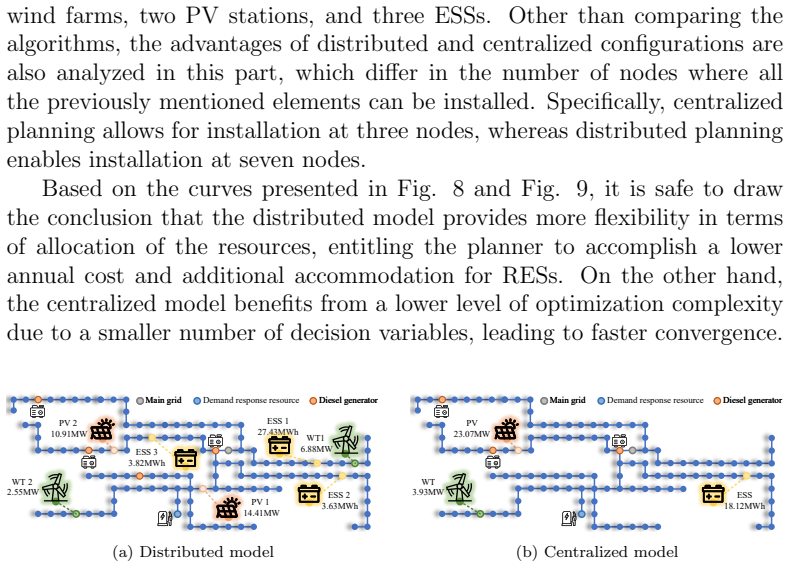
- Distributed placement of resources across more nodes in the 118-bus network yields lower annual cost and more renewable absorption than centralized placement, at the price of a more complex optimization.
- The reported convergence curves indicate that, even in the noiseless setting, the noise-aware optimizer reaches its near-benchmark solution in less computation time than standard BO and PSO.
Reading between the lines
- If the zero-mean, fixed-variance Gaussian noise assumption is replaced by a heteroscedastic model (noise growing with plan cost or with renewable penetration), the same framework should be extendable by letting the GP noise parameter vary with the input; the paper does not test this.
- The noise-aware treatment of simulation error is not specific to distribution networks: any expensive black-box simulator with stochastic inputs could adopt the same Gaussian-noise-plus-NEI recipe, so the method may transfer to other infrastructure planning problems.
- A testable extension would be to run NBO on a synthetic benchmark with known true objective and skewed or input-dependent noise, checking whether the 0.2% error level is preserved or whether the simple reward selection becomes biased.
- The paper tunes the initial noise standard deviation against the test benchmark; an automatic way to infer it from the data (for instance by marginal likelihood) would make the method fully parameter-free and is an implied next step.
Signed reviews
Editorial analysis
A structured set of objections, weighed in public.
Referee Report
Summary. The paper proposes a noise-aware Bayesian optimization (NBO) algorithm for the collaborative capacity planning of distributed energy resources (DERs) in an active distribution network (ADN). The planning model is formulated as an annual-cost minimization over wind, PV, and storage capacities, with a lower-level quadratic programming dispatch simulation subject to security constraints. The deviation between ADN simulation and real operation is modeled as zero-mean Gaussian noise added to the objective (Eqs. 15-16). The NBO algorithm uses a Gaussian-process surrogate, a noisy expected improvement acquisition function, and a 'simple reward' selection based on the GP posterior mean. Validation is performed against BO, PSO, and a QP benchmark in noiseless cases (Table 2), against a 200-scenario test value in the noisy case (Section 5.3), and on a 118-bus network for scalability (Section 5.4). The paper claims that NBO overcomes environmental noise, achieves lower annual cost, and is more sample-efficient than the baselines.
Significance. If the claims hold, the work would offer a practical way to account for simulation-to-reality deviation in distribution network planning without massive scenario enumeration. The noiseless validation (Table 2) is a genuine strength: NBO closely matches or improves upon the QP benchmark across all five models, and the convergence curves in Fig. 5 indicate faster convergence than PSO. The scalability experiment on the 118-bus network, comparing centralized and distributed configurations, is also valuable. However, the central noise-aware claim rests on two points that are not yet fully supported: the adaptive noise-variance update in Algorithm 1 and the validation of the noise level in Section 5.3. The paper provides reproducible equations and a clear QP benchmark, but it does not ship code or machine-checked proofs. The reported 0.2044% error in the noisy case is a fitted quantity because σn is tuned on the test benchmark, so the quantitative noise-handling result is not yet independent. With revision addressing these issues, the paper would be a useful contribution.
major comments (3)
- [Algorithm 1, lines 7 and 13; §3.3 Eq. (16)] The adaptive noise variance update sets σn to a weighted average of its previous value and the sample standard deviation of all observed objective values. That statistic estimates the marginal spread of the noisy annual costs across the sampled capacity plans, not the variance of the noise term ε in Eq. (16), because it conflates the input-dependent variation of CT(x) with the observation noise. An overestimated σn shrinks the GP posterior mean toward the prior constant, attenuating the differences between candidate plans on which the final 'simple reward' selection (lines 17–18) relies. The paper provides no derivation for this update, no value for the adaptive rate ζ, and no sensitivity analysis. As written, the GP posterior used for NEI and final selection is not a valid posterior under the stated model, which undermines the claimed connection between the probabilistic surrogate and the noisy optimization results.
- [§5.3, Eq. (30) and Fig. 7a] The error e used to assess the GP inference is computed against the test value C_test, and the optimal initial noise standard deviation σn = 4.5e5 is selected by minimizing this same error on the test benchmark. Consequently, the reported 0.2044% error for NBO is a fitted result, not an independent out-of-sample validation of the noise-handling claim. This circularity also affects the paper's assertion in §3.3 that the Gaussian approximation 'has enough accuracy', because that assertion is justified only by the same Section 5.3 experiment. To support the central claim, the authors should estimate σn from data independent of the test benchmark (e.g., from historical simulation-vs-observation mismatch pairs) or report performance over a range of σn without selecting the best on the test set.
- [§5.2, Table 2 and Fig. 5] The comparison against 'basic BO' is not fully specified. The paper does not state what acquisition function the baseline uses, whether it is a noiseless or noisy EI variant, how the GP hyperparameters are initialized or re-estimated, or whether multiple restarts are performed. Since the central claim is that NBO outperforms BO, the baseline configuration must be described in enough detail to be reproducible and to ensure a fair comparison. Please provide the exact BO setup and cite a specific standard implementation, or otherwise document the configuration used.
minor comments (6)
- [§5.1] There is a typo: 'Inter CORE' should be 'Intel Core'.
- [§4, after Eq. (24)] The phrase 'quasi-Monte Carol' should be 'quasi-Monte Carlo'.
- [§3.3 and Algorithm 1] The notation for the noisy objective is inconsistent: Eq. (15) uses CobT(x), Algorithm 1 uses y and f(x), and Section 5.3 uses µD and e. Please unify the symbols for the observed noisy cost and the GP mean.
- [Fig. 7a] The caption describes a 'stacked bar chart', but the plotted curves for BO and NBO appear to be lines or single bars; please clarify the plot type and whether the error bars represent standard deviations across repeated optimization runs.
- [Fig. 9] The legend labels 'BO7/NBO7' and 'BO3/NBO3' are not defined in the caption; add a note that 7 and 3 refer to the number of installable nodes in the distributed and centralized models, respectively.
- [§5.3] The selection of Nres = 200 is stated to be 'by experiment', but the sensitivity of the test value to Nres is not shown; please report the experiment or provide a brief discussion.
Circularity Check
The headline noisy-case accuracy in Section 5.3 is partially circular because the noise hyperparameter σn is tuned against the same test-value error metric used to report the 0.2044% error.
-
fitted input called prediction
[Section 5.3, Eqs. (21), (29)-(30), Fig. 7a]
"As shown in Fig. 7a, the accuracy of the GP inference model is related to the initial noise standard deviation σn used in (21). With the proper selection of σn, in the case of the proposed model, optimal σn being 4.5e5, the error e can be reduced to only -0.4251% (BO) and 0.2044% (NBO), acceptably for practical use."
Equation (30) defines the reported accuracy as e=(μD−C_test_T)/C_test_T×100%, where μD is the GP posterior mean from Eq. (21). That posterior mean depends on σn through [K(X,X)+σnI]^{-1}. The paper then selects the 'optimal σn' of 4.5e5 by inspection of the e-versus-σn relationship in Fig. 7a, using the same 200-scenario test value that defines e. The reported NBO error of 0.2044% and BO error of -0.4251% are therefore in-sample optima of the evaluation metric with respect to a tuned hyperparameter, not independent out-of-sample predictions. The Section 5.3 claim that the Gaussian approximation is 'testified to have enough accuracy' is consequently partly circular: the noise level is fitted to the very benchmark used to validate the approximation.
full rationale
The paper's main derivation chain (noise model Eqs. (15)-(16), GP posterior Eqs. (20)-(21), NEI acquisition Eqs. (22)-(25), and final simple-reward selection in Algorithm 1) is self-contained and follows the external Letham et al. noisy BO framework; these are not self-citations and no uniqueness argument is imported from the authors' own prior work. The one clear circular step is in the noisy-case validation: Section 5.3 tunes the initial noise standard deviation σn to minimize the same test-value error e that is then reported as the algorithm's accuracy. This makes the headline noisy-case error a fitted quantity rather than an independent prediction. Algorithm 1's adaptive update of σn as the sample standard deviation of observed objective values is a statistical mis-specification concern (it conflates objective variation with observation noise), but it is not a reduction of a claimed prediction to its inputs, so it is not counted as circularity here. Because the noiseless Section 5.2 comparison against a QP benchmark and the external methodology provide independent content, the overall circularity is partial, not complete.
Assumptions & free parameters
free parameters (4)
- Initial noise standard deviation sigma_n =
4.5e5 (selected by experiment)
- Adaptive rate zeta =
Not reported
- Number of test scenarios Nres =
200
- GP kernel hyperparameters (sigma, v, l) =
Not reported
assumptions (6)
- domain assumption Simulation deviation epsilon(P_res) is zero-mean Gaussian with fixed variance sigma_n^2
- domain assumption The simulation deviation is independent of the capacity scheme x and homoscedastic
- domain assumption The test value averaged over 200 scenarios approximates the true annual cost CT(x)
- domain assumption Random RES scenarios drawn from historical data are representative of future operation
- domain assumption The linearized power flow model from [27] is accurate for the ADN
- standard math The NEI approximation via quasi-Monte Carlo from Letham et al. [28] is correct
Cite this review
Pith. "Pith review of Noise-Aware Bayesian Optimization Approach for Capacity Planning of the Distributed Energy Resources in an Active Distribution Network." pith.science (2026). https://pith.science/paper/2NT4WHVL
@misc{pith2026241208370,
  author       = {Pith},
  title        = {Pith review of: Noise-Aware Bayesian Optimization Approach for Capacity Planning of the Distributed Energy Resources in an Active Distribution Network},
  year         = {2026},
  howpublished = {\url{https://pith.science/paper/2NT4WHVL}},
  note         = {Machine review of arXiv:2412.08370}
}
read the original abstract
The growing penetration of renewable energy sources (RESs) in active distribution networks (ADNs) leads to complex and uncertain operation scenarios, resulting in significant deviations and risks for the ADN operation. In this study, a collaborative capacity planning of the distributed energy resources in an ADN is proposed to enhance the RES accommodation capability. The variability of RESs, characteristics of adjustable demand response resources, ADN bi-directional power flow, and security operation limitations are considered in the proposed model. To address the noise term caused by the inevitable deviation between the operation simulation and real-world environments, an improved noise-aware Bayesian optimization algorithm with the probabilistic surrogate model is proposed to overcome the interference from the environmental noise and sample-efficiently optimize the capacity planning model under noisy circumstances. Numerical simulation results verify the superiority of the proposed approach in coping with environmental noise and achieving lower annual cost and higher computation efficiency.
Figures


Figures from the paper (6 more)



Reference graph
Works this paper leans on
-
[1]
Privacy-preserving distributed energy transaction in active distribution networks,
X. Chang, Y. Xu, H. Sun, and Q. Wu, “Privacy-preserving distributed energy transaction in active distribution networks,” IEEE Trans. Power Syst., vol. 38, no. 4, pp. 3413–3426, 2023
work page 2023
-
[2]
D. Liu, X. Zhang, and C. K. Tse, “Effects of high level of penetration of renewable energy sources on cascading failure of modern power systems,” IEEE Jour. Emer. Select. Top. Circu. Syste. , vol. 12, no. 1, pp. 98–106, 2022
work page 2022
-
[3]
Assessment of energy storage technologies: A review,
M. M. Rahman, A. O. Oni, E. Gemechu, and A. Kumar, “Assessment of energy storage technologies: A review,” Energy Conv. Manag. , vol. 223, p. 113295, 2020
work page 2020
-
[4]
J. Tan, Q. Wu, and X. Zhang, “Optimal planning of integrated electricity and heat system considering seasonal and short-term thermal energy storage,” IEEE Trans. Smart Grid , vol. 14, no. 4, pp. 2697–2708, 2023
work page 2023
-
[5]
Power system planning with increasing variable renew. energy: A review of optimization models,
X. Deng and T. Lv, “Power system planning with increasing variable renew. energy: A review of optimization models,” J. Clean Prod. , vol. 246, p. 118962, 2020. 24
work page 2020
-
[6]
Milp model for long-term energy mix planning with consideration of power system reserves,
M. Wierzbowski, W. Lyzwa, and I. Musial, “Milp model for long-term energy mix planning with consideration of power system reserves,”Appl. Energy, vol. 169, pp. 93–111, 2016
work page 2016
-
[7]
Z. Guo, L. Ma, P. Liu, I. Jones, and Z. Li, “A multi-regional modelling and optimization approach to china’s power generation and transmission planning,” Energy, vol. 116, pp. 1348–1359, 2016
work page 2016
-
[8]
B. Chen, T. Liu, X. Liu, C. He, L. Nan, L. Wu, and X. Su, “Distribution- ally robust coordinated expansion planning for generation, transmission, and demand side resources considering the benefits of concentrating solar power plants,” IEEE Trans. Power Syst. , vol. 38, no. 2, pp. 1205–1218, 2023
work page 2023
Show all 29 references
-
[9]
Long-term optimisation model of the tunisian power system,
A. Dhakouani, F. Gardumi, E. Znouda, C. Bouden, and M. Howells, “Long-term optimisation model of the tunisian power system,” Energy, vol. 141, pp. 550–562, 2017
2017
-
[10]
Two-stage planning for electricity-gas coupled integrated energy system with carbon capture, utilization, and storage considering carbon tax and price uncertainties,
A. Xuan, X. Shen, Q. Guo, and H. Sun, “Two-stage planning for electricity-gas coupled integrated energy system with carbon capture, utilization, and storage considering carbon tax and price uncertainties,” IEEE Trans. Power Syst. , vol. 38, no. 3, pp. 2553–2565, 2023
2023
-
[11]
Data-driven resource planning for virtual power plant integrating demand response customer selection and storage,
H. Liang and J. Ma, “Data-driven resource planning for virtual power plant integrating demand response customer selection and storage,” IEEE Trans. Ind. Inform. , vol. 18, no. 3, pp. 1833–1844, 2021
2021
-
[12]
Stochastic wind farm expansion planning with decision-dependent uncertainty under spatial smoothing effect,
W. Yin, S. Feng, and Y. Hou, “Stochastic wind farm expansion planning with decision-dependent uncertainty under spatial smoothing effect,” IEEE Trans. Power Syst. , vol. 38, no. 3, pp. 2845–2857, 2023
2023
-
[13]
Adaptive integrated plan- ning of electricity networks and fast charging stations under electric vehicle diffusion,
Y. Tao, J. Qiu, S. Lai, X. Sun, and J. Zhao, “Adaptive integrated plan- ning of electricity networks and fast charging stations under electric vehicle diffusion,” IEEE Trans. Power Syst., vol. 38, no. 1, pp. 499–513, 2023
2023
-
[14]
Bi-level coordinated planning of active distribution network considering demand response resources and severely restricted scenar- ios,
Y. Huang, Z. Lin, X. Liu, L. Yang, Y. Dan, Y. Zhu, Y. Ding, and Q. Wang, “Bi-level coordinated planning of active distribution network considering demand response resources and severely restricted scenar- ios,” J. Mod. Power Syst. Clean Energy , vol. 9, no. 5, pp. 1088–1100, 2021. 25
2021
-
[15]
A multi-step reconfiguration model for active distribution network restoration integrating dg start-up sequences,
H. Sekhavatmanesh and R. Cherkaoui, “A multi-step reconfiguration model for active distribution network restoration integrating dg start-up sequences,” IEEE Trans. Sustain. Energy, vol. 11, no. 4, pp. 2879–2888, 2020
2020
-
[16]
Optimal planning of dis- tributed energy storage systems in active distribution networks embed- ding grid reconfiguration,
M. Nick, R. Cherkaoui, and M. Paolone, “Optimal planning of dis- tributed energy storage systems in active distribution networks embed- ding grid reconfiguration,” IEEE Trans. Power Syst. , vol. 33, no. 2, pp. 1577–1590, 2017
2017
-
[17]
Planning active dis- tribution networks considering multi-dg configurations,
S. S. Al Kaabi, H. Zeineldin, and V. Khadkikar, “Planning active dis- tribution networks considering multi-dg configurations,” IEEE Trans. Power Syst. , vol. 29, no. 2, pp. 785–793, 2013
2013
-
[18]
Optimal co-planning of esss and line reinforcement considering the dis- patchability of active distribution networks,
J. H. Yi, R. Cherkaoui, M. Paolone, D. Shchetinin, and K. Knezovic, “Optimal co-planning of esss and line reinforcement considering the dis- patchability of active distribution networks,” IEEE Trans. Power Syst., vol. 38, no. 3, pp. 2485–2499, 2023
2023
-
[19]
A novel shared energy storage planning method considering the correlation of renewable un- certainties on the supply side,
Q. Wang, X. Zhang, C. Yi, Z. Li, and D. Xu, “A novel shared energy storage planning method considering the correlation of renewable un- certainties on the supply side,” IEEE Trans. Sustain. Energy , vol. 13, no. 4, pp. 2051–2063, 2022
2022
-
[20]
Electrical load pattern group- ing based on centroid model with ant colony clustering,
G. Chicco, O.-M. Ionel, and R. Porumb, “Electrical load pattern group- ing based on centroid model with ant colony clustering,” IEEE Trans. Power Syst. , vol. 28, no. 2, pp. 1706–1715, 2012
2012
-
[21]
An efficient power system planning model considering year-round hourly operation simulation,
N. Zhang, H. Jiang, E. Du, Z. Zhuo, P. Wang, Z. Wang, and Y. Zhang, “An efficient power system planning model considering year-round hourly operation simulation,” IEEE Trans. Power Syst. , vol. 37, no. 6, pp. 4925–4935, 2022
2022
-
[22]
Economic analysis and optimization of a renewable energy based power supply system with different energy storages for a remote island,
M. S. Javed, T. Ma, J. Jurasz, F. A. Canales, S. Lin, S. Ahmed, and Y. Zhang, “Economic analysis and optimization of a renewable energy based power supply system with different energy storages for a remote island,” Renew. Energy, vol. 164, pp. 1376–1394, 2021
2021
-
[23]
Benefits of strate- gically sizing wind-integrated energy storage and transmission,
S. Bhattacharjee, R. Sioshansi, and H. Zareipour, “Benefits of strate- gically sizing wind-integrated energy storage and transmission,” IEEE Trans. Power Syst., vol. 36, no. 2, pp. 1141–1151, 2020. 26
2020
-
[24]
Two-stage stochastic optimization model for multi-microgrid planning,
E. G. Vera, C. A. Ca˜ nizares, M. Pirnia, T. P. Guedes, and J. D. M. Trujillo, “Two-stage stochastic optimization model for multi-microgrid planning,” IEEE Trans. Smart Grid, vol. 14, no. 3, pp. 1723–1735, 2023
2023
-
[25]
Transportable energy storage system planning for mitigating grid vulnerability,
Y. Tao, J. Qiu, S. Lai, and Z. Y. Dong, “Transportable energy storage system planning for mitigating grid vulnerability,” IEEE Trans. Power Syst., vol. 38, no. 5, pp. 4462–4475, 2023
2023
-
[26]
Distribution network planning enhancement via network reconfiguration and dg integration using dataset approach and water cycle algorithm,
M. A. Muhammad, H. Mokhlis, K. Naidu, A. Amin, J. F. Franco, and M. Othman, “Distribution network planning enhancement via network reconfiguration and dg integration using dataset approach and water cycle algorithm,” J. Mod. Power Syst. Clean Energy , vol. 8, no. 1, pp. 86–93, 2020
2020
-
[27]
Novel linearized power flow and linearized opf models for active distribution networks with application in distribution lmp,
H. Yuan, F. Li, Y. Wei, and J. Zhu, “Novel linearized power flow and linearized opf models for active distribution networks with application in distribution lmp,” IEEE Trans. Smart Grid , vol. 9, no. 1, pp. 438–448, 2016
2016
-
[28]
Constrained bayesian optimization with noisy experiments,
B. Letham, B. Karrer, G. Ottoni, and E. Bakshy, “Constrained bayesian optimization with noisy experiments,” Bayesian Anal., vol. 14, no. 2, pp. 495–519, 2019
2019
-
[29]
An improved ts algorithm for loss- minimum reconfiguration in large-scale distribution systems,
D. Zhang, Z. Fu, and L. Zhang, “An improved ts algorithm for loss- minimum reconfiguration in large-scale distribution systems,” Electr. Power Syst. Res. , vol. 77, no. 5-6, pp. 685–694, 2007. 27
2007
Reviewed August 11, 2026 · model on record in the stance chip above.
Discussion (0). Continue with ORCID to comment.