REVIEW 4 major objections 4 minor 31 references
Geometric-combinatorial approaches to tilting theory for weighted projective lines
T0 review · 4 major / 4 minor · reviewed 2026-08-10 · deepseek-v4-flash
Pith's one-line read The paper establishes a bijection between indecomposable coherent sheaves on the weighted projective line of type $(2,2,n)$ and skew-curves on a cylinder with $n$ boundary-marked points, and shows pseudo-triangulations correspond to…
desk verdict A useful equivariant geometric model for coh-X(2,2,n), but the central bijection rests on an unproved compatibility statement imported from an unpublished companion; needs that filled before it can be trusted. read the letter →
The pith
A machine-rendered reading of the paper's core claim, the machinery that carries it, and where it could break.
The reading
What carries the argument
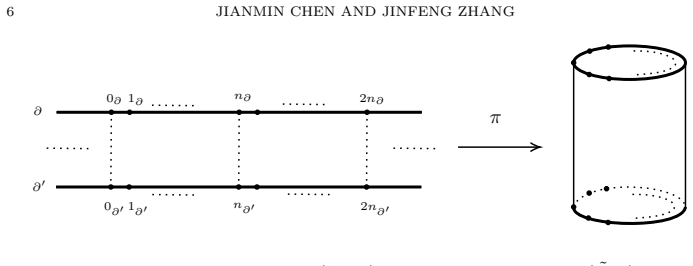
The central object is the marked cylinder $(S,M,\sigma)$, where $S$ is a cylinder, $M$ has $n$ marked points on each boundary, and $\sigma$ is the order-2 self-homeomorphism induced by reflection $(x,y)\mapsto(-x,1-y)$ on the universal cover. A skew-curve is the equivariant data obtained from a curve in the $(n,n)$ model: a half of a $\sigma$-fixed curve, an unordered pair $\{\gamma,\sigma(\gamma)\}$, or a parameterized loop with a $\pm$ label or paired with its inverse parameter. The key transfer identity is $\varphi(\sigma(\gamma))=\sigma_{1,2}(\varphi(\gamma))$, which makes the surface involution agree with the automorphism exchanging the two weighted points of the $(n,n)$ model; through it, Ext-vanishing is read off from intersection numbers according to the criterion of Proposition 4.9. A skew-arc is a skew-curve compatible with itself, and a pseudo-triangulation is a maximal set of distinct pairwise compatible skew-arcs; these are the combinatorial shadows of tilting sheaves.
What would settle it
For a small $n$ such as $n=4$, enumerate all curves in $C_b\cup C_p$ and all indecomposables in $\operatorname{coh}\mathbb{Y}$ and directly verify $\varphi(\sigma(\gamma))=\sigma_{1,2}(\varphi(\gamma))$; one mismatch would refute Proposition 3.5. Independently, compute $\dim\operatorname{Ext}^1_{\mathbb{X}}(\widehat\varphi(\widehat\gamma_1),\widehat\varphi(\widehat\gamma_2))$ for every pair of skew-curves satisfying conditions (T1)-(T2) in Proposition 4.9, looking for a pair with total intersection $I=0$ and non-zero $\operatorname{Ext}^1$: any such pair refutes the equivariant intersection-to-Ext transfer.
Extended reading notes
Core claim
The central claim is Proposition 3.5: there is a bijection $\widehat\varphi:\widehat C\to\operatorname{ind}(\operatorname{coh}\mathbb{X})$ sending each skew-curve to an indecomposable sheaf. Line bundles are the two halves of $\sigma$-fixed boundary curves, extension bundles are pairs $\{\gamma,\sigma(\gamma)\}$ from non-fixed curves, and the simple sheaves in the $\tau$-period-2 tubes are the distinguished parameterized loops; the correspondence is made explicit in Table 1. Proposition 4.16 upgrades this to a one-to-one correspondence between pseudo-triangulations on $(S,M,\sigma)$ and tilting sheaves, so each tilting sheaf has exactly $n+3$ indecomposable summands. Corollary 4.17 states that flipping a skew-arc in a pseudo-triangulation produces exactly the object one gets by tilting mutation of the corresponding sheaf, and Theorem 5.11 concludes that the tilting graph $G(T_{\mathbb{X}})$ is connected. The whole dictionary rests on the equivariant relationship $\operatorname{coh}\mathbb{X}\cong(\operatorname{coh}\mathbb{Y})^G$, where $\mathbb{Y}$ is the weighted projective line of type $(n,n)$ and $G$ is the order-2 group exchanging its two weighted points.
Load-bearing premise
The load-bearing premise is that the unpublished base model [12] for type $(n,n)$ is correct, and in particular that $\varphi(\sigma(\gamma))=\sigma_{1,2}(\varphi(\gamma))$ and that the intersection-to-Ext criterion remains valid after equivariantization; if those fail, the bijection and both tilting theorems collapse.
Editorial extensions
If this is right
- Tilting sheaves in $\operatorname{coh}\mathbb{X}(2,2,n)$ are classified by pseudo-triangulations, recovering the known classification of tilting bundles of type $(2,2,n)$ as the subclass with no loops.
- Mutation at an indecomposable summand is the geometric flip of its skew-arc; hence every mutation has a unique inverse and the exchange graph of tilting sheaves is the flip graph of pseudo-triangulations.
- Any two tilting sheaves are connected by a finite sequence of mutations because any two pseudo-triangulations of $(S,M,\sigma)$ are connected by flips, as established in Theorem 5.11.
- An almost complete tilting sheaf has exactly two complements, matching the fact that a skew-arc in a pseudo-triangulation has exactly one flip.
- The $\mathbb{Z}(\vec{x}_1-\vec{x}_2)$-stable tilting bundles form a connected subgraph that can be mutated to any other stable tilting bundle through explicit sequences of flips.
- The correspondence gives a uniform bookkeeping device: whether a collection of sheaves is rigid and tilting can be read directly from the intersection pattern of the corresponding skew-curves.
Reading between the lines
- Editorial inference: if the compatibility identity $\varphi(\sigma(\gamma))=\sigma_{1,2}(\varphi(\gamma))$ is checked directly for small $n$, the geometric model and the connectivity theorem would no longer depend on the unpublished base preprint [12].
- Editorial inference: the same equivariantization template suggests analogous surface models for other weighted projective lines obtained as quotients by finite subgroups of the automorphism group, as long as the group action is compatible with the base model's curve bijection.
- Editorial inference: the correspondence opens a counting route: the number of tilting sheaves on $\mathbb{X}(2,2,n)$ should equal the number of pseudo-triangulations of $(S,M,\sigma)$, a finite quantity that the flip graph could enumerate for each $n$; the paper does not compute these counts.
Formalized claims in Lean
-
Claim #1: The central claim is Proposition 3.5: there is a bijection $\widehat\varphi:\widehat C\to\operatorname{ind}(\operatorname{coh}\mathbb{X})$ sending each skew-curve to an indecomposable sheaf. Line bundles are the two halves of $\sigma$-fixed boundary curves, extension bundles are pairs $\{\gamma,\sigma(\gamma)\}$ from non-fixed curves, and the simple sheaves in the $\tau$-period-2 tubes are the dis
/-- @claim 1 The central claim is Proposition 3.5: there is a bijection $\widehat\varphi:\widehat C\to\operatorname{ind}(\operatorname{coh}\mathbb{X})$ sending each skew-curve to an indecomposable sheaf. Line bundles are the two halves of $\sigma$-fixed boundary curves, extension bundles are pairs $\{\gamma,\sigma(\gamma)\}$ from non-fixed curves, and the simple sheaves in the $\tau$-period-2 tubes are the dis -/
def central_claim : Prop :=
Editorial analysis
A structured set of objections, weighed in public.
Referee Report
Summary. The paper proposes a geometric-combinatorial model for the category of coherent sheaves on the weighted projective line of type (2,2,n). The model is a cylindrical surface with n marked points on each boundary, equipped with an order 2 self-homeomorphism. The authors construct a bijection between indecomposable sheaves and skew-curves, define compatibility and pseudo-triangulations, prove that pseudo-triangulations correspond to tilting sheaves, show that the flip of a skew-arc corresponds to tilting mutation, and use these tools to prove connectivity of the tilting graph. The main results are Proposition 3.5 (the bijection), Proposition 4.16 (pseudo-triangulations versus tilting sheaves), Corollary 4.17 (flip equals mutation), and Theorem 5.11 (connectivity of the tilting graph).
Significance. If the main claims hold, the paper provides a useful geometric model for a category that has been studied from an algebraic perspective, and it gives a new proof of the connectivity of the tilting graph. The paper is clearly written and contains explicit examples and tables. It also ships a substantial amount of technical machinery, including an appendix on equivariantization and an appendix on flips, and it makes a concrete new prediction: that flips of skew-arcs coincide with tilting mutations. The main weakness is the heavy reliance on the unpublished preprint [12] and on a compatibility statement that is asserted rather than proved; these points are load-bearing for the central bijection and the derived correspondences.
major comments (4)
- [Section 3.2, Proposition 3.5] The proof of Proposition 3.5 asserts that the homeomorphism σ is compatible with the automorphism σ_{1,2} in the sense φ(σ(γ)) = σ_{1,2}(φ(γ)) for every curve γ ∈ C_b ∪ C_p, and states that this is 'implicit in the proof of [12, Theorem 1.1]'. This equality is load-bearing: it is exactly what matches the geometric quotient in §3.2 with the algebraic equivariantization in Appendix A, and without it Table 1 is not a bijection. The authors should either give a direct proof of this compatibility from the definition of φ, or state it as an explicit hypothesis with a precise reference to a specific statement in [12].
- [Section 4.2, Proposition 4.9] Proposition 4.9 applies [12, Theorem 3.10] as an intersection-to-Ext criterion after equivariantization. It is not shown that this criterion is compatible with the G-action or with the induction and forgetful functors used in the proof. In particular, the step where indecomposable direct summands of F∘Ind_2(φ̂(γ_i)) are said to correspond to curves in C(γ_i), and the inequality obtained from [14, Lemma 3.4], need justification. If the intersection–Ext criterion does not survive equivariantization, the geometric characterization of compatibility collapses for all skew-curves outside C_b,X.
- [Definition 4.3 and Proposition 4.16] Compatibility of skew-curves is defined directly as the vanishing of Ext^1 between the corresponding sheaves (Definition 4.3). Under this definition, Proposition 4.16 is to a large extent a reformulation of the definition of a tilting sheaf plus the bijection φ̂, rather than a geometric statement. The genuine geometric content must come from Proposition 4.9, but that proposition does not cover the loop-type skew-curves in C* (i.e. C_pw and C_sp). Thus, for the summands coming from C*, the paper does not provide a purely geometric criterion for compatibility; the 'pseudo-triangulation' description is only geometric for the curve-type skew-curves.
- [Proposition 4.15 and Appendix B] The proof of Proposition 4.15 asserts that the constructed set Γ_Λ is a triangulation and uses the formula |Γ_Λ| = 2n + 3|P_Λ|, but several cases (e.g. cases (3) and (4)) are dismissed as 'similar' or left to inspection. Likewise, Appendix B lists three types of flips but does not prove that every skew-arc in a pseudo-triangulation falls into exactly one of these types, nor that the described replacement always yields a new pseudo-triangulation. These steps are needed because the flip relation is used in Corollary 4.17 and Theorem 5.11.
minor comments (4)
- [Abstract / Introduction] There is a typo in the abstract and again in the introduction: 'titling' should be 'tilting'.
- [References] The paper relies heavily on the unpublished preprint [12]; references [13], [14], and [16] are also recent preprints or papers. It would be helpful to mark these as such and to state explicitly which parts of the argument depend on [12].
- [Table 1] In the row for C_σ_p, the index expression ~[D_{i-j-1,i}] is used, while the definition of C_σ_p earlier uses ~[D_{i,j}] with j-i ≥ 2; the relation between these two notations should be clarified.
- [Figures] Several figures (e.g. Figures 1, 2 and the flip diagrams in Appendix B) are small and contain labels that are difficult to read; higher-resolution versions would improve the presentation.
Circularity Check
The tilting correspondence is partly a relabeling of Ext-vanishing, and the central bijection rests on an unproved compatibility statement imported from the same authors' unpublished preprint.
-
self citation load bearing
[Section 3.2, proof of Proposition 3.5]
"Next, note that the diffeomorphism σ can naturally be regarded as an element of the mapping class group of ( S, M) and it is implicit in the proof of [ 12, Theorem 1.1] that σ is compatible with σ1,2 in the following sense: φ(σ(γ)) = σ1,2(φ(γ)), for any curve γ ∈ Cb ∪ Cp."
Proposition 3.5 is the foundation of the paper: it constructs the bijection φhat between skew-curves and indecomposable sheaves on X(2,2,n). The proof does not derive the compatibility φ(σ(γ)) = σ1,2(φ(γ)); it cites an unpublished preprint by overlapping authors and says the statement is implicit there. That compatibility is exactly what connects the geometric quotient curves to the algebraic equivariantization. Without it, Table 1 does not give a well-defined bijection, and Proposition 4.16, Corollary 4.17, and Theorem 5.11 inherit the gap. This is a load-bearing self-citation rather than an independently verified mathematical input.
-
self definitional
[Definition 4.3 and Proposition 4.16]
"Two skew-curves ˆγ1 and ˆγ2 in ˆC are called compatible if dimk Ext1 X( ˆφ(ˆγ1), ˆφ(ˆγ2)) = dim k Ext1 X( ˆφ(ˆγ2), ˆφ(ˆγ1)) = 0 . ... Let Λ = {ˆγ1, ˆγ2, · · · , ˆγn+3} be a pseudo-triangulation on ( S, M, σ). Let T = ⊕n+3 i=1 ˆφ(ˆγi). According to the definition of pseudo-triangulation, we have dimkExt1 X( ˆφ(ˆγi), ˆφ(ˆγj)) = 0 ... Combining with Proposition 4.1, we get that T is a tilting sheaf in coh- X."
The geometric notion compatible is defined directly as vanishing of Ext between the corresponding sheaves, and pseudo-triangulation is defined as a maximal set of pairwise compatible skew-arcs. Therefore the forward direction of Proposition 4.16 is true by definition: the pairwise Ext-vanishing condition is exactly the rigidity part of the tilting condition, with the count |Λ| = n + 3 supplying the rest. The theorem is a relabeling of the algebraic tilting criterion in geometric vocabulary. The genuinely geometric content would have to come from an independent intersection criterion, which is not fully established for the C∗ skew-curves and is imported from [12] for the others.
1 more flagged steps
-
self citation load bearing
[Section 4.2, proof of Proposition 4.9]
"By [ 12, Theorem 3.10], the condition I(C(ˆγ1), C(ˆγ2)) = 0 implies that the right-hand side is zero. It follows that Ext 1 X(φ(ˆγ1), φ(ˆγ2)) = 0."
Proposition 4.9 is the bridge that gives geometric meaning to the algebraically defined compatibility: it asserts that non-intersection of associated curves is equivalent to Ext-vanishing. The proof invokes [12, Theorem 3.10], an intersection-to-Ext criterion proved in the same authors' unpublished preprint, and does not show that the criterion remains valid after the equivariantization and induction steps used here. Thus the central equivalence between intersections and Ext is not derived in this paper; it is transported from a self-cited source whose applicability to the (S, M, σ) equivariant setting is assumed rather than established.
full rationale
The paper contains a genuine attempt to build a geometric model, and much of the combinatorics in Sections 5 and Appendix B is self-contained. However, the two main structural claims are not fully independent of the authors' prior unpublished work. Proposition 3.5 imports the key compatibility φ(σ(γ)) = σ1,2(φ(γ)) from [12] by assertion; Proposition 4.9 imports the intersection-to-Ext criterion [12, Theorem 3.10]. Moreover, Definition 4.3 defines compatibility of skew-curves as Ext-vanishing of the associated sheaves, so Proposition 4.16 is partially a restatement of the tilting definition rather than a derived geometric correspondence. These dependencies are load-bearing: if the compatibility or the equivariantized intersection criterion fails, the bijection between skew-curves and indecomposable sheaves, and hence the tilting, flip, and connectivity theorems, collapse. The paper is not wholly circular—the count |Λ| = n + 3, the flip construction, and the connectivity arguments are new combinatorial work—but the central bijection and the geometric meaning of compatibility rely on self-citations and on a definition that builds the target algebraic property into the geometric object. Score 6 reflects partial circularity: some predictions and correspondences reduce by construction or by a self-citation chain.
Assumptions & free parameters
assumptions (7)
- domain assumption Geometric model for coh-X(n,n): bijection phi between curves C and indecomposable sheaves, and intersection criterion for Ext^1 ([12, Theorems 3.4 and 3.10]).
- domain assumption Equivalences (coh-X)^{Z(x1-x2)} ≅ coh-Y and (coh-Y)^G ≅ coh-X (Proposition A.2, based on [17] and [9]).
- domain assumption Orbifold quotient Y/G ≅ X with the orbit weights listed in Remark A.1 ([27]).
- domain assumption Every indecomposable bundle on X(2,2,n) is a line bundle or an extension bundle E_L⟨x⟩, with uniqueness properties from [25] and [16, Proposition 2.3(i)].
- standard math Tilting criterion for hereditary categories: T is tilting iff Ext^1(T,T)=0 and the number of indecomposable summands equals rank K0 (Proposition 4.1 from [29]).
- standard math Almost complete tilting objects have exactly two complements ([24]).
- standard math Any two triangulations of a polygon are connected by flips.
invented entities (2)
-
skew-curves
independent evidence
-
pseudo-triangulations
independent evidence
Cite this review
Pith. "Pith review of Geometric-combinatorial approaches to tilting theory for weighted projective lines." pith.science (2026). https://pith.science/paper/FQDUJZNX
@misc{pith2026250106703,
  author       = {Pith},
  title        = {Pith review of: Geometric-combinatorial approaches to tilting theory for weighted projective lines},
  year         = {2026},
  howpublished = {\url{https://pith.science/paper/FQDUJZNX}},
  note         = {Machine review of arXiv:2501.06703}
}
read the original abstract
We provide a geometric-combinatorial model for the category of coherent sheaves on the weighted projective line of type (2,2,n) via a cylindrical surface with n marked points on each of its upper and lower boundaries, equipped with an order 2 self-homeomorphism. A bijection is established between indecomposable sheaves on the weighted projective line and skew-curves on the surface. Moreover, by defining a skew-arc as a self-compatible skew-curve and a pseudo-triangulation as a maximal set of distinct pairwise compatible skew-arcs, we show that pseudo-triangulations correspond bijectively to tilting sheaves. Under this bijection, the flip of a skew-arc within a pseudo-triangulation coincides with the tilting mutation. As an application, we prove the connectivity of the tilting graph for the category of coherent sheaves.
Figures

Reference graph
Works this paper leans on
-
[12]
J. Chen, S. Ruan, and H. Zhang. Geometric model for weigh ted projective lines of type ( p, q ). arXiv preprint arXiv:2310.04695 , 2023
work page Pith review arXiv 2023
-
[1]
C. Amiot and P.-G. Plamondon. The cluster category of a su rface with punctures via group actions. Adv. Math. , 389:Paper No. 107884, 63, 2021
work page 2021
-
[2]
M. Auslander, M. I. Platzeck, and I. Reiten. Coxeter func tors without diagrams. Trans. Amer. Math. Soc. , 250:1–46, 1979
work page 1979
- [3]
-
[4]
K. Baur and R. Coelho Sim˜ oes. A geometric model for the mo dule category of a gentle algebra. Int. Math. Res. Not. IMRN , (15):11357–11392, 2021
work page 2021
-
[5]
K. Baur and R. J. Marsh. A geometric model of tube categori es. J. Algebra , 362:178–191, 2012
work page 2012
-
[6]
I. N. Bernstein, I. M. Gelfand, and V. A. Ponomarev. Coxet er functors, and Gabriel’s theorem. Uspehi Mat. Nauk , 28(2(170)):19–33, 1973
work page 1973
-
[7]
T. Br¨ ustle and J. Zhang. On the cluster category of a mark ed surface without punctures. Algebra Number Theory , 5(4):529–566, 2011
work page 2011
Show all 31 references
-
[8]
Caldero, F
P. Caldero, F. Chapoton, and R. Schiffler. Quivers with rel ations arising from clusters ( An case). Trans. Amer. Math. Soc. , 358(3):1347–1364, 2006
2006
-
[9]
Chen, X.-W
J. Chen, X.-W. Chen, and S. Ruan. The dual actions, equiva riant autoequivalences and stable tilting objects. Ann. Inst. Fourier (Grenoble) , 70(6):2677–2736, 2020
2020
-
[10]
Chen, X.-W
J. Chen, X.-W. Chen, and S. Ruan. The dual actions, equiv ariant autoequivalences and stable tilting objects. Ann. Inst. Fourier (Grenoble) , 70(6):2677–2736, 2020
2020
-
[11]
J. Chen, Y. Lin, and S. Ruan. Tilting bundles and the miss ing part on a weighted projective line of type (2 , 2, n ). J. Pure Appl. Algebra , 219(7):2538–2558, 2015
2015
-
[13]
J. Chen, S. Ruan, and J. Zhang. Geometric model for vecto r bundles via infinite marked strips. arXiv preprint arXiv:2405.07793 , 2024
2024 arXiv
-
[14]
X.-W. Chen. A note on serre duality and equivariantizat ion. arXiv preprint arXiv:1409.6864 , 2014
2014 arXiv
-
[15]
X.-W. Chen. Equivariantization and Serre duality I. Appl. Categ. Structures , 25(4):539–568, 2017
2017
-
[16]
Dong and S
Q. Dong and S. Ruan. On two open questions for extension b undles. J. Algebra, 662:407–430, 2025
2025
-
[17]
Q. Dong, S. Ruan, and H. Zhang. Equivariant approach to w eighted projective curves. J. Algebra, 608:388–411, 2022
2022
-
[18]
Fomin, M
S. Fomin, M. Shapiro, and D. Thurston. Cluster algebras and triangulated surfaces. I. Cluster complexes. Acta Math. , 201(1):83–146, 2008
2008
-
[19]
Fu and S
C. Fu and S. Geng. On cluster-tilting graphs for heredit ary categories. Adv. Math., 383:Paper No. 107670, 26, 2021
2021
-
[20]
Geigle and H
W. Geigle and H. Lenzing. A class of weighted projective curves arising in representation theory of finite-dimensional algebras. In Singularities, representation of algebras, and vector bundles (Lambrecht, 1985) , volume 1273 of Lecture Notes in Math. , pages 265–297. Springer,...
1985
-
[21]
S. Geng. Mutation of tilting bundles of tubular type. J. Algebra , 550:186–209, 2020
2020
-
[22]
Happel and L
D. Happel and L. Unger. On the set of tilting objects in he reditary categories. In Represen- tations of algebras and related topics , volume 45 of Fields Inst. Commun. , pages 141–159. Amer. Math. Soc., Providence, RI, 2005
2005
-
[23]
P. He, Y. Zhou, and B. Zhu. A geometric model for the modul e category of a skew-gentle algebra. Math. Z. , 304(1):Paper No. 18, 41, 2023
2023
-
[24]
H¨ ubner
T. H¨ ubner. Exzeptionelle vektorb¨ undel und reflektio nen an kippgarben ¨ uber projektiven gewichteten kurven, 1996. Dissertation, Universit¨ at Paderborn
1996
-
[25]
Kussin, H
D. Kussin, H. Lenzing, and H. Meltzer. Triangle singula rities, ADE-chains, and weighted projective lines. Adv. Math. , 237:194–251, 2013
2013
-
[26]
H. Lenzing. W eighted projective lines and application s. In Representations of algebras and related topics, EMS Ser. Congr. Rep., pages 153–187. Eur. Math. Soc., Z¨ uri ch, 2011
2011
-
[27]
H. Lenzing. W eighted projective lines and Riemann surf aces. In Proceedings of the 49th Symposium on Ring Theory and Representation Theory , pages 67–79. Symp. Ring Theory Represent. Theory Organ. Comm., Shimane, 2017
2017
-
[28]
Lenzing and H
H. Lenzing and H. Meltzer. The automorphism group of the derived category for a weighted projective line. Comm. Algebra , 28(4):1685–1700, 2000
2000
-
[29]
Lenzing and I
H. Lenzing and I. Reiten. Hereditary Noetherian catego ries of positive Euler characteristic. Math. Z. , 254(1):133–171, 2006. GEOMETRIC-COMBINATORICS IN TILTING THEORY ON WPL (2,2,N) 2 9
2006
-
[30]
Qiu and Y
Y. Qiu and Y. Zhou. Cluster categories for marked surfac es: punctured case. Compos. Math., 153(9):1779–1819, 2017
2017
-
[31]
R. Schiffler. A geometric model for cluster categories of type Dn. J. Algebraic Combin. , 27(1):1–21, 2008. School of Mathematical Sciences, Xiamen University, 361005, Xiamen, P.R. China Email address : chenjianmin@xmu.edu.cn School of Mathematical Sciences, Xiamen University, 3...
2008
Reviewed August 10, 2026 · model on record in the stance chip above.
Discussion (0). Continue with ORCID to comment.