REVIEW 3 major objections 4 minor 47 references
Lateral migration and bouncing of a deformable bubble rising near a vertical wall. Part 2. Highly inertial regimes
T0 review · 3 major / 4 minor · reviewed 2026-08-10 · deepseek-v4-flash
Pith's one-line read What decides if a rising bubble escapes a wall or sticks to it
desk verdict Two genuinely new mechanisms for high-Re bubble-wall interactions, both worth taking seriously despite unresolved grid-convergence questions in the near-wall collision phase. read the letter →
The pith
A machine-rendered reading of the paper's core claim, the machinery that carries it, and where it could break.
The reading
What carries the argument
The argument rests on two quantitative objects. (1) The interface spinning rate $\boldsymbol{\Omega}(t) = \frac{3}{2V_s}\int_{V_s} \frac{\mathbf{r} \times \mathbf{u}}{|\mathbf{r}|^2}\, dV_s$, which measures the average fluid rotation over the bubble surface; the paper shows escape sets in once the maximum of $|\Omega_z|$ exceeds about 1.8 during a bounce, and uses a force balance to estimate the Magnus lift coefficient $C_L^\Omega \approx 0.5 \pm 0.07$. (2) The frontal-area scaling $S_\perp \propto \chi^{-1/3}$ of an oblate spheroid, which connects the transient reduction of the aspect ratio $\chi$ during wall approach to an increase of transverse drag and virtual-mass forces during departure, the ingredient that traps the bubble in the NWZ regime.
What would settle it
Measure the interface spinning rate around a bubble during a wall collision (for example, with particle image velocimetry in a liquid with Ga ≈ 70 and Bo ≈ 0.05): if the bubble escapes from the wall even though the maximum |Ω_z| stays below about 1.8, the Magnus-based escape criterion is wrong. Alternatively, a direct measurement of the bubble's frontal area during the approaching and departing halves of a near-wall zigzag that shows no increase during departure would contradict the proposed trapping mechanism.
Extended reading notes
Core claim
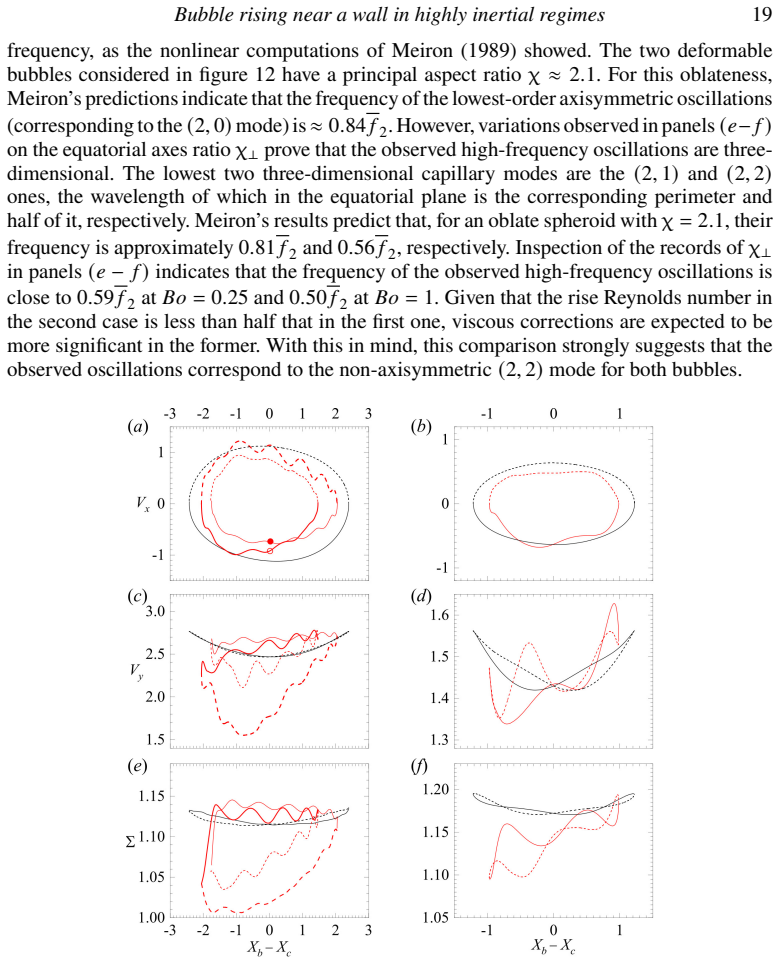
The central discovery is a pair of inertial mechanisms that determine the near-wall fate of bubbles at Reynolds numbers of order 100–1000. In the absence of path instability, once the Galilei number exceeds a critical value, a bubble that collides with the wall experiences an abrupt flow reversal in the gap, which generates a strong rotational motion around the interface (the interface spinning rate $\Omega_z$ reaches values of order unity). This rotation produces a repulsive Magnus-like lift force $\mathbf{F}_L^M \propto \boldsymbol{\Omega} \times \mathbf{V}$ that acts for a long time after the bounce, allowing the bubble to escape the wall region after one or two bounces — the bouncing-tumbling-escaping (BTE) scenario. For bubbles beyond the path-instability threshold, the paper identifies a competing wall-ward trapping mechanism: when the bubble approaches the wall, its rise speed drops sharply, transiently reducing its oblateness; because the frontal area opposing transverse motion scales as $\chi^{-1/3}$, the bubble presents a larger area when departing than when returning, so transverse drag and added-mass forces are larger during departure, counteracting the repulsive wake–wall interaction and confining the bubble to a periodic near-wall zigzag (NWZ). A third scenario, wavy migration away (WMA), occurs when these effects are too weak, and the bubble drifts away while zigzagging or spiralling.
Load-bearing premise
The load-bearing premise is that the under-resolved lubrication film at gaps smaller than about 1/136 of the bubble radius does not change the qualitative dynamics; the paper itself notes that spin generation and rebound details during 'collisions' remain sensitive to grid resolution.
Editorial extensions
If this is right
- If the spin-based escape criterion is correct, the maximum interface spinning rate during a wall collision can be used as a predictor for whether a given bubble will escape or keep bouncing.
- The estimated Magnus lift coefficient (about 0.5 ± 0.07) provides a quantitative input for low-order models of near-wall bubble motion.
- The NWZ trapping mechanism implies that bubbles with larger zigzag amplitude are more likely to be trapped, which explains the existence of a finite Bond-number window for trapping.
- The wall does not trigger path instability; it only selects the oscillation plane, so the threshold Bond number from unbounded-flow stability analysis applies in wall-bounded configurations.
- Wall proximity can increase the Strouhal number of zigzagging by up to about 20% at Bo ≥ 0.25, so near-wall oscillations are faster than their unbounded counterparts.
Reading between the lines
- One could test the spin criterion directly in experiments by using particle image velocimetry around a bubble during a wall bounce and correlating the measured surface vorticity with the escape outcome.
- The trapping mechanism suggests that surfactants, which alter shape oscillations and surface mobility, could shift the Bond-number window for near-wall trapping; this is a natural extension to contaminated systems.
- Since the BTE mechanism relies on the attractive Bernoulli force to build up impact velocity, changes in initial bubble-wall separation should affect escape only when the impact velocity is too low, as the paper's appendix confirms; one might therefore expect the critical Galilei number for escape to depend weakly on release distance.
- The long memory of the initial separation in NWZ regimes at high Ga implies that short experimental columns may not reach the developed trapped state; results from such experiments should be interpreted with caution.
Signed reviews
Editorial analysis
A structured set of objections, weighed in public.
Referee Report
Summary. The paper reports three-dimensional numerical simulations of a single deformable bubble rising near a vertical wall in the range 30 < Ga <= 90 and 0.02 <= Bo <= 2, extending the authors' Part 1 to highly inertial regimes. It identifies three new types of motion: bouncing-tumbling-escaping (BTE) for low Bond numbers and high Galilei numbers, in which the bubble escapes after one or two wall collisions because strong interfacial rotation generates a Magnus-like repulsive force; near-wall zigzagging (NWZ) for intermediate Bond numbers at high Ga, in which a transient reduction of bubble oblateness during close wall approaches increases the frontal area during departure and thereby enhances transverse drag and added-mass resistance; and wavy migration away (WMA) for path-unstable bubbles that depart from the wall while zigzagging or spiralling. The regimes are organized in a phase diagram, and simulation results are compared against experiments in water and silicone oils, with good agreement on Strouhal numbers and path characteristics.
Significance. If the proposed mechanisms are correct, the paper resolves a striking contradiction between moderate-Reynolds-number observations, where path-unstable bubbles migrate away from the wall, and high-Reynolds-number experiments in water, where bubbles are trapped near the wall. The study is valuable for its systematic parameter sweep, its quantitative comparisons with independent experiments (de Vries 2001; Jeong & Park 2015; Estepa-Cantero et al. 2024), and its explicit discussion of numerical limitations. The critical spin rate and the Magnus lift coefficient are falsifiable phenomenological predictions, although they are extracted from the same simulations used to construct the regime map. The work is a solid basis for low-order models of near-wall bubble motion, provided the resolution sensitivity of the collision phase is addressed.
major comments (3)
- [Section 2 / Appendix A, Figure 17] The production resolution is not demonstrated to be converged for the collision phase that drives both new mechanisms. The paper states that even Delta_min = 1/136 is insufficient to resolve the lubrication film when the dimensionless gap delta drops below Delta_min, and Figure 17 shows that for (Bo, Ga) = (0.05, 90) the final escape position changes from about 6.75R to 5.5R when Delta_min is refined from 1/68 to 1/136, a 19% shift. Since the interfacial spin Omega_z in the BTE scenario is generated during these under-resolved collisions, and the NWZ trapping depends on wake-wall interaction at minimal gap, the critical value max(|Omega_z|) = 1.8 and the phase boundaries in Figure 2(a) may be resolution-dependent. The authors should either demonstrate convergence at a finer resolution (e.g., Delta_min = 1/256) for representative BTE and NWZ cases, or quantify the uncertainty of the thresholds arising from this numerical limitation.
- [Section 4, Figure 8 and Appendix B] The threshold max(|Omega_z|) = 1.8 is obtained from simulations with different initial separations: X0 = 2 for most cases, but X0 = 3.5 for 40 <= Ga <= 70. Appendix B shows that X0 affects the number of bounces and the impact velocity in BTE cases. Because the maximum spin rate is expected to depend on the collision kinematics, the threshold should be shown to be robust to X0, or the dataset used to infer it should be made homogeneous in X0. Without this, the quoted critical value may reflect an artefact of the initialization protocol rather than a universal feature of the BTE transition.
- [Section 5.3] The NWZ trapping mechanism is inferred from kinematic quantities (surface area Sigma and frontal area S_perp) rather than from a direct assessment of the transverse forces. The claim that increased transverse drag and added mass are what counteract the repulsive wake-wall force would be more convincing if the authors provided a force budget over one zigzag period, at least for one NWZ case, or a quantitative estimate of the two resistive contributions during the departing stage. As presented, the correlation between area asymmetry and trapping is suggestive but does not close the force balance.
minor comments (4)
- [Figure 2(a) caption] The legend uses the same open-square symbol for four different regimes (periodic bouncing with collisions, periodic bouncing without collisions, damped bouncing, and migration away from the wall). Please use distinct symbols or clarify the entries.
- [Section 4, force-balance paragraph] The estimate C_L^Omega = 0.5 +/- 0.07 should be reported with a wider uncertainty, since it depends on the assumed added-mass coefficient C_I = 1/2 and on neglecting the trailing-vortex contribution, both of which are acknowledged as uncertain in the same paragraph.
- [Section 2, notation] The symbol Delta_min is used both for the dimensional minimum cell size and for its dimensionless counterpart (e.g., 'Delta_min = 1/68' and 'Delta_min/R'). Please distinguish the two, for instance by writing Delta_min/R explicitly wherever dimensionless values are used.
- [References] The reference for Estepa-Cantero et al. (2024) is listed with the same title as Cano-Lozano et al. (2016); please verify the title and bibliographic data.
Circularity Check
No load-bearing circularity: the BTE and NWZ mechanisms are inferred from direct simulations and checked against independent experiments (de Vries 2001; Estepa-Cantero et al. 2024).
-
fitted input called prediction
[Section 4 (Figure 8) and Section 6 (Summary)]
"These results suggest that the bubble path transitions from the periodic bouncing regime to the BTE regime when the maximum spinning rate exceeds a critical value close to 1.8. ... Bubbles are found to eventually escape from the wall region every time the spinning rate characterizing the rotational flow at the bubble surface exceeds a critical value."
The critical value max(|Ω_z|) = 1.8 is not derived from an independent model; it is the horizontal line drawn in Figure 8 through the same set of simulated bouncing and BTE cases it is said to separate. The Section 6 summary restates that empirical separation as a general escape law, so the criterion 'escape iff max|Ω_z| > 1.8' is equivalent, by construction, to the classification shown in the figure and adds no independent information about where the BTE boundary lies. Likewise, the Magnus lift coefficient C_Ω^L ≈ 0.5 ± 0.07 is estimated from the force balance of the very escape event it is used to explain.
-
self citation load bearing
[Section 2 (numerical approach), with counter-evidence in Appendix A (Figure 17)]
"It was shown in Part 1 that this under-resolution has virtually no effect on the bouncing frequency and only lowers the maximum separation achieved by the bubble after a 'collision' event by a few percent."
Section 2 invokes Part 1 (Shi, Zhang & Magnaudet 2024) to justify treating the unresolved lubrication film as a benign 'bubble-wall collision.' The BTE and NWZ mechanisms that form the paper's central claims are both activated during such under-resolved collision events. However, the present paper's own grid test shows that at (Bo, Ga) = (0.05, 90) the final escape position shifts from 6.75R to 5.5R (about 19%) when Δmin is refined from 1/68 to 1/136, and no test at 1/272 establishes convergence of the spin generation that sets the 1.8 threshold. Hence this self-citation is not verified support in the regime considered here.
full rationale
The paper's central claims are (i) the BTE escape mechanism, namely that a strong interface spin generated during a wall collision produces a Magnus-like repulsive force that drives the bubble away from the wall, and (ii) the NWZ trapping mechanism, namely that a transient oblateness reduction during wall approaches enlarges the frontal area opposing departure, so transverse drag and added mass overcome the repulsive wake-wall force. Both mechanisms are inferred from direct numerical simulation of the two-phase Navier-Stokes equations and are not derived from any quantity that is defined in terms of the claimed outcome. The spin rate Ω is defined independently via (2.2) from the interface flow field; the escape is defined by the observed trajectory; the frontal area S_⊥ is measured geometrically. No equation in the paper reduces to another by construction, and no first-principles result is imported solely through a self-citation: the neutral curve of Bonnefis et al. (2024) is used to partition the phase diagram, but the present simulations independently confirm the onset of path instability and the Strouhal-number predictions of that linear analysis, so the comparison is a genuine cross-check rather than a circular loop. The two flagged steps are mild. First, the threshold max(|Ω_z|) ≈ 1.8 and the Magnus coefficient C_Ω^L ≈ 0.5 are read from the same simulations they are used to characterize; the paper is transparent about this ('suggest', 'estimate'), and the escape itself is a direct simulation output corroborated by the independent experiments of de Vries (2001) and de Vries et al. (2002). Second, the Part 1 self-citation asserting a 'few percent' effect of collision under-resolution is quantitatively contradicted by the paper's own Figure 17 in the high-Ga regime, but the qualitative scenario (escape vs. periodic bouncing) is preserved at both resolutions, the adaptive production scheme matches the finest tested resolution, and the limitation is explicitly stated in Section 2. These features raise the score slightly above zero but do not compromise the independence of the central derivation. On the correctness side, the grid-sensitivity of the final escape position and the absence of a convergence test at 1/272 are substantive robustness risks, but they are concerns about numerical accuracy, not circularity of the argument.
Assumptions & free parameters
free parameters (2)
- Critical maximum surface spinning rate |Omega_z|_crit =
approximately 1.8
- Magnus lift coefficient C_L^Omega =
approximately 0.5 plus or minus 0.07
assumptions (5)
- domain assumption The two-phase incompressible Navier-Stokes equations solved with the Basilisk volume-of-fluid method accurately model the bubble and surrounding liquid.
- domain assumption The bubble interface is clean with constant surface tension, and the vertical wall is hydrophilic with no contact-angle or surfactant effects.
- domain assumption The neutral curve for path instability in an unbounded fluid from Bonnefis et al. (2024) applies to the wall-bounded cases considered.
- ad hoc to paper The transverse inertia-induced force during BTE escape is estimated with added-mass coefficient C_I approximately 1/2 and by neglecting the contribution of trailing vortices.
- domain assumption Quasi-steady transverse drag follows Moore's high-Reynolds-number prediction for a spherical bubble.
Cite this review
Pith. "Pith review of Lateral migration and bouncing of a deformable bubble rising near a vertical wall. Part 2. Highly inertial regimes." pith.science (2026). https://pith.science/paper/SKEYYOJF
@misc{pith2026250117001,
  author       = {Pith},
  title        = {Pith review of: Lateral migration and bouncing of a deformable bubble rising near a vertical wall. Part 2. Highly inertial regimes},
  year         = {2026},
  howpublished = {\url{https://pith.science/paper/SKEYYOJF}},
  note         = {Machine review of arXiv:2501.17001}
}
abstract
The fate of deformable buoyancy-driven bubbles rising near a vertical wall under highly inertial conditions is investigated numerically. In the absence of path instability, simulations reveal that when the Galilei number, $Ga$, which represents the buoyancy-to-viscous force ratio, exceeds a critical value, bubbles escape from the near-wall region after one to two rounds of bouncing, while at smaller $Ga$ they perform periodic bounces without escaping. The escape mechanism is rooted in the vigorous rotational flow that forms around a bubble during its bounce at high enough $Ga$, resulting in a Magnus-like repulsive force capable of driving it away from the wall. Path instability takes place with bubbles whose Bond number, the buoyancy-to-capillary force ratio, exceeds a critical $Ga$-dependent value. Such bubbles may or may not escape from the wall region, depending on the competition between the classical repulsive wake-wall interaction mechanism and a specific wall-ward trapping mechanism. The latter results from the reduction of the bubble oblateness caused by the abrupt drop of the rise speed when the bubble-wall gap becomes very thin. Owing to this transient shape variation, bubbles exhibiting zigzagging motions with a large enough amplitude experience larger transverse drag and virtual mass forces when departing from the wall than when returning to it. With moderately oblate bubbles, i.e. in an intermediate Bond number range, this effect is large enough to counteract the repulsive interaction force, forcing such bubbles to perform a periodic zigzagging-like motion at a constant distance from the wall.
Figures


Figures from the paper (19 more)




Reference graph
Works this paper leans on
-
[1]
, " * write output.state after.block = add.period write newline
ENTRY address author booktitle chapter edition editor howpublished institution journal key month note number organization pages publisher school series title type volume year eprint label extra.label sort.label short.list INTEGERS output.state before.all mid.sentence after.sentence after.block FUNCTION init.state.consts #0 'before.all := #1 'mid.sentence ...
-
[2]
write newline
" write newline "" before.all 'output.state := FUNCTION n.dashify 't := "" t empty not t #1 #1 substring "-" = t #1 #2 substring "--" = not "--" * t #2 global.max substring 't := t #1 #1 substring "-" = "-" * t #2 global.max substring 't := while if t #1 #1 substring * t #2 global.max substring 't := if while FUNCTION word.in bbl.in capitalize " " * FUNCT...
-
[3]
Auguste, F. & Magnaudet, J. 2018 Path oscillations and enhanced drag of light rising spheres . J. Fluid Mech. 841 , 228--266
work page 2018
-
[4]
Bonnefis, P. , Fabre, D. & Magnaudet, J. 2023 When, how, and why the path of an air bubble rising in pure water becomes unstable . Proc. Natl. Acad. Sci. U.S.A. 120 , e2300897120
work page 2023
-
[5]
Bonnefis, P. , Sierra-Ausin, J. , Fabre, D. & Magnaudet, J. 2024 Path instability of deformable bubbles rising in N ewtonian liquids: A linear study . J. Fluid Mech. 980 , A19
work page 2024
-
[6]
Cai, R. , Ju, E. , Chen, W. & Sun, J. 2023 Different modes of bubble migration near a vertical wall in pure water . Korean J. Chem. Eng. 40 , 67--78
work page 2023
-
[7]
Cano-Lozano, J. C. , Mart\'inez-Baz\'an, C. , Magnaudet, J. & Tchoufag, J. 2016 Paths and wakes of deformable nearly spheroidal rising bubbles close to the transition to path instability . Phys. Rev. Fluids 1 , 053604
work page 2016
-
[8]
Duineveld, P. C. 1994 Bouncing and coalescence of two bubbles in water . PhD thesis, Univ. Twente
work page 1994
Show all 47 references
-
[9]
Duineveld, P. C. 1995 The rise velocity and shape of bubbles in pure water at high Reynolds number . J. Fluid Mech. 292 , 325--332
1995
-
[10]
& Risso, F
Ellingsen, K. & Risso, F. 2001 On the rise of an ellipsoidal bubble in water: oscillatory paths and liquid-induced velocity . J. Fluid Mech. 440 , 235--268
2001
-
[11]
, Mart\'inez-Baz\'an, C
Estepa-Cantero, C. , Mart\'inez-Baz\'an, C. & Bola\ nos Jim\'enez, R. 2024 Paths and wakes of deformable nearly spheroidal rising bubbles close to the transition to path instability . Phys. Fluids 36 , 013304
2024
-
[12]
& Williamson, C
Horowitz, M. & Williamson, C. H. K. 2010 The effect of Reynolds number on the dynamics and wakes of freely rising and falling spheres . J. Fluid Mech. 651 , 251--294
2010
-
[13]
& Park, H
Jeong, H. & Park, H. 2015 Near-wall rising behaviour of a deformable bubble at high Reynolds number . J. Fluid Mech. 771 , 564--594
2015
-
[14]
& Hussain, F
Jeong, J. & Hussain, F. 1995 On the identification of a vortex . J. Fluid Mech. 285 , 69--94
1995
-
[15]
Kok, J. B. 1993 Dynamics of a pair of gas bubbles moving through liquid. P art I . T heory. Eur. J. Mech. B Fluids 12 , 515--540
1993
-
[16]
1932 Hydrodynamics\/
Lamb, H. 1932 Hydrodynamics\/ . Cambridge University Press
1932
-
[17]
& Park, H
Lee, J. & Park, H. 2017 Wake structures behind an oscillating bubble rising close to a vertical wall . Int. J. Multiphase Flow 91 , 225--242
2017
-
[18]
2011 A reciprocal theorem for the prediction of loads on a body moving in an inhomogeneous flow at arbitrary R eynolds number
Magnaudet, J. 2011 A reciprocal theorem for the prediction of loads on a body moving in an inhomogeneous flow at arbitrary R eynolds number . J. Fluid Mech. 689 , 564--604
2011
-
[19]
& Mougin, G
Magnaudet, J. & Mougin, G. 2007 Wake instability of a fixed spheroidal bubble . J. Fluid Mech. 572 , 311--337
2007
-
[20]
Meiron, D. I. 1989 On the stability of gas bubbles rising in an inviscid fluid . J. Fluid Mech. 198 , 101--114
1989
-
[21]
1977 Hydrodynamics of deformable contiguous spherical shapes in an incompressible inviscid fluid
Miloh, T. 1977 Hydrodynamics of deformable contiguous spherical shapes in an incompressible inviscid fluid . J. Eng. Math. 11 , 349--372
1977
-
[22]
Moore, D. W. 1963 The boundary layer on a spherical gas bubble . J. Fluid Mech. 16 , 161--176
1963
-
[23]
& Magnaudet, J
Mougin, G. & Magnaudet, J. 2002 Path instability of a rising bubble . Phys. Rev. Lett. 88 , 014502
2002
-
[24]
& Magnaudet, J
Mougin, G. & Magnaudet, J. 2006 Wake-induced forces and torques on a zigzagging/spiralling bubble . J. Fluid Mech. 567 , 185--194
2006
-
[25]
, Lakkaraju, R
Mundhra, R. , Lakkaraju, R. , Das, P. K. , Pakhomov, M. A. & Lobanov, P. D. 2023 Effect of wall proximity and surface tension on a single bubble rising near a vertical wall . Water 15 , 1567
2023
-
[26]
2009 An accurate adaptive solver for surface-tension-driven interfacial flows
Popinet, S. 2009 An accurate adaptive solver for surface-tension-driven interfacial flows . J. Comput. Phys. 228 , 5838--5866
2009
-
[27]
2015 A quadtree-adaptive multigrid solver for the S erre-- G reen-- N aghdi equations
Popinet, S. 2015 A quadtree-adaptive multigrid solver for the S erre-- G reen-- N aghdi equations . J. Comput. Phys. 302 , 336--358
2015
-
[28]
2017 Bubble rising in a large tank
Popinet, S. 2017 Bubble rising in a large tank. Available at: http://basilisk.fr/src/examples/bubble.c
2017
-
[29]
, Mari \'e , J
Rastello, M. , Mari \'e , J. L. , Grosjean, N. & Lance, M. 2009 Drag and lift forces on interface-contaminated bubbles spinning in a rotating flow . J. Fluid Mech. 624 , 159--178
2009
-
[30]
2024 Reversal of the transverse force on a spherical bubble rising close to a vertical wall at moderate-to-high Reynolds numbers
Shi, P. 2024 Reversal of the transverse force on a spherical bubble rising close to a vertical wall at moderate-to-high Reynolds numbers . Phys. Rev. Fluids 9 , 023601
2024
-
[31]
, Rzehak, R
Shi, P. , Rzehak, R. , Lucas, D. & Magnaudet, J. 2020 Hydrodynamic forces on a clean spherical bubble translating in a wall-bounded linear shear flow . Phys. Rev. Fluids 5 , 073601
2020
-
[32]
, Zhang, J
Shi, P. , Zhang, J. & Magnaudet, J. 2024 Lateral migration and bouncing of a deformable bubble rising near a vertical wall. P art 1. M oderately inertial regimes . J. Fluid Mech. 998 , A8
2024
-
[33]
Sugioka, K. I. & Tsukada, T. 2015 Direct numerical simulations of drag and lift forces acting on a spherical bubble near a plane wall . Int. J. Multiphase Flow 71 , 32--37
2015
-
[34]
, Takagi, S
Tagawa, Y. , Takagi, S. & Matsumoto, Y. 2014 Surfactant effect on path instability of a rising bubble . J. Fluid Mech. 738 , 124--142
2014
-
[35]
& Magnaudet, J
Takemura, F. & Magnaudet, J. 2003 The transverse force on clean and contaminated bubbles rising near a vertical wall at moderate Reynolds number . J. Fluid Mech. 495 , 235--253
2003
-
[36]
, Takagi, S
Takemura, F. , Takagi, S. , Magnaudet, J. & Matsumoto, Y. 2002 Drag and lift forces on a bubble rising near a vertical wall in a viscous liquid . J. Fluid Mech. 461 , 277--300
2002
-
[37]
, Fabre, D
Tchoufag, J. , Fabre, D. & Magnaudet, J. 2015 Weakly nonlinear model with exact coefficients for the fluttering and spiraling motion of buoyancy-driven bodies . Phys. Rev. Lett. 115 , 114501
2015
-
[38]
2007 Leonardo's paradox: Path and shape instabilities of particles and bubbles
Veldhuis, C. 2007 Leonardo's paradox: Path and shape instabilities of particles and bubbles . PhD thesis, Univ. Twente
2007
-
[39]
, Biesheuvel, A
Veldhuis, C. , Biesheuvel, A. & van Wijngaarden , L. 2008 Shape oscillations on bubbles rising in clean and in tap water . Phys. Fluids 20 , 040705
2008
-
[40]
de Vries , A. W. G. 2001 Path and wake of a rising bubble . PhD thesis, Univ. Twente
2001
-
[41]
de Vries , A. W. G. , Biesheuvel, A. & van Wijngaarden , L. 2002 Notes on the path and wake of a gas bubble rising in pure water . Int. J. Multiphase Flow 28 , 1823--1835
2002
-
[42]
1976 Hydrodynamic interaction between gas bubbles in liquid
van Wijngaarden , L. 1976 Hydrodynamic interaction between gas bubbles in liquid . J. Fluid Mech. 77 , 27--44
1976
-
[43]
, Zhang, H
Yan, H. , Zhang, H. , Liao, Y. , Zhang, H. , Zhou, P. & Liu, L. 2022 A single bubble rising in the vicinity of a vertical wall: A numerical study based on volume of fluid method . Ocean Eng. 263 , 112379
2022
-
[44]
& Magnaudet, J
Zenit, R. & Magnaudet, J. 2008 Path instability of rising spheroidal air bubbles: A shape-controlled process . Phys. Fluids 20 , 061702
2008
-
[45]
& Magnaudet, J
Zenit, R. & Magnaudet, J. 2009 Measurements of the streamwise vorticity in the wake of an oscillating bubble . Int. J. Multiphase Flow 35 , 195--203
2009
-
[46]
Zhang, J. , Ni, M. & Magnaudet, J. 2021 Three-dimensional dynamics of a pair of deformable bubbles rising initially in line. P art 1. M oderately inertial regimes . J. Fluid Mech. 920 , A16
2021
-
[47]
, Dabiri, S
Zhang, Y. , Dabiri, S. , Chen, K. & You, Y. 2020 An initially spherical bubble rising near a vertical wall . Int. J. Heat Fluid Flow 85 , 108649
2020
Reviewed August 10, 2026 · model on record in the stance chip above.
Discussion (0). Continue with ORCID to comment.