REVIEW 4 major objections 5 minor 78 references
Detection of Ubiquitous Circumbinary Matter in Hot Subdwarfs Formed from Common-Envelope Ejections
T0 review · 4 major / 5 minor · reviewed 2026-08-09 · deepseek-v4-flash
Pith's one-line read The paper claims that roughly 20% of hot subdwarf binaries are surrounded by long-lived circumbinary gas from common-envelope ejections.
desk verdict A bold but under-supported claim of ubiquitous circumbinary matter around hot subdwarfs; worth peer review, but the detection fraction is not yet a measurement. read the letter →
The pith
A machine-rendered reading of the paper's core claim, the machinery that carries it, and where it could break.
The reading
What carries the argument
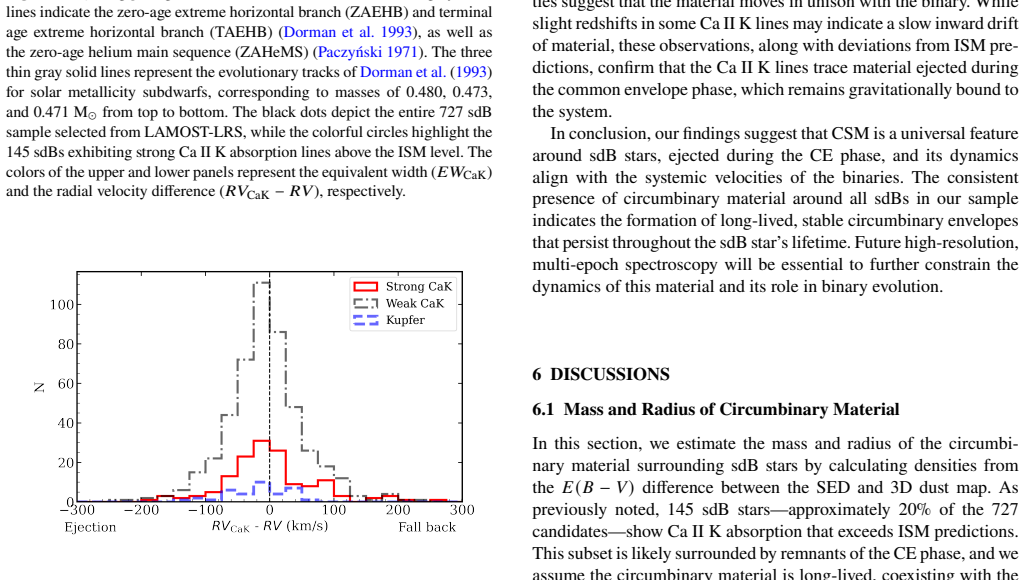
The load-bearing diagnostic is the Ca II K absorption line at 3934.77 Å. The paper combines three comparisons. First, because sdB atmospheres are too hot to produce Ca II K, the line's equivalent width is compared with the reddening $E(B-V)$ from the Bayestar19 dust map through an ISM-only calibration from OB stars; stars whose equivalent width lies above that relation carry extra absorbing gas. Second, the SED-fit reddening is compared with the three-dimensional dust-map reddening, so a local excess of dust and gas shows up as $\Delta E(B-V) > 0$. Third, the Ca II K radial velocity is compared with the binary's systemic velocity; agreement means the gas is dynamically tied to the binary, not a random interstellar cloud. The Gaussian-fit measurement of the line's equivalent width and velocity is the single measurement that feeds all three tests.
What would settle it
Take high-resolution spectra ($R \gtrsim 10{,}000$) of the Ca II K line in the 145 excess stars and separate the absorption into components. If the excess components appear at interstellar velocities or follow the binary's orbital phase instead of its systemic velocity, the circumbinary interpretation would be ruled out.
Extended reading notes
Core claim
The central claim is that common-envelope ejecta survive around hot subdwarf binaries as a stable, gas-dominated circumbinary envelope. Among 727 sdB candidates from the LAMOST-LRS survey, 145 show Ca II K equivalent widths that exceed the ISM-only relation built from OB stars, and their SED-derived reddening $E(B-V)_{\mathrm{SED}}$ exceeds the Bayestar19 three-dimensional dust-map value $E(B-V)_{\mathrm{Bayestar}}$, with the two excesses tracking each other. The Ca II K radial velocities cluster around the binary systemic velocities, including a detailed nine-epoch orbital fit for PG0848+186 in which the line velocity stays constant while the star moves. The paper concludes that the excess absorption traces circumbinary material ejected during the common-envelope phase, that it persists for up to $\sim 10^8$ years rather than dissipating on planetary-nebula timescales, and that it forms a wedge-shaped, anisotropic envelope with opening angle $\pm 11.5^\circ$, radius roughly 14,000$-$31,000 AU, and mean hydrogen column density $7.6\times10^{20}\,\mathrm{cm}^{-2}$.
Load-bearing premise
The identification of 145 stars with circumstellar matter rests on the assumption that the reddening excess measured by SED fitting over the three-dimensional dust map comes from material around the star, and not from errors in the dust map, the single-star SED model, or the distance.
Editorial extensions
If this is right
- If the central claim is right, common-envelope ejecta are not always transient: a significant fraction of sdB binaries retain bound, gas-dominated circumbinary envelopes for the full $\sim 10^8$ years of the sdB phase.
- Under the wedge geometry with opening angle $\pm 11.5^\circ$, the 20% detection rate reflects line-of-sight orientation, so the true occurrence of long-lived envelopes among sdB binaries could be considerably higher.
- The estimated envelope radius (about 14,000$-$31,000 AU) and low mean column density ($7.6\times10^{20}\,\mathrm{cm}^{-2}$) imply the material is tenuous and mostly gaseous, consistent with the absence of infrared excess in WISE photometry.
- The constant Ca II K velocity across nine epochs for PG0848+186, while the star's velocity varies with a 0.53-day orbit, shows the absorbing material is circumbinary rather than orbiting with the visible star.
- Na I D and K I lines track the interstellar medium, while Ca II K traces the hotter inner circumstellar gas, so Ca II K can serve as a population-level tracer of post-common-envelope environments.
Reading between the lines
- A geometric corollary the paper leaves implicit: if the wedge angle is $\pm 11.5^\circ$ and orientations are random, the 20% detection fraction implies that long-lived circumbinary envelopes could surround close to 100% of sdB binaries, making the phenomenon the norm rather than the exception.
- The same excess-plus-velocity test could be applied to other post-common-envelope populations, such as sdO binaries or detached white-dwarf binaries, to see whether envelope survival time depends on the mass of the ejected envelope, orbital period, or companion type.
- If the envelope is really dust-free gas at $\sim 10^4$-$10^5$ AU scales, it should be detectable in radio recombination lines or free-free continuum; a detection would independently confirm the mass and geometry inferred from Ca II K.
- A falsifying check the paper does not carry out: compare the Ca II K excess rate in sdB binaries against a control sample of single hot stars with no common-envelope history; a similar excess rate there would weaken the CE interpretation.
Editorial analysis
A structured set of objections, weighed in public.
Referee Report
Summary. The paper analyzes Ca II K absorption in 727 hot subdwarf (sdB) candidates from LAMOST-LRS DR7, focusing on 623 stars with measurable lines. It constructs an ISM baseline EW(Ca II K) versus E(B-V) from 284 OB stars and identifies 145 sdBs whose Ca II K absorption exceeds this baseline and whose SED-derived reddening exceeds the Bayestar19 3D dust-map reddening. The authors interpret these 145 stars as hosts of circumbinary material ejected during a common-envelope phase, argue from the approximately 20% detection fraction that such material is ubiquitous and long-lived, and use the detection fraction and an assumed remnant mass to estimate a wedge geometry and a radius of 14015-31338 AU. They also compare Ca II K radial velocities with binary systemic velocities, including a nine-epoch orbital solution for PG0848+186, and analyze Na I D and K I lines to separate ISM from CSM contributions.
Significance. If the interpretation is correct, the paper would provide a large, homogeneous sample of common-envelope remnants around hot subdwarf binaries, with implications for common-envelope physics, binary evolution, and the persistence of circumbinary material. The study has notable strengths: a large and carefully vetted LAMOST sample, visual inspection of spectra, the use of two quasi-independent diagnostics (equivalent-width excess and SED-versus-dust-map reddening excess), a control sample of OB stars, and a multi-epoch orbital analysis of one target. However, the central claim is currently not established because the detection sample is defined by the same excess criteria later used to infer ubiquity, the ISM baseline depends on the completeness of a smoothed 3D dust map, and the radial-velocity evidence has insufficient precision to distinguish CSM from ISM. The wedge-angle and mass/radius estimates are model-dependent rather than empirical.
major comments (4)
- [Sections 3.2, 3.3, and 5.1] The 145-star sample is constructed by requiring both EW(Ca II K) above the ISM relation of Eq. (2) and E(B-V)_SED > E(B-V)_Bayestar. The 'ubiquity' fraction of about 20% quoted in Section 5.1 and the abstract is therefore the fraction of the 727 stars that pass these specific thresholds, not an independent measurement of the circumbinary matter fraction. The selection is not shown to be a >3-sigma excess: the uncertainties in E(B-V)_SED listed in Table 1 are not propagated into the E(B-V)_SED - E(B-V)_Bayestar threshold, and the EW excess threshold is likewise not quantified in units of its uncertainty. I request a threshold-robustness analysis, e.g., the detection fraction as a function of EW-excess significance and SED-excess significance, and explicit wording that the 20% is conditional on the adopted selection criteria.
- [Sections 3.2 and 3.3] The entire excess interpretation rests on Bayestar19 fully capturing interstellar reddening and on the SED fit being unbiased. Bayestar19 is a smoothed 3D map and can miss compact ISM clouds at the distances and latitudes of these sdBs; a star behind such a cloud would show exactly the observed pattern, namely Ca II K EW above Eq. (2) and E(B-V)_SED above E(B-V)_Bayestar, with no circumbinary matter required. The external validation uses only 23 LAMOST OB stars and reports that 87% fall in the 95% confidence band, which is not a stringent goodness-of-fit test. In addition, the SED fit assumes a single sdB photosphere (Section 3.3); unresolved cool companions or continuum misnormalization can bias E(B-V)_SED upward. The paper should test the ISM hypothesis directly, for example with high-resolution Ca II K and Na I component structure, or with distance-resolved dust maps along each sight line, before interpreting the 145 stars as common-envelope ejecta.
- [Sections 5.2 and 6.2] The kinematic support is too weak to distinguish CSM from ISM. The mean Ca II K radial-velocity uncertainty is about 24.9 km/s (Section 6.2), and for the best-case target PG0848+186 the Ca II K velocity is -13.3 +/- 32.4 km/s, consistent with both the systemic velocity (-29.2 +/- 3.1 km/s) and zero within 1 sigma. The statement that the lines 'confirm' a common-envelope origin is therefore overstated. Stacking spectra of many targets, or obtaining higher-resolution data for a subsample, is needed to show that the absorbing gas follows the binary systemic velocity rather than the local ISM velocity field.
- [Section 6.1] The quoted radius (14015-31338 AU) and wedge angle (+/- 11.5 degrees) are not empirical measurements. The wedge angle is derived from the 20% detection fraction, the column density is derived from the same reddening excess under an assumed gas-to-dust ratio, and the radius is derived from an assumed remnant common-envelope mass of 0.1-0.5 M_sun. This is a consistency check of a model, not a determination, and should be presented as such rather than as a headline result in the abstract and conclusion. An independent geometric constraint, such as time-variable line profiles or occultation signatures, is needed before these numbers can be quoted as measured properties.
minor comments (5)
- [Abstract and Section 7] The abstract and conclusion state that circumbinary material is a 'universal feature' or 'ubiquitous', which conflicts with the 20% detection fraction; the paper should say 'common' and explicitly note that 80% of the sample shows no detectable excess.
- [Table 1 and Data Availability] Table 1 lists column definitions only; the full 727-row data table is not included in the manuscript and is only available upon request. For reproducibility, the complete machine-readable table should be published as supplementary material.
- [Equations (3) and (4)] The typesetting of Equations (3) and (4) makes it difficult to distinguish exponents from multiplicative factors; the equations should be rewritten with explicit powers and parentheses.
- [Section 6.2] The argument that subtracting the ISM contribution is 'unnecessary' because the mean EW error (0.23 A) exceeds the ISM contribution (0.1 A) is not logically valid; the relevant comparison is between the excess EW and the ISM EW, not between the measurement error and the ISM EW.
- [Figure 3] The statement that 87% of the control OB stars fall within the 95% confidence band is not a formal goodness-of-fit statistic; the paper should report the scatter or chi-square of the control sample around Eq. (2).
Circularity Check
The 20% ubiquity fraction is the selection fraction by construction, and the mass/radius estimate folds that same fraction back in as the wedge angle.
-
self definitional
[Section 3.3 and Section 5.1]
"This selection resulted in a final sample of 145 sdB stars for further analysis. ... We identified 145 sdB stars, approximately 20% of the 727 candidates, exhibiting Ca II K absorption that exceeds ISM predictions and the reddening excess than the reddening from 3D dustmaps."
The 145 stars are defined in Section 3.3 by the two criteria: Ca II K equivalent width above the ISM relation and E(B-V)_SED > E(B-V)_Bayestar. Section 5.1 then reports 145/727 = 20% as an observational detection fraction and uses that fraction to argue that circumbinary matter is long-lived. The fraction is the output of the selection, not an independent population statistic; changing the thresholds would change the reported ubiquity. The claim 'approximately 20% of the 727 candidates exhibit...' is therefore a restatement of the sample definition rather than an independent measurement.
-
fitted input called prediction
[Section 6.1, 'Mass and Radius of Circumbinary Material']
"The 20% detection rate suggests a partial solid-angle filling factor... Based on the observed fraction of stars exhibiting Ca II K absorption, we assume the wedge angle is approximately ±11.5◦. ... Assuming a uniform distribution of material within a wedge-like circumbinary disk with a wedge angle of ±11.5◦, we estimate the ejected mass using a mean column density of 1.8×10⁻³ g cm−2. ... we estimate the radius of the circumbinary material to be between 31338 AU and 14015 AU."
The wedge angle is not measured; it is inferred from the same 20% detection fraction that was produced by the Section 3.3 selection. The radius estimate then uses that wedge angle together with an assumed remnant mass and the same mean column density derived from the selection variable E(B-V)_SED - E(B-V)_Bayestar. Thus the quoted radius range is a restatement of the input detection fraction and assumed mass, converted into a length scale by an adopted geometry. The 'predicted' circumbinary radius is therefore forced by the detection fraction used to calibrate the wedge angle, rather than being an independent constraint.
full rationale
The paper is not circular in its basic spectroscopic detection: the Ca II K excess is measured against an ISM relation calibrated on OB stars, and the reddening excess uses an independent SED fit against the Bayestar19 3D dust map. Those are independent diagnostics, so individual candidate identification is not definitionally circular. The circularity enters in the population claim and the physical characterization. First, the headline 'approximately 20% of the 727 candidates' is literally the number of stars that survive the sample-selection filters in Section 3.3, and the same number is then presented as evidence of ubiquity and long-lived CE material; it is a selection fraction, not an independent detection rate. Second, the mass/radius estimate in Section 6.1 calibrates the wedge angle from that same 20% fraction and then uses the wedge angle to predict the radius, so the radius is a repackaged version of the detection fraction plus assumed mass. The unpublished self-citation for the gas-to-dust ratio ('Li et al., in preparation') is load-bearing only for the mass/radius estimate, which is already circular, and not for the central detection; I therefore do not count it as a separate circular step. Systematic risks such as Bayestar19 missing small-scale ISM structure or the single-star SED assumption biasing E(B-V)_SED are correctness concerns, not circularity, and are not scored here.
Assumptions & free parameters
free parameters (4)
- ISM EW_CaK baseline intercept and slope =
0.52 +/- 0.06 A/mag; 0.07 +/- 0.01 A
- Gas-to-dust ratio (GDR) =
2.80(+0.37/-0.34) x 10^21 cm^-2 mag^-1
- Wedge opening angle =
+/-11.5 degrees
- Remnant CE mass =
0.1 to 0.5 solar masses
assumptions (6)
- domain assumption Ca II K absorption is not intrinsic in sdB spectra
- domain assumption The OB-star EW_CaK vs E(B-V) relation is a valid ISM baseline for sdB sightlines
- domain assumption Bayestar19 3D dust map fully represents line-of-sight ISM reddening
- domain assumption The sdB star contributes 100% of the light in SED fitting
- ad hoc to paper The 20% detection fraction maps directly to a covering fraction and lifetime
- ad hoc to paper The wedge model geometry follows from the detection fraction
invented entities (1)
-
Wedge-shaped circumbinary envelope
Cite this review
Pith. "Pith review of Detection of Ubiquitous Circumbinary Matter in Hot Subdwarfs Formed from Common-Envelope Ejections." pith.science (2026). https://pith.science/paper/SJ7SJHC4
@misc{pith2026250200822,
  author       = {Pith},
  title        = {Pith review of: Detection of Ubiquitous Circumbinary Matter in Hot Subdwarfs Formed from Common-Envelope Ejections},
  year         = {2026},
  howpublished = {\url{https://pith.science/paper/SJ7SJHC4}},
  note         = {Machine review of arXiv:2502.00822}
}
read the original abstract
The formation of compact binary systems is largely driven by their evolution through a common envelope (CE) phase, crucial for understanding phenomena such as type Ia supernovae and black hole mergers. Despite their importance, direct observational evidence for CE material has been elusive due to the transient nature of these envelopes. Numerical simulations suggest that some envelope material may persist post-ejection. In this study, we investigate circumstellar material (CSM) surrounding hot subdwarf (sdB) stars, focusing on material ejected during the CE phase of binary evolution. We analyze Ca II K absorption lines in 727 sdB candidates from the LAMOST-LRS survey, selecting 145 stars with strong absorption features, indicating the presence of CSM. We compare the velocities of the Ca II K lines with the systemic velocities of sdB binaries, confirming that the material originates from ejected common-envelope material. The results show that the CSM persists long after the CE event, suggesting the formation of a stable, long-lived circumstellar environment around sdB stars. This study enhances our understanding of the role of CSM in post-CE evolution and provides new insights into the physical processes shaping the evolution of sdB binaries.
Figures


Figures from the paper (6 more)




Reference graph
Works this paper leans on
-
[1]
write newline
" write newline "" before.all 'output.state := FUNCTION fin.entry write newline FUNCTION new.block output.state before.all = 'skip after.block 'output.state := if FUNCTION new.sentence output.state after.block = 'skip output.state before.all = 'skip after.sentence 'output.state := if if FUNCTION not #0 #1 if FUNCTION and 'skip pop #0 if FUNCTION or pop #1...
-
[2]
write newline
" write newline "" before.all 'output.state := FUNCTION fin.entry write newline FUNCTION new.block output.state before.all = 'skip after.block 'output.state := if FUNCTION new.sentence output.state after.block = 'skip output.state before.all = 'skip after.sentence 'output.state := if if FUNCTION not #0 #1 if FUNCTION and 'skip pop #0 if FUNCTION or pop #1...
-
[3]
Blagorodnova N., et al., 2017, @doi [ ] 10.3847/1538-4357/834/2/107 , https://ui.adsabs.harvard.edu/abs/2017ApJ...834..107B 834, 107
-
[4]
Blanco-Cuaresma S., 2019, @doi [Monthly Notices of the Royal Astronomical Society.] 10.1093/mnras/stz549 , https://ui.adsabs.harvard.edu/abs/2019MNRAS.486.2075B 486, 2075
-
[5]
Blanco-Cuaresma S., Soubiran C., Heiter U., Jofr \'e P., 2014, @doi [Astronomy & Astrophysics.] 10.1051/0004-6361/201423945 , https://ui.adsabs.harvard.edu/abs/2014A&A...569A.111B 569, A111
-
[6]
Bohlin R. C., Savage B. D., Drake J. F., 1978, @doi [ ] 10.1086/156357 , https://ui.adsabs.harvard.edu/abs/1978ApJ...224..132B 224, 132
doi:10.1086/156357 1978
-
[7]
Chamandy L., Blackman E. G., Frank A., Carroll-Nellenback J., Tu Y., 2020, @doi [ ] 10.1093/mnras/staa1273 , https://ui.adsabs.harvard.edu/abs/2020MNRAS.495.4028C 495, 4028
- [8]
Show all 78 references
-
[9]
Clayton M., Podsiadlowski P., Ivanova N., Justham S., 2017, @doi [Monthly Notices of the Royal Astronomical Society.] 10.1093/mnras/stx1290 , https://ui.adsabs.harvard.edu/abs/2017MNRAS.470.1788C 470, 1788
2017 doi
-
[10]
Cui X.-Q., et al., 2012, @doi [Research in Astronomy and Astrophysics] 10.1088/1674-4527/12/9/003 , https://ui.adsabs.harvard.edu/abs/2012RAA....12.1197C 12, 1197
2012 doi
-
[11]
T., O'Connell R
Dorman B., Rood R. T., O'Connell R. W., 1993, @doi [ ] 10.1086/173511 , https://ui.adsabs.harvard.edu/abs/1993ApJ...419..596D 419, 596
1993 doi
-
[12]
J., Petigura E
Fulton B. J., Petigura E. A., Blunt S., Sinukoff E., 2018, @doi [Publications of the Astronomical Society of the Pacific.] 10.1088/1538-3873/aaaaa8 , https://ui.adsabs.harvard.edu/abs/2018PASP..130d4504F 130, 044504
2018 doi
-
[13]
Gaia Collaboration et al., 2021, @doi [Astronomy & Astrophysics.] 10.1051/0004-6361/202039657 , https://ui.adsabs.harvard.edu/abs/2021A&A...649A...1G 649, A1
2021 doi
-
[14]
P., Marsh T
Geier S., Raddi R., Gentile Fusillo N. P., Marsh T. R., 2019, @doi [Astronomy & Astrophysics.] 10.1051/0004-6361/201834236 , https://ui.adsabs.harvard.edu/abs/2019A&A...621A..38G 621, A38
2019 doi
-
[15]
B., 2021, @doi [ ] 10.1093/mnras/stab2291 , https://ui.adsabs.harvard.edu/abs/2021MNRAS.507.2659G 507, 2659
Glanz H., Perets H. B., 2021, @doi [ ] 10.1093/mnras/stab2291 , https://ui.adsabs.harvard.edu/abs/2021MNRAS.507.2659G 507, 2659
2021 doi
-
[16]
Gonz \'a lez-Bol \' var M., De Marco O., Lau M. Y. M., Hirai R., Price D. J., 2022, @doi [ ] 10.1093/mnras/stac2301 , https://ui.adsabs.harvard.edu/abs/2022MNRAS.517.3181G 517, 3181
2022 doi
-
[17]
O., Corbally Christopher J., 2009, Stellar Spectral Classification
Gray R. O., Corbally Christopher J., 2009, Stellar Spectral Classification
2009
-
[18]
M., Schlafly E., Zucker C., Speagle J
Green G. M., Schlafly E., Zucker C., Speagle J. S., Finkbeiner D., 2019, @doi [The Astrophysical Journal.] 10.3847/1538-4357/ab5362 , https://ui.adsabs.harvard.edu/abs/2019ApJ...887...93G 887, 93
2019 doi
-
[19]
Han Z., Podsiadlowski P., Maxted P. F. L., Marsh T. R., Ivanova N., 2002, @doi [Monthly Notices of the Royal Astronomical Society.] 10.1046/j.1365-8711.2002.05752.x , https://ui.adsabs.harvard.edu/abs/2002MNRAS.336..449H 336, 449
2002
-
[20]
Han Z., Podsiadlowski P., Maxted P. F. L., Marsh T. R., 2003, @doi [Monthly Notices of the Royal Astronomical Society.] 10.1046/j.1365-8711.2003.06451.x , https://ui.adsabs.harvard.edu/abs/2003MNRAS.341..669H 341, 669
2003
-
[21]
Han Z.-W., Ge H.-W., Chen X.-F., Chen H.-L., 2020, @doi [Research in Astronomy and Astrophysics] 10.1088/1674-4527/20/10/161 , https://ui.adsabs.harvard.edu/abs/2020RAA....20..161H 20, 161
2020 doi
-
[22]
Heber U., 2009, @doi [Annual Rev. Astron. Astrophys.] 10.1146/annurev-astro-082708-101836 , https://ui.adsabs.harvard.edu/abs/2009ARA&A..47..211H 47, 211
2009 doi
-
[23]
Heber U., 2016, @doi [Publications of the Astronomical Society of the Pacific.] 10.1088/1538-3873/128/966/082001 , https://ui.adsabs.harvard.edu/abs/2016PASP..128h2001H 128, 082001
2016 doi
-
[24]
Henden A., Munari U., 2014, Contributions of the Astronomical Observatory Skalnate Pleso, https://ui.adsabs.harvard.edu/abs/2014CoSka..43..518H 43, 518
2014
-
[25]
J., Beers T
Hettinger T., Badenes C., Strader J., Bickerton S. J., Beers T. C., 2015, @doi [ ] 10.1088/2041-8205/806/1/L2 , https://ui.adsabs.harvard.edu/abs/2015ApJ...806L...2H 806, L2
2015 doi
-
[26]
Hoadley K., et al., 2020, @doi [Nature.] 10.1038/s41586-020-2893-5 , https://ui.adsabs.harvard.edu/abs/2020Natur.587..387H 587, 387
2020 doi
-
[27]
Hubeny I., Lanz T., 1995, @doi [The Astrophysical Journal.] 10.1086/175226 , https://ui.adsabs.harvard.edu/abs/1995ApJ...439..875H 439, 875
1995 doi
-
[28]
Iaconi R., De Marco O., Passy J.-C., Staff J., 2018, @doi [ ] 10.1093/mnras/sty794 , https://ui.adsabs.harvard.edu/abs/2018MNRAS.477.2349I 477, 2349
2018 doi
-
[29]
Ivanova N., Nandez J. L. A., 2016, @doi [Monthly Notices of the Royal Astronomical Society.] 10.1093/mnras/stw1676 , https://ui.adsabs.harvard.edu/abs/2016MNRAS.462..362I 462, 362
2016 doi
-
[30]
Ivanova N., Podsiadlowski P., 2003, in Hillebrandt W., Leibundgut B., eds, From Twilight to Highlight: The Physics of Supernovae. p. 19 ( @eprint arXiv astro-ph/0210368 ), @doi 10.1007/10828549_3
2003 arXiv
-
[31]
Ivanova N., et al., 2013a, @doi [The Astronomy and Astrophysics Review.] 10.1007/s00159-013-0059-2 , https://ui.adsabs.harvard.edu/abs/2013A&ARv..21...59I 21, 59
-
[32]
L., Lombardi J
Ivanova N., Justham S., Avendano Nandez J. L., Lombardi J. C., 2013b, @doi [Science.] 10.1126/science.1225540 , https://ui.adsabs.harvard.edu/abs/2013Sci...339..433I 339, 433
-
[33]
Ivanova N., Justham S., Ricker P., 2020, Common Envelope Evolution , @doi 10.1088/2514-3433/abb6f0
2020 doi
-
[34]
Khouri T., Vlemmings W. H. T., Tafoya D., P \'e rez-S \'a nchez A. F., S \'a nchez Contreras C., G \'o mez J. F., Imai H., Sahai R., 2021, @doi [Nature Astronomy] 10.1038/s41550-021-01528-4 , https://ui.adsabs.harvard.edu/abs/2022NatAs...6..275K 6, 275
2021 doi
-
[35]
S., Park H.-J., Kim Y
Koo J.-R., Lee Y. S., Park H.-J., Kim Y. K., Beers T. C., 2022, @doi [ ] 10.3847/1538-4357/ac3423 , https://ui.adsabs.harvard.edu/abs/2022ApJ...925...35K 925, 35
2022 doi
-
[36]
Kramer M., Schneider F. R. N., Ohlmann S. T., Geier S., Schaffenroth V., Pakmor R., R \"o pke F. K., 2020, @doi [ ] 10.1051/0004-6361/202038702 , https://ui.adsabs.harvard.edu/abs/2020A&A...642A..97K 642, A97
2020 doi
-
[37]
Kupfer T., et al., 2015, @doi [Astronomy & Astrophysics.] 10.1051/0004-6361/201425213 , https://ui.adsabs.harvard.edu/abs/2015A&A...576A..44K 576, A44
2015 doi
-
[38]
Y., Vergely J
Lallement R., Welsh B. Y., Vergely J. L., Crifo F., Sfeir D., 2003, @doi [ ] 10.1051/0004-6361:20031214 , https://ui.adsabs.harvard.edu/abs/2003A&A...411..447L 411, 447
2003 doi
-
[39]
Lanz T., Hubeny I., 2003, @doi [The Astrophysical Journal.s] 10.1086/374373 , https://ui.adsabs.harvard.edu/abs/2003ApJS..146..417L 146, 417
2003 doi
-
[40]
S., Dor \'e O., 2017, @doi [ ] 10.3847/1538-4357/aa84af , https://ui.adsabs.harvard.edu/abs/2017ApJ...846...38L 846, 38
Lenz D., Hensley B. S., Dor \'e O., 2017, @doi [ ] 10.3847/1538-4357/aa84af , https://ui.adsabs.harvard.edu/abs/2017ApJ...846...38L 846, 38
2017 doi
-
[41]
Li J., et al., 2022, @doi [Monthly Notices of the Royal Astronomical Society.] 10.1093/mnras/stac1768 , https://ui.adsabs.harvard.edu/abs/2022MNRAS.515.3370L 515, 3370
2022 doi
-
[42]
Liu C., et al., 2015, @doi [Research in Astronomy and Astrophysics] 10.1088/1674-4527/15/8/004 , https://ui.adsabs.harvard.edu/abs/2015RAA....15.1137L 15, 1137
2015 doi
-
[43]
Luo Y., N \'e meth P., Wang K., Wang X., Han Z., 2021, @doi [The Astrophysical Journal.s] 10.3847/1538-4365/ac11f6 , https://ui.adsabs.harvard.edu/abs/2021ApJS..256...28L 256, 28
2021 doi
-
[44]
B., et al., 2005, @doi [ ] 10.1111/j.1365-2966.2005.09496.x , https://ui.adsabs.harvard.edu/abs/2005MNRAS.363..911L 363, 911
Lynn B. B., et al., 2005, @doi [ ] 10.1111/j.1365-2966.2005.09496.x , https://ui.adsabs.harvard.edu/abs/2005MNRAS.363..911L 363, 911
2005
-
[45]
MacLeod M., Macias P., Ramirez-Ruiz E., Grindlay J., Batta A., Montes G., 2017, @doi [ ] 10.3847/1538-4357/835/2/282 , https://ui.adsabs.harvard.edu/abs/2017ApJ...835..282M 835, 282
2017 doi
-
[46]
A., Kre owski J., 2009, @doi [ ] 10.1051/0004-6361/20079144 , https://ui.adsabs.harvard.edu/abs/2009A&A...507..833M 507, 833
Megier A., Strobel A., Galazutdinov G. A., Kre owski J., 2009, @doi [ ] 10.1051/0004-6361/20079144 , https://ui.adsabs.harvard.edu/abs/2009A&A...507..833M 507, 833
2009 doi
-
[47]
M., 2016, @doi [ ] 10.1051/0004-6361/201526577 , https://ui.adsabs.harvard.edu/abs/2016A&A...588A..25M 588, A25
Miller Bertolami M. M., 2016, @doi [ ] 10.1051/0004-6361/201526577 , https://ui.adsabs.harvard.edu/abs/2016A&A...588A..25M 588, A25
2016 doi
-
[48]
Morrissey P., et al., 2007, @doi [The Astrophysical Journal.s] 10.1086/520512 , https://ui.adsabs.harvard.edu/abs/2007ApJS..173..682M 173, 682
2007 doi
-
[49]
Munari U., Zwitter T., 1997, , https://ui.adsabs.harvard.edu/abs/1997A&A...318..269M 318, 269
1997
-
[50]
Murga M., Zhu G., M \'e nard B., Lan T.-W., 2015, @doi [Monthly Notices of the Royal Astronomical Society.] 10.1093/mnras/stv1277 , https://ui.adsabs.harvard.edu/abs/2015MNRAS.452..511M 452, 511
2015 doi
-
[51]
Paczy \'n ski B., 1971, , https://ui.adsabs.harvard.edu/abs/1971AcA....21....1P 21, 1
1971
-
[52]
73, Structure and Evolution of Close Binary Systems
Paczynski B., 1976, in Eggleton P., Mitton S., Whelan J., eds, IAU Symposium Vol. 73, Structure and Evolution of Close Binary Systems. p. 75
1976
-
[53]
Passy J.-C., et al., 2012, @doi [ ] 10.1088/0004-637X/744/1/52 , https://ui.adsabs.harvard.edu/abs/2012ApJ...744...52P 744, 52
2012 doi
-
[55]
K., De Marco O., 2023, @doi [Living Reviews in Computational Astrophysics] 10.1007/s41115-023-00017-x , https://ui.adsabs.harvard.edu/abs/2023LRCA....9....2R 9, 2
R \"o pke F. K., De Marco O., 2023, @doi [Living Reviews in Computational Astrophysics] 10.1007/s41115-023-00017-x , https://ui.adsabs.harvard.edu/abs/2023LRCA....9....2R 9, 2
2023 doi
-
[56]
T., Schneider F
Sand C., Ohlmann S. T., Schneider F. R. N., Pakmor R., R \"o pke F. K., 2020, @doi [ ] 10.1051/0004-6361/202038992 , https://ui.adsabs.harvard.edu/abs/2020A&A...644A..60S 644, A60
2020 doi
-
[57]
D., Bohlin R
Savage B. D., Bohlin R. C., Drake J. F., Budich W., 1977, @doi [ ] 10.1086/155471 , https://ui.adsabs.harvard.edu/abs/1977ApJ...216..291S 216, 291
1977 doi
-
[58]
N., Geier S., Kupfer T., 2022, @doi [ ] 10.1051/0004-6361/202244214 , https://ui.adsabs.harvard.edu/abs/2022A&A...666A.182S 666, A182
Schaffenroth V., Pelisoli I., Barlow B. N., Geier S., Kupfer T., 2022, @doi [ ] 10.1051/0004-6361/202244214 , https://ui.adsabs.harvard.edu/abs/2022A&A...666A.182S 666, A182
2022 doi
-
[59]
F., Finkbeiner D
Schlafly E. F., Finkbeiner D. P., 2011, @doi [The Astrophysical Journal.] 10.1088/0004-637X/737/2/103 , https://ui.adsabs.harvard.edu/abs/2011ApJ...737..103S 737, 103
2011 doi
-
[60]
J., Finkbeiner D
Schlegel D. J., Finkbeiner D. P., Davis M., 1998, @doi [The Astrophysical Journal] 10.1086/305772 , https://ui.adsabs.harvard.edu/abs/1998ApJ...500..525S 500, 525
1998 doi
-
[61]
Sch \"o nrich R., 2012, @doi [ ] 10.1111/j.1365-2966.2012.21631.x , https://ui.adsabs.harvard.edu/abs/2012MNRAS.427..274S 427, 274
2012
-
[62]
Sch \"o nrich R., Binney J., Dehnen W., 2010, @doi [Monthly Notices of the Royal Astronomical Society.] 10.1111/j.1365-2966.2010.16253.x , https://ui.adsabs.harvard.edu/abs/2010MNRAS.403.1829S 403, 1829
2010
-
[63]
R., Howk J
Sembach K. R., Howk J. C., Ryans R. S. I., Keenan F. P., 2000, @doi [ ] 10.1086/308173 , https://ui.adsabs.harvard.edu/abs/2000ApJ...528..310S 528, 310
2000 doi
-
[64]
F., et al., 2006, @doi [ ] 10.1086/498708 , https://ui.adsabs.harvard.edu/abs/2006AJ....131.1163S 131, 1163
Skrutskie M. F., et al., 2006, @doi [ ] 10.1086/498708 , https://ui.adsabs.harvard.edu/abs/2006AJ....131.1163S 131, 1163
2006 doi
-
[65]
V., et al., 2003, @doi [ ] 10.1046/j.1365-2966.2003.07074.x , https://ui.adsabs.harvard.edu/abs/2003MNRAS.346..119S 346, 119
Smoker J. V., et al., 2003, @doi [ ] 10.1046/j.1365-2966.2003.07074.x , https://ui.adsabs.harvard.edu/abs/2003MNRAS.346..119S 346, 119
2003
-
[66]
V., Keenan F
Smoker J. V., Keenan F. P., Fox A. J., 2015, @doi [ ] 10.1051/0004-6361/201425190 , https://ui.adsabs.harvard.edu/abs/2015A&A...582A..59S 582, A59
2015 doi
-
[67]
Steinmetz T., Kami \'n ski T., Schmidt M., Kiljan A., 2024, @doi [ ] 10.1051/0004-6361/202347818 , https://ui.adsabs.harvard.edu/abs/2024A&A...682A.127S 682, A127
2024 doi
-
[68]
Tylenda R., et al., 2011, @doi [Astronomy & Astrophysics.] 10.1051/0004-6361/201016221 , https://ui.adsabs.harvard.edu/abs/2011A&A...528A.114T 528, A114
2011 doi
-
[69]
Virtanen P., et al., 2020, @doi [Nature Methods] 10.1038/s41592-019-0686-2 , https://rdcu.be/b08Wh 17, 261
2020 doi
-
[70]
Vos J., et al., 2012, @doi [Astronomy & Astrophysics.] 10.1051/0004-6361/201219723 , https://ui.adsabs.harvard.edu/abs/2012A&A...548A...6V 548, A6
2012 doi
-
[71]
H., N \'e meth P., Green E
Vos J., stensen R. H., N \'e meth P., Green E. M., Heber U., Van Winckel H., 2013, @doi [Astronomy & Astrophysics.] 10.1051/0004-6361/201322200 , https://ui.adsabs.harvard.edu/abs/2013A&A...559A..54V 559, A54
2013 doi
-
[72]
H., Vu c kovi \'c M., Van Winckel H., 2017, @doi [Astronomy & Astrophysics.] 10.1051/0004-6361/201730958 , https://ui.adsabs.harvard.edu/abs/2017A&A...605A.109V 605, A109
Vos J., stensen R. H., Vu c kovi \'c M., Van Winckel H., 2017, @doi [Astronomy & Astrophysics.] 10.1051/0004-6361/201730958 , https://ui.adsabs.harvard.edu/abs/2017A&A...605A.109V 605, A109
2017 doi
-
[73]
Wang S., Chen X., 2019, @doi [The Astrophysical Journal.] 10.3847/1538-4357/ab1c61 , https://ui.adsabs.harvard.edu/abs/2019ApJ...877..116W 877, 116
2019 doi
-
[74]
F., 1975, PhD thesis, University of Cambridge, UK
Webbink R. F., 1975, PhD thesis, University of Cambridge, UK
1975
-
[75]
L., Dreizler S., Nagel T., Rauch T., Schuh S
Werner K., Deetjen J. L., Dreizler S., Nagel T., Rauch T., Schuh S. L., 2003, in Hubeny I., Mihalas D., Werner K., eds, Astronomical Society of the Pacific Conference Series Vol. 288, Stellar Atmosphere Modeling. p. 31 ( @eprint arXiv astro-ph/0209535 )
2003 arXiv
-
[76]
L., et al., 2010, @doi [Astronomical Journal.] 10.1088/0004-6256/140/6/1868 , https://ui.adsabs.harvard.edu/abs/2010AJ....140.1868W 140, 1868
Wright E. L., et al., 2010, @doi [Astronomical Journal.] 10.1088/0004-6256/140/6/1868 , https://ui.adsabs.harvard.edu/abs/2010AJ....140.1868W 140, 1868
2010 doi
-
[77]
Xiang M., et al., 2022, @doi [ ] 10.1051/0004-6361/202141570 , https://ui.adsabs.harvard.edu/abs/2022A&A...662A..66X 662, A66
2022 doi
-
[78]
Zhao G., Zhao Y.-H., Chu Y.-Q., Jing Y.-P., Deng L.-C., 2012, @doi [Research in Astronomy and Astrophysics] 10.1088/1674-4527/12/7/002 , https://ui.adsabs.harvard.edu/abs/2012RAA....12..723Z 12, 723
2012 doi
-
[79]
M., 2006, @doi [Proceedings of the National Academy of Science] 10.1073/pnas.0602277103 , https://ui.adsabs.harvard.edu/abs/2006PNAS..10312274Z 103, 12274
Ziurys L. M., 2006, @doi [Proceedings of the National Academy of Science] 10.1073/pnas.0602277103 , https://ui.adsabs.harvard.edu/abs/2006PNAS..10312274Z 103, 12274
2006 doi
Reviewed August 9, 2026 · model on record in the stance chip above.
Discussion (0). Continue with ORCID to comment.