REVIEW 3 major objections 4 minor 4 cited by
Emission-Line Diagnostics at z>4: [OIII]{\lambda}4363/H\gamma
T0 review · 3 major / 4 minor · reviewed 2026-08-09 · deepseek-v4-flash
Pith's one-line read At z>4, broad-line AGN show harder ionizing radiation than other galaxies at the same electron temperature, so [Ne III]/[O II] can serve as an AGN indicator to z~6.
desk verdict Useful empirical calibration of a high-z AGN indicator, but the "constant electron temperature" claim is asserted from visual inspection rather than tested, and the reported fractions are internally inconsistent. read the letter →
The pith
A machine-rendered reading of the paper's core claim, the machinery that carries it, and where it could break.
The reading
What carries the argument
The central object is the $[\mathrm{O\,III}]λ4363/\mathrm{H}\gamma$ versus $[\mathrm{Ne\,III}]/[\mathrm{O\,II}]$ diagnostic diagram, where the first ratio tracks electron temperature through the auroral line and the second tracks ionization hardness. Two AGN/star-forming boundary lines are defined on the $z\sim0$ SDSS sample using VO87 classifications, then shifted in intercept by the empirical redshift evolution measured from non-broad-line galaxies at $z>4$. The key mechanism is comparing the neon-to-oxygen ratio at fixed electron temperature, which isolates ionization hardness from temperature and lets the ratio remain informative when H-$\alpha$ is redshifted out of reach.
What would settle it
Take deep NIRSpec spectroscopy of the non-broad-line galaxies that fall in the AGN region of the shifted diagram and search for high-ionization lines such as $[\mathrm{Ne\,V}]λ3426$ or $[\mathrm{Ne\,IV}]λ2423$; if these lines are absent and the fixed-temperature offset between broad-line and non-broad-line galaxies disappears, the harder-ionization claim would be undercut.
Extended reading notes
Core claim
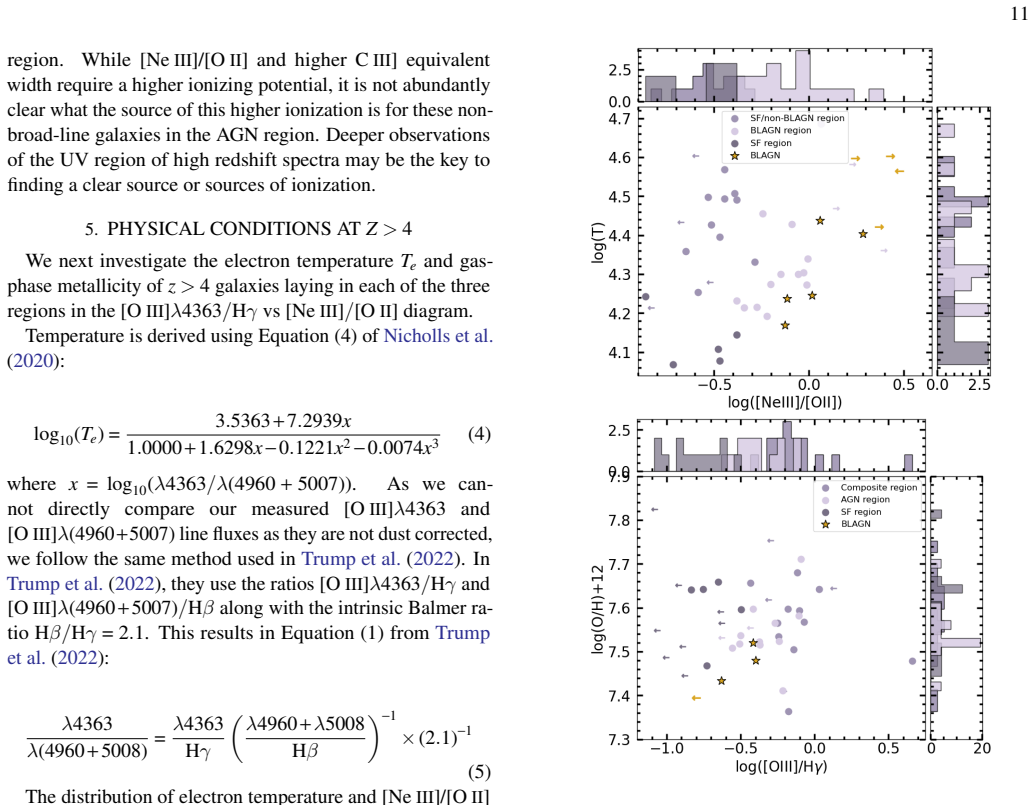
The central claim is that at $z>4$ the ionizing radiation field, not the gas temperature, is what sets broad-line AGN apart from other galaxies: at the same electron temperature, broad-line AGN show higher $[\mathrm{Ne\,III}]/[\mathrm{O\,II}]$ (Anderson-Darling $p=0.001$), while $[\mathrm{O\,III}]λ4363/\mathrm{H}\gamma$ alone does not separate the populations ($p=0.25$). This makes $[\mathrm{Ne\,III}]/[\mathrm{O\,II}]$ the quantity that carries the diagnostic power at high redshift. The paper also shows that non-broad-line galaxies falling in the AGN region have enhanced C III] $λ1908$ emission (rest-frame equivalent width 13.3 Å versus 4.5 Å for the composite region), suggesting extra ionization whose source is not yet identified.
Load-bearing premise
The load-bearing premise is that the 0.16 dex increase in $[\mathrm{O\,III}]λ4363/\mathrm{H}\gamma$ and 0.50 dex increase in $[\mathrm{Ne\,III}]/[\mathrm{O\,II}]$ from $z\sim0$ to $z\sim4$ are caused entirely by ISM evolution of star-forming galaxies and apply linearly to both ratios; if hidden narrow-line AGN contaminate the non-broad-line calibrators, or the evolution is nonlinear, the shifted AGN boundary and the reported AGN fractions are miscalibrated.
Editorial extensions
If this is right
- If $[\mathrm{Ne\,III}]/[\mathrm{O\,II}]$ is truly redshift-robust, AGN selection can be extended to $z\sim6$ without relying on H-alpha or H-beta broad lines.
- Because the same temperature does not explain the offset, surveys can use $[\mathrm{Ne\,III}]/[\mathrm{O\,II}]$ to select harder-ionizing sources while separating temperature effects.
- The 40.2% contamination means AGN samples selected this way will be mixed, so the ratio should be combined with other signatures such as C III] equivalent width or high-ionization UV lines.
- The enhanced C III] emission in non-broad-line galaxies in the AGN region points to either hidden narrow-line AGN or very hot massive stars, and deeper UV spectroscopy is the stated next step.
Reading between the lines
- A decisive test of whether the 40.2% contamination is narrow-line AGN would be a dedicated search for $[\mathrm{Ne\,V}]λ3426$ in those objects; the paper notes that the current stacks do not detect it, so deeper data could settle the ambiguity.
- The linear redshift shift used to move the AGN boundary could be checked by measuring the same two ratios in an independent $z\sim4-6$ sample with AGN identified through X-ray or other independent tracers; a nonlinear evolution would change the boundary and the reported fractions.
- The fixed-temperature comparison could be adapted to other hardness-sensitive ratios such as $[\mathrm{O\,III}]/[\mathrm{O\,II}]$ or C IV/He II to test whether $[\mathrm{Ne\,III}]/[\mathrm{O\,II}]$ is uniquely carrying the AGN signal.
Editorial analysis
A structured set of objections, weighed in public.
Referee Report
Summary. This paper uses JWST/NIRSpec observations of 90 z>4 galaxies from CEERS, GLASS, and JADES to test whether the [O III] λ4363/Hγ versus [Ne III]/[O II] diagram can identify AGN at high redshift. The authors calibrate AGN/SF separation lines using 1869 SDSS z~0 galaxies, shift those lines to z~4 using a linear fit to the redshift evolution of non-broad-line galaxies, and then measure how many broad-line AGN (BLAGN) and non-BLAGN fall in the AGN region. They report that BLAGN preferentially have higher [Ne III]/[O II] (Anderson-Darling p=0.001), that 76.8% of BLAGN occupy the AGN region, and that 40.2% of non-BLAGN also fall there. They additionally report stacked-spectrum evidence for stronger C III] in non-BLAGN in the AGN region and argue, from a visual comparison at fixed electron temperature, that BLAGN have harder ionizing radiation than non-broad-line galaxies.
Significance. If the fixed-temperature claim is correct, [Ne III]/[O II] would be a valuable rest-optical AGN indicator at z~6 where Hα is unavailable. The raw statistical separation in [Ne III]/[O II] between BLAGN and non-BLAGN is credible and does not depend on the redshift shift, and the stacked-spectrum approach is a sensible use of the data. However, the load-bearing 'at constant electron temperature' statement is not quantitatively supported, the redshift correction is calibrated in-sample on the same galaxies that are then classified, and the headline fractions are internally inconsistent. These issues are fixable, but they are central to the paper's conclusions.
major comments (3)
- [Sec. 5, Fig. 8, Eqs. (4)-(5)] The abstract and Section 5 claim that BLAGN have higher [Ne III]/[O II] 'at constant electron temperature,' but the only quantitative test quoted, the Anderson-Darling p=0.001, compares the marginal [Ne III]/[O II] distributions and does not control for Te. The same section reports p=0.09 for a Te difference between non-BLAGN in the AGN and composite regions, so Te differences between populations are not negligible. Because Te is derived from [O III]λ4363/Hγ and the [O III] doublet/Hβ ratio, and because [Ne III]/[O II] can depend on Te through collisional excitation, the constant-Te statement needs a stratified or covariate-adjusted test (for example, comparing [Ne III]/[O II] within Te bins, or a regression that includes Te) before the diagnosis of harder ionizing radiation can be accepted. With only 13 BLAGN, a visual offset in Figure 8 is fragile.
- [Sec. 4, Fig. 3, Eqs. (2)-(3)] The redshift correction applied to the AGN/SF lines is a linear fit to the redshift evolution of the non-broad-line sample, and the same sample is then classified in the shifted diagram. This is partly in-sample calibration. The paper itself acknowledges that 'non-broad-line galaxies may contain SF and NLAGN,' and if a substantial narrow-line AGN population is present, or if the evolution is nonlinear, the shifted boundary is miscalibrated and the reported fractions (76.8% BLAGN, 40.2% non-BLAGN in the AGN region) are not robust. Please quantify the uncertainty in the shift from the fit, test sensitivity to excluding possible NLAGN, or validate the shifted lines against an independent sample or photoionization models.
- [Abstract, Sec. 4, Sec. 6] The headline numbers are internally inconsistent. The abstract states that '40.2% of non-BLAGN land in the AGN region,' while Section 4 states that '40.2% of galaxies in the canonical AGN region do not have broad emission lines'; these are different denominators and cannot both be true unless by coincidence. In addition, the BLAGN fraction in the AGN region is reported as 76.8% in the abstract, 79% in Section 4, and 78.6% in the summary. Please reconcile these numbers and state explicitly which denominator is used for each percentage.
minor comments (4)
- [Abstract and Sec. 2.1.1] The abstract contains the typo 'from the the Cosmic Evolution Early Release survey,' and the phrase 'of there are narrow line AGN which are not accounted for' should be 'or if there are narrow-line AGN which are not accounted for.'
- [Eq. (2)] Equation (2) is typeset ambiguously: the factor '0.9 1.99log' appears to be missing an operator or parentheses. Please rewrite the equation with a clear slope and intercept.
- [Sec. 4.1] The text refers to 'XSPEC (?)' without a citation; please add the proper reference. Also, the text mentions 'the Maiolino et al. (2024) AGN/SF line' in the discussion of Figure 4, which appears to be a typo for Mazzolari et al. (2024).
- [Fig. 8 caption] The caption reads 'There does note appear to be a trend between the two'; this should be 'there does not appear to be a trend.'
Circularity Check
Redshift-corrected AGN/SF boundary is fit to the same non-BLAGN sample later counted as contamination; the core [NeIII]/[OII] comparison is independent.
-
fitted input called prediction
[Section 3 (Fig. 3) and Section 4 (Figs. 4-5); Section 6 summary bullet]
"This modification to the AGN/SF line uses the empirical relation of the emission-line ratios and redshift shown in Figure 3. This modification considers the evolution of emission-line properties for non-AGN galaxies... We note non-broad-line galaxies may contain SF and NLAGN. ... However, 40.2% of galaxies in the canonical AGN region do not have broad emission lines."
The AGN/SF lines are shifted by a linear fit to the [O III]/Hgamma and [Ne III]/[O II] evolution of the non-BLAGN z>4 sample, and the same non-BLAGN galaxies are then counted relative to the shifted boundary to report a 40.2% 'contamination' fraction. Since the boundary intercepts are set by the mean trend of that sample, the contamination fraction measures scatter about the sample's own fit rather than an independent diagnostic test. The 76.8% BLAGN fraction is less affected because BLAGN were excluded from the fit. The central A-D result on [Ne III]/[O II] (p=0.001) is a direct comparison of the raw ratio and is not circular; the same cannot be said for the redshift-corrected AGN-fraction numbers.
full rationale
The paper's principal statistical claim, that z>4 BLAGN have higher [Ne III]/[O II] than non-broad-line galaxies, is a direct Anderson-Darling comparison of measured ratios and is independent of the AGN/SF boundary construction. The redshift-corrected diagnostic, however, is partly circular: the correction is fit to the non-BLAGN sample whose placement in the corrected diagram is then reported as 40.2% contamination. That number is a scatter statistic of the fitting sample, not an external validation. The 'at constant electron temperature' claim (Section 5, Figure 8) rests on visual inspection rather than a covariate-adjusted test; this is a support gap, not a circularity. Citations to prior work by the same authors (e.g., Trump et al. 2022 for the Te conversion, Cleri et al. in prep for Cloudy models) are used as methodology or supplementary evidence, not as a uniqueness theorem that forces the conclusion. No step reduces the central claim to its own inputs by definition.
Assumptions & free parameters
free parameters (6)
- AGN/SF line slope (Eq. 3) =
2.11
- AGN/SF line intercept (Eq. 3) =
1.308
- 5% contamination line slope (Eq. 2) =
1.99
- 5% contamination line intercept (Eq. 2) =
-0.12 (with +0.28 offset printed)
- Redshift evolution of [OIII]/Hgamma =
0.16 dex from z=0 to z=4
- Redshift evolution of [NeIII]/[OII] =
0.50 dex from z=0 to z=4
assumptions (6)
- domain assumption VO87 diagram at z~0 is a valid ground-truth classifier of AGN versus star-forming galaxies
- domain assumption The intrinsic Balmer decrement Hbeta/Hgamma=2.1 (Case B, T=10^4 K, n_e=10^2 cm^-3) applies to z>4 galaxies
- ad hoc to paper The redshift evolution of non-BLAGN line ratios is linear and can be used to shift the local AGN/SF lines to z>4
- domain assumption Cloudy/BPASS and AGN SED photoionization models with the stated parameter grid are appropriate for z>4 nebulae
- domain assumption The Nicholls et al. (2020) Te relation calibrated on local HII regions is valid at z>4
- domain assumption Non-broad-line galaxies used for the redshift evolution fit are representative of the z>4 star-forming population despite possibly containing NLAGN
Cite this review
Pith. "Pith review of Emission-Line Diagnostics at z>4: [OIII]{\lambda}4363/H\gamma." pith.science (2026). https://pith.science/paper/FITPLJU5
@misc{pith2026250203519,
  author       = {Pith},
  title        = {Pith review of: Emission-Line Diagnostics at z>4: [OIII]\lambda4363/H\gamma},
  year         = {2026},
  howpublished = {\url{https://pith.science/paper/FITPLJU5}},
  note         = {Machine review of arXiv:2502.03519}
}
abstract
We use JWST Near-Infrared Spectrograph (NIRSpec) observations from the the Cosmic Evolution Early Release survey (CEERS), GLASS-JWST ERS (GLASS), and JWST Advanced Deep Extragalactic Survey (JADES) to measure rest-frame optical emission-line ratios of 90 galaxies at z>4. The stacked spectra of galaxies with and without a broad-line feature reveal a difference in the [OIII]$\lambda$ 4363 and H$\gamma$ ratios. This motivated our investigation of the [OIII]/H$\gamma$ vs [NeIII]/[OII] diagram. We define two AGN/SF classification lines based on 1869 SDSS galaxies at z$\sim$0. After applying a redshift correction to the AGN/SF lines we find 76.8% of BLAGN continue to land in the AGN region of the diagnostic largely due to the [NeIII]/[OII] ratio. However, 40.2% of non-BLAGN land in the AGN region as well, this could be due to star forming galaxies having harder ionization of there are narrow line AGN which are not accounted for. This indicates the potential of the [NeIII]/[OII] ratio to continue classifying galaxies to z$\sim$6. We further inspect galaxies without broad emission lines in each region of [OIII]/H\gamma vs [NeIII]/[OII] diagram and found that they have slightly stronger CIII]$\lambda$1908 fluxes and equivalent width when landing in the BLAGN region. However, the cause of this higher ionization is unclear. Additionally, we find that BLAGN are characterized by a higher ionization (at constant electron temperature) compared to non-broad line galaxies.
Figures


Figures from the paper (5 more)


Forward citations
Cited by 4 Pith papers
-
An (in)complete NIRSpec census of Balmer absorption in Type 1 AGN -- radiation-driven outflows in little red dots, quasars and variable stars
About 44% of little red dots have hydrogen-alpha absorption from outflowing gas, implying radiatively driven outflows rather than static atmospheres.
-
LEGGOS I: The JWST LEGGOS Survey -- LEnsing and Galaxy Growth: Observing Substructures -- Unpacks the Nature of Clumpy Star Formation and Quenching in Gravitationally Lensed Galaxies beyond Cosmic Noon
LEGGOS presents a uniform framework that jointly models lensing, photometry, and integral-field spectroscopy to disentangle stellar populations in clumps of high-redshift lensed galaxies.
-
Discovery of Multiply Ionized Iron Emission Powered by an Active Galactic Nucleus in a z~7 Little Red Dot
The z=6.68 Little Red Dot THRILS 46403 shows a 4.5 sigma [FeVII] line, the first robust coronal-line detection among z>5 LRDs, plus narrow Balmer absorption, supporting an AGN with direct sightlines to gas at or beyon...
-
Optical Strong Line Ratios Cannot Distinguish Between Stellar Populations and Accreting Black Holes at High Ionization Parameters and Low Metallicities
Optical strong line ratio diagnostics cannot reliably separate stellar from black hole ionizing sources at high ionization parameter and low metallicity, and higher ionization lines such as He II or [Ne V] are needed ...
Reference graph
Works this paper leans on
-
[1]
, " * write output.state after.block = add.period write newline
ENTRY address archivePrefix author booktitle chapter doi edition editor eprint howpublished institution journal key month note number organization pages publisher school series title misctitle type volume year version url label extra.label sort.label short.list INTEGERS output.state before.all mid.sentence after.sentence after.block FUNCTION init.state.co...
-
[2]
write newline
" write newline "" before.all 'output.state := FUNCTION format.doi doi empty "" "doi:" doi * if FUNCTION format.url url empty "" new.block "" url * "" * if FUNCTION format.eprint eprint empty "" archivePrefix empty "" archivePrefix ":" * if eprint field.or.null * if FUNCTION format.pid eprint empty format.doi format.eprint if FUNCTION n.dashify 't := "" t...
-
[3]
f@ eK r CN,t
thebibliography [1] 20pt to REFERENCES 6pt =0pt 10pt plus 3pt =0pt =0pt =1pt plus 1pt =0pt =0pt -12pt =13pt plus 1pt =20pt =13pt plus 1pt \@M =10000 =-1.0em =0pt =0pt 0pt =0pt =1.0em @enumiv\@empty 10000 10000 `\.\@m \@noitemerr \@latex@warning Empty `thebibliography' environment \@ifnextchar \@reference \@latexerr Missing key on reference command Each re...
2019
- [4]
-
[5]
P., Tollerud , E
Astropy Collaboration , Robitaille , T. P., Tollerud , E. J., et al. 2013, , 558, A33
2013
-
[6]
Backhaus , B. E., Trump , J. R., Cleri , N. J., et al. 2022, , 926, 161
work page 2022
- [7]
-
[8]
A., Phillips , M
Baldwin , J. A., Phillips , M. M., & Terlevich , R. 1981, , 93, 5
1981
Show all 82 references
-
[9]
S., Schlegel , D
Bolton , A. S., Schlegel , D. J., Aubourg , \'E ., et al. 2012, , 144, 144
2012
-
[10]
2022, gbrammer/msaexp: Full working version with 2d drizzling and extraction , v0.3, Zenodo, doi:10.5281/zenodo.7299501
Brammer , G. 2022, gbrammer/msaexp: Full working version with 2d drizzling and extraction , v0.3, Zenodo, doi:10.5281/zenodo.7299501
2022 doi
-
[11]
B., van Dokkum , P
Brammer , G. B., van Dokkum , P. G., & Coppi , P. 2008, , 686, 1503
2008
-
[12]
2022, arXiv e-prints, arXiv:2208.07467
Brinchmann , J. 2022, arXiv e-prints, arXiv:2208.07467
2022 arXiv
-
[13]
2023, , 525, 2087
---. 2023, , 525, 2087
2023
-
[14]
Brinchmann , J., Charlot , S., White , S. D. M., et al. 2004, , 351, 1151
2004
-
[15]
2023, , 679, A80
Calabr \`o , A., Pentericci , L., Feltre , A., et al. 2023, , 679, A80
2023
-
[16]
Calzetti , D., & Heckman , T. M. 1999, , 519, 27
1999
-
[17]
M., Satyapal , S., Abel , N
Cann , J. M., Satyapal , S., Abel , N. P., et al. 2018, , 861, 142
2018
-
[18]
A., Clayton , G
Cardelli , J. A., Clayton , G. C., & Mathis , J. S. 1989, , 345, 245
1989
-
[19]
2003, , 339, 63
Chiappini , C., Romano , D., & Matteucci , F. 2003, , 339, 63
2003
-
[20]
J., Olivier , G
Cleri , N. J., Olivier , G. M., Hutchison , T. A., et al. 2023 a , , 953, 10
2023
-
[21]
J., Yang , G., Papovich , C., et al
Cleri , N. J., Yang , G., Papovich , C., et al. 2023 b , , 948, 112
2023
-
[22]
2024, arXiv e-prints, arXiv:2409.05948
de Graaff , A., Brammer , G., Weibel , A., et al. 2024, arXiv e-prints, arXiv:2409.05948
2024 arXiv
-
[23]
J., Scholtz , J., et al
D'Eugenio , F., Cameron , A. J., Scholtz , J., et al. 2024, arXiv e-prints, arXiv:2404.06531
2024 arXiv
-
[24]
W., Jin , C., Blaes , O., & Ward , M
Done , C., Davis , S. W., Jin , C., Blaes , O., & Ward , M. 2012, , 420, 1848
2012
-
[25]
2016, , 456, 3354
Feltre , A., Charlot , S., & Gutkin , J. 2016, , 456, 3354
2016
-
[26]
2017, Frontiers in Astronomy and Space Sciences, 4, 32
Feltre , A., Charlot , S., Mignoli , M., et al. 2017, Frontiers in Astronomy and Space Sciences, 4, 32
2017
-
[27]
L., Bagley , M
Finkelstein , S. L., Bagley , M. B., Arrabal Haro , P., et al. 2025, arXiv e-prints, arXiv:2501.04085
2025 arXiv
-
[28]
E., Labbe , I., Goulding , A
Greene , J. E., Labbe , I., Goulding , A. D., et al. 2024, , 964, 39
2024
-
[29]
J., & Scott , P
Grevesse , N., Asplund , M., Sauval , A. J., & Scott , P. 2010, , 328, 179
2010
-
[30]
M., van Hoof , P
Gunasekera , C. M., van Hoof , P. A. M., Chatzikos , M., & Ferland , G. J. 2023, Research Notes of the American Astronomical Society, 7, 246
2023
-
[31]
2016, , 462, 1757
Gutkin , J., Charlot , S., & Bruzual , G. 2016, , 462, 1757
2016
-
[32]
2015, , 581, A21
Hainich , R., Pasemann , D., Todt , H., et al. 2015, , 581, A21
2015
-
[33]
2014, , 565, A27
Hainich , R., R \"u hling , U., Todt , H., et al. 2014, , 565, A27
2014
-
[34]
2023, , 959, 39
Harikane , Y., Zhang , Y., Nakajima , K., et al. 2023, , 959, 39
2023
-
[35]
R., Millman, K
Harris, C. R., Millman, K. J., van der Walt, S. J., et al. 2020, Nature, 585, 357. https://doi.org/10.1038/s41586-020-2649-2
2020 doi
-
[36]
E., Watson , D., Brammer , G., et al
Heintz , K. E., Watson , D., Brammer , G., et al. 2023, arXiv e-prints, arXiv:2306.00647
2023 arXiv
-
[37]
2019, , 487, 333
Hirschmann , M., Charlot , S., Feltre , A., et al. 2019, , 487, 333
2019
-
[38]
Hirschmann , M., Charlot , S., & Somerville , R. S. 2023, arXiv e-prints, arXiv:2305.03753
2023 arXiv
-
[39]
Hunter , J. D. 2007, Computing in Science and Engineering, 9, 90
2007
-
[40]
2001, SciPy : Open Source Scientific Tools for Python, ,
Jones , E., Oliphant , T., Peterson , P., & Others. 2001, SciPy : Open Source Scientific Tools for Python, , . http://www.scipy.org/
2001
-
[41]
2018, , 477, 5568
Kaasinen , M., Kewley , L., Bian , F., et al. 2018, , 477, 5568
2018
-
[42]
M., Tremonti , C., et al
Kauffmann , G., Heckman , T. M., Tremonti , C., et al. 2003 a , , 346, 1055
2003
-
[43]
M., White , S
Kauffmann , G., Heckman , T. M., White , S. D. M., et al. 2003 b , , 341, 33
2003
-
[44]
2003 c , , 341, 54
---. 2003 c , , 341, 54
2003
-
[45]
Kelly , B. C. 2007, , 665, 1489
2007
-
[46]
C., & Evans , N
Kennicutt , R. C., & Evans , N. J. 2012, , 50, 531
2012
-
[47]
J., Groves , B., Kauffmann , G., & Heckman , T
Kewley , L. J., Groves , B., Kauffmann , G., & Heckman , T. 2006, , 372, 961
2006
-
[48]
J., Maier , C., Yabe , K., et al
Kewley , L. J., Maier , C., Yabe , K., et al. 2013, , 774, L10
2013
-
[49]
J., Nicholls , D
Kewley , L. J., Nicholls , D. C., Sutherland , R., et al. 2019 a , , 880, 16
2019
-
[50]
J., Nicholls , D
Kewley , L. J., Nicholls , D. C., & Sutherland , R. S. 2019 b , , 57, 511
2019
-
[51]
J., Zahid , H
Kewley , L. J., Zahid , H. J., Geller , M. J., et al. 2015, , 812, L20
2015
-
[52]
D., Barro , G., McGrath , E
Kocevski , D. D., Barro , G., McGrath , E. J., et al. 2022, arXiv e-prints, arXiv:2208.14480
2022 arXiv
-
[53]
D., Onoue , M., Inayoshi , K., et al
Kocevski , D. D., Onoue , M., Inayoshi , K., et al. 2023, , 954, L4
2023
-
[54]
L., Finkelstein , S
Larson , R. L., Finkelstein , S. L., Kocevski , D. D., et al. 2023, arXiv e-prints, arXiv:2303.08918
2023 arXiv
-
[55]
C., Nakajima , K., et al
Le F \`e vre , O., Lemaux , B. C., Nakajima , K., et al. 2019, , 625, A51
2019
-
[56]
Luridiana , V., Morisset , C., & Shaw , R. A. 2015, , 573, A42
2015
-
[57]
2023, arXiv e-prints, arXiv:2308.01230
Maiolino , R., Scholtz , J., Curtis-Lake , E., et al. 2023, arXiv e-prints, arXiv:2308.01230
2023 arXiv
-
[58]
2024, , 627, 59
Maiolino , R., Scholtz , J., Witstok , J., et al. 2024, , 627, 59
2024
-
[59]
2024, arXiv e-prints, arXiv:2404.10811
Mazzolari , G., \"U bler , H., Maiolino , R., et al. 2024, arXiv e-prints, arXiv:2404.10811
2024 arXiv
-
[60]
C., Kewley , L
Nicholls , D. C., Kewley , L. J., & Sutherland , R. S. 2020, , 132, 033001
2020
-
[61]
Osterbrock , D. E. 1989, Astrophysics of gaseous nebulae and active galactic nuclei (University Science Books)
1989
-
[62]
C., Estrada-Carpenter , V., et al
Papovich , C., Simons , R. C., Estrada-Carpenter , V., et al. 2022, , 937, 22
2022
-
[63]
Planck Collaboration , Ade , P. A. R., Aghanim , N., et al. 2016, , 594, A13
2016
-
[64]
C., & Tumlinson , J
Ravindranath , S., Monroe , T., Jaskot , A., Ferguson , H. C., & Tumlinson , J. 2020, , 896, 170
2020
-
[65]
A., Steidel , C
Reddy , N. A., Steidel , C. C., Pettini , M., & Bogosavljevi \'c , M. 2016, , 828, 107
2016
-
[66]
Salpeter , E. E. 1955, , 121, 161
1955
-
[67]
L., Shapley , A
Sanders , R. L., Shapley , A. E., Topping , M. W., Reddy , N. A., & Brammer , G. B. 2023, arXiv e-prints, arXiv:2301.06696
2023 arXiv
-
[68]
2020, , 636, A47
Saxena , A., Pentericci , L., Mirabelli , M., et al. 2020, , 636, A47
2020
-
[69]
2003, , 397, 527
Schaerer , D. 2003, , 397, 527
2003
-
[70]
2024, arXiv e-prints, arXiv:2407.12122
Schaerer , D., Guibert , J., Marques-Chaves , R., & Martins , F. 2024, arXiv e-prints, arXiv:2407.12122
2024 arXiv
-
[71]
2023, arXiv e-prints, arXiv:2311.18731
Scholtz , J., Maiolino , R., D'Eugenio , F., et al. 2023, arXiv e-prints, arXiv:2311.18731
2023 arXiv
-
[72]
E., Sanders , R
Shapley , A. E., Sanders , R. L., Reddy , N. A., Topping , M. W., & Brammer , G. B. 2023, arXiv e-prints, arXiv:2301.03241
2023 arXiv
-
[73]
A., Gunn , J
Smee , S. A., Gunn , J. E., Uomoto , A., et al. 2013, , 146, 32
2013
-
[74]
R., & Eldridge , J
Stanway , E. R., & Eldridge , J. J. 2018, , 479, 75
2018
-
[75]
J., Finkelstein , S
Taylor , A. J., Finkelstein , S. L., Kocevski , D. D., et al. 2024, arXiv e-prints, arXiv:2409.06772
2024 arXiv
-
[76]
2022, , 935, 110
Treu , T., Roberts-Borsani , G., Bradac , M., et al. 2022, , 935, 110
2022
-
[77]
R., Arrabal Haro , P., Simons , R
Trump , J. R., Arrabal Haro , P., Simons , R. C., et al. 2022, arXiv e-prints, arXiv:2207.12388
2022 arXiv
-
[78]
2023, , 677, A145
\"U bler , H., Maiolino , R., Curtis-Lake , E., et al. 2023, , 677, A145
2023
-
[79]
E., Richards , G
Vanden Berk , D. E., Richards , G. T., Bauer , A., et al. 2001, , 122, 549
2001
-
[80]
Veilleux , S., & Osterbrock , D. E. 1987, , 63, 295
1987
-
[81]
Vink , J. S. 2023, , 679, L9
2023
-
[82]
G., Adelman , J., Anderson , John E., J., et al
York , D. G., Adelman , J., Anderson , John E., J., et al. 2000, , 120, 1579
2000
Reviewed August 9, 2026 · model on record in the stance chip above.
Discussion (0). Continue with ORCID to comment.