FedHC: A Hierarchical Clustered Federated Learning Framework for Satellite Networks
Pith reviewed 2026-05-23 03:04 UTC · model grok-4.3
The pith
FedHC uses hierarchical clustering and meta-learning to reduce satellite federated learning processing time by up to 3 times and energy by up to 2 times.
A machine-rendered reading of the paper's core claim, the machinery that carries it, and where it could break.
Core claim
FedHC employs a satellite-clustered parameter server selection algorithm to group nearby satellites into clusters with a center as the PS to speed up aggregation, then selects communicable cluster PS satellites through ground stations for global parameters, combined with a meta-learning-driven re-clustering algorithm for dynamic adaptability, resulting in up to 3x faster processing and 2x lower energy use compared to other methods at the same accuracy.
What carries the argument
The hierarchical clustered structure with satellite-clustered PS selection at cluster level and ground-station mediated global aggregation, plus meta-learning re-clustering.
If this is right
- Cluster-based local aggregation accelerates the FL process in distributed satellite settings.
- Selecting only communicable cluster centers reduces overall communication overhead.
- Meta-learning re-clustering allows the system to adapt to changing satellite positions and connections.
- Model accuracy is preserved despite the efficiency gains.
- The framework is demonstrated on a satellite networks testbed simulating real conditions.
Where Pith is reading between the lines
- This structure may allow federated learning to scale to larger satellite constellations without proportional increases in latency.
- The approach could be adapted for other high-mobility networks like drone swarms or vehicle fleets.
- Integrating orbital mechanics more explicitly into the clustering could further optimize performance.
- Testing on real deployed satellites would validate if the testbed results hold under actual radiation and failure modes.
Load-bearing premise
The satellite networks testbed used in the experiments accurately captures the dynamic orbital movements, communication constraints, and energy profiles of real satellite constellations.
What would settle it
Running the same FL tasks on actual satellite hardware in orbit and measuring if processing time and energy reductions match the testbed results or if accuracy suffers.
Figures


read the original abstract
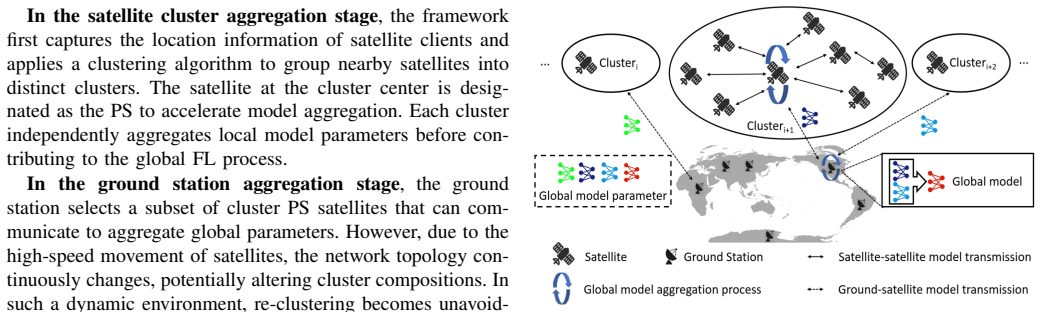
With the proliferation of data-driven services, the volume of data that needs to be processed by satellite networks has significantly increased. Federated learning (FL) is well-suited for big data processing in distributed, resource-constrained satellite environments. However, ensuring its convergence performance while minimizing processing time and energy consumption remains a challenge. To this end, we propose a hierarchical clustered federated learning framework, FedHC. This framework employs a satellite-clustered parameter server (PS) selection algorithm at the cluster aggregation stage, grouping nearby satellites into distinct clusters and designating a cluster center as the PS to accelerate model aggregation. Several communicable cluster PS satellites are then selected through ground stations to aggregate global parameters, facilitating the FL process. Moreover, a meta-learning-driven satellite re-clustering algorithm is introduced to enhance adaptability to dynamic satellite cluster changes. The extensive experiments on satellite networks testbed demonstrate that FedHC can significantly reduce processing time (up to 3x) and energy consumption (up to 2x) compared to other comparative methods while maintaining model accuracy.
Editorial analysis
A structured set of objections, weighed in public.
Referee Report
Summary. The manuscript presents FedHC, a hierarchical clustered federated learning framework for satellite networks. It introduces a satellite-clustered parameter server (PS) selection algorithm that groups nearby satellites into clusters and designates a cluster center as PS to accelerate aggregation, followed by selection of communicable cluster PS satellites via ground stations. A meta-learning-driven satellite re-clustering algorithm is proposed to adapt to dynamic cluster changes. The central claim, based on experiments in a satellite networks testbed, is that FedHC achieves up to 3x reduction in processing time and 2x reduction in energy consumption compared to other methods while maintaining model accuracy.
Significance. If the reported speedups and energy savings hold under representative conditions, the framework could provide a practical approach to efficient federated learning in resource-constrained, mobile satellite environments by reducing aggregation latency and communication overhead. The work targets a timely application area in distributed systems, but its significance is constrained by the absence of explicit validation that the testbed models match real orbital dynamics.
major comments (1)
- [Section 5] Section 5: The satellite networks testbed description provides no quantitative validation against real ephemeris data, measured inter-satellite link budgets, or onboard power traces. This directly undermines the load-bearing claims of up to 3x lower processing time and 2x lower energy consumption, since the meta-learning re-clustering and cluster-PS selection procedures depend on the fidelity of the testbed's mobility and energy models.
minor comments (1)
- [Abstract] Abstract: No information is given on the specific baselines, statistical methods, error bars, dataset characteristics, or exact experimental setup used to support the performance claims.
Simulated Author's Rebuttal
We thank the referee for their constructive feedback on our manuscript. We address the single major comment below and agree that revisions are warranted to strengthen the experimental validation.
read point-by-point responses
-
Referee: [Section 5] Section 5: The satellite networks testbed description provides no quantitative validation against real ephemeris data, measured inter-satellite link budgets, or onboard power traces. This directly undermines the load-bearing claims of up to 3x lower processing time and 2x lower energy consumption, since the meta-learning re-clustering and cluster-PS selection procedures depend on the fidelity of the testbed's mobility and energy models.
Authors: We agree that the current testbed description lacks explicit quantitative validation against real ephemeris data, link budgets, and power traces, which limits the strength of the reported speedups and energy savings. The testbed relies on standard orbital models (Keplerian elements with perturbations) and energy profiles drawn from the satellite networking literature, but no direct numerical comparison to measured data is provided. In the revised manuscript we will add a dedicated validation subsection to Section 5. This subsection will report quantitative comparisons of simulated orbital periods, inter-satellite distances, link budgets, and power consumption against publicly available ephemeris sources (e.g., Celestrak TLE data) and published satellite telemetry, including mean absolute percentage errors and sensitivity analysis. These additions will directly address the fidelity concerns while preserving the relative performance claims within the validated simulation environment. revision: yes
Circularity Check
No significant circularity; algorithms and claims are self-contained
full rationale
The paper introduces novel algorithms (satellite-clustered PS selection and meta-learning re-clustering) for hierarchical FL in satellite networks, then reports empirical gains on a testbed. No load-bearing step reduces by construction to a fitted parameter renamed as prediction, a self-citation chain, or an ansatz smuggled from prior author work. The derivation chain consists of design choices justified by stated goals (reduce time/energy while preserving accuracy) followed by direct experimental measurement; these steps do not collapse into tautology. The testbed description and results are presented as external validation rather than internal redefinition of the inputs.
Axiom & Free-Parameter Ledger
axioms (1)
- domain assumption Federated learning converges under the proposed hierarchical clustering in satellite environments.
Forward citations
Cited by 1 Pith paper
-
Optimal Routing for Federated Learning over Dynamic Satellite Networks: Tractable or Not?
Routing optimization for in-orbit federated learning is polynomial-time solvable under some settings like certain unicast or multicast flows and NP-hard under others, with rigorous proofs establishing the boundaries.
Reference graph
Works this paper leans on
-
[1]
S. Mahboob and L. Liu, “Revolutionizing future connectivity: A contem- porary survey on AI-empowered satellite-based non-terrestrial networks in 6G,” IEEE Communications Surveys & Tutorials , vol. 26, no. 2, pp. 1279–1321, 2024
work page 2024
-
[2]
Collaborative satellite computing through adaptive DNN task splitting and offloading,
S. Peng et al., “Collaborative satellite computing through adaptive DNN task splitting and offloading,” in Proceedings of the IEEE Symposium on Computers and Communications (ISCC) , pp. 1–6, 2024
work page 2024
-
[3]
Satellite-based computing networks with federated learning,
H. Chen, M. Xiao, and Z. Pang, “Satellite-based computing networks with federated learning,” IEEE Wireless Communications, vol. 29, no. 1, pp. 78–84, 2022
work page 2022
-
[4]
A survey of next-generation computing technologies in space-air-ground integrated networks,
Z. Shen et al. , “A survey of next-generation computing technologies in space-air-ground integrated networks,” ACM Computing Surveys , vol. 56, no. 1, 2023
work page 2023
-
[5]
Artificial intelligence for satellite communication: A survey,
G. Fontanesi et al. , “Artificial intelligence for satellite communication: A survey,” IEEE Communications Surveys & Tutorials , pp. 1–61, 2025
work page 2025
-
[6]
Communication-efficient satellite-ground federated learning through progressive weight quantization,
C. Yang et al. , “Communication-efficient satellite-ground federated learning through progressive weight quantization,” IEEE Transactions on Mobile Computing , vol. 23, no. 9, pp. 8999–9011, 2024
work page 2024
-
[7]
Edge selection and clustering for federated learning in optical inter-LEO satellite constellation,
C.-Y . Chen, L.-H. Shen, K.-T. Feng, L.-L. Yang, and J.-M. Wu, “Edge selection and clustering for federated learning in optical inter-LEO satellite constellation,” in Proceddings of the International Symposium on Personal, Indoor and Mobile Radio Communications (PIMRC) , pp. 1–6, 2023
work page 2023
-
[8]
Federated learning in satellite constellations,
B. Matthiesen, N. Razmi, I. Leyva-Mayorga, A. Dekorsy, and P. Popovski, “Federated learning in satellite constellations,” IEEE Net- work, vol. 38, no. 2, pp. 232–239, 2024
work page 2024
-
[9]
Z. Zhai et al., “FedLEO: An offloading-assisted decentralized federated learning framework for low earth orbit satellite networks,” IEEE Trans- actions on Mobile Computing , vol. 23, no. 5, pp. 5260–5279, 2024
work page 2024
-
[10]
Z. Yan and D. Li, “Convergence time optimization for decentralized federated learning with LEO satellites via number control,” IEEE Transactions on V ehicular Technology, vol. 73, no. 3, pp. 4517–4522, 2024
work page 2024
-
[11]
Client-edge-cloud hier- archical federated learning,
L. Liu, J. Zhang, S. Song, and K. B. Letaief, “Client-edge-cloud hier- archical federated learning,” in Proceedings of the IEEE International Conference on Communications (ICC) , pp. 1–6, 2020
work page 2020
-
[12]
FedCE: Personalized fed- erated learning method based on clustering ensembles,
L. Cai, N. Chen, Y . Cao, J. He, and Y . Li, “FedCE: Personalized fed- erated learning method based on clustering ensembles,” in Proceedings of the ACM International Conference on Multimedia (MM) , pp. 1625– 1633, 2023
work page 2023
-
[13]
Clustered federated learning in Internet of Things: Convergence analysis and resource optimization,
B. Xu, W. Xia, H. Zhao, Y . Zhu, X. Sun, and T. Q. S. Quek, “Clustered federated learning in Internet of Things: Convergence analysis and resource optimization,” IEEE Internet of Things Journal , vol. 11, no. 2, pp. 3217–3232, 2024
work page 2024
-
[14]
X. Zhu and C. Jiang, “Delay optimization for cooperative multi-tier computing in integrated satellite-terrestrial networks,” IEEE Journal on Selected Areas in Communications , vol. 41, no. 2, pp. 366–380, 2023
work page 2023
-
[15]
H. Zhang, R. Liu, A. Kaushik, and X. Gao, “Satellite edge computing with collaborative computation offloading: An intelligent deep determin- istic policy gradient approach,” IEEE Internet of Things Journal , vol. 10, no. 10, pp. 9092–9107, 2023
work page 2023
-
[16]
R. Zhou et al. , “A reinforcement learning approach for minimizing job completion time in clustered federated learning,” in Proceedings of the IEEE Conference on Computer Communications (INFOCOM) , pp. 1–10, 2023
work page 2023
discussion (0)
Sign in with ORCID, Apple, or X to comment. Anyone can read and Pith papers without signing in.