Self-affine quadrangles
Pith reviewed 2026-05-25 08:04 UTC · model grok-4.3
The pith
All 3-self-affine convex quadrangles fall into five one-parameter families and thirteen singular affine types
A machine-rendered reading of the paper's core claim, the machinery that carries it, and where it could break.
Core claim
We characterize all 3-self-affine convex quadrangles, obtaining 5 one-parameter families and 13 singular examples of affine types. This way we reduce the quest for all n-self-affine convex quadrangles to the open case n=4.
What carries the argument
n-self-affine quadrangle: a quadrangle that admits a dissection into n affine images of itself, with the pieces required to match at vertices and overlap properly along edges
If this is right
- All convex quadrangles are n-self-affine for every n greater than or equal to 5
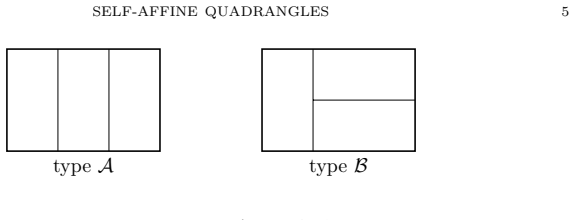
- The only 2-self-affine convex quadrangles are trapezoids
- n-self-affine non-convex quadrangles exist for every n greater than or equal to 3 but not for n equal to 2
- The problem of classifying all n-self-affine convex quadrangles is now reduced to the single open case n equal to 4
Where Pith is reading between the lines
- The listed families may supply starting points for constructing explicit dissections when n equals 4
- The distinction between convex and non-convex cases suggests that convexity imposes stricter limits on the smallest usable n
Load-bearing premise
Every 3-self-affine convex quadrangle admits a dissection whose affine images satisfy the vertex-matching and edge-overlap conditions required for a valid tiling of the original quadrangle.
What would settle it
Discovery of one convex quadrangle that dissects into three affine copies of itself yet lies outside the five families and thirteen examples would falsify the classification.
Figures




read the original abstract
A quadrangle in the Euclidean plane is called $n$-self-affine if it has a dissection into $n$ affine images of itself. All convex quadrangles are known to be $n$-self-affine for every $n \ge 5$. The only $2$-self-affine convex quadrangles are trapezoids. Here we characterize all $3$-self-affine convex quadrangles, obtaining $5$ one-parameter families and $13$ singular examples of affine types. This way we reduce the quest for all $n$-self-affine convex quadrangles to the open case $n=4$. In addition, we show that there are $n$-self-affine non-convex quadrangles for all $n \ge 3$, but not for $n=2$.
Editorial analysis
A structured set of objections, weighed in public.
Referee Report
Summary. The manuscript defines an n-self-affine quadrangle as one that admits a dissection into n affine images of itself. It proves that every convex quadrangle is n-self-affine for all n ≥ 5, that the only 2-self-affine convex quadrangles are trapezoids, and that there exist n-self-affine non-convex quadrangles for every n ≥ 3 (but none for n = 2). The central result is a complete classification of 3-self-affine convex quadrangles into five one-parameter families together with thirteen singular examples; this reduces the general problem of classifying all n-self-affine convex quadrangles to the remaining open case n = 4.
Significance. If the classification is exhaustive, the result is a concrete advance in the study of self-affine dissections: it supplies explicit parametric families and isolated examples that can be checked directly, and it cleanly isolates the n = 4 case. The separation between convex and non-convex behavior is also useful. The paper does not appear to contain machine-checked proofs or reproducible code, but the explicit listing of families constitutes a falsifiable prediction that can be tested by independent enumeration.
major comments (2)
- [§3] §3 (classification of 3-self-affine convex quadrangles): the completeness of the case analysis rests on an enumeration of dissection topologies satisfying vertex-matching and edge-overlap conditions. No argument is given that every possible 3-dissection of a convex quadrangle falls into one of the enumerated topological types (different placements of internal vertices, partial edge sharings, or vertex identifications). Without such an exhaustiveness proof or an independent computer-assisted enumeration of small dissections, it remains possible that additional families exist outside the five listed ones and the thirteen examples.
- [Theorem 1.3] Theorem 1.3 (the five families and thirteen examples): each family is obtained by solving systems of affine-map equations under the assumption that the dissection uses one of the listed topologies. If an unlisted topology admits a solution, the stated list would be incomplete; the manuscript does not provide a separate lemma showing that the chosen topologies are the only ones compatible with convexity and the affine-image requirement.
minor comments (2)
- [Figures 2–3] Figure 2 and Figure 3: the edge labels and vertex identifications are difficult to read at the printed size; adding a supplementary table that lists the affine coefficients for each singular example would improve verifiability.
- [§2 and §4] Notation: the symbol for the affine map is introduced in §2 but reused with different subscript conventions in §4; a single consistent notation throughout would reduce reader effort.
Simulated Author's Rebuttal
We thank the referee for the careful review and for identifying the need for an explicit exhaustiveness argument in the topological case analysis. We will revise the manuscript to include such an argument.
read point-by-point responses
-
Referee: [§3] §3 (classification of 3-self-affine convex quadrangles): the completeness of the case analysis rests on an enumeration of dissection topologies satisfying vertex-matching and edge-overlap conditions. No argument is given that every possible 3-dissection of a convex quadrangle falls into one of the enumerated topological types (different placements of internal vertices, partial edge sharings, or vertex identifications). Without such an exhaustiveness proof or an independent computer-assisted enumeration of small dissections, it remains possible that additional families exist outside the five listed ones and the thirteen examples.
Authors: We agree that the manuscript lacks an explicit lemma establishing exhaustiveness of the enumerated topologies. In the revised version we will add a lemma that classifies all admissible placements of internal vertices and edge identifications compatible with convexity and the requirement that each piece is an affine image of the quadrangle; the argument proceeds by considering the possible combinatorial types of a 3-piece dissection of a convex 4-gon and showing that only the topologies already treated can arise. revision: yes
-
Referee: [Theorem 1.3] Theorem 1.3 (the five families and thirteen examples): each family is obtained by solving systems of affine-map equations under the assumption that the dissection uses one of the listed topologies. If an unlisted topology admits a solution, the stated list would be incomplete; the manuscript does not provide a separate lemma showing that the chosen topologies are the only ones compatible with convexity and the affine-image requirement.
Authors: This observation is equivalent to the preceding comment. The new lemma will prove that no other topology can satisfy the convexity and affine-image conditions, thereby confirming that the five families and thirteen examples constitute the complete list. revision: yes
Circularity Check
No circularity; direct geometric classification
full rationale
The paper performs a case-by-case geometric classification of 3-self-affine convex quadrangles by enumerating dissections into three affine copies, yielding 5 families and 13 examples. No equations, fitted parameters, self-referential definitions, or load-bearing self-citations appear. The result is an enumeration derived from the definition of self-affinity and affine transformations, without reducing any claim to its own outputs by construction. This is the expected outcome for a pure classification theorem in combinatorial geometry.
Axiom & Free-Parameter Ledger
Reference graph
Works this paper leans on
-
[1]
K. Blechschmidt, C. Richter: Non-self-affine convex pentagons. Beitr. Algebra Geom. 56, no. 1, 263–267 (2015)
work page 2015
-
[2]
B¨ orner:Affine Abbildungen in der Ebene
W. B¨ orner:Affine Abbildungen in der Ebene. Die Wurzel. Zeitschrift f¨ ur Mathematik.54, November 2020, 233, 248–255 (2020)
work page 2020
-
[3]
Ditrich: Elementar k-selbst¨ ahnliche Zerlegungen einfacher Polygone
F. Ditrich: Elementar k-selbst¨ ahnliche Zerlegungen einfacher Polygone. Diploma thesis. Friedrich Schiller University, Jena, 1995
work page 1995
-
[4]
Edgar: Measure, topology, and fractal geometry
G.A. Edgar: Measure, topology, and fractal geometry. Undergraduate Texts in Mathematics. Springer-Verlag, New York, 1990
work page 1990
-
[5]
K. Falconer: Fractal geometry. Mathematical foundations and applications. John Wiley & Sons, Ltd., Chichester, 1997
work page 1997
-
[6]
Golomb: Replicating figures in the plane
S.W. Golomb: Replicating figures in the plane. Math. Gaz. 48, 403–412 (1964)
work page 1964
-
[7]
B. Gr¨ unbaum, G.C. Shephard: Tilings and patterns. W.H. Freeman and Company, New York, 1987
work page 1987
-
[8]
Hertel: Zur Affingeometrie konvexer Polygone
E. Hertel: Zur Affingeometrie konvexer Polygone. Jenaer Schriften zur Mathematik und Informatik, Math/Inf/00/22, 26 pp. (2000), preprint, https://www.minet.uni-jena.de/ /Math-Net/reports/shadows/00-09report.html
work page 2000
- [9]
-
[10]
Mandelbrot: The fractal geometry of nature
B.B. Mandelbrot: The fractal geometry of nature. W.H. Freeman and Co., San Francisco, CA, 1982
work page 1982
-
[11]
Osburg: Selbst¨ ahnliche Polyeder.Doctoral thesis
I. Osburg: Selbst¨ ahnliche Polyeder.Doctoral thesis. Friedrich Schiller University, Jena, 2004, https://nbn-resolving.org/urn:nbn:de:gbv:27-dbt-003580-1
work page 2004
-
[12]
Richter: Examples of 3-self-affine convex quadrangles
C. Richter: Examples of 3-self-affine convex quadrangles. Jenaer Schriften zur Mathematik und Informatik, Math/Inf/10/04, 5 pp. (2010), preprint, https://www.minet.uni-jena.de/ /Math-Net/reports/shadows/10-04report.html
work page 2010
-
[13]
Richter: Self-affine convex discs are polygons
C. Richter: Self-affine convex discs are polygons. Beitr. Algebra Geom. 53, no. 1, 219–224 (2012)
work page 2012
-
[14]
Richter: Self-affinity of discs under glass-cut dissections
C. Richter: Self-affinity of discs under glass-cut dissections. (submitted) https://arxiv. org/abs/2404.11460
-
[15]
Scherer: A puzzling journey to the reptiles and related animals
K. Scherer: A puzzling journey to the reptiles and related animals. Privately published, Auckland, New Zealand, 1987
work page 1987
-
[16]
F. Zimmermann: Ausgew¨ ahlte Aspekte der Selbstaffinit¨ at von Scheiben.Thesis submitted as part of the preliminary board exam for teachers. Friedrich Schiller University, Jena, 2023. Institute for Mathematics, Friedrich Schiller University, 07737 Jena, Germany Email address: christian.richter@uni-jena.de Email address: zimmermann.f@uni-jena.de
work page 2023
discussion (0)
Sign in with ORCID, Apple, or X to comment. Anyone can read and Pith papers without signing in.