A nonnegativity-preserving finite element method for a class of parabolic SPDEs with multiplicative noise
Pith reviewed 2026-05-23 02:50 UTC · model grok-4.3
The pith
A finite element discretization for parabolic SPDEs with multiplicative noise preserves nonnegativity of the solution unconditionally on the spatial mesh size when the initial datum is nonnegative.
A machine-rendered reading of the paper's core claim, the machinery that carries it, and where it could break.
Core claim
We introduce a finite element discretization of this SPDE that is convergent and which, subject to a nonnegative initial datum and unconditionally with respect to the spatial discretization parameter, preserves nonnegativity of the numerical solution throughout the course of evolution. We perform a mathematical analysis of this method. In addition, in the associated linear setting, we develop a fully discrete scheme that also preserves nonnegativity, and we present numerical experiments that illustrate the advantages of the proposed method over alternative finite element and finite difference methods that were previously considered in the literature, which do not necessarily guarantee nonneg
What carries the argument
Finite element discretization preserving nonnegativity unconditionally with respect to the spatial discretization parameter
If this is right
- Numerical solutions remain nonnegative for nonnegative initial data regardless of mesh size.
- The discretization converges to the solution of the continuous SPDE.
- A fully discrete scheme in the linear case also preserves nonnegativity.
- Numerical tests show better performance than methods without nonnegativity guarantee.
Where Pith is reading between the lines
- The approach could be adapted to SPDEs with different noise structures or in higher dimensions.
- It may inform the design of positivity-preserving schemes for other stochastic evolution equations.
- Practical implementations might reduce artifacts in simulations of nonnegative quantities like concentrations or prices.
Load-bearing premise
The continuous SPDE possesses a unique nonnegative solution whenever the initial datum is nonnegative.
What would settle it
A computation on any mesh size where the discrete solution takes a negative value at some time despite a nonnegative initial datum.
Figures


read the original abstract
We consider a prototypical parabolic SPDE with finite-dimensional multiplicative noise, which, subject to a nonnegative initial datum, has a unique nonnegative solution. Inspired by well-established techniques in the deterministic case, we introduce a finite element discretization of this SPDE that is convergent and which, subject to a nonnegative initial datum and unconditionally with respect to the spatial discretization parameter, preserves nonnegativity of the numerical solution throughout the course of evolution. We perform a mathematical analysis of this method. In addition, in the associated linear setting, we develop a fully discrete scheme that also preserves nonnegativity, and we present numerical experiments that illustrate the advantages of the proposed method over alternative finite element and finite difference methods that were previously considered in the literature, which do not necessarily guarantee nonnegativity of the numerical solution.
Editorial analysis
A structured set of objections, weighed in public.
Referee Report
Summary. The paper considers a prototypical parabolic SPDE with finite-dimensional multiplicative noise that admits a unique nonnegative solution for nonnegative initial data. It introduces a finite element discretization inspired by deterministic positivity-preserving techniques; the scheme is proved convergent and shown to preserve nonnegativity unconditionally with respect to the spatial mesh size h whenever the initial datum is nonnegative. A fully discrete nonnegativity-preserving scheme is developed for the associated linear problem, accompanied by mathematical analysis and numerical experiments comparing the method to existing FEM and FDM approaches that do not guarantee nonnegativity.
Significance. If the central claims hold, the work supplies a structure-preserving discretization for SPDEs with multiplicative noise, a setting where unconditional nonnegativity preservation (independent of h) is uncommon and practically useful. The extension of deterministic techniques to the stochastic case, together with the fully discrete linear variant and the numerical comparisons, strengthens the literature on reliable simulation methods for problems in which negative values are unphysical.
minor comments (3)
- [Abstract / §1] The abstract states that the continuous problem possesses a unique nonnegative solution under nonnegative initial data, but the precise assumptions on the coefficients and noise (e.g., regularity or growth conditions) are not restated; a brief reminder in §2 would improve readability.
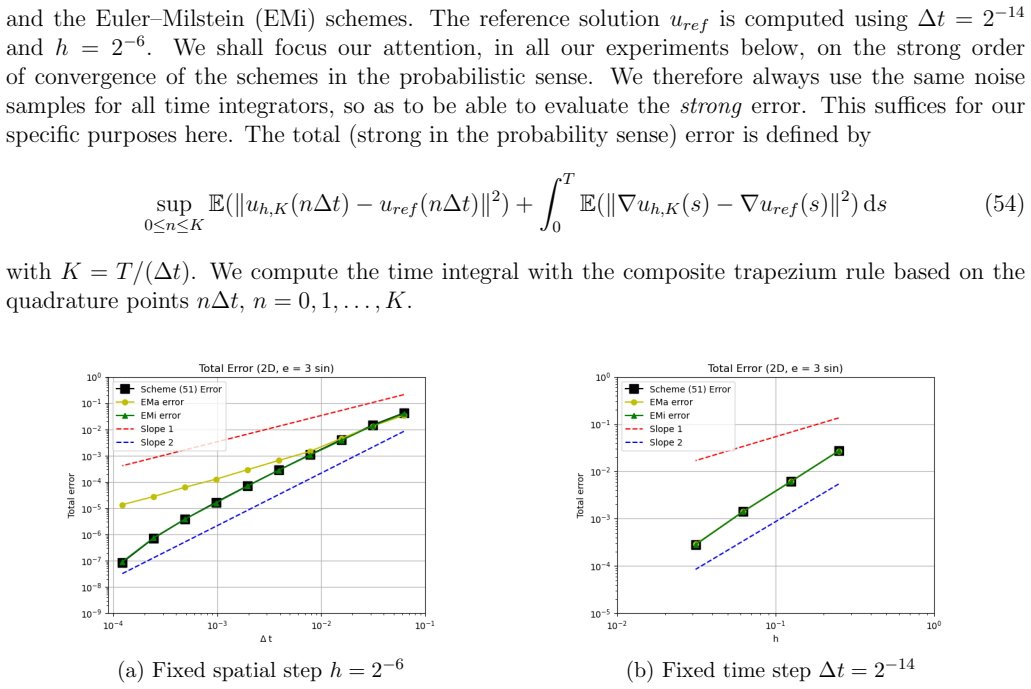
- [Numerical experiments] Figure captions and axis labels in the numerical section could be expanded to indicate the specific values of the noise dimension and time-step size used in each experiment.
- [Conclusion] A short remark on how the analysis extends (or does not extend) to infinite-dimensional noise would clarify the scope of the result.
Simulated Author's Rebuttal
We thank the referee for their positive assessment of the manuscript, the accurate summary, and the recommendation of minor revision. No major comments appear in the provided report.
Circularity Check
No significant circularity
full rationale
The paper takes the existence and uniqueness of a nonnegative solution to the continuous SPDE (under nonnegative initial data) as the problem setting rather than deriving it internally. The central contribution is an independent analysis proving that a specific FEM scheme (inspired by but not reducing to deterministic analogs) converges and preserves nonnegativity unconditionally in the mesh size h. No equations reduce a claimed prediction or uniqueness result to a fitted parameter or self-citation by construction; no ansatz is smuggled via prior work by the same authors; the derivation chain consists of standard FEM error estimates and positivity arguments that stand on their own without load-bearing self-references or renaming of known results.
Axiom & Free-Parameter Ledger
axioms (1)
- domain assumption The SPDE has a unique nonnegative solution subject to nonnegative initial datum.
Forward citations
Cited by 1 Pith paper
-
A Fully Discrete Nonnegativity-Preserving FEM for a Stochastic Heat Equation
A mass-lumped FEM with Lie-Trotter splitting preserves nonnegativity and converges for the stochastic heat equation with finite-rank colored noise.
Reference graph
Works this paper leans on
-
[1]
A. Alfonsi. On the discretization schemes for the CIR (and Bessel squared) processes. Monte Carlo Methods Appl. , 11(4):355–384, 2005
work page 2005
-
[2]
A. Alfonsi. High order discretization schemes for the CIR process: application to affine term structure and Heston models. Math. Comp., 79(269):209–237, 2010
work page 2010
-
[3]
A. Alfonsi. Affine diffusions and related processes: simulation, theory and applications, volume 6 of Bocconi & Springer Series . Springer, Cham; Bocconi University Press, Milan, 2015
work page 2015
-
[4]
J. W. Barrett and E. S¨ uli. Finite element approximation of finitely extensible nonlinear elastic dumbbell models for dilute polymers. ESAIM: Mathematical Modelling and Numerical Analysis, 46(4):949–978, 2012
work page 2012
-
[5]
F. E. Benth. On the positivity of the stochastic heat equation. Potential Analysis, 6:127–148, 1997
work page 1997
-
[6]
C.-E. Br´ ehier, D. Cohen, and J. Ulander. Analysis of a positivity-preserving splitting scheme for some nonlinear stochastic heat equations. arXiv preprint arXiv:2302.08858 , 2023
-
[7]
S. C. Brenner and L. R. Scott. The mathematical theory of finite element methods , volume 15 of Texts in Applied Mathematics . Springer, New York, third edition, 2008
work page 2008
-
[8]
P. Chatzipantelidis, Z. Horv´ ath, and V. Thom´ ee. On preservation of positivity in some fi- nite element methods for the heat equation. Computational Methods in Applied Mathematics , 15(4):417–437, 2015
work page 2015
-
[9]
L. Chen and J. Huang. Comparison principle for stochastic heat equation on Rd. The Annals of Probability, 47(2):989–1035, 2019
work page 2019
-
[10]
K. Chrysafinos and L. S. Hou. Error estimates for semidiscrete finite element approximations of linear and semilinear parabolic equations under minimal regularity assumptions. SIAM J. Numer. Anal., 40(1):282–306, 2002
work page 2002
-
[11]
P. A. Cioica and S. Dahlke. Spatial Besov regularity for semilinear stochastic partial differential equations on bounded Lipschitz domains. Int. J. Comput. Math. , 89(18):2443–2459, 2012. 26
work page 2012
-
[12]
P. A. Cioica, S. Dahlke, S. Kinzel, F. Lindner, T. Raasch, K. Ritter, and R. L. Schilling. Spatial Besov regularity for stochastic partial differential equations on Lipschitz domains. Studia Math., 207(3):197–234, 2011
work page 2011
-
[13]
P. A. Cioica, K.-H. Kim, K. Lee, and F. Lindner. On theLq(Lp)-regularity and Besov smoothness of stochastic parabolic equations on bounded Lipschitz domains. Electron. J. Probab., 18:no. 82, 41, 2013
work page 2013
-
[14]
P. A. Cioica-Licht, K.-H. Kim, and K. Lee. On the regularity of the stochastic heat equation on polygonal domains in R2. J. Differential Equations , 267(11):6447–6479, 2019
work page 2019
-
[15]
F. Cornalba and J. Fischer. The Dean–Kawasaki equation and the structure of density fluctua- tions in systems of diffusing particles. Archive for Rational Mechanics and Analysis , 247(5):76, 2023
work page 2023
-
[16]
J. Cresson, M. Efendiev, and S. Sonner. On the positivity of solutions of systems of stochas- tic PDEs. ZAMM-Journal of Applied Mathematics and Mechanics/Zeitschrift f¨ ur Angewandte Mathematik und Mechanik , 93(6-7):414–422, 2013
work page 2013
-
[17]
G. Da Prato and J. Zabczyk. Stochastic equations in infinite dimensions. Cambridge university press, 2014
work page 2014
-
[18]
A. Debussche, S. de Moor, and M. Hofmanov´ a. A regularity result for quasilinear stochastic partial differential equations of parabolic type. SIAM J. Math. Anal. , 47(2):1590–1614, 2015
work page 2015
-
[19]
A. Djurdjevac, A. Almgren, and J. Bell. A hybrid algorithm for systems of non-interacting particles. arXiv preprint arXiv:2409.00299 , 2024
-
[20]
A. Djurdjevac, H. Kremp, and N. Perkowski. Weak error analysis for a nonlinear SPDE ap- proximation of the Dean–Kawasaki equation. Stochastics and Partial Differential Equations: Analysis and Computations , pages 1–26, 2024
work page 2024
-
[21]
C. Donati-Martin and ´E. Pardoux. White noise driven SPDEs with reflection.Probability Theory and Related Fields, 95:1–24, 1993
work page 1993
-
[22]
F. Eckhardt, P. A. Cioica-Licht, and S. Dahlke. Besov regularity for the stationary Navier-Stokes equation on bounded Lipschitz domains. Appl. Anal., 97(3):466–485, 2018
work page 2018
-
[23]
G. R. M. Flores. On the (strict) positivity of solutions of the stochastic heat equation. The Annals of Probability, 42(4):1635 – 1643, 2014
work page 2014
-
[24]
H. Fujii. Some remarks on finite element analysis of time-dependent field problems. Theory and Practice of Finite Element Structural Analysis , pages 91–106, 1973
work page 1973
-
[25]
I. Gy¨ ongy and A. Millet. On discretization schemes for stochastic evolution equations.Potential analysis, 23:99–134, 2005
work page 2005
-
[26]
I. Gy¨ ongy and A. Millet. Rate of convergence of space time approximations for stochastic evolution equations. Potential analysis, 30(1):29–64, 2009
work page 2009
-
[27]
E. Hausenblas. Numerical analysis of semilinear stochastic evolution equations in Banach spaces. Journal of Computational and Applied Mathematics , 147(2):485–516, 2002. 27
work page 2002
-
[28]
M. Hofmanov´ a. Strong solutions of semilinear stochastic partial differential equations. NoDEA Nonlinear Differential Equations Appl. , 20(3):757–778, 2013
work page 2013
-
[29]
K.-H. Kim, K. Lee, and J. Seo. Sobolev space theory and H¨ older estimates for the stochastic partial differential equations on conic and polygonal domains.J. Differential Equations, 340:463– 520, 2022
work page 2022
- [30]
-
[31]
R. Kruse. Optimal error estimates of Galerkin finite element methods for stochastic partial differential equations with multiplicative noise. IMA Journal of Numerical Analysis , 34(1):217– 251, 2014
work page 2014
-
[32]
R. Kruse. Strong and weak approximation of semilinear stochastic evolution equations , volume 2093 of Lecture Notes in Mathematics . Springer, Cham, 2014
work page 2093
-
[33]
N. Krylov. Itˆ o’s formula for theLp -norm of stochastic W 1 p -valued processes. Probability Theory and Related Fields, 147:583–605, 07 2010
work page 2010
-
[34]
Z. Lei, S. Gan, and Z. Chen. Strong and weak convergence rates of logarithmic transformed truncated EM methods for SDEs with positive solutions. Journal of Computational and Applied Mathematics, 419:114758, 2023
work page 2023
- [35]
-
[36]
G. J. Lord, C. E. Powell, and T. Shardlow. An introduction to computational stochastic PDEs , volume 50. Cambridge University Press, 2014
work page 2014
-
[37]
G. J. Lord and A. Tambue. Stochastic exponential integrators for the finite element discretization of SPDEs for multiplicative and additive noise. IMA Journal of Numerical Analysis , 33(2):515– 543, 2013
work page 2013
-
[38]
F. Magaletti, M. Gallo, S. P. Perez, J. A. Carrillo, and S. Kalliadasis. A positivity-preserving scheme for fluctuating hydrodynamics. Journal of Computational Physics , 463:111248, 2022
work page 2022
-
[39]
X. Mao, F. Wei, and T. Wiriyakraikul. Positivity preserving truncated Euler–Maruyama method for stochastic Lotka–Volterra competition model. Journal of Computational and Applied Math- ematics, 394:113566, 2021
work page 2021
-
[40]
P. Mart´ ınez-Lera and M. De Corato. A finite element method for stochastic diffusion equations using fluctuating hydrodynamics. Journal of Computational Physics , 510:113098, 2024
work page 2024
-
[41]
L. A. Oganesjan and L. A. Ruhovec. Variatsionno-raznostnye metody resheniya ellipticheskikh uravneni˘i. Akad. Nauk Armyan. SSR, Erevan, 1979
work page 1979
-
[42]
´E. Pardoux. ´Equations aux d´ eriv´ ees partielles stochastiques de type monotone. InS´ eminaire ´Equations aux D´ eriv´ ees Partielles (1974–1975), III, pages Exp. No. 2, 10. Coll` ege de France, Paris, 1975
work page 1974
-
[43]
´E. Pardoux. Stochastic partial differential equations and filtering of diffusion processes. Stochas- tics, 3(1-4):127–167, 1980. 28
work page 1980
-
[44]
C. Scalone. Positivity preserving stochastic θ-methods for selected SDEs. Applied Numerical Mathematics, 172:351–358, 2022
work page 2022
-
[45]
L. Szpruch, X. Mao, D. J. Higham, and J. Pan. Numerical simulation of a strongly nonlinear Ait-Sahalia-type interest rate model. BIT Numerical Mathematics , 51:405–425, 2011
work page 2011
-
[46]
A. Tambue and J. D. Mukam. Strong convergence of the linear implicit Euler method for the finite element discretization of semilinear SPDEs driven by multiplicative or additive noise. Applied Mathematics and Computation , 346:23–40, 2019
work page 2019
- [47]
-
[48]
J. B. Walsh. Finite element methods for parabolic stochastic PDEs. Potential Analysis, 23:1–43, 2005
work page 2005
-
[49]
Y. Yan. The finite element method for a linear stochastic parabolic partial differential equation driven by additive noise. Chalmers Finite Element Center, Chalmers University of Technology , 7, 2003
work page 2003
-
[50]
X. Yang, Z. Yang, and C. Zhang. Stochastic heat equation: numerical positivity and almost surely exponential stability. Computers & Mathematics with Applications , 119:312–318, 2022. 29
work page 2022
discussion (0)
Sign in with ORCID, Apple, or X to comment. Anyone can read and Pith papers without signing in.